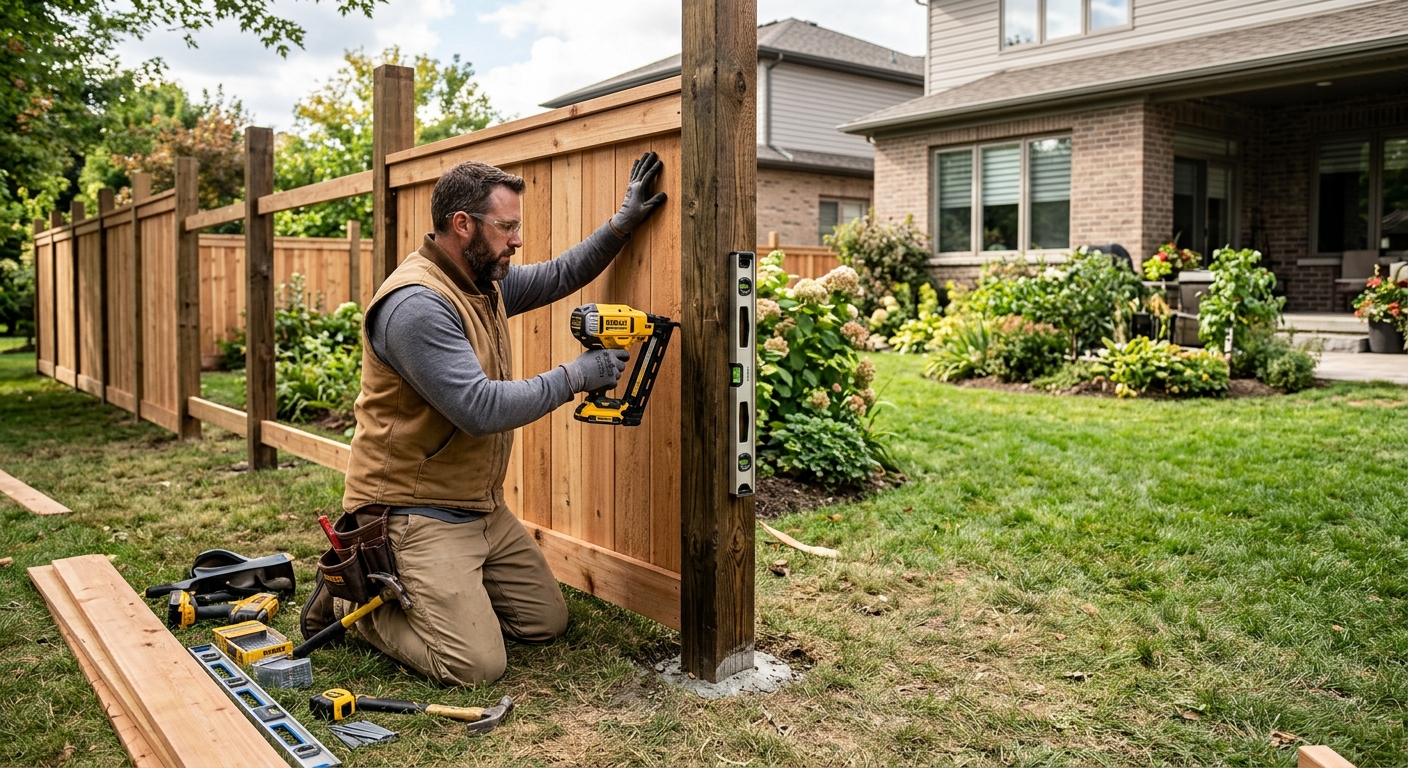
Fencing options and costs in Dovercourt-Wallace Emerson-Junction
Dovercourt-Wallace Emerson-Junction is a busy, established part of Toronto, and that shows up in fencing demand: as the population sits at 36,625 (Statistics Canada, 2021 Census), many households are maintaining older properties, refreshing rear-yard privacy, and replacing weathered boundaries. In practice, the biggest cost decisions come down to what you want the fence to do (privacy versus visibility), how often you’re willing to maintain it, and how much stability you need for Toronto’s freeze-thaw cycles. In older neighbourhoods around Dovercourt Village and the Emerson Junction area, it’s especially common to see demand spike for new privacy fences as families modernize landscaping and backyard spaces.
Toronto-area pricing is also shaped by local ground conditions and the way frost moves through Southern Ontario. The region’s commonly referenced frost line of about 42"–48" means posts are usually set deeper—often roughly 3.5–4 ft—so they don’t heave and rack as winter shifts. On top of that, solid privacy styles (wood or vinyl) generally need heavier posts and closer spacing to resist wind uplift and panel movement. That’s why concrete-set posts are the norm for 6–8 ft fences, even when a “driven post” sounds cheaper at first glance.
To help you compare options quickly, review the cost and performance ranges below, then we can narrow to the best fit for your yard access, gate count, and privacy needs.
| Material |
Lifespan |
Maintenance |
Privacy Rating |
Price per Linear Foot |
| Pressure-treated pine (standard wood) |
10–15 years |
Stain/seal every 2–3 years |
High (solid boards) |
$65–$120 |
| Cedar (natural rot resistance) |
15–25 years |
Annual inspection; stain as needed (often 2–3 years) |
High (solid boards) |
$80–$135 |
| Vinyl / PVC (no-maintenance) |
20–30 years |
Wash as needed; no staining |
High (solid privacy panels) |
$75–$130 |
| Chain-link (galvanized steel) |
20–35 years |
Rinse; occasional coating touch-ups |
Low (visual access) |
$45–$85 |
| Aluminum ornamental |
25–40 years |
Wash seasonally; check hardware |
Medium (semi-open) |
$90–$160 |
| Composite / recycled material |
20–30 years |
Occasional cleaning; no staining |
High (solid styles) |
$85–$150 |
Prices are estimates only and vary by project scope, site access and material selection.
What affects the price of fencing in Dovercourt-Wallace Emerson-Junction
In Dovercourt-Wallace Emerson-Junction, it’s normal to see quotes for what looks like the “same fence” come in 30–50% apart across Toronto and Ontario. The difference usually isn’t the top rail—it’s the buried work: post depth, concrete setting, access complexity, and how much panel and hardware reinforcement is needed to stop racking in wind. Even when materials are similar, contractors price differently based on local waste disposal, how they protect existing landscaping, and the time required to fit posts into mixed soils.
Toronto climate drives the foundation approach. Using the commonly referenced Southern Ontario frost line of about 42"–48", posts are often set 4–6 inches below the design frost depth to reduce heaving. In practical terms, many fences end up with holes around 1.5–2.0 m deep, which increases labour and concrete/ready-mix costs compared with gravel-pack or driven posts. For solid privacy fences, wind forces still matter locally—while Toronto isn’t as exposed as the Prairies, we still see uplift and racking issues if post size and spacing aren’t adequate. That’s why 6–8 ft privacy runs often need closer spacing and sturdier posts, and why vinyl/wood “lightweight” installs can cost more to reinforce properly.
Two concrete examples from the Dovercourt-Wallace Emerson-Junction market: (1) If your yard requires concrete-set posts due to frost considerations, a pressure-treated wood privacy fence that might look like $65–$120 per linear foot on paper can climb when deeper holes and extra brace work are needed. (2) If you choose vinyl/PVC at $75–$130 per linear foot, the higher material cost can be justified when you want fewer callbacks—especially when you expect “set it and forget it” rather than re-staining wood every 2–3 years.
| Price Factor |
Why It Matters |
Cost Impact |
| Fence length in linear feet |
The most direct driver of materials, posts, and labour |
Major (often 50–70% of total) |
| Post depth required |
Frost line determines hole depth and post length |
High; deeper holes add concrete and excavation time |
| Post setting method |
Concrete-set is more stable than gravel pack or driven posts |
Medium to high; concrete increases material and labour |
| Material choice |
Vinyl, cedar, and chain-link vary widely in cost and upkeep |
Medium to high; impacts per-foot rate and hardware |
| Gate count and type |
Gates require stronger frames, hinges, and latching hardware |
Medium; each gate can add a meaningful fixed cost |
| Grade and terrain |
Slopes require stepping or raking panels to keep alignment |
Medium; extra labour and sometimes additional materials |
| Old fence removal and disposal |
Scrap handling, hauling, and possible concrete removal |
Medium; can add hours and landfill/hauling fees |
| Permit fees and survey / property line locate |
Complex projects require more documentation and verification |
Low to medium; can still affect total project timing |
Permits & regulations in Ontario
In Ontario, fences above a height threshold typically require a building permit—commonly cited as around 2.0 m (6.5 ft) for the rear yard, and about 1.0–1.2 m (3–4 ft) for the front yard or corners (requirements can vary by location and property situation). Regardless of height, fences must be built on or within your property boundaries and follow municipal setback rules. Before you dig any post hole, you also need to arrange utility locates through Ontario One Call to avoid hitting buried services.
For Dovercourt-Wallace Emerson-Junction homeowners, a smart starting point is to confirm property lines and any constraint areas before construction—either through a survey, or by locating your pins and verifying the boundary. Shared fence ownership is governed by Ontario line-fences legislation, so if you’re replacing a boundary fence, it’s worth clarifying responsibilities in writing.
What usually requires a permit: a new fence or replacement that exceeds the typical height thresholds (especially rear/privacy heights) or involves notable changes that trigger municipal review. What typically does not require a permit: lower boundary fences below the usual height limits, minor repairs, or like-for-like replacements that don’t increase height or move the fence line—though confirmation is still wise.
To verify a contractor in Ontario, check three things: (1) Ontario licence status through the relevant provincial/online registry listings, (2) certificate of insurance (liability) showing active coverage and appropriate limits, and (3) WSIB/WCB clearance—ask for the document number or clearance letter and confirm the coverage dates. If they can’t produce current proof, that’s a risk you don’t want to absorb.
Choosing the right fence material for Dovercourt-Wallace Emerson-Junction
Choosing the right fence in Dovercourt-Wallace Emerson-Junction is mostly about matching material to your priorities: privacy, low maintenance, budget, and how long you want the fence to look good. Pressure-treated pine is usually the budget-first option, but in Toronto’s freeze-thaw and wet/dry swings it tends to grey and weather quickly unless you stain or seal every 2–3 years. Cedar looks great and has better natural rot resistance, but it still benefits from periodic maintenance to preserve colour and reduce surface cracking. Vinyl/PVC offers no-stain convenience, yet in extreme cold it can become brittle if installed with poor post spacing or inadequate hardware—so the “cheap vinyl kit” problem is often actually an installation problem.
For privacy and wind stability, solid panels are the main factor—post depth and reinforcement matter as much as material. Using Toronto’s commonly referenced frost line (about 42"–48"), concrete-set posts are usually recommended for 6–8 ft privacy fences so they don’t heave. That depth and the local soil conditions (often clay/mixed soils) are why many installers build fences with concrete-set posts rather than driven options.
Where it becomes a dollars-and-satisfaction decision: if you’re comparing pressure-treated pine at roughly $65–$120 per linear foot versus cedar at about $80–$135, paying the extra can be justified when you want fewer “refinish” cycles and a more consistently attractive finish. Vinyl can be higher upfront (often $75–$130 depending on scope), but it’s often the best match when you value a low-maintenance ownership experience. Chain-link is the lowest cost and longest-lasting for fencing life, but it won’t deliver privacy unless you add screening or slats. Aluminum ornamental gives a clean look and resists rust, but it provides less privacy due to its open design.
| Material |
Cold Tolerance |
Lifespan |
Annual Maintenance |
Best For |
Price Band |
| Pressure-treated pine |
Good (if properly sealed and installed) |
10–15 years |
Inspect; plan staining every 2–3 years |
Budget privacy with willingness to maintain |
$65–$120 |
| Cedar |
Good (better rot resistance) |
15–25 years |
Inspect; stain as needed (often 2–3 years) |
Better look and longer natural appeal |
$80–$135 |
| Vinyl / PVC |
Fair to good (installation quality matters) |
20–30 years |
Wash as needed; check posts/hardware |
Low maintenance privacy |
$75–$130 |
| Chain-link |
Excellent |
20–35 years |
Rinse; occasional tension/hardware checks |
Security on a tighter budget |
$45–$85 |
| Aluminum ornamental |
Excellent |
25–40 years |
Wash seasonally; hardware checks |
Front-yard appearance with light security |
$90–$160 |
| Composite / recycled |
Good (choose quality products) |
20–30 years |
Wash/cleaning; occasional inspection |
Solid privacy with low staining |
$85–$150 |
How to choose a fencing contractor in Dovercourt-Wallace Emerson-Junction
Choosing a fencing contractor in Ontario comes down to proof and clarity, not just the lowest number. First, verify licensing: ask whether they’re properly registered to carry out the work where required in Ontario and ensure they can provide current liability insurance. Next, confirm WSIB/WCB coverage—look for a clearance letter or certificate showing active coverage and validity dates. For the easiest cross-check, request their insurance certificate before work starts and confirm the project address matches what they’re covering.
Then get 2–3 itemised written quotes—lump-sum numbers without breakdowns are where surprises start. A solid quote should separate labour, materials, concrete/post setting, rail/panel build, gate framing, hardware, and any demolition/removal. Scope items should be explicit: is permit pulling included (if needed), is disposal included for the old fence, and are there line-locate/survey costs if property pins need verification?
Warranty matters: ask for the workmanship warranty length and whether it covers post setting and panel alignment, and confirm the manufacturer warranty for the product itself. If the manufacturer warranty is limited to the original purchaser, find out whether it’s transferable to you after installation. Payment schedule should be conservative: never pay more than 10–15% upfront, and hold back until the fence is complete and any punch-list items are done. Finally, demand a written start date and completion estimate in the contract, especially in a neighbourhood like Dovercourt-Wallace Emerson-Junction where access and demolition timing can affect schedule.
- Request licence/registration details and confirm they match the company name on the quote and invoices.
- Ask for a certificate of liability insurance and verify coverage is active (not expired).
- Provide WSIB/WCB clearance documentation before signing.
- Get quotes itemised by materials, concrete/post setting, labour, gates, and disposal.
- Confirm post depth approach in writing (concrete-set for privacy fences in cold conditions).
- Clarify whether they include utility locate coordination and any protection for existing landscaping.
- Ask how they handle slopes: stepped posts/panels versus raked sections.
- Verify gate hardware quality (hinges, latches, and reinforcement) and whether centres are correct.
- Confirm debris removal and landfill/hauling costs are included or listed separately.
- Check workmanship warranty length and what it covers (including post-settlement and alignment).
- Use a payment schedule with a 10–15% upfront cap and a holdback until completion.
- Ensure the contract includes start date, completion estimate, and cleanup expectations.
Red flags specific to Dovercourt-Wallace Emerson-Junction installs: contractors who won’t discuss post depth and concrete-set approach; quotes that omit gate hardware details (especially for walk-through or double drive gates); refusal to provide insurance/WSIB/WCB documentation; vague “we’ll take care of permits” language without stating who pulls them; and schedules that start immediately without utility locate planning, which increases the odds of delays or costly rework.
Frequently asked questions — fencing in Dovercourt-Wallace Emerson-Junction
What fence style offers the best wind resistance in Dovercourt-Wallace Emerson-Junction?
In Dovercourt-Wallace Emerson-Junction, the best wind resistance usually comes from a well-braced solid privacy fence with properly sized posts and correct panel spacing, not from a flimsy “cheap solid panel.” A common best approach is a 6–8 ft privacy style built with sturdy post sizes and reinforcement on corner and end runs, with concrete-set posts set to suit Southern Ontario frost conditions. Chain-link can resist wind because it’s open, but it won’t block wind the same way a solid fence does—so it’s often chosen for security rather than wind deflection. If your run is longer or near open corners, budget for stronger hardware and closer spacing to prevent racking during gusty freeze-thaw seasons (Ontario).
How much does a fence cost in Dovercourt-Wallace Emerson-Junction?
For most residential jobs in the Toronto economic region around Dovercourt-Wallace Emerson-Junction, typical installed price bands are: pressure-treated wood privacy often lands around $65–$120 per linear foot, vinyl/PVC around $75–$130, chain-link around $45–$85, and aluminum/metal ornamental around $90–$160. Your final quote can land higher if you need deeper concrete-set post holes for a tall fence, have multiple gates, require old fence removal, or have a sloped yard needing stepped/raked panels. Because the area’s mix of older properties and backyard upgrades drives frequent replacements, it’s worth expecting pricing variability—and insisting on itemised labour/material breakdowns.
How deep should fence posts be for Dovercourt-Wallace Emerson-Junction's frost?
For Southern Ontario in Dovercourt-Wallace Emerson-Junction, a practical rule many contractors follow is setting posts below the design frost line—often referenced at about 42"–48"—to reduce heaving. In real terms, that usually means concrete-set posts set roughly 3.5–4 feet deep for many privacy applications, and sometimes deeper depending on soil and the fence height. The key is that deeper holes generally mean longer posts and more concrete, which affects cost. Always confirm the post depth plan in your quote and ask how they anchor posts for 6–8 ft fences, especially where clay/mixed soils and freeze-thaw cycles are a factor.
Wood vs vinyl vs aluminum fence — which is best?
“Best” depends on what you want most. Wood (pressure-treated pine) is often the most flexible and budget-friendly, commonly around $65–$120, but it typically needs staining/sealing every 2–3 years to slow weathering and keep the finish looking even. Cedar looks better and resists rot more naturally, often landing above standard wood. Vinyl/PVC (often $75–$130) is popular when you want low maintenance, but you still need correct installation and adequate reinforcement for cold cracking resistance. Aluminum ornamental (often $90–$160) is great for appearance and rust resistance, but it’s usually not a privacy solution due to its open design. For privacy-first yards, wood or vinyl with solid panels usually wins in Toronto-area conditions.
Do I need a permit to build a fence in Ontario?
Ontario rules commonly require a building permit when a fence exceeds typical height thresholds—often cited around 2.0 m (6.5 ft) in the rear and about 1.0–1.2 m (3–4 ft) at the front or corners—though the exact requirement can vary with location and property circumstances. Even if a permit isn’t required for a lower fence, you must still respect property lines and municipal setback bylaw limits. For any digging, you must request utility locates through Ontario One Call before post-hole excavation. In Dovercourt-Wallace Emerson-Junction, the safest approach is to ask your contractor to state clearly whether a permit is needed for your height and layout, and to document what they’ll pull versus what you’ll need to arrange.
How long does a wood fence last in Dovercourt-Wallace Emerson-Junction?
A properly installed wood fence in Dovercourt-Wallace Emerson-Junction typically lasts about 10–15 years for pressure-treated pine, assuming you set posts appropriately for freeze-thaw conditions and keep up with staining/sealing. Cedar often lasts longer—commonly 15–25 years—because it resists rot better, but it still benefits from periodic maintenance to limit greying and surface deterioration. The biggest early-life failure points are usually shallow post depth, poor concrete setting, and inadequate bracing on corners/end runs. Toronto’s wet-to-freezing seasonal swings make maintenance more important than people expect, especially for solid privacy fences where wind can stress panels if spacing and hardware aren’t sized correctly.