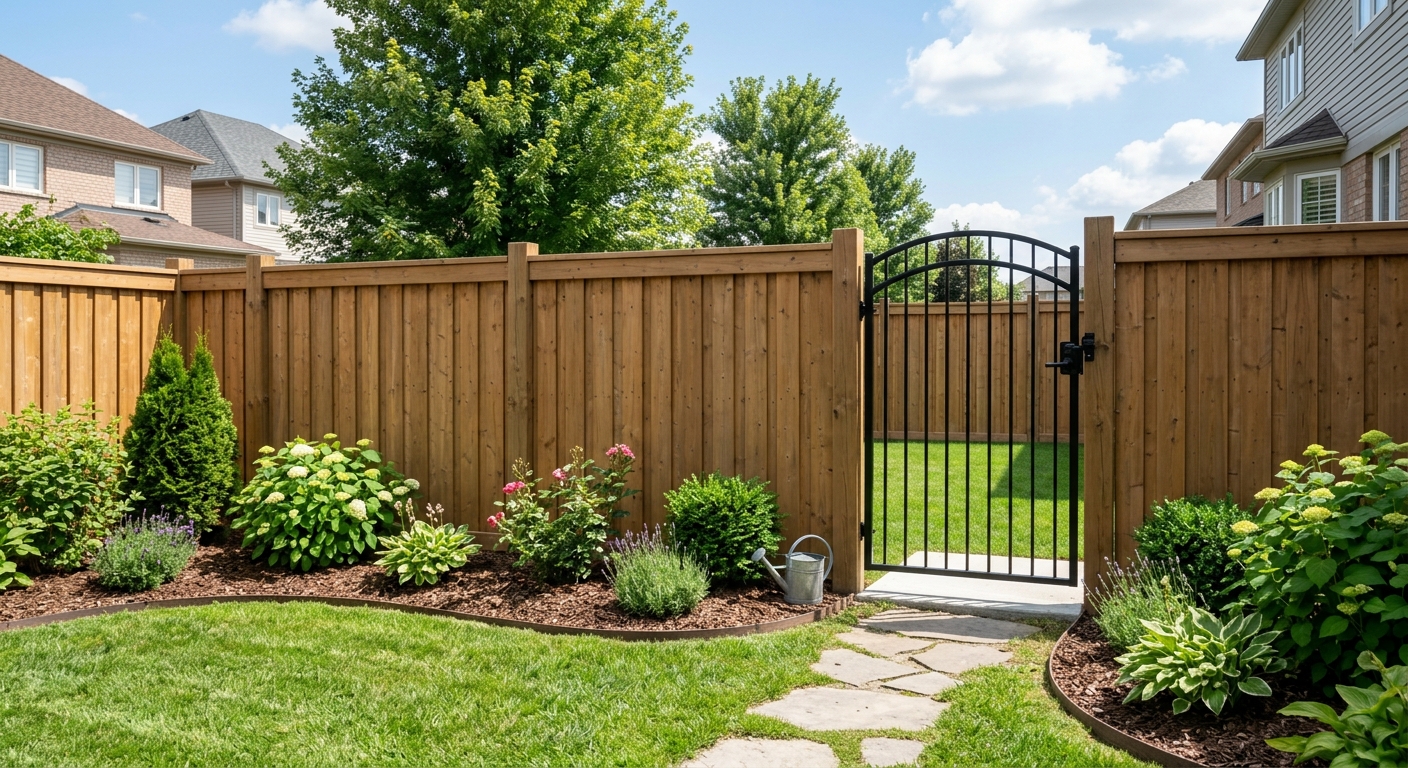
Fencing options and costs in Norfolk County
Norfolk County homeowners typically have a clear shortlist—wood, vinyl, chain-link, aluminum, and newer composite options—because each handles privacy, budget, and maintenance differently. With 22,510 homeowner households and 81.6% of households owning their homes (Statistics Canada, 2021 Census), demand stays steady, especially where single-detached houses are common. In fact, 82.7% of dwellings are single-detached, meaning many properties need perimeter upgrades for privacy, pets, and yard access. That housing mix makes fencing contractors busy across the Hamilton–Niagara Peninsula, where older homes (62.0% built before 1981) often have aging fence lines that need replacing during driveway, landscaping, or garden renovations (Statistics Canada, 2021 Census).
Pricing in this region is shaped by frost and soil. With frost penetration around 1.2 m (4 ft), fence posts generally must be set below the design frost depth to prevent heaving and panel leaning over time. Most professional installs use concrete-set posts for long-term stability, particularly in clay soils that are common locally—this adds drilling time, longer posts, and mix costs versus simple tamped backfill. Wind exposure near hillier lots and lakeshore properties can also push design choices toward heavier posts or tighter spacing to reduce racking and panel damage.
In Norfolk County, trade demand is especially strong in and around Simcoe and Walsingham, where many lots have mature landscaping and frequent gate/patio additions. If you’re comparing options, the table below gives typical lifespan and price ranges per linear foot to help you budget before a site visit.
| Material |
Lifespan |
Maintenance |
Privacy Rating |
Price per Linear Foot |
| Pressure-treated pine (standard wood) |
10–15 years |
Stain/seal every 2–3 years; inspect posts after freeze–thaw |
High (solid picket/board) |
$16 – $26 |
| Cedar (natural rot resistance) |
15–25 years |
Light staining or sealing every 2–4 years; periodic hardware checks |
High (solid board) |
$22 – $34 |
| Vinyl / PVC (no-maintenance) |
20–30 years |
Wash as needed; replace warped rails if exposed to extreme cold impacts |
High (solid privacy style) |
$23 – $38 |
| Chain-link (galvanized steel) |
20–35 years |
Minimal; rinse debris and check tension/build-up near slopes |
Low to Medium (with privacy slats optional) |
$14 – $22 |
| Aluminum ornamental |
25–40 years |
Occasional cleaning; inspect gates after storms |
Low (open picket) |
$26 – $45 |
| Composite / recycled material |
25–35 years |
Low; occasional wash and hardware tightening |
High (board styles) |
$28 – $45 |
Prices are estimates only and vary by project scope, site access and material selection.
What affects the price of fencing in Norfolk County
In Norfolk County and the broader Hamilton–Niagara Peninsula, two quotes for what looks like the same 6 ft fence can vary by 30–50% because the real cost drivers aren’t just the material—they’re what happens below grade, how the fence is braced and gated, and how long the crew loses to drilling, disposal, and access. On one lot, we’re cutting clean straight line trenches; on another, we’re stepping around grade changes, working around mature trees, or redoing corner posts because the original layout was off by even a small amount. The result is a price spread even before you change from wood (a lower materials cost) to vinyl or aluminum (higher material cost).
Frost depth is a major factor in this region: with frost penetration around 1.2 m (4 ft), fence posts generally need to be set about 4–6 inches below the design frost depth. In cold Ontario conditions, that typically means 1.5–2.0 m into the ground for typical 6 ft residential fencing, especially where clay or compacted soil increases uplift risk. Many professional installs use concrete-set posts to resist frost heave, which raises labour and mix costs compared with tamped backfill. Wind and freeze–thaw also matter—panel racking from repeated movement can force heavier posts or tighter spacing, particularly on hilltop or lakeshore lots.
Concrete examples in Norfolk County: (1) Clay-heavy yards often require deeper drilling and extra concrete, which can push a wood privacy job closer to the upper end of local wood fence pricing (roughly the $45–$80 band, depending on post depth and gate count). (2) A yard with two drive gates and uneven terrain can increase labour disproportionately—sometimes shifting the project into the $70–$120 range for vinyl/PVC due to added bracing, longer rails, and extra hardware. (3) Chain-link in open access areas stays closer to the $35–$60 band because it installs faster with less post treatment.
| Price Factor |
Why It Matters |
Cost Impact |
| Fence length in linear feet |
The majority of costs scale directly with footage and post count |
Largest driver; linear pricing applies |
| Post depth required |
Frost line dictates hole depth and post length to prevent heaving |
Can add material and labour time significantly |
| Post setting method |
Concrete vs gravel pack vs driven posts changes stability and prep |
Concrete set generally costs more but lasts longer |
| Material choice |
Vinyl, cedar, and chain-link have different material and hardware profiles |
Shifts total cost across local price bands |
| Gate count and type |
Double-drive gates require heavier frames and stronger bracing |
Higher cost due to custom assembly and installs |
| Grade and terrain |
Sloped yards need stepped panels or raked frameworks |
More layout time and potential waste |
| Old fence removal and disposal |
Hauling, landfill fees, and demo time increase scope |
Often adds 5–20% depending on complexity |
| Permit fees and survey / property line locate |
Some heights or property adjustments require approvals/verification |
Can add a measurable fixed cost plus scheduling |
Permits & regulations in Ontario
In Ontario, many fence projects require a building permit when the fence is above typical height thresholds—commonly around 2.0 m (6.5 ft) for rear yards and about 1.0–1.2 m (3–4 ft) for front yards or corners, though specific municipal rules and site conditions can affect interpretation. Regardless of height, every fence must respect property lines and municipal setback bylaws. Before you dig any post holes, you also need utility locates (Ontario One Call). Damaging underground services can create delays and safety risks, so locates should be confirmed before any trenching or drilling.
Step-by-step, here’s how a Norfolk County homeowner can reduce disputes and verify compliance. First, confirm property line placement by obtaining a survey or at least a property pin locate before installation. This protects you from encroachment issues, especially on older lots where boundaries can be less clearly marked. Second, understand that shared fence ownership is typically addressed under provincial line-fence legislation, which can influence responsibilities for repairs or cost-sharing.
For contractor verification: ask for the contractor’s Ontario licence (where applicable to the scope), liability insurance, and proof of WSIB/WCB coverage. You can typically check online public listings for relevant contractor registration/clearances, and you should request a current certificate of insurance naming you/your property as an interested party if feasible. If they can’t provide certificates on request—or they won’t itemize insurance and coverage dates—treat that as a red flag.
Choosing the right fence material for Norfolk County
Choosing the right fencing material in Norfolk County is mainly about matching your priorities—privacy, low maintenance, upfront budget, and lifespan—to the reality of local climate. With freeze–thaw cycles and frost penetration of about 1.2 m (4 ft), your post setup matters as much as the surface material. Most long-term fences here rely on posts set below the frost line (often 1.5–2.0 m into the ground for typical residential heights) for stability. That’s why concrete-set posts are commonly used in this region; they reduce the risk of leaning and panel racking over repeated winter movement.
Pressure-treated pine is usually the lowest upfront option, but it needs staining or sealing every 2–3 years to slow grey weathering and protect surface fibres. Cedar offers better rot resistance and a nicer look as it weathers, but it still benefits from periodic maintenance. Vinyl/PVC is popular for “set it and forget it,” yet extreme cold impacts can make rails brittle if struck; it also has higher upfront costs. Chain-link is the most economical and longest-lasting on the hardware side, but it won’t provide privacy unless you add slats or a screen. Aluminum ornamental looks great and won’t rust, though it’s more for curb appeal than privacy.
For a simple dollar example: if a 50 ft privacy run in cedar comes in around the mid-to-upper range for wood/cedar pricing, you’re often paying for rot resistance and aesthetics—whereas pressure-treated pine might be cheaper today, but you’ll usually spend time and money maintaining it sooner. On wind-exposed lots, we also consider snow load and wind pressure; heavier posts and appropriate panel spacing reduce damage and costly callbacks.
| Material |
Cold Tolerance |
Lifespan |
Annual Maintenance |
Best For |
Price Band |
| Pressure-treated pine |
Good (with proper post depth and sealing) |
10–15 years |
Low to moderate (plan for staining every 2–3 years) |
Budget privacy with realistic maintenance |
$45 – $80 |
| Cedar |
Good (rot-resistant with weathering management) |
15–25 years |
Low to moderate (light sealing/stain as needed) |
Natural look and longer service life |
$60 – $95 |
| Vinyl / PVC |
Very good (avoid impacts; use correct rails/post system) |
20–30 years |
Very low (wash/inspect hardware) |
Low maintenance privacy |
$70 – $120 |
| Chain-link |
Excellent (galvanized steel) |
20–35 years |
Very low |
Security, pets, and visibility |
$35 – $60 |
| Aluminum ornamental |
Excellent (wont rust) |
25–40 years |
Very low |
Curb appeal with basic separation |
$80 – $150 |
| Composite / recycled |
Good (stable boards; still protect from impacts) |
25–35 years |
Low (wash and check fasteners) |
High privacy with low maintenance |
$85 – $140 |
How to choose a fencing contractor in Norfolk County
Start by verifying the basics the homeowner can check quickly: Ontario coverage, ability to legally work on the project scope, and proof they’re insured properly. Ask for (1) liability insurance—request the certificate and confirm coverage limits and expiry dates; (2) WSIB/WCB clearance or proof of coverage for their workers; and (3) any required Ontario registration/licensing tied to contracting and installation work in your scope. In practice, homeowners should check online registries where available, then confirm the certificate dates and address the policy wording that lists your jobsite/premises. If a contractor can’t produce updated documents, don’t “assume it’s fine.”
Next, get 2–3 itemised written quotes. You want a breakdown that separates labour and materials (including posts, concrete/gravel, brackets, rails, fasteners, and gate hardware). Avoid lump-sum quotes that don’t show what’s included. Read the scope line-by-line: is permit pulling included (if required), and is old fence removal and disposal included or billed separately? Confirm whether gates are supplied pre-hung or fabricated, and what “level/grade tolerance” they allow on sloped lots.
Warranty matters: ask for workmanship warranty length and whether it’s tied to the installation date and transferable to a new owner if you sell. Use a sensible payment schedule—never more than 10–15% upfront for deposits, and hold back the final payment until cleanup and punch-list items are complete. Finally, insist on a written start date and estimated completion timeline; in Norfolk County’s spring/fall windows, weather and frost depth scheduling can affect mobilization.
- Provide current liability insurance certificate with policy number and expiry date.
- Provide proof of WSIB/WCB coverage and clearance (not just a promise).
- Include an itemised labour + materials schedule in the quote.
- State post depth assumptions clearly (below frost) and what soil conditions were used.
- List setting method (concrete vs gravel pack) for the specific line items.
- Confirm how gates will be braced and how latches/hardware are selected.
- Detail what’s excluded: permit fees, survey/locates, tree/shrub trimming, stump removal.
- Specify disposal/hauling of the old fence and any topsoil/grading restoration.
- Include a workmanship warranty in writing and clarify start date.
- Clarify product/manufacturer warranty terms and whether you get registration forms.
- Use a payment schedule with 10–15% max deposit and a holdback until completion.
- Provide a written start date, weather contingency approach, and completion estimate.
Red flags we see with fence contractors in Norfolk County include: quotes that don’t specify post depth or concrete-set requirements for frost, refusing to share insurance/WSIB documents, vague scopes that don’t mention disposal or permits, offering unusually low pricing that skips gate bracing or uses minimal hardware, and asking for large upfront payments without a signed schedule.
Frequently asked questions — fencing in Norfolk County
How tall can my fence be in Norfolk County?
In Ontario, fence height limits often depend on whether the fence is in the front/corner area or the rear yard. A common guideline homeowners run into is that rear-yard fences around 2.0 m (6.5 ft) and front/corner fences around 1.0–1.2 m (3–4 ft) may trigger a building permit requirement, but local bylaw interpretation and site context matter. In Norfolk County, the practical advice is to treat height as a permitting and setback issue, not just an aesthetic choice. If you’re planning a full privacy style (solid boards or panels) near a corner, confirm the exact location relative to setbacks and any municipal rules before posts are dug—otherwise you can end up with rework that costs more than the original material upgrade. (Ontario rules and municipal bylaw specifics can affect the permit decision.)
Should fence posts be set in concrete here?
For Norfolk County properties, yes—concrete-set posts are commonly the right choice for long-term stability because frost penetration in southern Ontario is about 1.2 m (4 ft). To prevent heaving and leaning, posts typically need to be set below the design frost depth, which often works out to roughly 4–6 inches below that line and requires deeper holes. In many local soils, especially where clay is present, contractors prefer concrete around posts rather than relying only on tamped backfill. That said, the best method depends on soil and site conditions, so a proper layout inspection matters. This is also a cost driver: concrete-set systems add labour and mix material, which is one reason projects often land closer to the upper end of local wood pricing (for example, within the $45–$80 band for many wood installs) when you have multiple gates or difficult access.
What's the best fence for privacy?
The best privacy fence in Norfolk County is usually a solid-board design—pressure-treated pine, cedar, vinyl/PVC, or composite—because board-to-board spacing blocks sightlines. If you want the “most private” look, choose a design with minimal gaps and a solid framework that resists racking in winter wind and repeated freeze–thaw cycles. Cedar and treated wood both offer high privacy, but they require maintenance: staining typically every 2–3 years for pressure-treated pine is a common planning assumption to slow weathering. Vinyl/PVC is a strong fit when low maintenance is your priority; it costs more upfront, and many homeowners budget into the $70–$120 range for typical vinyl/PVC installs. Chain-link can be made more private with slats, but it generally won’t look or perform like a solid privacy panel unless you’re comfortable with a different look.
How do I compare fencing quotes?
When comparing quotes in Norfolk County, compare like with like: materials, post depth, and setting method should be stated clearly. Ask each contractor to itemise labour and materials and confirm whether posts are concrete-set below frost depth. Make sure gate hardware and bracing are included (especially for double-drive gates), because gates can change the labour profile and cost more than homeowners expect. Also check what’s excluded: old fence removal/disposal, permit pulling, survey/property line locate, and any restoring of grading or landscaping. Price alone can mislead—one quote might appear lower because it’s using shallower post holes or lighter hardware that won’t hold up to frost movement. Finally, confirm warranty terms: workmanship warranty length, product warranty duration, and whether warranties are transferable. A well-written quote reduces surprises after excavation begins.
How long does fence installation take in Norfolk County?
Timing depends on fence length, number of gates, terrain, and how easy the site access is for machinery and waste removal. For a typical residential run in Norfolk County, many installs are completed within a few working days, but longer projects can take longer if there are multiple line changes, steep grades, or delays from concrete work and curing. Frost depth planning can also affect scheduling in early spring—contractors often coordinate installs when soils are workable and post holes can be drilled safely to the required depth. If you choose vinyl or composite, the installation tends to still move quickly, but gate fabrication and alignment can add time. Ask each contractor for a written start date and a completion estimate tied to the scope (including disposal). If a quote doesn’t include timeline specifics or weather contingencies, it’s difficult to judge scheduling reliability.
Can I install a fence on a slope in Norfolk County?
Yes, you can install a fence on a slope in Norfolk County, but the key is how the fence is built to manage grade changes. Most privacy fences are either stepped (where the fence height changes in sections) or raked (where the rails follow the slope angle). The “best” approach depends on your material and the desired look—vinyl rails can be more visually sensitive to alignment, while wood and cedar often tolerate stepped adjustments nicely. Sloped yards usually add layout time and can increase materials waste, and it may affect post depth consistency (posts still must go deep enough for frost protection even when the surface grade changes). Make sure your quote specifies whether panels will be stepped or raked and how they’ll handle transitions at corners and near walkways or driveways. A clear grade plan helps prevent uneven sightlines and panel stress over freeze–thaw cycles.