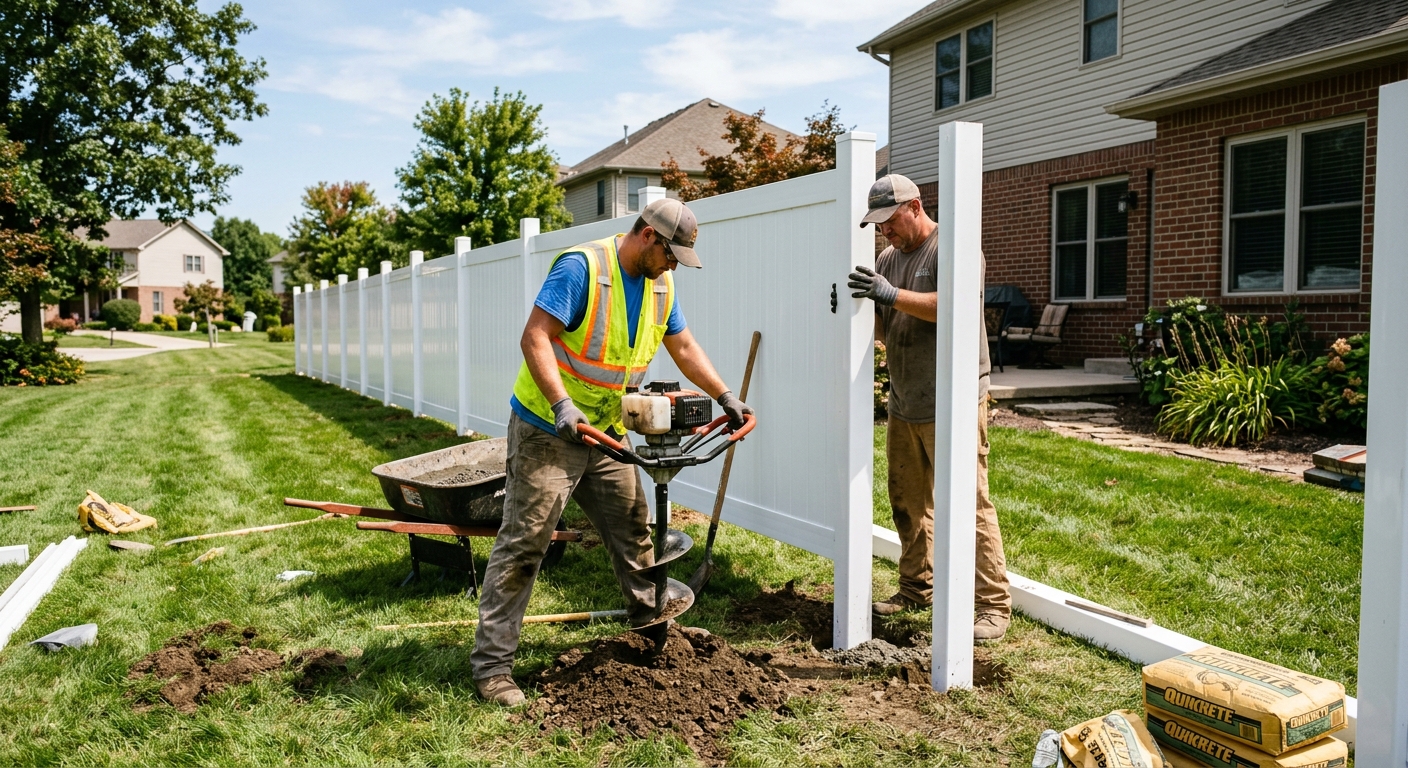
Fencing options and costs in Gravenhurst
Gravenhurst homeowners typically start with the same question: which fence will look good now, hold up through Muskoka winters, and still fit the budget. With 78.4% of local dwellings being single-detached homes (Statistics Canada, 2021 Census), there’s a steady demand for boundary fencing and yard upgrades—especially as older properties (54.9% built before 1981) get refreshed for comfort, safety and curb appeal. That age mix matters because many yards have older rails, leaning runs, and patchy footing that must be corrected before a new system can be installed.
In the Muskoka–Kawarthas region, the biggest cost driver is ground and climate. Our winters push the frost line in this part of Ontario to roughly 4 ft, so posts usually need to be set about 42–48 inches deep to reduce frost heave and long-term leaning. More digging or augering, more concrete, and more labour naturally raise the per-foot total—particularly on properties with rock pockets, clay seams, or limited access. Contractor availability also tightens during peak spring installs, which can affect scheduling and sometimes labour pricing.
You’ll notice higher fencing activity around the Muskoka Lakes and downtown-adjacent neighbourhoods where lots are smaller and backyard access can be tighter. Before choosing a material, it helps to compare typical installed ranges side-by-side—see the table below for Gravenhurst pricing and performance expectations.
| Material |
Lifespan |
Maintenance |
Privacy Rating |
Price per Linear Foot |
| Pressure-treated pine (standard wood) |
10–15 years |
Stain/seal every 2–3 years |
Medium–High (solid styles) |
$55 – $80 |
| Cedar (natural rot resistance) |
15–25 years |
Seal/stain every 3–4 years |
High (solid or close-board) |
$65 – $95 |
| Vinyl / PVC (no-maintenance) |
20–30 years |
Minimal (occasional wash) |
High (vinyl privacy panels) |
$65 – $95 |
| Chain-link (galvanized steel) |
20–30+ years |
Low (rinse; occasional touch-up) |
Low (open mesh) |
$40 – $65 |
| Aluminum ornamental |
25–40 years |
Low (wash; hardware checks) |
Low–Medium (open pickets) |
$70 – $110 |
| Composite / recycled material |
20–30 years |
Low (wash; inspect posts) |
Medium–High (solid/composite boards) |
$75 – $120 |
Prices are estimates only and vary by project scope, site access and material selection.
What affects the price of fencing in Gravenhurst
In Muskoka–Kawarthas, two fences that look similar can land 30–50% apart because the “hidden” work changes—mostly ground prep, frost-depth post setting, and how hard it is to get equipment to the back line. Even across Ontario, crews price differently depending on excavation difficulty, the number of gates, and whether your fence runs through sheltered lots or more exposed, wind-facing yards. In the Gravenhurst area, the labour mix can also shift through the season; spring installs often have higher scheduling demand, which can widen differences between quotes even when materials match.
The frost line is the defining factor for post depth. In cold Ontario regions like this, posts typically must be set 4–6 inches below the design frost depth to limit heaving—commonly meaning about 1.5–2.0 m (roughly 5–6.5 ft) into the ground depending on soil conditions and the fence system. That translates into longer posts, more concrete, and deeper holes, which pushes wood and vinyl projects toward the mid-to-upper bands (for example, wood around $55–$80 per linear foot, vinyl around $65–$95). Higher wind exposure also matters: open lots can require tighter post spacing or stronger panels so the fence doesn’t “sail,” which increases material and fastener/hardware costs.
In Gravenhurst specifically, costs often rise when you hit clay pockets that don’t drain well, or when you encounter rock or mixed fill that slows augers. Conversely, a sheltered in-town yard with looser soil and easy access can keep excavation efficient and land your project closer to the low end of the band—especially for chain-link, where a lighter system can still hold up well at a lower installed range (about $40–$65 per linear foot).
| Price Factor |
Why It Matters |
Cost Impact |
| Fence length in linear feet |
Most materials (rails, boards, mesh) scale directly with length |
Largest driver; fewer “fixed” charges |
| Post depth required |
Frost heave prevention requires deeper setting to about frost-depth levels |
Increases labour, concrete and longer posts |
| Post setting method |
Concrete setting vs gravel pack vs driven posts changes excavation and durability |
Concrete usually increases cost but reduces long-term failure |
| Material choice |
Vinyl/cedar require different fastening and panel systems vs mesh/open metal |
Vinyl/metal typically above chain-link; cedar sits between wood and vinyl |
| Gate count and type |
Gates add hinges, latches, braces, and alignment work |
Each gate commonly adds a noticeable fixed premium |
| Grade and terrain |
Slopes require stepped or raked panels and extra layout time |
More labour and materials for transitions |
| Old fence removal and disposal |
Hauling and disposal add crew time and tipping/transport costs |
Can add a substantial one-time charge |
| Permit fees and survey / property line locate |
Administrative steps and locating work prevent encroachment disputes |
Varies by municipality and job complexity |
Permits & regulations in Ontario
In Ontario, fence approvals often depend on height, location, and how your fence interacts with setbacks and property lines. As a practical homeowner guide in Gravenhurst, fences above a common threshold—typically around 2.0 m (about 6.5 ft) at the rear and about 1.0–1.2 m (about 3–4 ft) at the front or corner—may require a building permit. If your fence runs along a driveway entrance, corner lot, or near a required visibility area, you may also face additional municipal conditions even when the fence is not especially tall.
Before digging any post hole, call for utility locates (Ontario One Call). This is non-negotiable: hitting buried service lines can create major delays and safety issues. Next, obtain a survey or locate your property pins before installation. This helps avoid encroachment disputes—an especially common concern where older lots were subdivided and boundaries are not well marked.
Step-by-step contractor verification in Ontario: (1) confirm the contractor’s licence status using the appropriate Ontario business/contractor listings or directories your insurer expects; (2) request a Certificate of Insurance naming you as the certificate holder or with proof of your interest; (3) ask for WSIB/WCB coverage documentation relevant to the workers who will be on-site. If they can’t provide clear evidence, treat it as a red flag and request it before work begins.
Permits are most likely needed for taller fences and certain front/corner placements; a typical low fence within standard height limits may not require one, but always verify with the municipality or your contractor’s permit process for your exact layout.
Choosing the right fence material for Gravenhurst
Choosing a fence material in Gravenhurst is really about matching your priorities—privacy, low maintenance, and lifespan—to what Muskoka winters and wet freeze-thaw cycles will do to your posts and boards. Pressure-treated pine is usually the best upfront value, but the surface weathers fast outdoors; you should plan to stain or seal roughly every 2–3 years to prevent grey weathering and moisture penetration. Cedar looks great and resists rot better than standard pine, but it still benefits from periodic sealing to protect the grain and keep it looking uniform.
Vinyl/PVC is the low-maintenance favourite for many cottage and year-round households because it doesn’t require staining. However, in extreme cold snaps it can become more brittle, so quality installation matters: correct post spacing, solid posts, and good hardware alignment reduce the risk of cracking. Chain-link is typically the lowest-cost option and very durable over time, but it won’t provide privacy unless you add slats or plant screen solutions. Aluminum ornamental gives a clean, rust-resistant look and long service life with minimal upkeep, though it’s not for full privacy. Composite/recycled boards can deliver strong privacy with lower upkeep, but it’s a higher upfront material cost.
For all materials here, post depth is key due to frost. With the frost line roughly around 4 ft locally, many installations use concrete-set posts set about 42–48 inches deep to limit heaving and leaning over time. In clay pockets or frost-active soils, concrete-set posts are often worth the added work; they prevent the “wobble” that later requires re-aligning rails and gates. If you want privacy in a windy or open yard, choose solid systems (wood/cedar/vinyl/composite) and consider stronger posts and hardware.
Dollar-wise, the justification is usually straightforward: if you’re comparing chain-link at about $40–$65 per linear foot to vinyl privacy around $65–$95, the extra cost often pays back in reduced maintenance time and the privacy you actually use day to day—especially on properties where 1–2 seasons of poor wind buffering makes the yard less comfortable.
| Material |
Cold Tolerance |
Lifespan |
Annual Maintenance |
Best For |
Price Band |
| Pressure-treated pine |
Good (if properly sealed) |
10–15 years |
Low to moderate (check sealant/fasteners) |
Budget-friendly fencing with solid privacy styles |
$55 – $80 |
| Cedar |
Very good (natural rot resistance) |
15–25 years |
Low to moderate (seal/stain every few years) |
Appearance + rot resistance |
$65 – $95 |
| Vinyl / PVC |
Good (quality install recommended) |
20–30 years |
Minimal (wash/visual inspections) |
Low-maintenance privacy |
$65 – $95 |
| Chain-link |
Excellent (galvanized + powder options) |
20–30+ years |
Minimal |
Security on a budget; long service life |
$40 – $65 |
| Aluminum ornamental |
Very good |
25–40 years |
Minimal (hardware checks) |
Decorative boundaries with airflow |
$70 – $110 |
| Composite / recycled |
Very good (engineered boards) |
20–30 years |
Low (wash; inspect posts) |
Durable privacy with reduced upkeep |
$75 – $120 |
How to choose a fencing contractor in Gravenhurst
To pick the right fencing contractor in Gravenhurst, focus on documentation and clarity—not just the lowest line on a quote. First, verify Ontario licensing/business status where applicable, then confirm liability insurance and WSIB/WCB coverage for their workers. How to check: request a current Certificate of Insurance showing general liability and the job address (or at least your property), and ask for WSIB/WCB clearance or coverage confirmation for the specific crew. If they’re hesitant or can’t supply paperwork promptly, that’s a major warning sign.
Next, get 2–3 itemised written quotes. You want a breakdown that separates materials and labour, includes line-by-line allowance for posts, gates, and concrete/setting method, and clearly lists what happens to debris. Avoid lump-sum numbers that don’t tell you what’s included. Ask whether disposal and hauling are included, whether permit paperwork is pulled by the contractor (if required), and whether the quote assumes a survey/property line locate or uses existing marks.
Warranty should be in writing: confirm workmanship coverage length (for example, for posts, rails, alignment and gate hardware), and distinguish it from the manufacturer’s product warranty. Ask if it’s transferable if you sell the home. For payments, never allow more than 10–15% upfront; hold back the remainder until completion and walk-through.
Finally, lock in the schedule: request a start date, an estimated completion window, and confirmation of winter suitability for any materials that are temperature sensitive.
- Confirm the contractor provides proof of general liability insurance.
- Confirm WSIB/WCB clearance or coverage for the workers who will be on-site.
- Request an itemised quote (posts, rails, fence panels/mesh, gates, concrete setting, disposal, hardware).
- Ask what is excluded (demo, excavation beyond post holes, uneven grade adjustments, rock removal).
- Get clarity on post setting method: concrete vs gravel pack vs alternative approach.
- Ensure utility locate is included or at least scheduled by the contractor.
- Ask whether the quote includes gate hardware upgrades (latches, hinges, braces) and alignment.
- Verify warranty terms for workmanship and what triggers warranty service.
- Ask whether product warranty is tied to the installer and how it’s documented.
- Confirm payment schedule (10–15% maximum upfront; holdback until completion).
- Request a written timeline and what happens if frost or weather affects installation.
- Confirm they clean up and haul debris away to an approved disposal location.
Red flags in Gravenhurst include quotes that don’t specify post depth or setting method, refusal to provide insurance/WSIB documentation, “too good to be true” pricing that omits gate hardware/bracing, vague scopes with no disposal or permit responsibility stated, and contractors who pressure you to pay a large deposit before any measurements or layout are confirmed.
Frequently asked questions — fencing in Gravenhurst
Who owns and maintains a shared fence?
In Ontario and around Gravenhurst, shared fences typically follow line-fence principles: the fence is treated as a boundary structure, and responsibility can depend on the agreement between adjoining owners and how the fence was originally built or updated. If a fence is truly on or serving a shared boundary, neighbouring owners often split maintenance responsibilities or contribute to replacement costs, but the exact “who pays” can vary with the circumstances. The safest approach is to confirm whether the fence is on the property line and whether there’s an existing cost-sharing agreement or written understanding. Before spending, ask your contractor to help document the condition and recommended repairs, then discuss costs with your neighbour in writing.
How do I find my property line before fencing?
For fencing in Gravenhurst, don’t rely on old stakes, informal markers, or “it looks like the line.” Start by locating your property pins or obtaining a survey/locate showing the boundary. If you don’t have recent survey documentation, a property line locate performed by a qualified surveyor can clarify where posts should be placed to avoid encroachment disputes. Then, before any digging, call utility locates through Ontario One Call. When you’re working on older homes—many in the Muskoka–Kawarthas area were built before 1981 (Statistics Canada, 2021 Census)—boundary clarity is especially important because layouts and vegetation growth can obscure original survey points. This step can save you from having to relocate a fence after the fact.
What's the most low-maintenance fence?
For low maintenance in Ontario, vinyl/PVC is often the top choice, especially for privacy panels. Vinyl typically carries an installed price band around $65–$95 per linear foot, but homeowners choose it because it doesn’t need staining like pine or cedar. That said, “no maintenance” doesn’t mean “no inspections”—you still want periodic checks of post alignment and gate hardware, particularly after freeze-thaw cycles. Cedar can also be relatively manageable if you stay consistent with sealing every few years. If your main goal is minimal upkeep with a longer lifespan, chain-link is extremely low maintenance, but it won’t provide privacy unless you add slats or plant screening. In Gravenhurst’s winter conditions, correct installation and post setting matter as much as the material.
How tall can my fence be in Gravenhurst?
Fence height rules can depend on whether the fence is located at the rear yard versus the front/corner side yard and whether it creates concerns like visibility. As a common Ontario planning baseline homeowners use in practice, fences above roughly 2.0 m (about 6.5 ft) at the rear and around 1.0–1.2 m (about 3–4 ft) at the front or corner may require a building permit, and municipal setback or visibility rules can apply. The most important step is to confirm your exact location and height requirements with the municipality and your contractor’s permit process. If you’re planning a privacy upgrade on an exposed lot, tell your contractor the intended height so they can size posts and hardware appropriately for wind and snow load.
Should fence posts be set in concrete here?
In Gravenhurst, concrete-set posts are commonly recommended because our winter frost can be significant—frost heave resistance depends on getting posts set at the right depth and with stable footing. With the local design frost conditions being roughly around 4 ft, posts typically need to be set about 42–48 inches deep to reduce leaning over time. Concrete helps lock the post in place in frost-active soil. That said, the “best” method depends on your soil and the fence system. A responsible installer will explain the trade-offs and show you what depth and setting method they’re proposing in the quote. If you’re comparing bids, look for whether they specify post depth, concrete quantities (or an alternative), and how they handle soft spots, clay pockets, or mixed fill.
What's the best fence for privacy?
For privacy in Gravenhurst’s winter-and-wind conditions, solid-panel fences are usually the best fit—vinyl/PVC privacy, cedar close-board, or pressure-treated wood with solid sections. Vinyl privacy is popular because it’s durable through Ontario weather and typically lands around $65–$95 per linear foot installed, with very low day-to-day upkeep. Cedar generally provides excellent appearance and rot resistance, but you still need periodic sealing. Pressure-treated pine can be the budget route, commonly around $55–$80 per linear foot for standard wood systems. Regardless of material, privacy performance depends on correct post spacing and post setting depth; otherwise, gaps and leaning can develop after freeze-thaw cycles. If your yard faces strong winds, ask about bracing and stronger posts so the panels don’t flex.