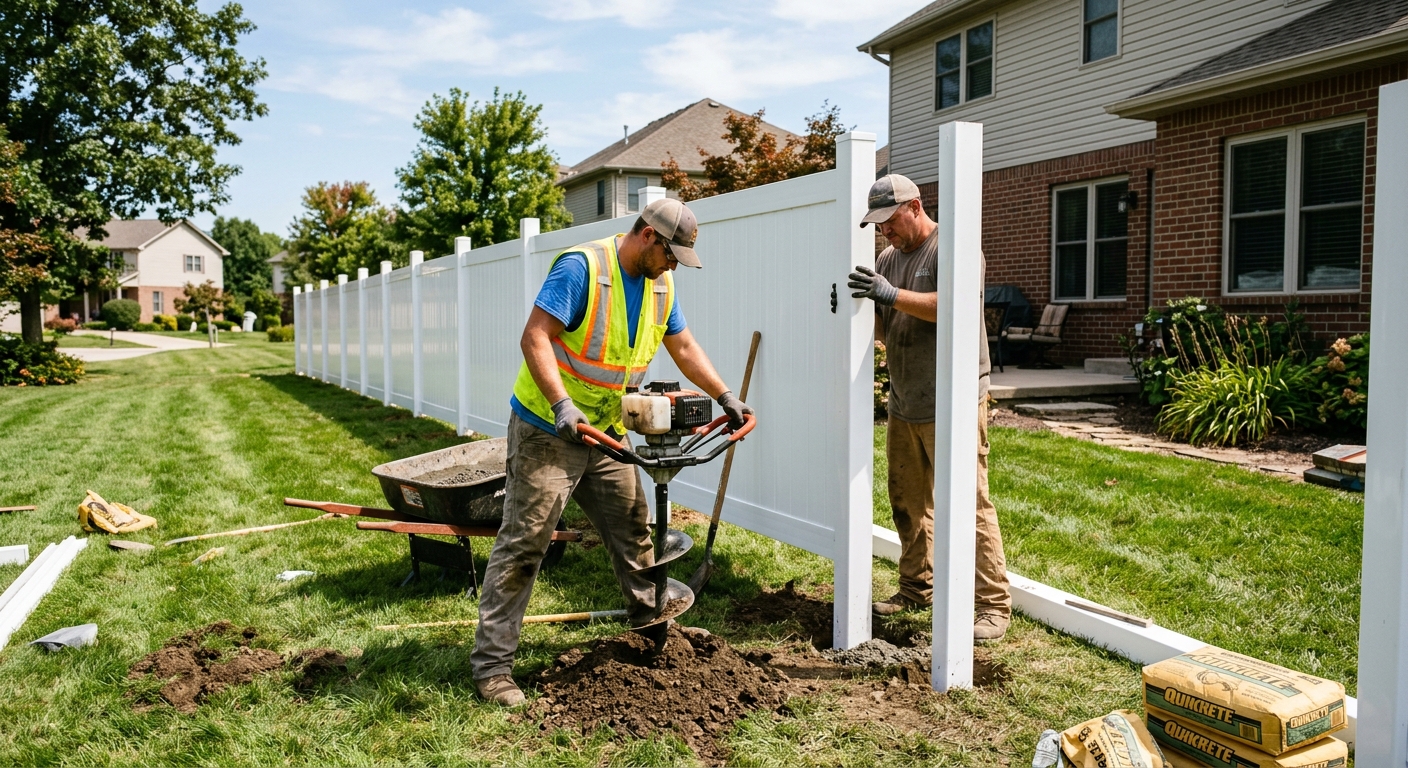
Fencing options and costs in Windsor
Windsor homeowners can choose from several fencing styles, but costs often land in different places depending on privacy needs, gate counts, and how deep posts must be set. Windsor is home to 229,660 residents (Statistics Canada, 2021 Census), and detached homes make up 60.1% of dwelling types—so there’s steady demand for yard fencing around places like Walkerville and the south end near Erie Street. With 58,960 homeowner households (Statistics Canada, 2021 Census), many projects are planned as long-term upgrades rather than short-term fixes.
In the Windsor–Sarnia corridor, we design around southern Ontario’s frost line, roughly 1.2 m (about 4 ft). That typically means posts go at least 3 ft deep, and many structural footings end up set below the frost line with concrete. On tight lots or where access is limited, that extra excavation and concrete volume becomes a major labour-and-material cost driver. The Windsor climate isn’t as wind-constant as open prairie areas, but gusts near the Lake Erie/Lake Huron influence and wide farm-field exposures can still make solid panels act like sails—especially for taller privacy fences. That’s why we sometimes tighten post spacing or choose more wind-shedding designs (board-on-board, aluminum, or chain-link with wind considerations) to protect alignment and gate operation.
Contractor availability and turnaround can also vary by season—spring install demand is high—so booking earlier often reduces schedule pressure. Below is a practical comparison of common materials so you can benchmark your quote before we review your layout, gates, and ground conditions, using the local price bands for Windsor.
| Material |
Lifespan |
Maintenance |
Privacy Rating |
Price per Linear Foot |
| Pressure-treated pine (standard wood) |
10–15 years |
Stain/seal every 2–3 years |
High (solid pickets) |
$45–$80 |
| Cedar (natural rot resistance) |
15–25 years |
Light staining every 2–3 years (recommended) |
High (solid boards) |
$60–$95 |
| Vinyl / PVC (no-maintenance) |
20–30 years |
Occasional wash only |
High (privacy styles) |
$65–$110 |
| Chain-link (galvanized steel) |
20–30 years |
Minimal (rinse/spot touch-ups) |
Low–medium (depends on mesh/adding privacy slats) |
$30–$55 |
| Aluminum ornamental |
25–35 years |
Wash as needed |
Low–medium (ornamental pickets) |
$70–$130 |
| Composite / recycled material |
20–30 years |
Occasional cleaning; inspect hardware |
High (board systems) |
$85–$135 |
Prices are estimates only and vary by project scope, site access and material selection.
What affects the price of fencing in Windsor
In Windsor–Sarnia, even two “same fence” quotes can differ by 30–50% because pricing is driven by site conditions and how posts are engineered for frost and wind—not just the material you choose. A lot of homeowners compare numbers and assume it’s only about wood vs vinyl, but the bigger swing usually comes from excavation depth, concrete volume, and the time needed to line up panels on uneven ground.
Here’s the reality for Windsor: southern Ontario’s frost line is about 1.2 m (roughly 4 ft). To help prevent heaving, we typically place posts with embedment around 4–6 inches below the design frost depth; on many Windsor lots that works out to roughly 1.5–2.0 m into the ground. That drives longer posts, more digging, and concrete setting. In colder Ontario regions, this is why base pricing for “wood” isn’t always the lowest when proper structural footings are included. Where wind is stronger—such as more open stretches near the lakes and larger field backyards—we may tighten post spacing and increase hardware sizes, which raises labour and sometimes pushes you into more wind-tolerant systems.
Two concrete examples from Windsor projects: (1) Replacing a short side run with simple 4 ft spacing might stay closer to the wood band (often around $45–$80 per linear foot), while (2) a 6 ft privacy run with two gates and deeper concrete footings can move toward the vinyl band ($65–$110), even if the overall lineal footage is similar. (3) A sloped rear yard often requires stepped panels or raked rails, adding layout time and sometimes more materials.
| Price Factor |
Why It Matters |
Cost Impact |
| Fence length in linear feet |
Most materials and most labour scale directly with total length |
Largest swing on almost every Windsor quote |
| Post depth required |
Frost line dictates embedment, post length, and hole depth |
Can materially increase material and labour cost |
| Post setting method |
Concrete vs gravel pack vs driven posts affects stability and time |
Concrete footings usually add time and concrete volume |
| Material choice |
Vinyl, cedar, and chain-link have different hardware, durability and complexity |
Shifts you between local bands (e.g., wood vs vinyl vs chain-link) |
| Gate count and type |
Gates need stronger posts, hinges, latches, and often diagonal bracing |
More gates = higher structural and hardware cost |
| Grade and terrain |
Sloped yards require stepped or raked panels and extra layout time |
Extra labour and sometimes more rails/panels |
| Old fence removal and disposal |
Demolition, hauling, and disposal are time-dependent |
Can add notable cost vs build-on-new |
| Permit fees and survey / property line locate |
Some installations need permits; pin locating reduces disputes |
Adds admin cost and scheduling time |
Permits & regulations in Ontario
In Ontario, fence requirements commonly depend on height and placement. As a practical homeowner guideline in Windsor, fences above a typical rear threshold of about 2.0 m (6.5 ft) and about 1.0–1.2 m (3–4 ft) near the front or corners often trigger a building permit requirement, though exact thresholds can vary by municipal bylaws. Regardless of height, all fences must respect property lines and municipal setback rules. If your fence might affect neighbour sight lines, easements, or drainage, plan for additional review time.
Before anyone digs any post hole, call for utility locates through Ontario One Call to mark buried services. You should also obtain a survey or have your property pins located before installing, especially on older lots and established neighbourhoods where fences were set by previous owners.
Shared fence ownership is a civil matter under Ontario line-fences principles—so before you spend on repairs on a shared boundary, confirm whether it’s truly on the shared line and agree on cost responsibility with your neighbour.
What usually DOES require a permit: higher fences near the rear/side where height exceeds local thresholds, and any installation that could affect setbacks, easements, or required visibility. What typically does NOT: basic low-height decorative fencing within front-yard limits (still subject to bylaw), and routine replacements that match the existing height and location—if approved by the municipality where applicable.
To verify a contractor, ask for proof and check: (1) Ontario business/licensing details via online registry sources where applicable, (2) a current certificate of insurance showing liability coverage, and (3) clearance/coverage evidence for workers under WSIB where the contractor uses employees. For WSIB, request documentation showing active coverage (or an appropriate clearance letter/confirmation). If they can’t provide it quickly, that’s a red flag before work begins.
Choosing the right fence material for Windsor
Choosing the right fence material in Windsor is mostly about matching what you want—privacy, low maintenance, budget, and lifespan—to what the local climate and frost conditions will do over time. With 60.1% of dwellings being single-detached homes (Statistics Canada, 2021 Census), many lots have full perimeter fencing needs, so durability and post stability matter as much as appearance.
Pressure-treated pine is the budget-friendly start, but it generally needs staining or sealing every 2–3 years to limit grey weathering and protect against moisture cycling. Cedar looks better and has better natural rot resistance, yet it still benefits from maintenance to keep colour and reduce warping at joints. Vinyl/PVC is popular for “set-and-forget” care, but in extreme cold it can become brittle if installed incorrectly or if panels are stressed—so we build with proper expansion allowances and hardware. Chain-link is the lowest-cost option and lasts a long time, but it provides low privacy unless you add slats or privacy screening. Aluminum ornamental is rust-resistant and mid- to higher-cost, but it’s typically not a privacy solution unless you pair it with screening.
Because Windsor–Sarnia has a frost line around 1.2 m (about 4 ft), posts often require deep embedment (commonly 3 ft+ and frequently 4 ft in exposed/clay-heavy conditions) and concrete-set footings on many projects. That structural work is often similar regardless of material, which is why your material choice should focus on the balance between maintenance and long-term appearance.
As an example: if pressure-treated pine comes in near the wood band (around $45–$80 per linear foot) but cedar is nearer the higher wood end (often $60–$95), the extra cost can be justified if you want improved appearance and fewer early replacements due to rot. If you truly want the lowest upkeep, vinyl in the local range (commonly $65–$110) can be worth the jump—especially when you’re also buying time and consistency during busy spring install periods.
| Material |
Cold Tolerance |
Lifespan |
Annual Maintenance |
Best For |
Price Band |
| Pressure-treated pine |
Good with proper staining and sealed tops |
10–15 years |
Low-to-moderate (plan for 2–3 year staining cycles) |
Budget-focused privacy in stable locations |
$45–$80 |
| Cedar |
Good; tolerates moisture better than pine |
15–25 years |
Low-to-moderate (stain periodically to reduce graying) |
Natural look with better rot resistance |
$60–$95 |
| Vinyl / PVC |
Very good when installed with correct tension/allowances |
20–30 years |
Very low (wash and inspect hardware) |
Low-maintenance privacy |
$65–$110 |
| Chain-link |
Excellent (galvanized steel resists rust) |
20–30 years |
Very low (occasional rinse; tighten fasteners) |
Security and long life on a budget |
$30–$55 |
| Aluminum ornamental |
Excellent (powder-coated and rust-resistant) |
25–35 years |
Very low (wash and check latches) |
Curb appeal with secure perimeter |
$70–$130 |
| Composite / recycled |
Good; stable when properly braced |
20–30 years |
Low (cleaning plus hardware inspection) |
Privacy with less upkeep than wood |
$85–$135 |
How to choose a fencing contractor in Windsor
Choosing a contractor in Windsor should start with verifying Ontario coverage and accountability, not just the price. First, ask whether they carry liability insurance—request a certificate of insurance and confirm the coverage is active and matches the scope (fence installation includes excavation, handling, and gate work). Second, if they use employees, verify WSIB coverage: ask for proof of current WSIB status or a clearance letter/confirmation showing they are properly registered/covered. Third, confirm they are operating as a legitimate Ontario business (and match the name/company on the quote to what appears in public business registry listings).
Next, get 2–3 itemised written quotes. You want a labour + materials breakdown (posts, rails, pickets/mesh, concrete, hardware, gates, and any line locating or survey allowance), not a single lump sum. Ask what’s excluded: landscaping patching, rock removal, permit pull, locating property pins, demolition of the existing fence, and disposal. If they include permit work, get it in writing—if not, you may be paying extra later.
Warranty matters too. A solid workmanship warranty should be stated clearly (often covering post setting and alignment for a defined period). Also ask about the product/manufacturer warranty and whether it’s transferable if you sell your home. For payment schedule, avoid paying more than 10–15% upfront; hold back part of the payment until the full job is completed, final measurements are confirmed, and gates operate properly.
Finally, request a written start date and completion estimate. In Windsor’s busy seasons, an estimated timeframe should still be specific enough that you can plan around access, inspections, and yard restoration.
- Provide certificate of liability insurance on request and confirm effective dates.
- Show WSIB coverage proof/clearance if they employ workers.
- Use a written contract with materials list and exact heights/styles.
- Include total linear feet and the post spacing method.
- State post depth/embedment approach for Windsor frost conditions.
- Itemise excavation, concrete (if used), and disposal of old fencing.
- Confirm whether Ontario One Call locates are arranged and included.
- Clarify permit responsibility: “permit included” vs “permit by homeowner”.
- List gate hardware brand/type and confirm swing direction and latch height.
- State warranty length for workmanship and product separately.
- Schedule payments with a small upfront deposit (10–15%) and a completion holdback.
- Provide an expected start date and completion timeline in writing.
In Windsor, common fencing contractor red flags include: quoting only a material total without post depth/concrete assumptions; refusing to provide insurance/WSIB proof; describing permit work as “probably not needed” without checking your exact height/location; and starting without calling for utility locates or without confirming property lines when slopes or older boundary markers exist.
Frequently asked questions — fencing in Windsor
What is the most weather-resistant fence for Windsor's climate?
For Windsor conditions, the most weather-resistant choices are typically chain-link with galvanized components or aluminum ornamental, because they’re less affected by moisture cycling and rot. Chain-link is also cost-efficient in the local range of $30–$55 per linear foot, while aluminum ornamental often lands in the higher band (around $70–$130) depending on style and gate complexity. That said, “weather-resistant” depends on post stability: Windsor’s frost line is about 1.2 m (roughly 4 ft), so properly deep embedment and correct post setting matter as much as material. If you want maximum wind stability, consider open designs that reduce sail effect, especially for taller runs near exposed yards.
How do I prevent wood fence rot in Windsor?
Wood rot usually starts where moisture sits at the bottom edges and around fasteners. In Windsor, the key is correct post depth and proper separation from ground contact—posts should be embedded below the frost line and set using methods that limit trapped water. Choose pressure-treated pine or cedar, and seal/stain with the right products on cut ends and horizontal rails. Plan staining every 2–3 years for pressure-treated pine, and maintain cedar periodically to reduce graying and protect joints. Also ensure water can drain away from the fence line and avoid burying the wood directly into soil. If you’re replacing a failing section, don’t just swap panels—verify the posts are secure and not heaving after winter freezes.
What is the cost per linear foot for fencing in Windsor?
In Windsor, many installed fences fall into predictable local bands based on material and the structural requirements of your site. Pressure-treated pine is often around $45–$80 per linear foot, vinyl/PVC typically ranges near $65–$110, and chain-link often comes in at about $30–$55. Those numbers assume appropriate frost-line embedment for posts (often requiring 1.5–2.0 m embedment in practice, depending on soil exposure and design) and proper gate hardware. If your yard has clay-heavy soil, limited access, multiple gates, or requires old fence removal, the effective cost per foot can move toward the higher end of the band because excavation, concrete, and labour increase.
Should I repair or replace my old fence in Windsor?
Repair can be worthwhile when only boards/pickets or a single section is failing and the posts are still stable and not leaning after freeze-thaw cycles. In Windsor, the biggest “repair vs replace” decision is whether the problem is localized rot versus structural movement from frost heave. If you notice wobbling, uneven rails, or post bases that sink or shift, replacement is usually the safer long-term option because fixing panels won’t correct a failed foundation. Also consider how old the fence is: with many homes built before 1981 (Statistics Canada, 2021 Census), older fences often used setups that are more prone to movement or rot at contact points. If you’re replacing, we recommend a full line assessment so new posts match the embedment requirements.
How do I handle a fence dispute with a neighbour in Ontario?
Fence disputes in Ontario are often about property line location and who is responsible for costs. Start by confirming the boundary: request a survey or have pins located so you’re not guessing where the fence should sit. In practical Windsor terms, this matters because older neighbourhoods can have offsets from previous owners’ installations. Communicate with your neighbour in writing, including your plan to assess the fence condition. If the fence is on/at a shared boundary, Ontario line-fences principles typically guide shared responsibilities, but the exact outcome depends on location and circumstances. If you can’t agree, pause major work until boundary location is verified—digging first can escalate costs and complicate resolution.
What fence style offers the best wind resistance in Windsor?
In Windsor, the best wind resistance usually comes from styles that reduce sail effect while still maintaining structure. Open or semi-open designs—like chain-link, aluminum ornamental, or board-on-board with alternating overlap—tend to shed wind load better than fully solid privacy panels. That’s important near exposed areas and where spring gusts are more noticeable, especially for taller fences. Wind performance also depends on engineering: tighter post spacing, stronger posts, and correctly set concrete footings (below frost conditions) help prevent shifting and wracking. If you need high privacy, consider designs that break up wind flow, and ensure gates are braced and aligned so they don’t rack in heavy gusts.