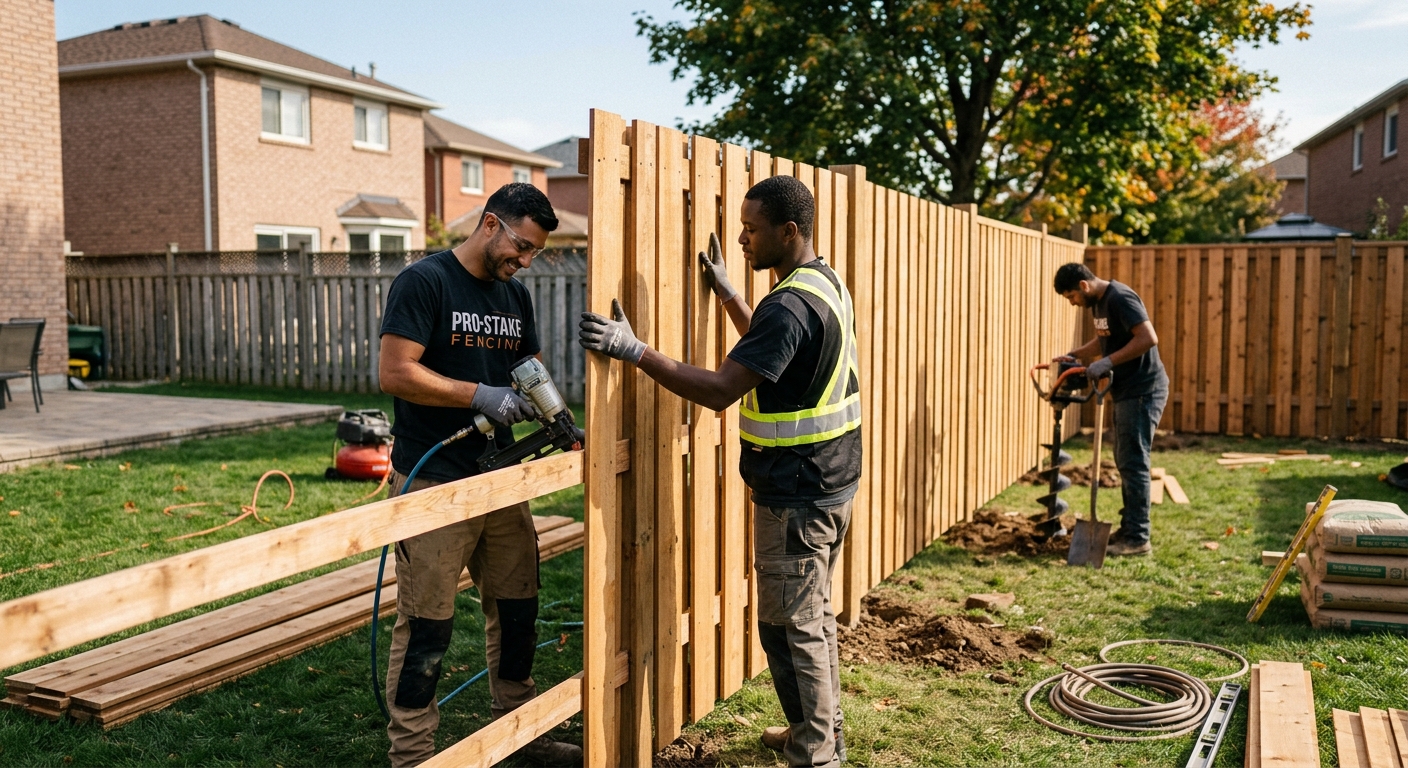
Fencing options and costs in North Perth
North Perth homeowners typically choose fencing based on privacy needs, yard size, and how winter frost behaves on their specific soil. With 71.4% of local households owning their homes and single-detached houses making up 70.2% of dwellings, the demand for perimeter fencing is steady across the township and surrounding rural lanes. That matters because many projects are full-yard installs (not just a small side run), and full runs mean more post holes set below frost protection depth.
In the Stratford–Bruce Peninsula region, frost depth is one of the biggest cost drivers for residential fencing. To prevent heaving in clay and mixed soils common across Perth, Grey, and Bruce, contractors typically set posts about 0.9–1.2 m deep (3–4 ft), often with concrete footings. Wind exposure also plays a role: open farm fields and Lake Huron shorelines can increase lateral loads, so privacy wood or vinyl may need closer post spacing or upgraded hardware.
In North Perth, trade demand is especially noticeable around Fullarton and rural pockets along the highway corridors where properties have longer frontages and fewer natural wind breaks. Crews tend to batch installs in these areas because post-hole excavation and concrete setting are time-intensive, and weather windows in spring and early summer affect when concrete can be poured and cured properly.
Below are realistic budget ranges so you can compare materials before you request site-specific quotes.
| Material |
Lifespan |
Maintenance |
Privacy Rating |
Price per Linear Foot |
| Pressure-treated pine (standard wood) |
10–15 years |
Stain/seal every 2–3 years to reduce grey weathering |
Medium–High (solid/board styles) |
$55–$85 |
| Cedar (natural rot resistance) |
15–25 years |
Light staining or sealing every 3–4 years |
High (solid board/wide picket) |
$65–$105 |
| Vinyl / PVC (no-maintenance) |
20–30 years |
Rinse as needed; no staining |
High (privacy styles) |
$75–$115 |
| Chain-link (galvanized steel) |
25–35 years |
Occasional rinse; keep fabric taut and posts plumb |
Low (security only) |
$35–$55 |
| Aluminum ornamental |
25–40 years |
Wash annually; check hardware after wind events |
Low–Medium (typical pickets) |
$90–$150 |
| Composite / recycled material |
20–30 years |
Low; occasional cleaning |
High (privacy panels) |
$95–$150 |
Prices are estimates only and vary by project scope, site access and material selection.
What affects the price of fencing in North Perth
In North Perth, it’s common to see the same overall fence idea come in 30–50% apart across the Stratford–Bruce Peninsula region and broader Ontario. The gap usually isn’t the “brand” of material—it’s the amount of excavation, how posts must be set for frost, how many gates you need, and how each contractor handles exposed conditions and unknown underground constraints.
Frost protection is the first driver. Even for a straight residential run, practical Ontario installs typically place posts about 4–6 inches below the design frost depth to reduce the risk of heaving. In cold areas like ours, that means posts often go roughly 1.5–2.0 m into the ground, requiring longer posts and concrete setting in many yards—both of which push labour hours and material costs up. Wind exposure affects the second driver: in open fields near North Perth, contractors often tighten post spacing and upgrade brackets to resist lateral load on solid privacy fences, which can raise costs versus more sheltered lots.
Here are a few concrete examples of why your quote can be higher or lower locally. First, clay-heavy soils around Perth/County road allowances can increase the time spent digging and setting posts straight—especially if there’s heavy frost in early spring. Second, a yard with an existing fence removal and buried sections may require additional disposal runs. Third, properties built before 1981 (51.3% of homes in the broader local profile) sometimes have older underground services closer to the fence line, which can extend locates and excavation time. If your budget is primarily security, chain-link budgets around $35,–$55 per linear foot can be the most affordable; for full privacy with upgraded post spacing, vinyl often lands near $75,–$115.
| Price Factor |
Why It Matters |
Cost Impact |
| Fence length in linear feet |
More footage means more posts, hardware, and assembly time |
Highest driver; small measurement changes can swing the total |
| Post depth required |
Frost line determines post length and hole depth |
Deeper holes and longer posts can add significant labour/material |
| Post setting method |
Concrete vs. gravel pack vs. driven posts affects stability |
Concrete-set posts cost more but reduce long-term movement |
| Material choice |
Vinyl/cedar need different bracing, clips and assembly methods than chain-link |
Typical band differences shift overall project cost by tens of percent |
| Gate count and type |
Gates require heavier frames, hinges, latches and sometimes power hardware |
Drive-through (double) gates can add labour and hardware beyond the fence run |
| Grade and terrain |
Slope needs stepped or raked panels and careful layout |
More cutting and longer layout time than flat yards |
| Old fence removal and disposal |
Existing posts may be concreted and difficult to extract |
Adds hauling fees and additional labour hours |
| Permit fees and survey / property line locate |
Locates and any required permits affect schedule and admin time |
Not always required, but when they are, they add predictable costs |
Permits & regulations in Ontario
In Ontario, fence rules are typically tied to property line respect and municipal setback bylaws, and a permit may be required when a fence exceeds the height thresholds—commonly around 2.0 m (6.5 ft) at the rear and about 1.0–1.2 m (3–4 ft) at the front or corner. North Perth homeowners should treat these as starting points and confirm details with the local office before ordering materials, especially if you’re planning a tall privacy fence on a corner lot or facing a busy road.
Before any digging, call for utility locates through Ontario One Call so crews know where power, telecom, and other services sit. Also consider obtaining a survey or property line locate before installation; that avoids costly disputes when neighbouring fence lines don’t match older boundaries or when iron pins aren’t visible. Shared fence ownership rules are governed by Ontario’s line-fences legislation, which can affect who pays if the fence is on (or is considered) a boundary line.
What usually DOES require a permit: installing or replacing a fence that exceeds typical height thresholds (particularly at the front/corner) or projects that the municipality flags due to visibility/sightlines. What typically does NOT require a permit: standard rear-yard fence replacements within typical limits, provided they stay fully within the property line and municipal setbacks.
To verify a contractor before you sign: check an Ontario licence/registration for the trade they’re performing (where applicable), request a certificate of insurance naming you as additionally insured, and confirm WSIB/WCB coverage for their workers. Where to look—ask for the COI document and clearance letter directly from the contractor, and verify coverage details using the insurer and the clearance letter reference number they provide (don’t rely on verbal assurances).
Choosing the right fence material for North Perth
Choosing the right fence material in North Perth is about matching what you want—privacy, low maintenance, and budget—to what our winters do to materials. Pressure-treated pine is the classic budget option, but it typically needs staining or sealing every 2–3 years to reduce greying and wear from freeze–thaw cycles. Cedar resists rot better and looks warmer year-round, yet it still benefits from periodic sealing so it maintains consistent colour and doesn’t weather unevenly.
Vinyl/PVC is popular for “install and forget” because it won’t need staining, and it holds up well when installed correctly with the right post supports. The catch is that vinyl panels can become brittle if exposed to extreme cold when the fence system is not rigidly braced—so good post depth and hardware matter more than people expect. Chain-link is usually the lowest initial cost and longest-lasting for security, but it won’t give privacy unless you add slats or plant screens. Aluminum ornamental offers a rust-resistant decorative look and good longevity, though it won’t deliver privacy like board fences.
On the frost line question: because Southern Ontario’s practical frost depth is about 1.2 m (4 ft), many residential fences in this region are built with posts set roughly 0.9–1.2 m deep, often with concrete footings for stability. For exposed rural sites, that “set deep and brace properly” approach helps all materials, particularly privacy styles. In real dollars, if pressure-treated pine privacy comes in around $55,–$85 per linear foot, moving to vinyl around $75,–$115 is often justified when you want to avoid recurring staining and you have a long fence run where labour savings over time are meaningful. For the privacy-first homeowner, cedar or vinyl can be more cost-effective than repeatedly restoring grey, weathered boards.
| Material |
Cold Tolerance |
Lifespan |
Annual Maintenance |
Best For |
Price Band |
| Pressure-treated pine |
Good with proper post depth and sealing |
10–15 years |
2–3 year staining cycle; minor repairs as needed |
Lowest upfront privacy with ongoing upkeep willingness |
$55,–$85 |
| Cedar |
Good; handles freeze–thaw well when sealed |
15–25 years |
Light sealing about every 3–4 years |
Better appearance and rot resistance for privacy |
$65,–$105 |
| Vinyl / PVC |
Very good if installed with rigid bracing |
20–30 years |
Wash/rinse as needed; check hardware |
Low-maintenance privacy in exposed yards |
$75,–$115 |
| Chain-link |
Good; galvanized holds up in Ontario winters |
25–35 years |
Minimal; occasional tighten and rinse |
Security and pet containment |
$35,–$55 |
| Aluminum ornamental |
Very good; no rust |
25–40 years |
Wash annually; hardware inspection |
Decorative front yard fencing with curb appeal |
$90,–$150 |
| Composite / recycled material |
Good; performs well when posts and spacing are correct |
20–30 years |
Low; periodic cleaning |
Privacy with reduced upkeep |
$95,–$150 |
How to choose a fencing contractor in North Perth
Choosing the right contractor matters more for fencing than many people expect because frost-depth posts, concrete work, and panel alignment are where the long-term performance is made (or lost). For North Perth projects, start by verifying Ontario coverage and credentials. Ask for proof of liability insurance (certificate of insurance), and confirm they carry WSIB/WCB coverage for workers on the site. To check: (1) request the COI showing you as additionally insured, (2) ask for a current WSIB/WCB clearance letter or proof of account status, and (3) confirm their registration/licensing for the type of work they’re doing—then match the details on documents to the company name and address you’re dealing with.
Next, get 2–3 itemised written quotes. You want a breakdown that separates labour, excavation/post setting (including concrete vs. alternative methods), material lines (boards/pickets/panels, hardware, gates), and disposal/removal. Avoid lump-sum quotes that don’t clarify what’s included. Also request whether pulling permits (if required), doing a locate, and property line verification are included or treated as extra line items.
Warranty should be clear: a workmanship warranty (often 1–2 years for installation) and a product/manufacturer warranty for materials (varies by fence type). Ask if it’s transferable to future homeowners, which can matter in a high-turnover market.
Payment schedule: never pay more than 10–15% upfront. Hold back remaining funds until the work is complete, the fence line is cleaned up, gates operate properly, and key measurements match the plan. Confirm start date and completion estimate in writing—especially in spring when curing time and frost conditions can impact schedule.
- Ask whether posts are set below frost depth and what depth/hole method they’ll use on your soil type.
- Confirm concrete details (mix, quantity estimate, and whether bases are poured or set in holes).
- Require an itemised quote: posts, rails, panels, brackets, and gates separated from labour.
- Ensure the scope states whether site protection, clean-up, and debris hauling are included.
- Get written confirmation on permit responsibilities and any property line locate/survey needs.
- Confirm fence height and style measured from grade (and whether slopes get stepped/raked panels).
- Ask how they handle underground locates results if something conflicts with the proposed line.
- Verify gate hardware specs (hinges, latch type, and whether it’s rated for snow loads/wind exposure).
- Check workmanship warranty length and what actions are required to keep it valid.
- Confirm product warranty coverage for materials and exclusions (scratches, improper cleaning, etc.).
- Use a payment schedule with 10–15% max upfront and progress payments tied to measurable milestones.
- Request a completion date window and what weather conditions could delay curing or installation.
Red flags to watch in North Perth: a contractor who won’t provide a certificate of insurance or WSIB/WCB proof; quotes that don’t specify post depth, concrete use, or gate hardware; “cash only” or requests for large upfront payments; vague warranties with no workmanship term; and changing scope after excavation starts without written change orders.
Frequently asked questions — fencing in North Perth
How tall can my fence be in North Perth?
In Ontario, height limits are usually tied to fence location (front/corner versus rear) and municipal setback bylaw rules. Many homeowners in North Perth plan around the common thresholds of about 2.0 m (6.5 ft) at the rear and roughly 1.0–1.2 m (3–4 ft) at the front or corner—fences at or above these heights are more likely to need a permit. Because corner lots can involve sightline considerations, it’s smart to confirm with the local bylaw office before ordering. If you’re replacing an existing tall fence, ask your contractor to document the current height and proposed height in the quote, so you’re not surprised by permit requirements or needed adjustments.
Should fence posts be set in concrete here?
For most residential fencing in North Perth, concrete-set posts are strongly recommended because frost depth drives movement risk. Practical installations in Southern Ontario typically set posts about 0.9–1.2 m (3–4 ft) deep, and that often means concrete footings to reduce heaving in clay and mixed soils. While some shallow methods exist, they’re more suitable for very sheltered spots and non-frost-sensitive designs. If your yard has heavier soil or you’re building a solid privacy fence (more wind load), concrete-set posts are usually the difference between “tight and straight” and “leaning after freeze–thaw.”
What's the best fence for privacy?
If privacy is your top priority in North Perth, look at solid board or privacy-style panels in cedar or vinyl. Vinyl privacy fences commonly come in around $75,–$115 per linear foot in this region, which is often chosen by homeowners who want low upkeep after winter. Cedar privacy is typically higher than the budget wood option but offers excellent appearance and rot resistance. If you choose pressure-treated pine for privacy, plan for staining every 2–3 years to keep the fence looking sharp. For any privacy fence, make sure the quote specifies post depth and post spacing appropriate to local wind exposure so panels don’t rack over time.
How do I compare fencing quotes?
Compare North Perth quotes line by line, not just by total price. Ask each contractor to itemise labour versus materials, and specifically confirm post depth, whether posts are concrete-set, and how they’ll handle slopes (stepped versus raked panels). Ensure gate construction is comparable: walk-through versus double drive gates can swing costs because of heavier frames and hinges. Check whether disposal/removal is included, and whether permits/locates are included or treated as separate items. Finally, look at warranty terms for workmanship and for the fence system materials. Two quotes that both say “vinyl fence” can still differ by post spacing, hardware quality, and excavation method.
How long does fence installation take in North Perth?
Timelines vary mainly with fence length, ground conditions, and whether there’s removal involved. In North Perth, straight runs on accessible yards can be quicker, but frost-protected post holes and concrete setting usually require proper curing time and dependable weather. A typical small section (for example, a backyard privacy run) might take a day or two once materials arrive, while full-yard installs can take several days including excavation, setting, panel assembly, and final adjustments for gate operation. If your project needs old fence removal or faces delays due to locates or wet ground, expect longer scheduling. Your contractor should give a start date and a completion estimate in writing.
Can I install a fence on a slope in North Perth?
Yes, you can install a fence on a slope in North Perth, and it’s fairly common. The key is choosing the right layout method: stepped panels (each section changes height) or raked panels (continuous slope follow) depending on the fence style. Privacy fences usually look best with stepped or well-planned raked sections so the top line stays consistent and posts remain plumb. A slope also increases labour for measurement, cutting, and hardware alignment, so it can affect cost even if linear footage stays the same. In your quote, confirm whether the contractor includes stepped/raked design and how they’ll maintain post depth for frost protection across the grade change.