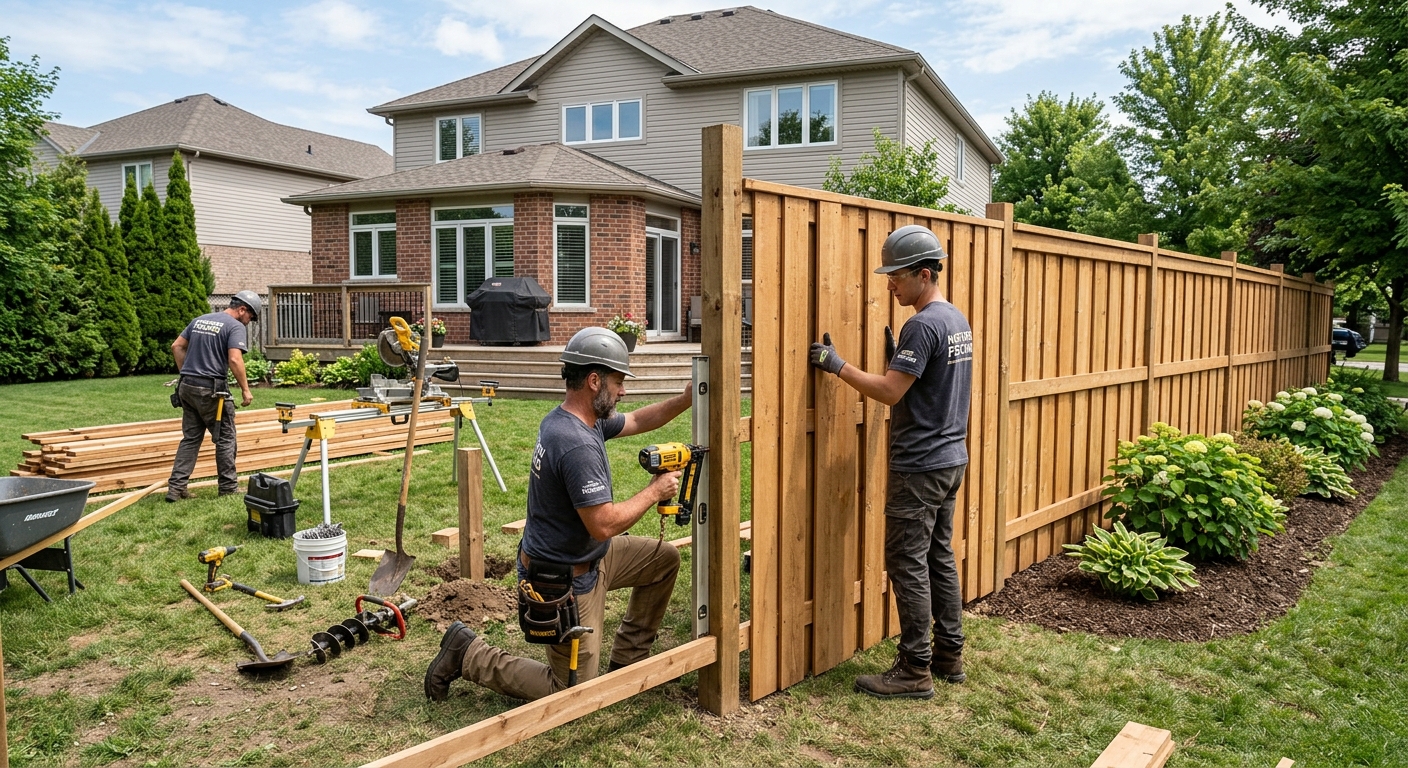
Fencing options and costs in Kenora
Kenora homeowners have lots of reasons to fence in—privacy from shoreline traffic, keeping kids and pets contained, and defining yard boundaries for a street-to-lake look. With 77.1% of dwellings in the area being single-detached homes (Statistics Canada, 2021 Census), the demand here is steady because fence lines are typically long and run along individual property boundaries. The homeowner base is also strong, with 73.5% of households owning, which usually means customers are planning for the long-term rather than “temporary fixes” (Statistics Canada, 2021 Census).
In Northwest Ontario, installed fence pricing is shaped by two big realities: deeper frost and wind. Frost penetrates farther than in southern Ontario, so fence posts typically need to be set roughly 1.2 m+ below grade to reduce the risk of frost heave. That means more excavation, more concrete for post setting, and longer material lengths. Wind exposure also affects design—open rural stretches and highway corridors around Kenora often see higher gusts, which pushes contractors toward closer post spacing and sturdier panel choices for both wood and privacy-style fences. Supply can also tighten in peak weeks when crews are balancing other deep-footing jobs.
Local demand is especially noticeable in residential pockets near downtown and the lake-facing areas where yards back onto busier access roads. If you’re comparing options, the table below summarizes typical materials for Kenora, including lifespan, upkeep, privacy performance, and common price bands.
| Material |
Lifespan |
Maintenance |
Privacy Rating |
Price per Linear Foot |
| Pressure-treated pine (standard wood) |
10–15 years |
Stain/seal every 2–3 years; inspect boards and rails |
High (solid/close pickets) |
$25 – $40 |
| Cedar (natural rot resistance) |
15–20 years |
Light staining/finishing every 2–4 years; seasonal inspection |
High (solid boards or close spacing) |
$30 – $55 |
| Vinyl / PVC (no-maintenance) |
20–30 years |
Rinse as needed; avoid impact and use proper post settings |
High (solid privacy styles) |
$35 – $60 |
| Chain-link (galvanized steel) |
20–25 years |
Occasional tension/repair; keep vegetation off rails |
Low–Medium (add slats for privacy) |
$20 – $35 |
| Aluminum ornamental |
25–40 years |
Wash annually; check fittings after freeze-thaw seasons |
Low–Medium (open pickets) |
$30 – $55 |
| Composite / recycled material |
20–30 years |
Minimal cleaning; replace warped sections if extreme impacts occur |
Medium–High (depends on panel type) |
$40 – $70 |
Prices are estimates only and vary by project scope, site access and material selection.
What affects the price of fencing in Kenora
In Kenora, it’s common to see two quotes for the “same” fence come in 30–50% apart. The difference usually isn’t the material brand—it’s how the contractor designs for Northwest Ontario conditions and what’s included in the scope (post depth, concrete, gates, disposal, and panel bracing). With local housing dominated by single-detached properties (Statistics Canada, 2021 Census), many projects are long runs with multiple corners and occasional gate sections, which means more layout time and more materials handling.
First, frost line depth sets how deep posts must be set. In cold regions, posts typically need to be set about 4–6 inches below the design frost depth to prevent heaving, which often translates to roughly 1.5–2.0 m into the ground. That pushes costs up because you need longer posts, more concrete setting, and bigger excavations. Second, wind exposure influences structure. While Kenora can be forested, open stretches and highway corridors behave differently—gusts tend to pull on fence panels, so contractors may increase post spacing or use heavier rails and picket/panel layouts. For context, Northwest Ontario wood installations are commonly in the $55–$90 range, while vinyl/PVC usually lands higher, often in the $70–$110 range depending on height and style.
Local soil and yard conditions can also move price up or down. For example, mixed or clay-heavy soils around Kenora may require slightly deeper or belled footings to resist movement. Gravel-rich driveways can make hauling and access easier, lowering labour time, while rocky ground can slow excavation and raise it. Older home areas also matter—homes built before 1981 make up 67.9% of the housing stock (Statistics Canada, 2021 Census), and many of these yards have older fences, sunk lines, and uneven grades that require re-straightening, which adds labour and sometimes additional posts.
| Price Factor |
Why It Matters |
Cost Impact |
| Fence length in linear feet |
Every additional foot adds posts, rails, and materials. |
Major—often the #1 driver of total cost |
| Post depth required |
Below-frost embedment prevents heaving and movement. |
Medium–High; deeper frost can add labour and concrete |
| Post setting method |
Concrete vs. gravel pack changes stability and hole prep. |
High when concrete is required for most posts |
| Material choice |
Different materials have different hardware and installation approaches. |
Can shift project by tens of percent (e.g., vinyl vs. chain-link) |
| Gate count and type |
Gates need heavier framing, latching, and hardware. |
Medium–High; drive-through gates cost more than walk-through |
| Grade and terrain |
Slopes require stepped/raked panels and extra measuring. |
Medium; increases labour and sometimes material waste |
| Old fence removal and disposal |
Demolition, haul-away, and backfilling take time. |
Medium; can add a significant day or two on longer runs |
| Permit fees and survey / property line locate |
Required paperwork and locating prevents encroachment problems. |
Low–Medium; varies by project complexity |
Permits & regulations in Ontario
In Ontario, fences that exceed height thresholds—commonly around 2.0 m (6.5 ft) along the rear and about 1.0–1.2 m (3–4 ft) at the front or corner—often require a building permit, especially when the fence is near a property boundary where visibility and setbacks matter. Separate from permits, you must respect your property line and any municipal setback rules. Before digging any post holes, you must call for utility locates through Ontario One Call (and follow the markings provided), because fence post excavation can hit buried services even on residential lots.
To avoid disputes, I strongly recommend getting a survey or at least a property-pin locate before installing, especially on older properties where fence lines may not match today’s lot line. Shared fence ownership is also governed by provincial line-fences principles, so if you’re building on or near a boundary fence, confirm roles and expectations with your neighbour early.
Practical permit guidance for Kenora: a permit is typically required when you’re building a high fence (around the 2.0 m range) or when it triggers local height/setback requirements. Many smaller, compliant front-yard fences often don’t trigger permitting, but your contractor should confirm the threshold for your exact location and height.
To verify a contractor, ask for (1) proof of Ontario licensing registration where applicable, (2) a certificate of insurance naming you as an additional insured, and (3) coverage for workers through WSIB/WCB. You can check the licence/registry details online, and you should be able to view current insurance certificates on request—clear, dated documents are the norm.
Choosing the right fence material for Kenora
Choosing a fence in Kenora comes down to matching material performance to cold weather, wind, and how much upkeep you want to do each year. Pressure-treated pine is the budget-friendly path, but in Northwest Ontario’s freeze-thaw seasons it typically needs staining or sealing every 2–3 years to reduce grey weathering and protect the surface. Cedar looks great and has natural rot resistance, which can stretch lifespan versus many standard woods, but it still benefits from periodic finishing to keep it stable in harsh winters.
Vinyl/PVC is popular because it’s low maintenance, but it performs best when the fence is built correctly for cold—proper post embedment and bracing matter because extreme cold can make some plastics more brittle if installed loosely. Chain-link is the lowest upfront option and it lasts well, but privacy is limited unless you add slats or decorative privacy screening. Aluminum ornamental offers a rust-resistant, neat look and mid-range costs, yet it’s open by design, so it won’t give “solid privacy.”
On post depth: because frost can heave in Northwest Ontario, fence posts should be set close to the frost protection zone—often about 1.2 m+ below grade in Kenora projects. For most privacy fences, concrete-set posts are common, especially where clay or mixed soils are present, because they reduce movement.
Wind and snow also matter. Heavier panels, tighter post spacing, and solid board rails help resist gust loads, which is why a vinyl privacy fence often costs more than chain-link: you’re paying for more structural parts, not just the skin. A practical example: if vinyl/PVC is in the $70–$110 per linear foot range for many installed jobs, versus wood at roughly $55–$90, the extra cost is often justified when you want minimal maintenance over 15–20+ years and you’re building in a wind-exposed run.
| Material |
Cold Tolerance |
Lifespan |
Annual Maintenance |
Best For |
Price Band |
| Pressure-treated pine |
Good with proper staining and tight installation |
10–15 years |
Inspect in spring; stain/seal every 2–3 years |
Budget privacy fences |
$55 – $90 |
| Cedar |
Excellent; handles moisture swings better than many woods |
15–20 years |
Light refinishing every 2–4 years |
Natural look with better rot resistance |
$60 – $95 |
| Vinyl / PVC |
Very good; requires correct post embedment and bracing |
20–30 years |
Rinse as needed; check hardware after freeze-thaw |
Low maintenance privacy and clean lines |
$70 – $110 |
| Chain-link |
Good; flexible structure tolerates movement |
20–25 years |
Minimal; adjust tension and address vegetation |
Security on a budget |
$35 – $65 |
| Aluminum ornamental |
Excellent; won’t rot or rust with good coating |
25–40 years |
Wash annually; check posts after winter |
Curbed street appeal and defined boundaries |
$80 – $140 |
| Composite / recycled |
Good; keep structure rigid to avoid warping |
20–30 years |
Occasional cleaning; inspect for impact damage |
Modern privacy with lower upkeep |
$90 – $150 |
How to choose a fencing contractor in Kenora
Choosing the right contractor in Kenora starts with verification. In Ontario, ask for proof of licensing/registration where applicable, liability insurance, and WSIB/WCB coverage for workers. The practical way to check: (1) look up the contractor’s registration details through the relevant online registry information provided for Ontario, (2) request a current certificate of insurance—confirm it’s not expired and that it covers fence installation activities, and (3) confirm WSIB/WCB coverage via a clearance letter or proof document. If the contractor can’t provide clear, dated documentation, that’s a stop sign.
Next, get 2–3 itemised written quotes. Look for a line-by-line breakdown: excavation and post setting (including concrete amounts), post depth assumptions, rail design, panel type, gate framing, fasteners/hardware, and the delivery fees if applicable. Avoid “lump sum only” quotes with vague language—on windy Northwest Ontario lots, small differences in embedment and bracing change long-term stability.
Read the scope carefully: what’s excluded (rock removal, extra concrete for frost conditions, old fence haul-away), is the permit pull included if required, and is disposal included? Ask about warranty details: workmanship warranty length, product/manufacturer warranty coverage, and whether the warranty is transferable if you sell your home.
On payment schedule, never pay more than about 10–15% upfront. Hold back the remainder until the job is complete, cleaned up, and any punch-list items are addressed. Finally, ask for the start date and an estimated completion window in writing, because weather and deeper footing needs can affect timelines in Kenora.
- Request itemised quotes (labour + materials, not just one total).
- Confirm post embedment depth meets Northwest frost risk (typically 1.2 m+).
- Ask whether posts are concrete-set or gravel-packed and why.
- Verify gate hardware and framing for heavy winds and freeze-thaw.
- Ensure the quote includes corner/line post quantity and spacing.
- Check that scope includes site protection, cleanup, and haul-away if removing old fencing.
- Confirm whether permit application is included when heights/setbacks trigger it.
- Read the warranty section for workmanship and product coverage separately.
- Ask if warranties require registration and how you submit claims.
- Confirm payment terms and insist on a written payment schedule.
- Get the installation timeline, including weather-related contingencies.
- Request evidence of past similar Kenora installs (photo examples of winter-ready builds).
Red flags I see too often in Kenora: (1) quotes that ignore below-frost embedment and talk only about “shallow holes,” (2) missing or outdated insurance/WSIB documentation, (3) no written scope for disposal or old fence removal, (4) warranties that only cover materials but not workmanship, and (5) asking for large upfront payments before measurements and layout are done.
Frequently asked questions — fencing in Kenora
What fence style offers the best wind resistance in Kenora?
In Kenora and across Northwest Ontario, the “best” wind-resistant choice is usually a solid or semi-solid design with proper structural bracing—privacy board fences and heavier vinyl privacy styles tend to hold shape better than flimsy, high-flex layouts. Wind isn’t just about gusts; it’s about how much load the fence can transfer through posts and rails. Because frost penetrates deeper in the region, posts also need to be set below frost—often around 1.2 m+—with concrete setting on many projects to prevent movement that worsens under wind load. If you’re seeing strong gusts near open stretches or road corridors, ask for closer post spacing and heavier rails rather than just changing materials.
How much does a fence cost in Kenora?
Fence costs in Kenora depend mainly on linear feet, post embedment depth, and the material you choose. As a local planning range, wood fence installation often lands around $55 – $90, while vinyl/PVC commonly falls around $70 – $110 for many installed projects. Chain-link is usually the lowest entry point, often $35 – $65, and aluminum ornamental typically runs $80 – $140. Your final number will change if you need gates, slope adjustments, old fence removal, or deeper below-frost concrete setting for stability in freeze-thaw cycles.
How deep should fence posts be for Kenora's frost?
For Kenora, you should plan for below-frost post embedment. Northwest Ontario requires posts be set deep enough to reduce frost heave—commonly achieved by setting posts roughly 4–6 inches below the design frost depth. In practical terms for many local installs, that often means about 1.2 m+ below grade, and in colder stretches with firm soil conditions it can be around 1.5–2.0 m into the ground. Contractors typically determine exact depth using local frost assumptions, yard conditions, and soil type. If a quote uses shallow holes or minimal concrete without explaining the frost strategy, it’s a risk for the fence line to shift after winter.
Wood vs vinyl vs aluminum fence — which is best?
There isn’t one universal “best”—it’s about priorities in Kenora’s climate. Wood (pressure-treated pine) is usually the most budget-friendly, commonly around $55 – $90, but it needs staining/sealing every 2–3 years to manage weathering in freeze-thaw. Cedar performs better aesthetically and resists rot longer, but it still needs periodic finishing. Vinyl/PVC is a strong fit if you want low maintenance and long-term consistency; it often costs more, frequently around $70 – $110, but you’re paying for fewer maintenance tasks. Aluminum ornamental is durable and rust-resistant, usually $80 – $140, but it won’t give the same privacy as a solid wood or vinyl fence.
Do I need a permit to build a fence in Ontario?
Often, yes—depending on height and location on the lot. In Ontario, fences above common thresholds—around 2.0 m (6.5 ft) in rear areas and about 1.0–1.2 m (3–4 ft) for front or corner sections—can require a building permit, particularly where visibility and setbacks apply. Even when a permit isn’t required, fences still must respect property lines and municipal rules. For a Kenora homeowner, verify the exact fence height and placement with your contractor and consider a survey or locate your property pins before digging. Also, don’t skip utility locates through Ontario One Call before post-hole excavation.
How long does a wood fence last in Kenora?
A wood fence in Kenora typically lasts about 10–15 years for pressure-treated pine when it’s installed for below-frost movement control and maintained through the winter cycle. Cedar can often reach 15–20 years with better natural rot resistance, especially when you keep up with finishing and address any loosened boards early. The biggest lifespan killers locally are frost-related post movement, poor post setting (shallow holes), and neglecting staining—grey weathering isn’t just cosmetic; it can accelerate surface breakdown. If you want a wood fence to reach the upper end of its range, insist on proper below-frost embedment, quality rails/hardware, and a maintenance schedule that matches Kenora winters.