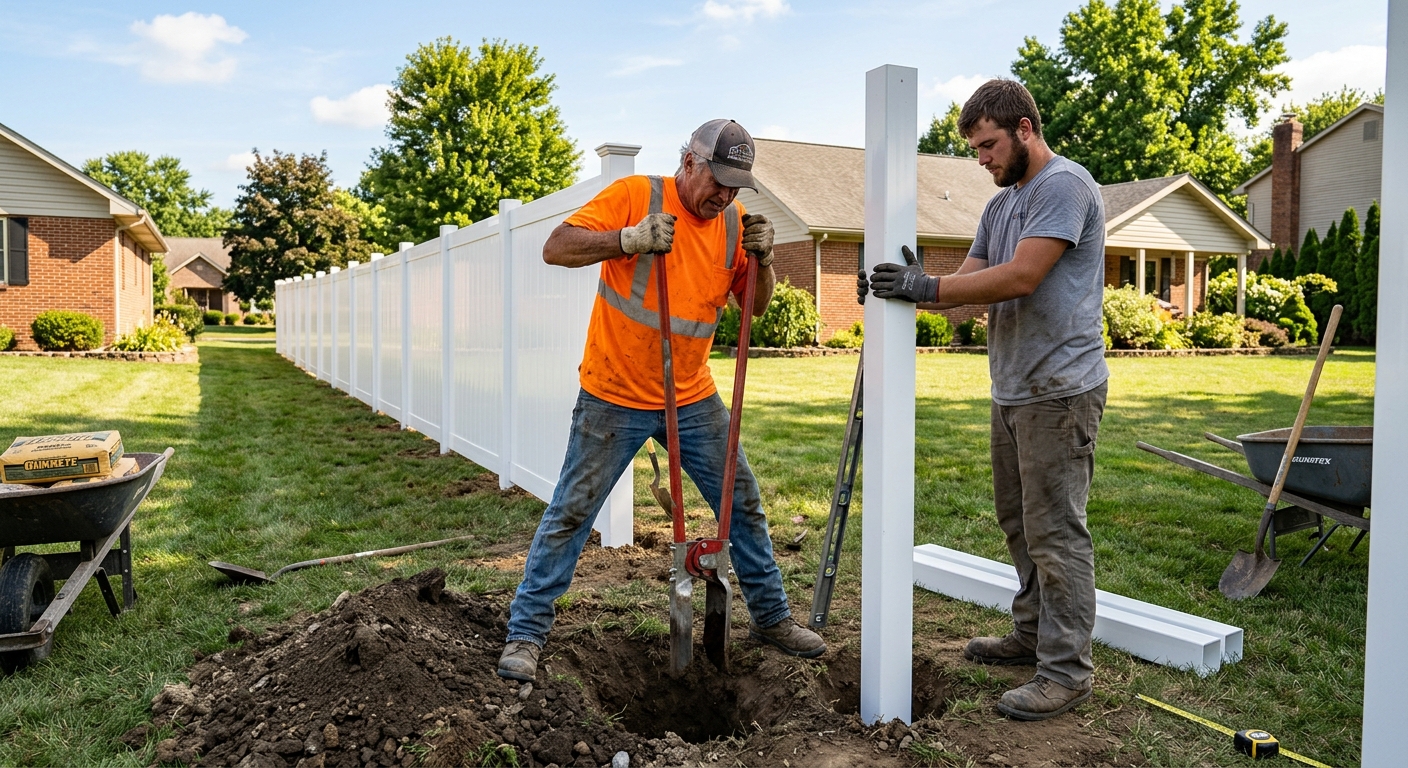
Fencing options and costs in Perth
Perth, Ontario has a mix of older properties and newer infill, and that balance shows up in local fencing demand. With 65.4% of homes built before 1981 (Statistics Canada, 2021 Census), many households are upgrading aging yardscapes, replacing sagging runs, or adding gates for side access. Perth also skews toward homeowners—55.8% of households are owner-occupied (Statistics Canada, 2021 Census)—so there’s steady demand for long-term, “set it and forget it” perimeter solutions.
In the Kingston–Pembroke economic region, fencing pricing is heavily influenced by frost line depth. Contractors typically set posts 36–48 inches deep (about 0.9–1.2 m) and use concrete-set posts for structural sections and gates, especially in clay/silty ground that amplifies freeze–thaw movement. On top of that, access around town (driveways, mature trees, and narrow side yards) can slow down installs and raise the per-foot price, even when the fence is a straightforward straight run. Areas near active neighbourhood pockets such as the downtown/Drummond Street corridor and adjacent residential streets often see faster turnarounds because homeowners want tidy, practical solutions before peak season.
Use the table below as a realistic “installed range” starting point for Perth. Once you confirm height, soil conditions, and whether you need gate hardware and disposal, your quote usually tightens to a narrower band.
| Material |
Lifespan |
Maintenance |
Privacy Rating |
Price per Linear Foot |
| Pressure-treated pine (standard wood) |
10–15 years |
Stain/seal every 2–3 years |
High (solid/close pickets) |
$55–$95 |
| Cedar (natural rot resistance) |
15–25 years |
Light stain/oil every 2–4 years |
High (solid/close boards) |
$65–$115 |
| Vinyl / PVC (no-maintenance) |
20–30 years |
Wash as needed |
High (solid privacy panels) |
$75–$140 |
| Chain-link (galvanized steel) |
20–35 years |
Occasional tension check |
Low (open mesh) |
$40–$80 |
| Aluminum ornamental |
30–40 years |
Wash as needed |
Low–Medium (openwork) |
$80–$160 |
| Composite / recycled material |
25–35 years |
Wash; limited touch-up |
Medium–High (solid boards) |
$95–$175 |
Prices are estimates only and vary by project scope, site access and material selection.
What affects the price of fencing in Perth
Even when two homeowners request the same “6 ft privacy fence,” quotes in Kingston–Pembroke can differ by 30–50% because the big cost drivers are site-specific: post depth, soil type, access for delivery/equipment, and whether gates and fence sections need reinforced framing. In Perth, older home lots often have mature landscaping and established walkways that make it harder to track straight lines or dig without careful handwork. Meanwhile, some properties have clay/silty ground where water retention increases freeze–thaw movement, so we plan for deeper holes and more robust post setting to reduce heaving.
Frost line depth is usually the first pricing conversation. Contractors account for the fact that posts must sit below the design frost depth—commonly by 4–6 inches—so in cold Ontario conditions posts are often set around 1.5–2.0 m into the ground with concrete. That raises material cost (longer posts) and labour (auger time, concrete, and extra alignment work). Wind exposure matters too: while Perth isn’t as harsh as the most exposed Prairie or coastal sites, sections nearer Lake Ontario and the Bay of Quinte can see strong gusts, so taller privacy fences may need tighter post spacing and sturdier rails.
Two practical examples: (1) If your yard has clay pockets that hold water, the same cedar or pressure-treated run can land at the upper end of the wood band—pushing toward $55–$95 per linear foot—because we use deeper holes and more concrete. (2) If you upgrade to vinyl/PVC, you may still need reinforced sections for gates, so the price moves from a “starting” view toward the upper part of $75–$140 per linear foot. Housing age also plays a role: older fences in pre-1981 neighbourhoods may include non-standard post locations, requiring removal and careful property line confirmation—adding labour and disposal.
| Price Factor |
Why It Matters |
Cost Impact |
| Fence length in linear feet |
The primary driver; most components scale directly with footage. |
Usually the biggest swing (commonly 40–70% of total cost). |
| Post depth required |
Frost line determines hole depth and post length to prevent heaving. |
Can add 10–25% with deeper concrete-set requirements. |
| Post setting method |
Concrete-set posts cost more than gravel pack; driven posts vary by soil. |
Often a 5–20% difference depending on ground conditions. |
| Material choice |
Vinyl/PVC and composite cost more than standard wood or chain-link. |
Typical range shift: wood (mid) to vinyl (higher) per foot. |
| Gate count and type |
Drive-through/double gates need heavier frames and hardware. |
Often adds 15–40% depending on gate size and reinforcement. |
| Grade and terrain |
Sloped yards require stepped panels or raked sections. |
May increase labour and material (often 5–15%). |
| Old fence removal and disposal |
Removal, hauling, and recycling/landfill fees vary by material. |
Can add 5–25% (higher with heavy embedded posts). |
| Permit fees and survey / property line locate |
Line-fence clarity reduces encroachment disputes and rework. |
Typically a smaller but meaningful add-on (5–20%). |
Permits & regulations in Ontario
In Ontario, permits depend on fence height and location. As a homeowner in Perth, the key threshold to plan around is that taller fences—often those above about 2.0 m (6.5 ft) at the rear and around 1.0–1.2 m (3–4 ft) at the front or corner—may require a building permit (and can also trigger additional local requirements). Even when a permit isn’t required, every fence must respect property lines and municipal setback bylaws. If you’re in a neighbourhood with older lot layouts, it’s especially worth confirming the line before you dig: buried utility corridors and offset pins are common in mature subdivisions.
Before digging any post hole, call for utility locates (Ontario One Call). Then verify your property pins: if you don’t already have a recent survey, ask for a property line locate so you’re not building on easements or encroaching on a neighbour. Shared fence ownership is handled through Ontario’s line-fences framework, so if your fence will land on or near a boundary, it’s smart to clarify responsibilities early.
What typically requires a permit: fence heights above the local “taller barrier” thresholds (especially rear/side) and any structure that changes the character or adds significant height. What typically does NOT: replacing the same fence height and material within the common residential ranges, where a neighbour-friendly, in-kind swap stays within setbacks and property line rules—though your contractor should confirm your exact situation.
To verify a contractor, confirm their Ontario registration (through the relevant provincial/municipal business registry listings), request a current certificate of insurance showing liability coverage, and ask for WSIB coverage status (or WCB clearance where applicable). If they can’t provide insurance details or clearance in writing, treat it as a major red flag.
Choosing the right fence material for Perth
Choosing the right fence material in Perth comes down to matching the product to your priorities—privacy, low maintenance, budget, and how long you want to avoid repairs. In Ontario’s freeze–thaw seasons, the post foundation matters as much as the cladding, so if your goal is durability, you want concrete-set posts where soil and frost depth require it (and reinforced framing at gates).
Pressure-treated pine is the budget-friendly option, but it typically needs staining or sealing every 2–3 years to prevent grey weathering and keep the surface protected. Cedar offers better natural rot resistance and a warmer look; it still benefits from periodic staining/oiling to extend appearance life. Vinyl/PVC is popular for low-maintenance yards—wash and move on—but extreme cold can be harsher on components if they’re installed too tightly without proper expansion allowance. Chain-link is the lowest-cost and longest-life perimeter solution, but it won’t deliver privacy unless you add slats or plant screening. Aluminum ornamental provides a clean, rust-resistant look; it’s usually mid-range on pricing but not a privacy solution on its own. Composite/recycled boards sit at the higher end and can be a great “wood-like” choice if you want fewer upkeep tasks.
In Kingston–Pembroke, we plan posts to sit below frost movement, often meaning deeper concrete-set installation around 1.5–2.0 m in colder conditions. That’s why the price gap between materials can be justified: you might pay roughly the wood band (for example, $55–$95 per linear foot for pressure-treated) but spend more upfront for vinyl in the $75–$140 per linear foot range when you want reduced upkeep across multiple winters. Wind gusts near the broader Great Lakes influence can also affect tall privacy installations, so tighter rails and post spacing are often required for 6–8 ft privacy fences, regardless of whether you choose wood or vinyl.
| Material |
Cold Tolerance |
Lifespan |
Annual Maintenance |
Best For |
Price Band |
| Pressure-treated pine |
Good (with proper post depth and top-surface protection) |
10–15 years |
Light inspection; stain/seal every 2–3 years |
Budget privacy where you’re okay with periodic upkeep |
$55–$95 |
| Cedar |
Good (holds up well through freeze–thaw when installed correctly) |
15–25 years |
Wash/inspect; stain/oil every 2–4 years |
Appearance-focused privacy with better rot resistance |
$65–$115 |
| Vinyl / PVC |
Good (allow for expansion; keep fastening within spec) |
20–30 years |
Wash as needed; check posts and hardware |
Low-maintenance privacy for busy homeowners |
$75–$140 |
| Chain-link |
Excellent (steel frame and bracing) |
20–35 years |
Occasional tension checks; touch up coating if needed |
Security and pets/yard definition |
$40–$80 |
| Aluminum ornamental |
Excellent (non-rusting frame) |
30–40 years |
Wash as needed |
Front-yard curb appeal with light security |
$80–$160 |
| Composite / recycled |
Very good (board stability with correct framing) |
25–35 years |
Wash; check hardware after winter |
Wood-like look with reduced upkeep |
$95–$175 |
How to choose a fencing contractor in Perth
When you hire a fencing contractor in Perth, verifying Ontario coverage and doing an apples-to-apples quote comparison matters more than chasing the lowest number. First, confirm the contractor’s business registration in Ontario and ask for liability insurance—the certificate should list the right insured entity and show coverage adequate for outdoor work. Next, request their WSIB/WCB clearance details (or a clearance letter, depending on their coverage status). You can also ask them to provide evidence that subcontractors, if any, are covered as well. If they won’t supply documents or show you how to verify them, that’s a major warning sign.
Get 2–3 itemised written quotes that break out labour and materials: post type and depth, rail and panel construction, gate hardware, concrete quantity (if applicable), and whether there’s disposal/hauling for old fence removal. Make sure the quote states what’s excluded (rock excavation, underground obstructions, extra height changes, or permit/survey responsibility). Warranty terms should be clear: separate workmanship warranty (how long they stand behind installation) and product/manufacturer warranty (what the material covers). Also ask if warranty is transferable when you sell your home.
For payments, follow a practical rule: never pay more than 10–15% upfront. Hold back the remainder until the job is complete and any punch list items are resolved. Finally, insist on a written timeline that includes a start date and a completion estimate based on weather and access.
- Provide proof of liability insurance (certificate of insurance) before work starts.
- Provide WSIB/WCB clearance or status in writing.
- Quote itemises post depth, concrete setting, and gate reinforcement details.
- Specifies material grade (e.g., pressure-treated rating) and fastening method.
- Confirms property line approach (survey pins/locate) and setback awareness.
- States who pulls permits if required and whether it’s included in the price.
- Includes disposal/hauling of removed fence and hardware.
- Includes a clear warranty split: workmanship vs manufacturer.
- Sets payment schedule with no more than 10–15% upfront.
- Includes a written start date and completion window.
- Shows how they handle rock, roots, or access issues (coring/hand-digging options).
- Explains how they address sloped yards (stepped vs raked panels) in the scope.
Red flags specific to fencing installs in Perth: (1) quotes that don’t state post depth or whether posts are concrete-set, (2) “lump sum” pricing with no gate hardware or disposal line item, (3) refusal to provide insurance/WSIB clearance documents, (4) no workmanship warranty terms in writing, and (5) pushing for large upfront payments or avoiding a written completion schedule.
Frequently asked questions — fencing in Perth
How long does fence installation take in Perth?
In Perth, most standard residential fence installs take about 1 to 3 days once materials are on site, but the timeline depends heavily on how many posts must be set below frost movement and whether you have gate assemblies. A straight run with no removal can move quickly, while lots with mature trees, uneven access, or buried obstructions often add time because we may need handwork or careful alignment. If your project includes old fence removal and concrete anchors, plan extra time for dismantling and disposal. For typical homeowner updates, you can often expect scheduling that’s weather-aware; freeze–thaw conditions can slow excavation when ground is hard or waterlogged, especially on clay-heavy sections.
Can I install a fence on a slope in Perth?
Yes—many Perth yards are sloped, and fences are commonly installed using stepped or raked panels so the top stays level (or the boards follow the grade in a controlled way). The right approach depends on the fence type and how much height change exists across the run. For privacy fences, stepped construction usually looks cleanest, while some board styles can be raked for a smoother transition. In Kingston–Pembroke conditions, proper layout matters because frost movement can exaggerate unevenness if posts aren’t set to consistent depth. Your contractor should also plan the post depth and concrete setting method to keep the fence stable through Ontario winters and spring thaw.
What is the most weather-resistant fence for Perth's climate?
For Perth’s freeze–thaw Ontario seasons, the most weather-resistant options usually combine sturdy post foundations with durable cladding. Vinyl/PVC is a strong low-upkeep choice for many homeowners; it typically falls in the $75–$140 per linear foot range installed and can handle repeated winters with minimal surface deterioration. Cedar can also be very durable, especially when posts are installed below frost movement and the wood is treated/maintained; it’s often priced between the wood mid-range and higher end depending on grade. Chain-link is extremely resilient in harsh weather and can last decades, but it won’t provide privacy unless upgraded with slats or screening. Regardless of material, correct post depth and reinforced gate sections are what prevent the early failures most people notice after winter.
How do I prevent wood fence rot in Perth?
Wood rot prevention starts at the base: posts must be set correctly and protected from trapped moisture at ground level. In Perth and across the Kingston–Pembroke area, that means planning for deeper holes and appropriate concrete setting where required so the post stays stable through freeze–thaw movement. For the boards, choose quality material (pressure-treated pine or cedar) and ensure the design sheds water—good spacing at the pickets and avoiding direct ponding reduces breakdown. Maintenance matters too: pressure-treated pine generally needs staining or sealing every 2–3 years to avoid grey weathering and moisture penetration. Cedar typically needs periodic oil/stain to protect its surface. If your existing fence is already soft near the bottom, replacement is often more cost-effective than patching a few boards because hidden rot may extend below the visible area.
What is the cost per linear foot for fencing in Perth?
In Perth, installed pricing generally aligns with Ontario’s material bands, but site conditions can push you toward the higher end. As a quick guide: chain-link commonly lands around $40–$80 per linear foot, pressure-treated wood around $55–$95 per linear foot, and vinyl/PVC around $75–$140 per linear foot. Aluminum ornamental often ranges from $80–$160 per linear foot depending on design density. The biggest swing factors are fence length, post depth requirements for frost movement, gate hardware, and whether rock or heavy clay forces more labour. If you’re comparing quotes, ask each contractor to show post depth, concrete setting, and what’s included in gate reinforcement so you’re comparing like-for-like.
Should I repair or replace my old fence in Perth?
Repairing can make sense when the fence is mostly sound—solid posts, good rail attachment, and only minor board damage. Replacement is usually the better option when posts have loosened, bases are rotting/soft, or the fence has significant sag from post movement after winter freeze–thaw cycles. In Perth, many older lots (with a larger share of homes built before 1981) have fences installed under older material and fastening practices, so what looks “fixable” sometimes hides deeper structural issues. A practical approach: get an on-site assessment that checks post stability (not just top rails), gate alignment, and how far damage has penetrated. If the fence removal and re-posting cost is close to a repair, replacing can reduce recurring maintenance and give you a cleaner, more reliable boundary for the next couple of decades.