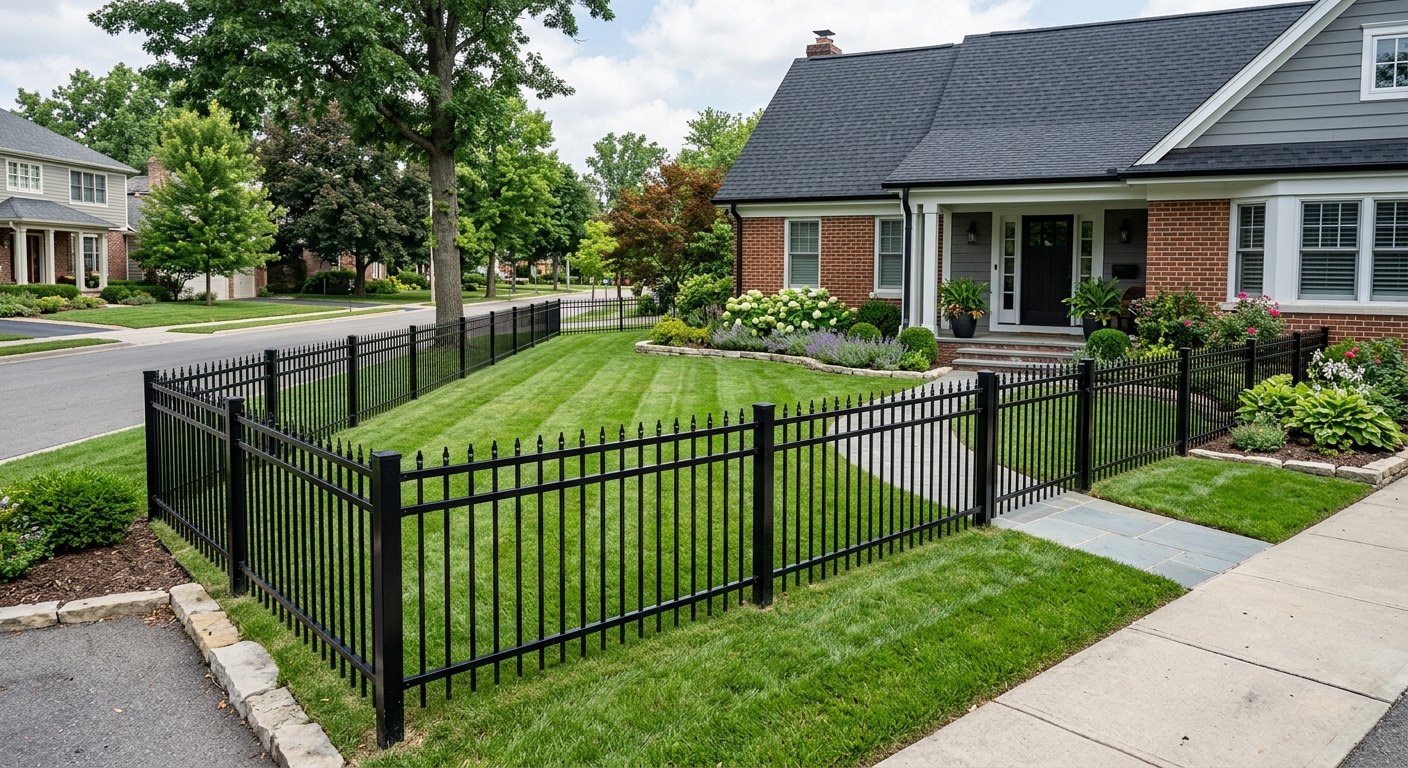
Fencing options and costs in St. Marys
Fencing in St. Marys ranges from simple, budget-friendly boundaries to full privacy systems—most homeowners shop based on how long the fence will last through Ontario winters and how much maintenance they’re willing to do. With 2,535 homeowner households in the area (81.0% of households own) and a housing stock where single-detached homes make up 69.8% of dwellings, demand tends to be steady: every detached property is a potential fencing project. (Statistics Canada, 2021 Census)
In the Stratford–Bruce Peninsula region, the big cost driver is frost depth. Posts must be set deep enough to sit below winter heaving, which means longer materials and more labour for excavating and concrete setting. That same frost requirement pushes even “mid-range” wood and metal jobs upward compared with locations that allow shallow, non-frost installations. Wind exposure also plays a role: while St. Marys isn’t the prairies, open farm-field edges and wider lots can create more lateral load than a sheltered urban backyard, so contractors may tighten spacing or upgrade hardware.
Trade activity is especially common around neighbourhoods with older housing stock—around the downtown and established residential pockets where many homes were built before 1981 (54.2%). Those lots often have ageing rails, sagging posts, or partial fences that need rebuilding in sections, not just a fresh run. From there, it’s an easier comparison to look at material lifespan, maintenance, and typical per-foot pricing.
| Material |
Lifespan |
Maintenance |
Privacy Rating |
Price per Linear Foot |
Price Range |
| Pressure-treated pine (standard wood) |
10–15 years |
Stain/seal every 2–3 years; inspect posts for looseness |
Good (solid panels) |
$55–$85 |
$55–$85 |
| Cedar (natural rot resistance) |
15–25 years |
Light sealing or oil stain every 2–3 years; keep bottoms clear of standing water |
Good (solid panels) |
$75–$105 |
$75–$105 |
| Vinyl / PVC (no-maintenance) |
20–30 years |
Occasional rinse; check for panel warping after extreme cold snaps |
Very good (solid privacy styles) |
$75–$115 |
$75–$115 |
| Chain-link (galvanized steel) |
20–35 years |
Occasional tightening; wash off debris |
Low (security only; no privacy unless upgraded) |
$35–$55 |
$35–$55 |
| Aluminum ornamental |
25–40 years |
Wash annually; touch up hardware if needed |
Low to moderate (ornamental pickets) |
$90–$150 |
$90–$150 |
| Composite / recycled material |
20–30 years |
Low—wash periodically; avoid abrasive cleaners |
Very good (privacy boards) |
$85–$130 |
$85–$130 |
Prices are estimates only and vary by project scope, site access and material selection.
What affects the price of fencing in St. Marys
In St. Marys (and the wider Stratford–Bruce Peninsula region), two quotes for the same fence style can still swing by 30–50%. The reason is that fencing pricing is strongly tied to ground conditions and installation method—not just the fence material. In older neighbourhood pockets—where many lots have mature trees, uneven grade, and existing fence remnants—contractors often spend extra time on excavation, post alignment, and safe removal. When the crew also has to work around driveways, sidewalks, or narrow gates, labour time increases quickly.
Most of that variation comes from frost and wind. Frost depth is the cost lever because posts must be set about 4–6 inches below the design frost depth to prevent heaving. Practically in Southern Ontario, that often translates to setting posts roughly 0.9–1.2 m (3–4 ft) deep, frequently with concrete footings; that means longer posts, more concrete, and more labour. Wind exposure is the second driver: open farm-field edges or wider yards can increase lateral load, so contractors may tighten post spacing and use sturdier rails—especially for privacy wood or vinyl that behaves like a sail.
Here are concrete St. Marys examples contractors see. If your fence line runs through clay or mixed soils, excavations can widen and require more concrete to stabilize posts, pushing wood from the lower end of the $55–$85 band toward the upper end. If you’re adding a second run near a corner where gusts hit hard, hardware upgrades can nudge vinyl/ PVC closer to $75–$115. On the other hand, a sheltered backyard on firm, sandy fill may allow faster excavation and slightly lower labour time for comparable footage.
Finally, the housing age matters: lots in neighbourhoods with older fences (and posts that have settled) often require partial removal and re-setting, which adds disposal and alignment labour even before you buy the new boards.
| Price Factor |
Why It Matters |
Cost Impact |
| Fence length in linear feet — the primary cost driver |
More footage means more posts, rails, fasteners, and labour hours |
Major; scales project total directly |
| Post depth required — frost line determines post length and hole depth |
Deeper holes increase excavation time and concrete volume; prevents heaving |
Major; one of the biggest swings between quotes |
| Post setting method — concrete vs. gravel pack vs. driven posts |
Concrete-set posts resist movement better in freeze/thaw and mixed soils |
Medium to major depending on soil and design |
| Material choice — vinyl vs. cedar vs. chain-link |
Different product costs and different rail/post sizes needed for stiffness |
Medium; can shift you between bands |
| Gate count and type — walk-through vs. drive-through (double) |
Gates require stronger frames, hinges, latches, and often wider posts |
Medium; can add significant add-ons |
| Grade and terrain — sloped yards require stepped or raked panels |
Slopes affect layout, custom cuts, and longer install time |
Medium; often overlooked in quick quotes |
| Old fence removal and disposal |
Extra labour for tear-out, stump/footing removal, and hauling |
Medium; can materially change the total |
| Permit fees and survey / property line locate |
Complex property edges may need formal locating before digging |
Low to medium; spikes if disputes or unclear lines |
Permits & regulations in Ontario
In Ontario, fence rules can depend on your municipality and property type, but the common practical threshold is height: fences above roughly 2.0 m (6.5 ft) at the rear and about 1.0–1.2 m (3–4 ft) at the front or corner often trigger a building permit requirement. Regardless of height, you must respect property lines and municipal setback bylaws. If a fence will straddle or appear close to a boundary, confirm the exact location before any post digging.
Before you dig a single post hole, arrange utility locates using Ontario One Call (or your provider’s equivalent process). This is non-negotiable for safety and to avoid costly service interruptions. For boundary accuracy, many homeowners also choose a survey or at least a property line locate by confirming your pins/markers—especially if you inherited an older fence line that may not reflect the current lot boundary. For shared fence ownership, provincial line-fences legislation governs responsibilities where fences are shared along boundaries.
How to verify your contractor before work starts: check their Ontario licence status through the appropriate Ontario consumer/professional registration listing used for their specific trade category (availability varies by trade type), confirm liability insurance with a current certificate of insurance showing your jobsite address, and verify WSIB coverage (coverage may be WCB-like depending on contractor setup). Ask for a clearance letter or proof of account clearance; don’t rely on verbal confirmation. Then request everything in writing—scope, heights, and the permit handling process.
Choosing the right fence material for St. Marys
Choosing the right fence material in St. Marys is mostly about balancing privacy, maintenance comfort, and how well the product handles Ontario’s freeze/thaw. Pressure-treated pine is the entry option, but it typically needs staining or sealing about every 2–3 years to avoid heavy grey weathering and to protect end grain where moisture collects. Cedar offers better natural rot resistance and usually looks warmer and cleaner for longer, but it still benefits from periodic sealing. Vinyl/PVC is popular because it’s genuinely low-maintenance—no yearly staining—but in extreme cold it can be more sensitive to installation details like proper spacing and fastening method.
For security-only needs, chain-link is the lowest upfront cost and has long service life, but it won’t provide privacy without an add-on screen or privacy slats. Aluminum ornamental fencing is rust-resistant and can last decades, yet it’s typically more of a “definition” fence than a privacy fence. Composite/recycled boards are often a strong compromise: low maintenance with better privacy coverage than ornamental styles, and good stability when installed on properly set posts.
Post depth still matters no matter what you pick. In the Stratford–Bruce Peninsula frost environment, contractors typically set posts around 0.9–1.2 m (3–4 ft) deep to sit below winter frost effects, and in many residential projects they use concrete-set posts to prevent movement. That’s why a “cheap” fence can cost more than expected if your soil needs full concrete setting.
As a dollar example, a homeowner may see pressure-treated wood near $55–$85 per linear foot, while switching to vinyl can move the budget toward $75–$115 per linear foot. The extra cost is justified if you want to eliminate staining labour for years and prefer a more uniform look—particularly useful for older lots where you’d otherwise be maintaining end grain and rail joints frequently.
| Material |
Cold Tolerance |
Lifespan |
Annual Maintenance |
Best For |
Price Band |
| Pressure-treated pine |
Good (with proper staining and post protection) |
10–15 years |
Seal/stain seasonally every 2–3 years; inspect fasteners |
Lowest upfront cost with acceptable upkeep |
$55–$85 |
| Cedar |
Very good (naturally rot-resistant) |
15–25 years |
Light sealing or oil stain every 2–3 years |
Attractive look + longer natural resistance |
$75–$105 |
| Vinyl / PVC |
Good (best with correct expansion/fastening) |
20–30 years |
Minimal—rinse/wash; check for panel alignment |
Low maintenance and consistent privacy panels |
$75–$115 |
| Chain-link |
Good (galvanized steel performs well) |
20–35 years |
Low—tighten and wash off debris |
Security, pets, and budget boundary fencing |
$35–$55 |
| Aluminum ornamental |
Very good (rust-resistant in freeze/thaw) |
25–40 years |
Minimal—annual wash and hardware check |
Front-yard curb appeal with open visibility |
$90–$150 |
| Composite / recycled |
Good (stable boards; depends on post quality) |
20–30 years |
Low—periodic cleaning, avoid harsh abrasives |
Privacy with low maintenance |
$85–$130 |
How to choose a fencing contractor in St. Marys
Choosing the right fencing contractor in St. Marys starts with proof. In Ontario, fencing work should be covered by liability insurance and the contractor should have WSIB coverage (where applicable for their employment setup). How to check: (1) ask for a current certificate of insurance and confirm the policy is active and that the certificate lists liability coverage; (2) request WSIB clearance/coverage proof before work begins; and (3) verify they are properly registered for the specific trade activity they’re performing (use Ontario’s applicable business/consumer registry and any trade-specific listings).
Next, get 2–3 itemised written quotes. A good fence quote separates labour and materials (posts, rails, fasteners, concrete, gates, removal, and disposal), rather than lump-summing everything. Confirm whether permits are included or whether you’re responsible for them. For job accuracy, ask if post holes include frost-depth depth, whether concrete setting is assumed, and whether grade breaks on sloped yards are handled by stepping or raking panels.
Look for clear warranty terms: workmanship warranty length (often tied to years), product/manufacturer warranty duration, and whether it’s transferable to you if you sell the home. On payment schedule, never pay more than about 10–15% upfront; use a holdback until the fence is complete and cleaned up. Finally, require a start date and completion estimate in writing, including weather-related contingency language.
- Provide an itemised quote (labour + each material line item, not just totals)
- State post depth plan and whether concrete-set posts are included
- List the post spacing and rail specs for your fence height and wind exposure
- Confirm gate hardware brand/type and whether gates are included in the linear footage
- Specify removal scope: old fence tear-out, hauling, and disposal fees
- Clarify who handles permits (and whether permit fees are included)
- Show a project timeline with start and completion dates
- Provide product warranty and workmanship warranty in writing
- Request proof of liability insurance (certificate with active dates)
- Request WSIB clearance proof (or equivalent coverage proof)
- Ask how they verify property lines (survey/locate, pin confirmation)
- Require payment schedule terms and a holdback until final walkthrough
In St. Marys, common red flags include quotes that omit post-depth and concrete setting details, contractors who won’t show insurance/WSIB proof, vague “all-in” pricing with no line items for gates or removal, requests for large upfront payments, and promises of “same-day permits” without explaining responsibility for municipal approvals.
Frequently asked questions — fencing in St. Marys
What is the most weather-resistant fence for St. Marys's climate?
For St. Marys and Southern Ontario freeze/thaw, the most consistently weather-resistant option is often a vinyl/PVC privacy fence on properly frost-set posts, or a well-installed cedar fence with correct sealing. The reason isn’t just the surface material—it’s the installation. Posts typically need to be set below frost influence (commonly around 0.9–1.2 m / 3–4 ft with concrete footings in residential work) so panels don’t heave and lean after winter. Cedar also performs well because it resists rot naturally, but it still needs periodic sealing to protect exposed grain. If your goal is durability with minimal maintenance, vinyl around $75–$115 per linear foot is a popular long-life choice in the St. Marys market.
How do I prevent wood fence rot in St. Marys?
To prevent wood rot in St. Marys, focus on three weak points: post bases, wet end grain, and airflow. Use pressure-treated lumber rated for ground contact (or cedar where appropriate) and make sure the lowest wood isn’t trapped in standing water or buried too shallowly above grade. Ensure posts are set at the proper depth for frost stability; otherwise, heaving opens gaps and lets moisture sit longer at the fasteners. For aesthetics and durability, stain/seal on a schedule (often every 2–3 years) and keep sprinklers from wetting the fence regularly. If your existing fence is rotting at the bottom rails, that usually means water is pooling—grading adjustments or toe clearance can help before you replace.
What is the cost per linear foot for fencing in St. Marys?
Typical residential pricing in St. Marys falls within material-based bands, with frost-depth post installation included. For wood fences, homeowners often budget roughly $55–$85 per linear foot depending on whether posts are concrete-set and how much removal is required. Vinyl/PVC commonly lands around $75–$115 per linear foot, while chain-link tends to be the lowest at about $35–$55. Aluminum ornamental is usually higher, around $90–$150, because it’s a stronger, more rigid system with more hardware and often a more labour-intensive install. If you’re quoted far outside these ranges, ask what’s included (post depth, concrete, gates, disposal, and permits).
Should I repair or replace my old fence in St. Marys?
Repair vs. replace depends on how widespread the damage is. If rot is limited to a few boards and the posts are still solid (no wobble, no heaving, and the bottom fasteners aren’t pulling out), targeted repair can make sense. Replacement is usually the better value when you see multiple failing posts, sagging sections that indicate footing movement, or repeated panel replacements because the original post depth or alignment was compromised. In St. Marys, many older fences in established neighbourhoods can be affected by freeze/thaw movement and water pooling near foundations and downspouts. If your fence line includes frequent replacements, adding the cost of long-term maintenance may outweigh the initial repair savings.
How do I handle a fence dispute with a neighbour in Ontario?
In Ontario, fence disputes are usually about boundaries, responsibility for shared fencing, or who has the right to modify the line. Start by verifying the exact property line: use your survey (or request a professional property line locate) rather than relying on the existing fence, which may have drifted over time. Document everything with photos, measurements, and written notes. If the dispute is about shared fence responsibility, Ontario’s line-fences rules generally govern shared boundary obligations. It’s often helpful to propose a practical compromise in writing—like splitting material costs and agreeing on the installation method—then keep communications calm and factual. If the neighbour is not cooperative, consider mediation or legal advice before digging post holes.
What fence style offers the best wind resistance in St. Marys?
In St. Marys, “best wind resistance” is usually about reducing sail effect while keeping the structure rigid. Solid privacy fences (especially boards or panels) can catch more lateral wind load, so durability comes from correct engineering details: tighter post spacing, heavier rails, and sturdy gate hardware. A properly installed wood or vinyl privacy fence can handle wind well when posts are frost-set and the top/bottom rails are secured to prevent racking. If your yard is more exposed near open areas, ask contractors about reinforcing the corners, using stronger posts at high-load points, and specifying appropriate hardware. Ornamental aluminum and chain-link generally allow more airflow and can experience less pressure, but they don’t provide the same privacy coverage.