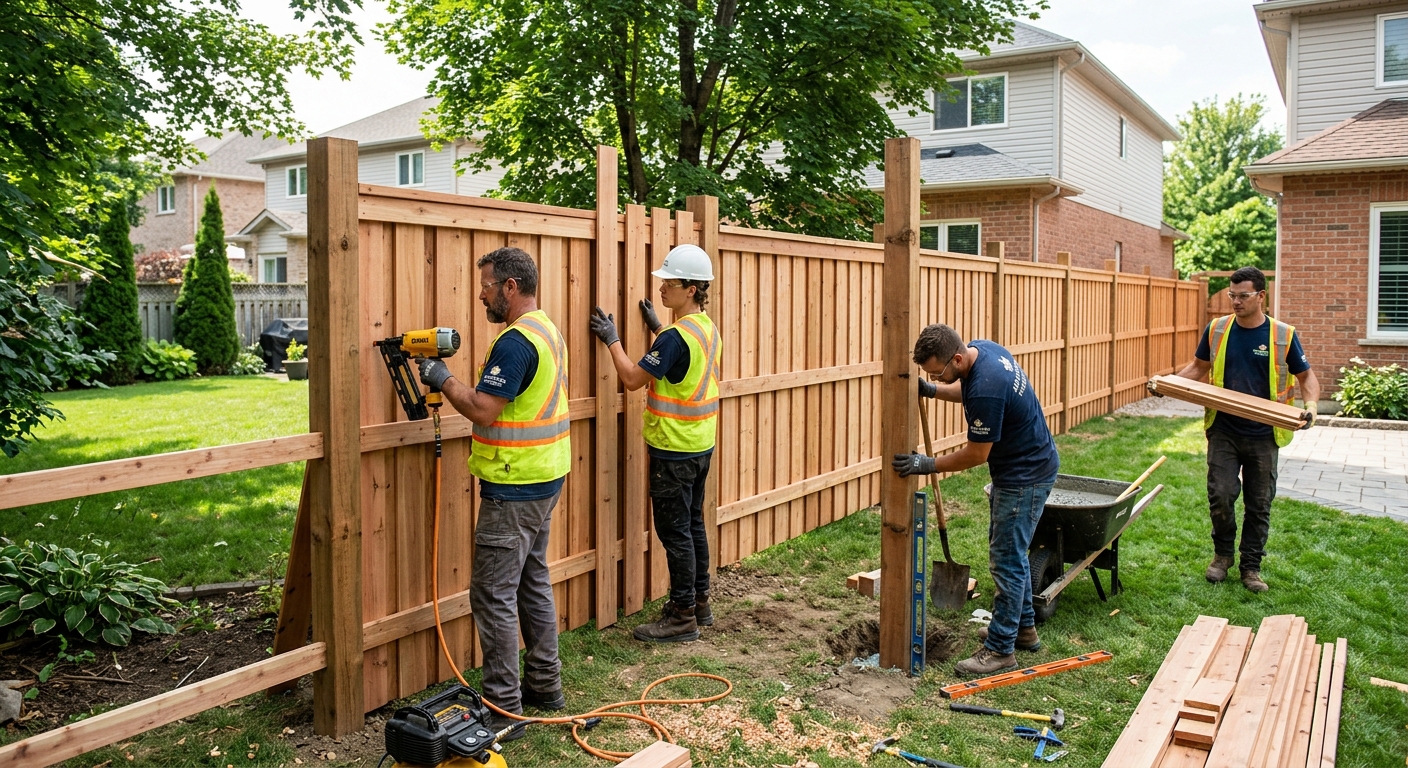
Fencing options and costs in Orillia
Orillia is a growing lake-and-lawn community, and for many homeowners the right fence is about privacy, curb appeal, and keeping pets and kids in safe boundaries. With 55.7% of local dwellings being single-detached homes and 61.2% of households owning their property (Statistics Canada, 2021 Census), there’s steady demand for backyard privacy fencing and side-yard security. You’ll also notice that most Orillia areas built before 1981 have older fences and mature landscaping, so new installs often include post replacement and careful layout around established features.
In the Kitchener–Waterloo–Barrie region, pricing is strongly shaped by Ontario’s freeze–thaw cycles. Contractors generally plan for deeper, concrete-set posts to reduce frost heave, especially for common 6 ft privacy fences—meaning more excavation, more concrete, and longer fence posts than in milder climates. Availability and pricing can also vary as the region alternates between busy spring installs and fall work when soil is easier to dig but contractors are managing longer backlogs.
In Orillia, the trade is especially busy around neighbourhoods like Wishing Well Drive and the West Ridge area, where many properties have open yards and frequent requests for taller privacy panels that hold up to wind-driven snow and spring storms. Use the comparison below to sanity-check typical options before you request quotes.
| Material |
Lifespan |
Maintenance |
Privacy Rating |
Price per Linear Foot |
Price Range |
| Pressure-treated pine (standard wood) |
10–15 years |
Stain/seal every 2–3 years |
High (solid panels) |
$18–$28 |
$45–$70 |
| Cedar (natural rot resistance) |
15–25 years |
Light wash/seal every 3–4 years |
High (solid panels) |
$22–$34 |
$55–$85 |
| Vinyl / PVC (no-maintenance) |
20–30 years |
Occasional rinse only |
High (privacy styles) |
$25–$40 |
$55–$90 |
| Chain-link (galvanized steel) |
20–35 years |
Minimal (check tension/fasteners) |
Low (security only) |
$14–$22 |
$35–$60 |
| Aluminum ornamental |
25–40 years |
Rinse; touch up occasional paint |
Medium (decorative pickets) |
$26–$45 |
$60–$110 |
| Composite / recycled material |
20–30 years |
Minimal (wash as needed) |
High (privacy boards) |
$26–$42 |
$65–$105 |
Prices are estimates only and vary by project scope, site access and material selection.
What affects the price of fencing in Orillia
In Orillia and across the wider Kitchener–Waterloo–Barrie area, two “similar” fence jobs can land 30–50% apart because the real cost drivers aren’t just the material. They’re how many posts you need, how deep they must go, how difficult the soil is to dig, and what’s required to keep the fence straight on a residential-grade lot. Even within the same city, older lots can have roots, buried services, and uneven boundaries that add labour.
Frost depth is the big Ontario factor. In this region, contractors typically set posts about 4–6 inches below the design frost depth to help prevent heaving. Practically, that usually means posts are placed roughly 1.5–2.0 m into the ground, with concrete-set posts becoming the standard for most wood, vinyl, and aluminum installations—especially for 6 ft privacy fences where wind stress and racking forces are higher. That’s why a wood privacy run often lands in the $45–$70 band, while vinyl and PVC privacy can push toward the $55–$90 band.
Concrete examples that change your cost in Orillia: (1) wet or clay-heavy soil can slow excavation and increase concrete volume for stable footing; (2) sandy patches may dig easier but can require more concrete consolidation for secure alignment; (3) properties with mature trees often need careful hole placement and sometimes additional time to avoid roots. Longer fence lines also amplify every other cost—so a 60 ft backyard upgrade can feel “reasonable,” while 120 ft side-yard and back-yard runs often see pricing climb quickly due to added labour per post and per gate.
| Price Factor |
Why It Matters |
Cost Impact |
| Fence length in linear feet |
The more linear footage, the more posts, rails, and hardware you need. |
Highest cost driver; can dominate the full quote. |
| Post depth required |
Frost line determines how deep holes must be dug to prevent heaving. |
Deeper posts increase excavation time and concrete quantity. |
| Post setting method |
Concrete-set posts resist shifting better in Ontario freeze–thaw. |
Concrete generally adds material and labour vs gravel pack. |
| Material choice |
Vinyl/PVC and cedar respond differently to cold and moisture. |
Can shift you between wood-like and higher-upfront bands. |
| Gate count and type |
Gates require heavier frames, more hardware, and accurate alignment. |
Multiple gates can add noticeable labour and cost. |
| Grade and terrain |
Slope requires stepped or raked panel/rail adjustments. |
More labour, extra fittings, and sometimes custom cutting. |
| Old fence removal and disposal |
Removal adds truck time and tipping/disposal costs. |
Can add a substantial line item, especially for large runs. |
| Permit fees and survey / property line locate |
Some tall fences may require permits; locating prevents boundary disputes. |
Varies by project and can add administrative and field time. |
Permits & regulations in Ontario
In Ontario, fence rules are tied to height thresholds and the local municipal bylaw framework. As a homeowner guide, fences above about 2.0 m (6.5 ft) at the rear and 1.0–1.2 m (3–4 ft) at the front or corner often trigger a building permit requirement, depending on where the fence is located on your property. Regardless of height, every fence must respect property lines and applicable setback bylaws.
Before anyone digs post holes, you should call for utility locates (Ontario One Call). Even if your yard “feels” clear, underground services can run through back lanes and side yards. If you can’t see and confirm your boundary pins, obtain a survey or ask for a property line locate so you don’t end up encroaching—fence disputes can turn expensive fast when neighbours argue the line. Shared fence ownership and line-fence responsibilities are handled under provincial line-fences legislation, which is why documenting where the fence sits matters.
What typically DOES require a permit: taller privacy/security fences around the rear that reach the roughly 2.0 m threshold, and any project your contractor flags for height or location. What typically does NOT: standard lower-height decorative fences that stay under the front/corner thresholds and stay within your property limits—though you should still confirm with your municipality for your exact location.
When verifying a contractor for an Orillia project, review three items: (1) Ontario licensing/registration status via the appropriate online registry the contractor lists; (2) liability insurance certificate showing they’re insured for property damage—ask for the certificate and confirm the coverage is current; and (3) WSIB/WCB coverage—request a current clearance letter or proof of account status and keep it with your contract paperwork.
Choosing the right fence material for Orillia
Choosing a fence in Orillia comes down to matching your material to how you use the yard. Most homeowners in detached homes want privacy first, but they also want low hassle during Ontario’s wet spring and cold winters—especially because many Orillia properties were built before 1981 (58.0% of dwellings), which often means older landscaping, established beds, and fence lines that may not be perfectly flat.
Pressure-treated pine is the budget-friendly route. It performs well in Ontario when posts are properly set, but it needs staining or sealing every 2–3 years to avoid grey weathering and to slow surface checks. Cedar offers natural rot resistance and usually looks better longer, but it still benefits from periodic finishing. Vinyl/PVC is popular for low maintenance—rinse and move on—but in extreme cold it can become less forgiving if a fence is installed too tight or without proper expansion allowances. Chain-link is the economical security choice and generally lasts a long time, yet it offers minimal privacy unless you add slats or screening. Aluminum ornamental resists rust and stays attractive, but it’s typically a “decorative security” look rather than full privacy. For winter wind and snow load, the most important factor is still the post depth and panel/rail rigidity—taller privacy fences need sturdier frameworks to reduce racking.
Because Kitchener–Waterloo–Barrie area frost conditions require deeper post placement, concrete-set posts are usually the safe standard for 6 ft privacy regardless of whether you choose wood or vinyl. That means the price difference is often justified by longevity and maintenance needs rather than initial material alone. For example, you might compare a wood privacy option in the $45–$70 range to vinyl in the $55–$90 band: if you hate annual staining and want a “set it and forget it” look, the extra upfront cost can pay off in labour and time.
| Material |
Cold Tolerance |
Lifespan |
Annual Maintenance |
Best For |
Price Band |
| Pressure-treated pine |
Good with concrete-set posts |
10–15 years |
Plan for staining every 2–3 years |
Budget privacy with flexible appearance |
$45–$70 |
| Cedar |
Very good; handles moisture better |
15–25 years |
Light finishing every 3–4 years |
Natural look, higher-end wood feel |
$55–$85 |
| Vinyl / PVC |
Good; needs proper expansion and strong bracing |
20–30 years |
Rinse/clean as needed |
Low maintenance privacy |
$55–$90 |
| Chain-link |
Excellent (galvanized) |
20–35 years |
Minimal; check tension and fasteners |
Security and keeping costs controlled |
$35–$60 |
| Aluminum ornamental |
Excellent; no rust concerns |
25–40 years |
Occasional rinse |
Decorative security |
$60–$110 |
| Composite / recycled |
Good; handles wet winters well |
20–30 years |
Low; wash as needed |
Privacy with reduced wood upkeep |
$65–$105 |
How to choose a fencing contractor in Orillia
In Ontario, a solid fence quote starts with proof the contractor is set up to do the work safely and legally. For an Orillia installation, verify: (1) Ontario licensing/registration status—ask for their business details and check the online registry listed in their contract or advertising; (2) liability insurance—request a current certificate of insurance and confirm it names the correct insured parties; and (3) WSIB/WCB coverage—ask for a clearance letter or proof of account status before work begins. Don’t accept “we’re covered” without documents you can review.
Next, require 2–3 itemised written quotes. You want labour and materials broken out (posts, rails, panels/boards, concrete, hardware, gates, and any removals), not one lump-sum number. Read the scope carefully for exclusions: is the permit pull included if the fence meets the height threshold? Is old fence removal and disposal included, or is it “haul away by owner”? Does the quote include a property line locate/survey, or is that on you? A good contractor spells out what happens if they hit roots, buried services, or soil conditions that make post holes more difficult.
On warranty, distinguish between workmanship and product. Ask how long the workmanship warranty lasts and whether it’s transferable to future owners. Confirm the payment schedule: never pay more than about 10–15% upfront, and hold back a portion until the fence is complete, straight, and cleaned up. Finally, put the start date and completion estimate in writing—fencing is weather-dependent, but deadlines and weather contingencies should still be clear.
- Provides Ontario business/licensing details in the written contract.
- Shows current liability insurance certificate (valid dates and insured parties).
- Supplies WSIB/WCB clearance letter or proof of account status.
- Quotes are itemised: materials, labour, concrete, hardware, gates, and cleanup.
- Includes post-depth and setting method (concrete-set standard for cold Ontario installs).
- States fence layout method (string line, measurement at corners, gate positioning).
- Clarifies permit responsibility if height thresholds apply.
- Specifies property line locate/survey inclusion or who pays if needed.
- Documents disposal/removal: debris haul-away and any tipping fees.
- Provides workmanship warranty length and what it covers (e.g., leaning posts, misalignment).
- Lists product warranty terms and whether it’s transferable.
- Uses a sensible payment schedule with a small deposit and holdback until completion.
Orillia red flags I watch for: (1) no proof of insurance or WSIB/WCB documentation; (2) quotes that don’t specify post depth or concrete setting, especially for 6 ft privacy; (3) “cheaper” estimates that omit gate hardware, removal, or disposal; (4) no written scope or schedule; and (5) pressure to pay a large upfront deposit before any materials are ordered.
Frequently asked questions — fencing in Orillia
Can I install a fence on a slope in Orillia?
Yes, you can install on a slope in Orillia, but the design needs to match the grade. Most fencing in the Orillia area is built using either stepped panels (stair-step levels between posts) or raked rails/boards (following the slope). To keep the fence straight and sturdy, contractors will also check post locations so the fence doesn’t end up “tilted” rather than properly graded. With Ontario freeze–thaw, post depth and concrete-set stability still matter—so you can’t compensate for slope by cutting corners on footing depth. If your property is near the privacy-fence height thresholds, confirm permit requirements with the municipality before digging.
What is the most weather-resistant fence for Orillia's climate?
For Orillia’s winters and spring melt cycles, the most weather-resistant choices are typically systems built on proper, deep foundations with concrete-set posts. In material terms, vinyl/PVC privacy and cedar tend to handle moisture cycles better than budget wood when installed correctly. Chain-link is also extremely durable because it’s galvanized and tends to resist rot, though it won’t provide privacy without additions. If you’re comparing price, wood privacy commonly falls around $45–$70 per linear foot equivalent in typical Ontario ranges, while vinyl/PVC often runs $55–$90—and that premium is usually tied to longevity and lower maintenance rather than foundation differences.
How do I prevent wood fence rot in Orillia?
Wood rot prevention in Orillia starts below ground: make sure the posts are set at the correct depth for frost conditions and are placed in concrete (not just dry gravel) for most Ontario fence installs. Above ground, keep water from pooling against boards and ensure a proper top cap where your design uses it. Pressure-treated pine can last well, but staining/sealing every 2–3 years helps slow greying and surface checking that allow moisture to penetrate. Cedar is more rot-resistant naturally, but it still needs finishing to maintain its surface. Finally, ask your contractor about hardware quality and how they space boards to allow drainage and reduce trapped moisture at joints.
What is the cost per linear foot for fencing in Orillia?
In Orillia, homeowners typically see fencing priced in bands that reflect both material and the extra labour needed for cold-weather post setting. As a practical rule, wood fence installation commonly falls into the $45–$70 band, chain-link tends to be the most economical around $35–$60, and vinyl/PVC privacy often sits near $55–$90. Aluminum ornamental usually ranges from $60–$110 depending on height and design. Your final per-linear-foot outcome depends heavily on fence length, gate count, post depth requirements, and whether removal/disposal is included.
Should I repair or replace my old fence in Orillia?
Repair can make sense if the fence is structurally sound—think: posts are straight, rails aren’t rotted through, and only a few boards or sections are damaged. Replacement is usually the better value when you see leaning panels, widespread post rot, or multiple rails that are failing, because fixing one area often reveals the next weak point once the fence is opened up. In Orillia, many homes have older fence lines and mature trees, and many properties have housing stock that predates 1981, which can correlate with older fence construction methods and materials. A quick on-site assessment should include checking post stability (not just board appearance) and reviewing whether the fence sits on the correct boundary.
How do I handle a fence dispute with a neighbour in Ontario?
In Ontario, fence disputes are usually resolved by confirming the property line and then agreeing on responsibilities. Start by documenting what you can: photos, measurements, and any existing survey/location info. If there’s uncertainty, obtain a survey or property line locate—don’t rely on “it looks right” or offset fences. Ontario line-fences legislation can govern shared fence responsibilities, but the physical placement still needs to be accurate. Before any repair or replacement, speak with your neighbour and propose a practical solution (shared costs for a mutually beneficial fence, or agreeing on who pays for a boundary correction). If permits apply due to fence height thresholds, ensure you’re both aligned on the design and compliance. Keep communication respectful and in writing.