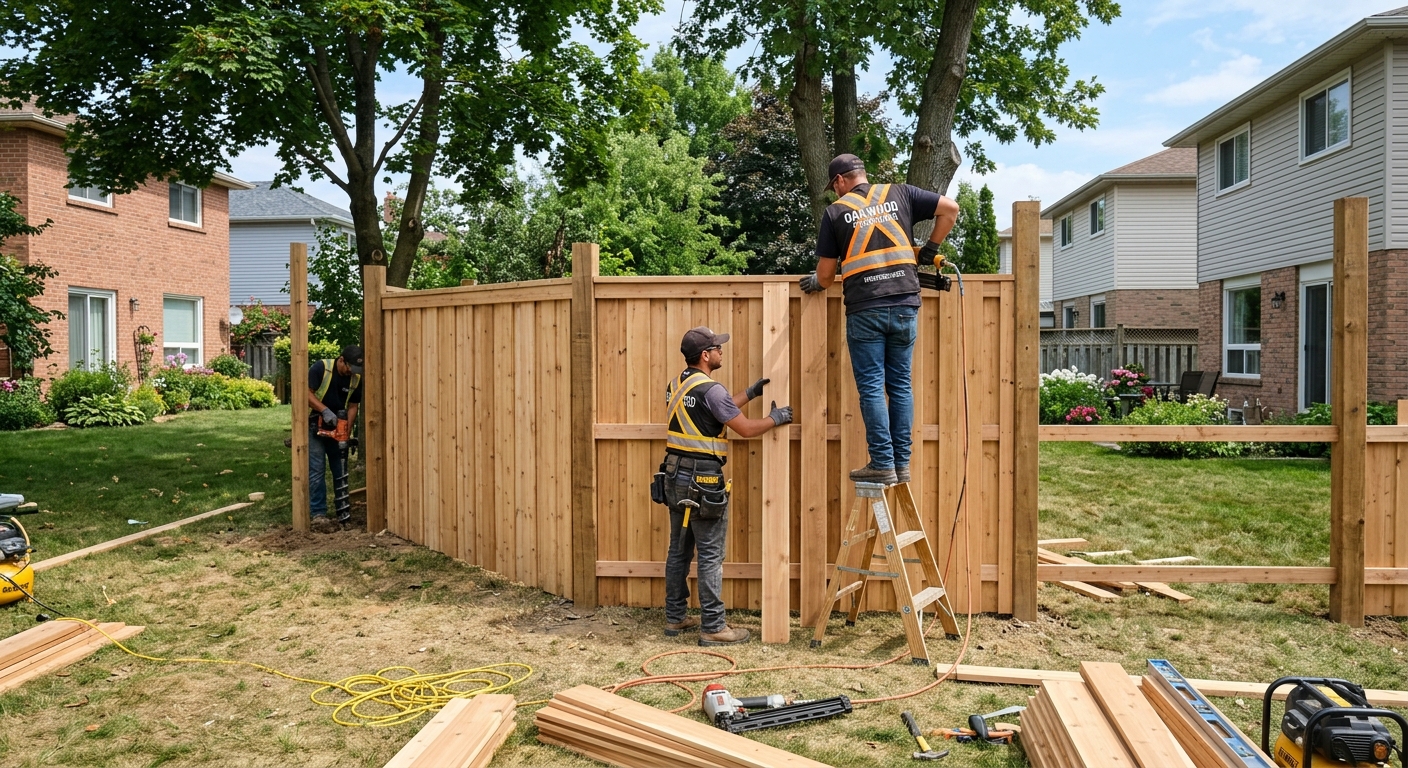
Fencing options and costs in Tweed
Tweed, Ontario is a small community where most homeowners still live in long-established neighbourhoods—so when a fence needs renewing, it tends to be a full perimeter job rather than a quick section fix. With 88.6% of local dwellings being single-detached homes, each detached property is a potential fencing customer, making housing type one of the strongest predictors of demand. In the Kingston–Pembroke economic region, you’ll also feel the mix of older housing stock: 61.2% of homes were built before 1981, and many properties were fenced with earlier material choices that don’t match today’s performance expectations.
Fencing costs here are shaped by frost depth and the freeze–thaw cycle. In southern and eastern Ontario, contractors commonly plan around roughly 1.2 m frost penetration, which means posts are often set about 36–48 inches deep to reduce heaving. That typically increases labour and materials versus milder regions, especially for privacy runs, gate locations, and sections near gates where the fence needs to stay plumb and rigid. Wind matters too—areas closer to open stretches can see gusts that push installers toward tighter post spacing and sturdier framing, which can move projects toward the upper end of Ontario’s local price band.
In Tweed, demand is especially steady around older residential pockets such as the downtown core and the highway-adjacent frontage areas where driveways and gates are common. Once you decide on style and height, the next step is comparing material options side by side, including typical lifespan, maintenance, and installed price per linear foot.
| Material |
Lifespan |
Maintenance |
Privacy Rating |
Price per Linear Foot |
| Pressure-treated pine (standard wood) |
10–15 years |
Stain/coat every 2–3 years |
Good (solid pickets) |
$55–$95 |
| Cedar (natural rot resistance) |
15–25 years |
Light staining/maintenance every 2–4 years |
Good (solid boards) |
$75–$120 |
| Vinyl / PVC (no-maintenance) |
25–35 years |
Rinse as needed; occasional repairs if damaged |
Very good (solid panels) |
$85–$140 |
| Chain-link (galvanized steel) |
20–30 years |
Minimal; periodic rinse |
Low (open mesh) |
$40–$80 |
| Aluminum ornamental |
25–40 years |
Wash/wipe; inspect hardware |
Low to medium (pickets) |
$80–$160 |
| Composite / recycled material |
20–30 years |
Occasional cleaning; no staining |
Good (boards/panels) |
$95–$155 |
Prices are estimates only and vary by project scope, site access and material selection.
What affects the price of fencing in Tweed
In Kingston–Pembroke and across Ontario, you can often see the same “length and height” fence quote differ by 30–50%. The difference usually isn’t the sticker on the material—it’s the ground conditions, post depth requirements, gate complexity, and how much labour is required to keep everything straight and code-compliant. In Tweed, many yards have older landscaping and established driveways, so contractors frequently deal with tight access, buried utilities, and settled soils that change how a crew sets posts.
Frost line depth is the biggest technical driver. Typical design frost penetration in southern/eastern Ontario is about 1.2 m, and contractors commonly set posts roughly 4–6 inches below that design frost depth. Practically, that means posts are often set about 1.5–2.0 m into the ground in colder stretches of the region, using longer posts and usually concrete-set or heavily engineered post holes. This adds material (longer lumber, concrete) and labour (deep holes, more alignment time), which is why wood privacy fences and gate-heavy layouts trend toward the upper end of the local wood bands (for example, the $55–$95 range).
Wind exposure can also change construction details. While Tweed isn’t the most extreme wind zone, gusts near open frontage can still justify tighter post spacing and sturdier rails—especially for 6–8 ft privacy fences—pushing framing labour higher. For homeowners weighing vinyl, note that higher upfront material cost can still make sense if you want to avoid repeated staining and straightening on older wood lines.
Concrete examples from local jobs include: (1) replacing a full perimeter where posts must go deep and concrete-set near a gate, versus (2) a short backyard run on firm, easily augered soil where gravel pack and fast alignment reduce labour. Another common cost swing is removal: taking down an old fence and hauling debris can add several hours per run, particularly when boards are tangled with roots or partially buried. Those factors, combined with current Ontario lumber and steel pricing, explain why quotes cluster mid-to-upper provincial averages.
| Price Factor |
Why It Matters |
Cost Impact |
| Fence length in linear feet |
Most materials and labour scale directly with linear footage |
High (major driver) |
| Post depth required |
Frost line determines how long posts must be and how deep holes go |
High (more concrete/auger time) |
| Post setting method |
Concrete-set posts resist movement better; gravel packs are faster where soils allow |
Medium to high |
| Material choice |
Vinyl/PVC and composite cost more per foot, cedar costs more than pine; chain-link is lower |
Medium to high |
| Gate count and type |
Drive-through and double gates need stronger frames and more hardware |
Medium (often pushes totals up) |
| Grade and terrain |
Sloped yards require stepped framing or raked panels to keep top rails level/consistent |
Medium |
| Old fence removal and disposal |
Demolition, handling, and hauling add labour and fees |
Low to medium (can be high if tangled/embedded) |
| Permit fees and survey / property line locate |
Locates reduce encroachment risk; permits may be required based on height and location |
Low to medium |
Permits & regulations in Ontario
In Ontario, fence rules typically include both property-line considerations and municipal setback/bylaw requirements. As a general guide, fences above a height threshold—often around 2.0 m (6.5 ft) for rear yards and about 1.0–1.2 m (3–4 ft) for front or corner areas—may require a building permit depending on where you’re building it and how your municipality regulates fences. Because Tweed homeowners often have driveways close to property lines, it’s smart to confirm your local requirements before ordering materials.
Before any post holes are dug, call for utility locates through Ontario One Call. Even if your property “looks empty,” fence posts can endanger buried services. Also, confirm property lines. Obtaining a survey (or at minimum verifying property pins/locates) helps you avoid disputes with neighbours and prevent building on land you don’t own.
To verify your contractor: (1) check the online Ontario business profile/contractor registration as applicable for fencing/contracting work, (2) request a current certificate of insurance showing liability coverage that matches the job size, and (3) confirm workers are covered under WSIB for worksite labour (the contractor should provide documentation upon request). If you don’t see clear, current paperwork, treat it as a bid-disqualifier.
In most cases, routine repairs below permit thresholds and replacing like-for-like fencing on the same footprint typically do not trigger the same permit need as building a new, taller barrier. However, if you’re changing height, moving location, or building near a corner/front yard limit, assume you’ll need confirmation—and ask before work starts.
Choosing the right fence material for Tweed
Choosing a fence in Tweed is less about what looks best on day one and more about what holds up through Ontario winters. With a climate that drives frost into the ground and frequent freeze–thaw, your post depth and the fence’s ability to stay rigid matter as much as the board itself. In Kingston–Pembroke, contractors commonly plan for posts set below design frost depth (often by several inches) using concrete where structural stability is critical, particularly at gates and long runs.
Pressure-treated pine is the usual budget choice, and it can fit homeowners who want to keep the project under the wood installation band of $55–$95 per linear foot. The trade-off is maintenance: plan to stain/coat every 2–3 years to slow grey weathering and reduce cracking. Cedar looks better for longer and resists rot naturally, but it still benefits from periodic finishing—especially if boards sit in damp shade. If you want low maintenance, vinyl/PVC is hard to beat. It doesn’t require staining and typically suits homeowners who want to avoid annual upkeep; however, it has higher upfront cost and can crack if impacted or if an installation detail fails under deep freeze conditions. Chain-link is the lowest-cost long-life option, but it offers minimal privacy, so it’s best where you want security rather than screening. Aluminum ornamental is attractive and won’t rust, but it generally doesn’t provide the privacy of solid wood/vinyl. Composite/recycled materials can be a middle path—strong, stain-free, and often well-suited to privacy designs.
Wind and snow load considerations matter too. Privacy fences act like sail panels; contractors may tighten post spacing or uprate rails in gust-prone stretches near open frontage. Concrete-set posts can be justified where frost movement would otherwise lean frames—especially with gates that need smooth operation.
A typical pricing decision looks like this: if a pine privacy fence is near the bottom of $55–$95, but vinyl lands in the higher band of $85–$140, the difference is often worth it when you want predictable maintenance and fewer weather-related cycles over 10–20 years. For many Tweed homeowners, that “pay more once to avoid repainting/staining” logic wins.
| Material |
Cold Tolerance |
Lifespan |
Annual Maintenance |
Best For |
Price Band |
| Pressure-treated pine |
Good (with proper post depth and coating) |
10–15 years |
Light inspection; stain/coat every 2–3 years |
Budget privacy with planned upkeep |
$55–$95 |
| Cedar |
Good (natural resistance to rot) |
15–25 years |
Rinse/inspect; stain lightly every 2–4 years |
Natural look and moderate maintenance |
$75–$120 |
| Vinyl / PVC |
Very good (impact protection helps in deep freeze) |
25–35 years |
Minimal: rinse as needed; check fittings |
Low maintenance privacy |
$85–$140 |
| Chain-link |
Very good |
20–30 years |
Minimal; periodic rinse |
Security and pet containment |
$40–$80 |
| Aluminum ornamental |
Very good |
25–40 years |
Minimal; wash and inspect hardware |
Decorative boundary with durability |
$80–$160 |
| Composite / recycled |
Good (depends on product system) |
20–30 years |
Minimal: clean; check for localized damage |
Privacy with low staining |
$95–$155 |
How to choose a fencing contractor in Tweed
Choosing the right fencing contractor in Tweed starts with proof, not promises. First, verify Ontario licensing/registration as applicable to the contractor’s business type and make sure their contact information matches the quote. Next, request a certificate of insurance showing liability coverage; it should list the correct legal business name and include jobsite activities (post installation, hauling, and any demolition). For workers, confirm WSIB coverage. A reputable contractor will be comfortable providing proof on request and will explain how they document jobsite safety.
Then get 2–3 itemised written quotes. You want a breakdown that separates labour (digging, setting posts, assembly) from materials (posts, rails, boards/panels, fasteners, gates, concrete) so you can compare like-for-like. Scope clarity is crucial: ask whether removal of the old fence is included, whether disposal/hauling fees are included, and whether a permit pull (if required due to height/location) is the homeowner’s or contractor’s responsibility. Also confirm who handles utility locates and how the contractor avoids lines when setting posts.
Warranty matters. Ask for both the workmanship warranty length and the manufacturer’s product warranty, and whether it transfers if you sell the home. For payment, avoid paying more than 10–15% upfront; hold back the balance until the fence is complete, cleaned up, and gates align properly. Finally, get the start date and completion estimate in writing, including weather contingencies for frost/ground conditions.
- Provide a written quote with measurements in linear feet and clear fence height.
- Include post spacing, post depth plan, and whether posts are concrete-set.
- List material specs (grade/type of wood, cedar source, PVC product line, rail size).
- Confirm gate hardware brand/type and swing direction.
- State whether concrete, fasteners, and gravel are included or extra.
- Clarify disposal and hauling for old fencing and debris.
- Show utility locate responsibility and excavation steps.
- Ask about the warranty for workmanship and whether it’s in writing.
- Confirm insurance certificate and WSIB coverage before scheduling.
- Use a payment schedule with no large final payments until punch-list completion.
- Include a timeline with start/completion dates and weather allowances.
- Require cleanup standards (site rake, sweep, and debris removal).
Red flags I see in Tweed bids include: vague quotes without post depth/post spacing details, contractors asking for large upfront deposits beyond 10–15%, a refusal to provide insurance/WSIB proof, “lump sum only” pricing with exclusions buried in email, and missing start dates or a written warranty scope.
Frequently asked questions — fencing in Tweed
How long does fence installation take in Tweed?
In Tweed, most typical residential fences are installed faster than homeowners expect, but the timeline depends heavily on ground conditions and gate count. A straightforward chain-link or shorter backyard wood run can move quickly once posts are planned and utility locates are complete; larger privacy fences with multiple gates often require more time for deep post setting, rail alignment, and adjustments for frost-season movement. If your soil is clay or silty and augering slows down, crews may spend extra time on post holes and concrete curing logistics, even when the assembly itself is quick. Planning for start-to-finish usually means budgeting extra days for inspection-ready completion, particularly for any concrete-set areas and gate hardware alignment. Expect quicker turnaround on projects that don’t require extensive old fence removal.
Can I install a fence on a slope in Tweed?
Yes, you can install a fence on a slope in Tweed, but the method needs to match the fence style. Most contractors will use stepped sections (each panel/rack is adjusted in increments) or raked panels (continuous angle), depending on the material and how much grade change you have. Step systems often cost a bit more because they involve more careful measuring, extra framing cuts, and alignment at the top rail. If your yard has a noticeable drop near a gate, you’ll also need hardware and latch alignment to ensure smooth operation through winter. As a general best practice in Ontario’s freeze–thaw climate, the contractor should confirm post depth and ensure each post is set at a stable depth, not just at the surface grade. That’s what prevents leaning after heavy snow and spring thaw.
What is the most weather-resistant fence for Tweed's climate?
For Tweed’s Ontario winter conditions, the most weather-resistant choices usually balance rigid structural setup with materials that handle moisture and freeze–thaw well. Vinyl/PVC privacy fences are popular because they don’t need staining and resist rot, which helps where damp soils can accelerate decay. Cedar is also a strong choice thanks to natural rot resistance, though you still need periodic maintenance to keep it looking sharp. For longevity, chain-link and aluminum ornamental options can outperform wood when you want low maintenance and durable hardware—especially for perimeter lines where privacy isn’t required. Regardless of material, your results depend on post depth planning for frost and whether gates are properly reinforced. If you’re budgeting, vinyl commonly lands in the $85–$140 per linear foot band, while pressure-treated wood is often closer to $55–$95, with more maintenance required over time.
How do I prevent wood fence rot in Tweed?
Wood rot prevention in Tweed mostly comes down to controlling moisture at the base of the fence and protecting the wood surface. First, ensure posts are set correctly below frost depth to reduce movement that can open gaps and trap water. Second, choose pressure-treated lumber for structural members and ensure the correct fasteners are used. Third, keep a maintenance schedule: stain or coat pressure-treated boards every 2–3 years (and cedar on a similar or slightly longer interval) so the surface repels water and reduces checking. Avoid burying end grain where it stays wet; proper spacing and rail design help airflow. If you have shaded areas or damp clay pockets, consider where concrete-set posts and proper drainage help. Finally, deal with early damage quickly—loose boards and failing fasteners let water in, and repairs later usually cost more.
What is the cost per linear foot for fencing in Tweed?
In Tweed, installed fencing costs typically follow the local Ontario price bands based on material and how complex the ground and layout are. Pressure-treated pine (standard wood) often lands around $55–$95 per linear foot, depending on post depth, rail configuration, and gate count. Vinyl/PVC is commonly higher at $85–$140 per linear foot for privacy-style systems. Chain-link tends to be the lower-cost option, often around $40–$80, while aluminum ornamental and more premium systems can be closer to $80–$160. The biggest reasons you might see a project quote near the top of a band include deep frost-set post holes in silty/clay ground, tight access for equipment, multiple gates, and disposal of an old fence. A proper itemised quote is the best way to compare true cost per foot.
Should I repair or replace my old fence in Tweed?
It’s usually worth repairing when the fence is structurally sound—posts are plumb, rails aren’t sagging, and damage is limited to a few boards or localized rot. Replace when you see widespread post movement, leaning sections that indicate frost heaving or foundation failure, or when rot has traveled into multiple rails/fastener points. In older Tweed properties (many built before 1981), fences can fail because early install methods didn’t always account for modern post-setting practices under freeze–thaw. If your fence is already near the end of its lifespan, replacement can be more cost-effective than repeated board swaps, especially when you’re also investing in correct post depth for frost protection and upgrading gate frames. If privacy and alignment are priorities, replacing with a more stable system can reduce ongoing labour and keep gates working smoothly through Ontario winters.