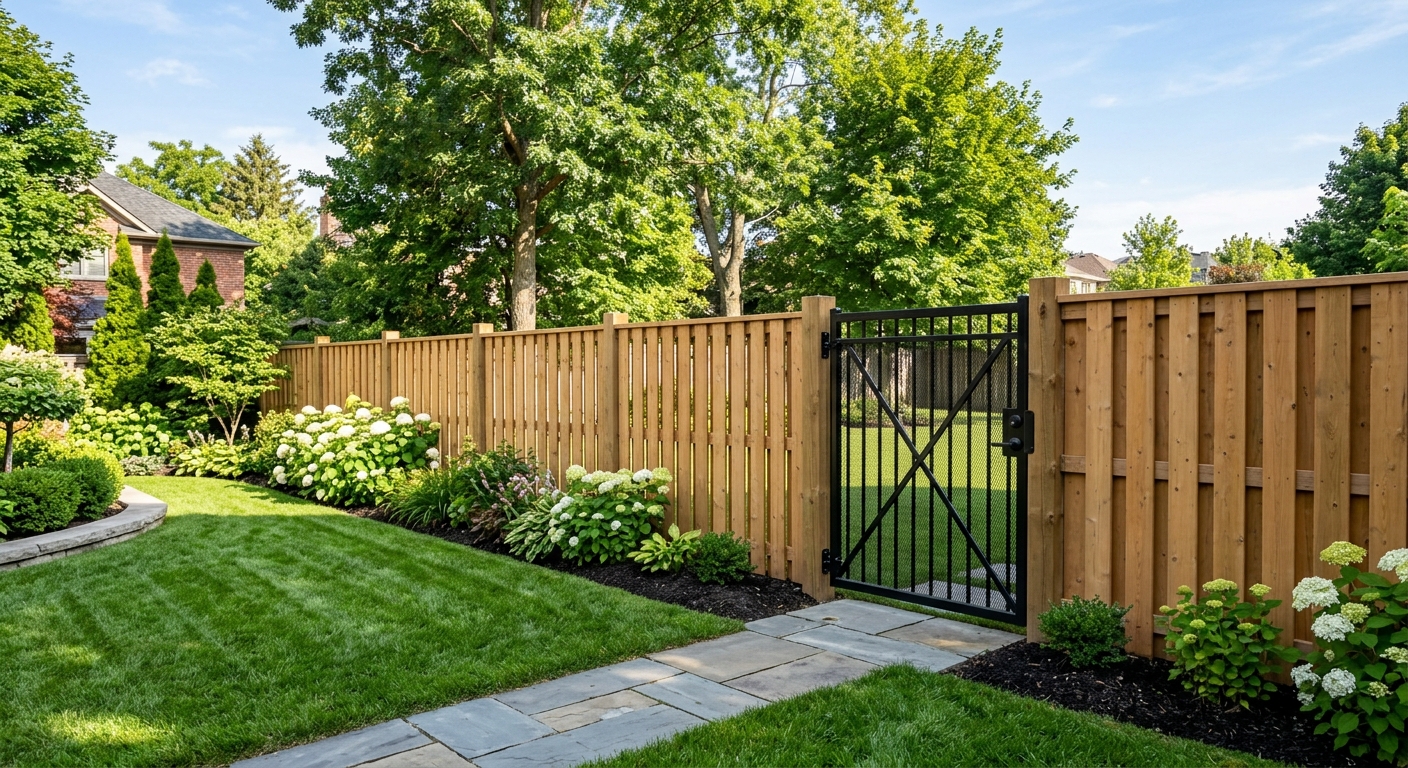
Fencing options and costs in Morrisburg
Morrisburg homeowners often ask for privacy, weather protection, and a fence that looks right on an older lot—but with a realistic budget. With a population of 3,014 (Statistics Canada, 2021 Census), the town has a smaller contractor pool than the GTA, so availability can tighten in peak spring installs. In practice, demand is strongest where detached homes and established yards are most common, since each property line is a potential boundary update. That steady local need is shaped by Toronto-region building habits: in Southern Ontario, frost line depth is commonly worked around at about 42"–48", and fence posts are typically set deeper to prevent frost heave. For taller privacy fences (6–8 ft), that means more labour for excavation and more concrete, which moves pricing upward versus simple, shallow post installs.
In Morrisburg’s river-adjacent and slightly wind-exposed areas—like parts of the west end where yards feel more open—panel style and post spacing matter for racking and uplift. If you’re in a neighbourhood such as near the St. Lawrence/Seaway corridor where lots can feel exposed, contractors may recommend heavier posts and closer spacing. When access is tight (driveways, mature trees, or narrow side yards), quotes also reflect longer on-site time and careful hole excavation.
Below is a practical comparison of common materials and what homeowners typically budget per linear foot in this tier—then you can line those numbers up with your height, gate count, and post depth requirements in the next section.
| Material |
Lifespan |
Maintenance |
Privacy Rating |
Price per Linear Foot |
| Pressure-treated pine (standard wood) |
10–15 years |
Stain or seal every 2–3 years |
Good privacy (solid boards) |
$65–$95 |
| Cedar (natural rot resistance) |
15–25 years |
Re-stain as needed (often every 3–4 years) |
Good to very good privacy (solid boards) |
$85–$120 |
| Vinyl / PVC (no-maintenance) |
20–30 years |
Rinse only; no painting |
Good privacy (solid panels) |
$75–$130 |
| Chain-link (galvanized steel) |
20–35 years |
Minimal (wash/spot repair) |
Low privacy unless you add slats/vines |
$45–$85 |
| Aluminum ornamental |
25–40 years |
Occasional cleaning; no rust |
Low to moderate privacy (open pickets) |
$90–$160 |
| Composite / recycled material |
25–35 years |
Low maintenance (wash; occasional fastener checks) |
Good privacy (solid styles) |
$95–$150 |
Prices are estimates only and vary by project scope, site access and material selection.
What affects the price of fencing in Morrisburg
In Morrisburg and across the wider Toronto economic region, two quotes for the “same” fence can land 30–50% apart because contractors price for real-world conditions, not just the material on the truck. In a smaller community (population 3,014; Statistics Canada, 2021 Census), scheduling and travel time can also influence labour rates and availability during spring ramp-up. Meanwhile, Toronto-area building practice is heavily shaped by Ontario’s freeze-thaw cycle: contractors plan for deeper post holes because frost heave can lift poorly set posts and buckle panels over time. The practical result is that post depth (often built as 4–6" below the design frost depth) drives excavation time, ready-mix use, and the need for longer posts—pushing labour and material costs up for privacy fences.
Local wind and weather aren’t like the Prairies, but racking still matters in open corners, near waterways, and on newer builds with straighter runs. Taller solid wood or vinyl panels (6–8 ft) generally require heavier posts (and closer centres) to resist uplift. By comparison, BC-style wet-climate rot isn’t the dominant driver here, but Southern Ontario still punishes untreated end-grain, so proper staining, cedar selection, and concrete-set posts remain important.
Concrete examples you’ll feel in Morrisburg: (1) a 60 linear foot privacy run often costs noticeably more when posts must be concrete-set at full depth versus a short-run chain-link line where driven posts may be feasible; (2) a yard with clay or mixed soils typically means slower digging and more concrete setting time—raising costs versus sandy soils that excavate cleanly; (3) adding two gates can shift your price into the next band because hardware, reinforcement, and alignment work are labour-intensive. If you’re choosing between a vinyl run in the $75–$130 range and wood installation in the $65–$120 band, the “difference” is usually justified when you factor in post setting, maintenance labour, and how many years you want to avoid repairs.
| Price Factor |
Why It Matters |
Cost Impact |
| Fence length in linear feet |
Most costs scale directly with feet installed (posts, rails, fasteners, labour). |
High (primary driver) |
| Post depth required |
Southern Ontario frost requirements set hole depth and required post length. |
Medium to high (adds labour + materials) |
| Post setting method |
Concrete-set posts increase stability but require extra excavation and ready-mix. |
High (often the biggest difference between quotes) |
| Material choice |
Vinyl/cedar/aluminium have different hardware, install method, and durability. |
Medium to high |
| Gate count and type |
Double-drive gates need wider framing, reinforcement, and better alignment. |
High per gate |
| Grade and terrain |
Slopes require stepped layouts or raked panels; spacing and cuts change labour. |
Medium |
| Old fence removal and disposal |
Demolition time, hauling, and potential buried materials affect labour. |
Medium to high |
| Permit fees and survey / property line locate |
Some fences need permitting and accurate boundary location reduces future disputes. |
Low to medium (but important) |
Permits & regulations in Ontario
In Ontario, a building permit is commonly required when you’re building a fence above typical height thresholds—often cited as about 2.0 m (6.5 ft) for rear yards and around 1.0–1.2 m (3–4 ft) for front yards or corners, depending on the municipality and local bylaw wording. Regardless of height, your fence must respect your property line and any municipal setback rules. For Morrisburg homeowners, the practical risk isn’t just fines—it’s the cost of rework if a fence crosses a boundary.
Before you dig any post holes, you should call for utility locates (Ontario One Call). Even if the area looks clear, contractors can hit buried services when installing deeper concrete-set posts. You’ll also want a survey or at least a proper locate of your property pins if you don’t have boundary markers. Shared fence ownership rules fall under Ontario’s line-fences legislation principles, which can affect who pays for repairs and how you handle a dispute.
Work that typically DOES require a permit: installing or replacing fences that exceed the common height thresholds, plus any project that triggers municipal requirements (for example, substantial changes near a corner or where sightlines are impacted). Work that typically does NOT require a permit: lower-height fences within allowed front/rear limits, simple repairs (replacing like-for-like sections), and small sections below the threshold—though you should still confirm with your municipality.
To verify a contractor, check: (1) Ontario contractor licence details through the appropriate online registry when applicable for their category of work, (2) liability insurance—ask for a certificate of insurance naming you as the additional insured when reasonable, and (3) WSIB coverage documentation (or WCB equivalent) via their clearance letter or proof of account. If a quote won’t provide proof on request, that’s a major red flag.
Choosing the right fence material for Morrisburg
Choosing the right fence material in Morrisburg is about matching your priorities—privacy, low maintenance, budget, and lifespan—to how Southern Ontario’s winters actually behave. The frost cycle (with posts commonly set deeper to resist heaving) makes post quality and installation method as important as the material itself. Pressure-treated pine is usually the best budget entry, but it typically needs staining or sealing every 2–3 years to avoid grey weathering and premature wear. Cedar looks and performs well because it resists rot better, but it still benefits from periodic staining and proper airflow around boards.
Vinyl/PVC is the low-maintenance option, and in this market it often comes in as the middle-to-upper price band (commonly aligning with the $75–$130 range). The trade-off is that extreme cold can make some products more brittle at thin sections, so quality manufacturing and correct post reinforcement matter. Chain-link is the lowest upfront cost and the longest-lasting option for durability, but it provides limited privacy unless you add privacy slats or a growing screen. Aluminum ornamental fencing offers rust resistance and a clean look, but it won’t block sightlines the way solid wood or vinyl will.
For frost considerations, Toronto practice generally pushes homeowners toward concrete-set posts for privacy fences where heights are 6–8 ft, because clay and mixed soils can shift if posts aren’t stabilized. If you want maximum stability with fewer repairs, that’s where paying for correct post depth often makes sense. For example: if you’re comparing a cedar privacy fence at roughly $85–$120 per linear foot versus pressure-treated pine at $65–$95, the extra cost can be justified when you factor in fewer maintenance cycles and longer service life.
| Material |
Cold Tolerance |
Lifespan |
Annual Maintenance |
Best For |
Price Band |
| Pressure-treated pine |
Good in Ontario if properly sealed; watch fastener corrosion |
10–15 years |
Minor checks; stain/seal every 2–3 years |
Lowest upfront cost with acceptable upkeep |
$65–$95 |
| Cedar |
Very good; stable boards when installed with correct spacing |
15–25 years |
Inspect annually; re-stain every 3–4 years |
Natural look, strong rot resistance, privacy |
$85–$120 |
| Vinyl / PVC |
Good; benefits from solid post reinforcement in freeze-thaw |
20–30 years |
Rinse/wash as needed; minimal repairs |
Low maintenance privacy runs |
$75–$130 |
| Chain-link |
Excellent; galvanized steel holds up through freeze-thaw |
20–35 years |
Minimal (wash and occasional tension/hinge checks) |
Security with long life (add slats for privacy) |
$45–$85 |
| Aluminum ornamental |
Excellent; powder-coated profiles resist winter wear |
25–40 years |
Occasional cleaning |
Clean curb appeal and rust-free perimeter |
$90–$160 |
| Composite / recycled |
Good; performance depends on product quality and fastening |
25–35 years |
Low maintenance (wash; fastener inspections) |
Privacy with low upkeep and durable boards |
$95–$150 |
How to choose a fencing contractor in Morrisburg
For a Morrisburg fencing project, your contractor should be able to prove they’re insured and set up for labour safety before you sign anything. Start by verifying Ontario licensing or relevant trade registration for their service category (ask them for the exact licence information and business details). Then request liability insurance: a current certificate of insurance showing coverage active at the start date of the job and your address tied to the work. Finally, confirm WSIB/WCB coverage by asking for a clearance letter or proof of account—this is the documentation you want if anything goes wrong on site.
Get 2–3 itemised written quotes rather than a lump sum. A solid quote breaks down: material supply (boards/panels, rails, post hardware), labour (demo, excavation, post setting, assembly), and extras like gate frames, hinges/latches, and finishing. Confirm what’s excluded: does the price include permit handling, utility locate costs, and disposal/hauling of the old fence? If they don’t mention disposal, assume it’s excluded and ask. Also check warranty details: workmanship warranty length (how long they’ll fix install issues), product/manufacturer warranty (what defects are covered), and whether warranties transfer to subsequent owners.
Payment schedule matters. Never pay more than 10–15% upfront. Hold back the remainder until the fence is complete, gates are functioning, and post spacing/alignment meets the agreed layout. Ask for a start date and completion estimate in writing so weather delays and materials lead times don’t turn into indefinite timelines.
- Ask for insurance proof (liability) before the first payment.
- Request WSIB/WCB clearance letter or coverage proof.
- Get licence/business details matching the quote and invoice.
- Demand itemised pricing: materials vs labour vs hardware vs disposal.
- Confirm post depth and setting method in writing (concrete vs alternative).
- Clarify fence height measurement method (finished height vs nominal).
- Ensure gate hardware is listed (hinge type, latch style, gate reinforcement).
- Check whether top caps, rails, and trim are included.
- Ask about slope handling: stepped vs raked panels on grades.
- Confirm disposal/hauling of old fence sections is included or priced separately.
- Verify permit responsibilities if your fence exceeds typical height limits.
- Get a written warranty statement for workmanship and products.
In Morrisburg, common red flags include: contractors who won’t put post depth and concrete-set requirements in the quote, quotes that are only a single total without line items, refusal to show insurance/WSIB proof on request, vague start dates without an estimated completion window, and high upfront deposits that exceed 10–15%.
Frequently asked questions — fencing in Morrisburg
How do I handle a fence dispute with a neighbour in Ontario?
Start by documenting everything: photos of the fence line, measurements, and any correspondence about the boundary. In Morrisburg and the rest of Ontario, boundary disputes can become expensive if you “solve” it by moving the fence without verifying property lines. If you don’t have clear property pins, arrange a survey or a property boundary locate before making changes. You should also review Ontario’s line-fences principles for shared responsibility and repairs, because ownership/maintenance costs may differ depending on how the fence is treated between neighbours. If the disagreement is about installation quality, you can require evidence of workmanship per the contract and warranty. For serious disputes or if the fence has already been built incorrectly, consider mediation or legal advice rather than unilateral changes that could increase costs.
What fence style offers the best wind resistance in Morrisburg?
For Morrisburg, the most wind-resistant choice is usually a properly braced solid fence with adequate post size, spacing, and concrete-set stability (especially for 6–8 ft privacy runs). In the Toronto region, wind doesn’t reach Prairie-level extremes, but uplift and racking still matter—particularly on open corners or where yards feel exposed. Solid panels (wood or vinyl) need heavier posts and closer centres to keep the fence from shifting in freeze-thaw and strong gusts. If you want maximum airflow while still offering some privacy, a lattice-top or semi-privacy configuration can reduce sail effect compared with fully solid panels. The key is to match the fence style to the post depth and setting method, not just the material.
How much does a fence cost in Morrisburg?
Costs depend on length, height, gate count, and how deep posts must be set for frost stability. In this local tier, homeowners typically see wood installation in the $65–$120 range and vinyl/PVC in the $75–$130 range per linear foot, with chain-link usually lower and aluminum often higher. If your project needs concrete-set posts (common for taller privacy fences), labour and ready-mix can push pricing toward the top of the band. For example, a straightforward 40 linear foot chain-link perimeter may land nearer the lower end, while a 60 linear foot 6–8 ft privacy fence with two gates can move into a higher total range due to excavation, concrete setting, and gate hardware.
How deep should fence posts be for Morrisburg's frost?
In Southern Ontario, frost line depth is commonly accounted for at about 42"–48", and best practice is to set posts deep enough to prevent heaving—often translating to digging roughly 4–6 inches below the design frost depth. That typically means posts are set about 3.5–4 feet down, and for many Morrisburg privacy fences contractors plan for 1.5–2.0 m of embedment in practice, depending on soil and local conditions. For 6–8 ft fences, contractors almost always recommend concrete-set posts rather than simply driven posts to improve long-term stability, especially in clay and mixed soils common across the region. Your contractor should specify the planned post depth and setting method in writing.
Wood vs vinyl vs aluminum fence — which is best?
“Best” depends on what you value most in Ontario weather. Wood (pressure-treated pine or cedar) offers a traditional look and good privacy, but wood requires periodic maintenance—often staining or sealing every 2–3 years for pine and about every 3–4 years for cedar. Vinyl/PVC is usually the lowest-maintenance privacy option; it’s higher upfront, often aligning with the $75–$130 per linear foot range, but it typically needs just rinsing. Aluminum ornamental fencing is rust-resistant and has excellent longevity, but it’s open picket by design, so it’s not the top pick if you want maximum privacy. Many Morrisburg homeowners choose vinyl for privacy with minimal work, and aluminum for front curb appeal/perimeter security where openness is acceptable.
Do I need a permit to build a fence in Ontario?
In Ontario, many fences above common height thresholds—often around 2.0 m (6.5 ft) at the rear and roughly 1.0–1.2 m (3–4 ft) in front or corners—may require a building permit, depending on your municipality’s bylaw language. Even when a permit isn’t required, you still must respect property lines and any setback rules. In Morrisburg, the safest approach is to confirm in advance, especially for taller privacy fences or corner lots where sightlines matter. Before any digging, you must arrange utility locates through Ontario One Call. If you’re unsure about the height or placement, ask your contractor to spell out permit responsibility and whether they’ll help with the paperwork. For boundary accuracy, use a survey/property locate so you don’t encroach.