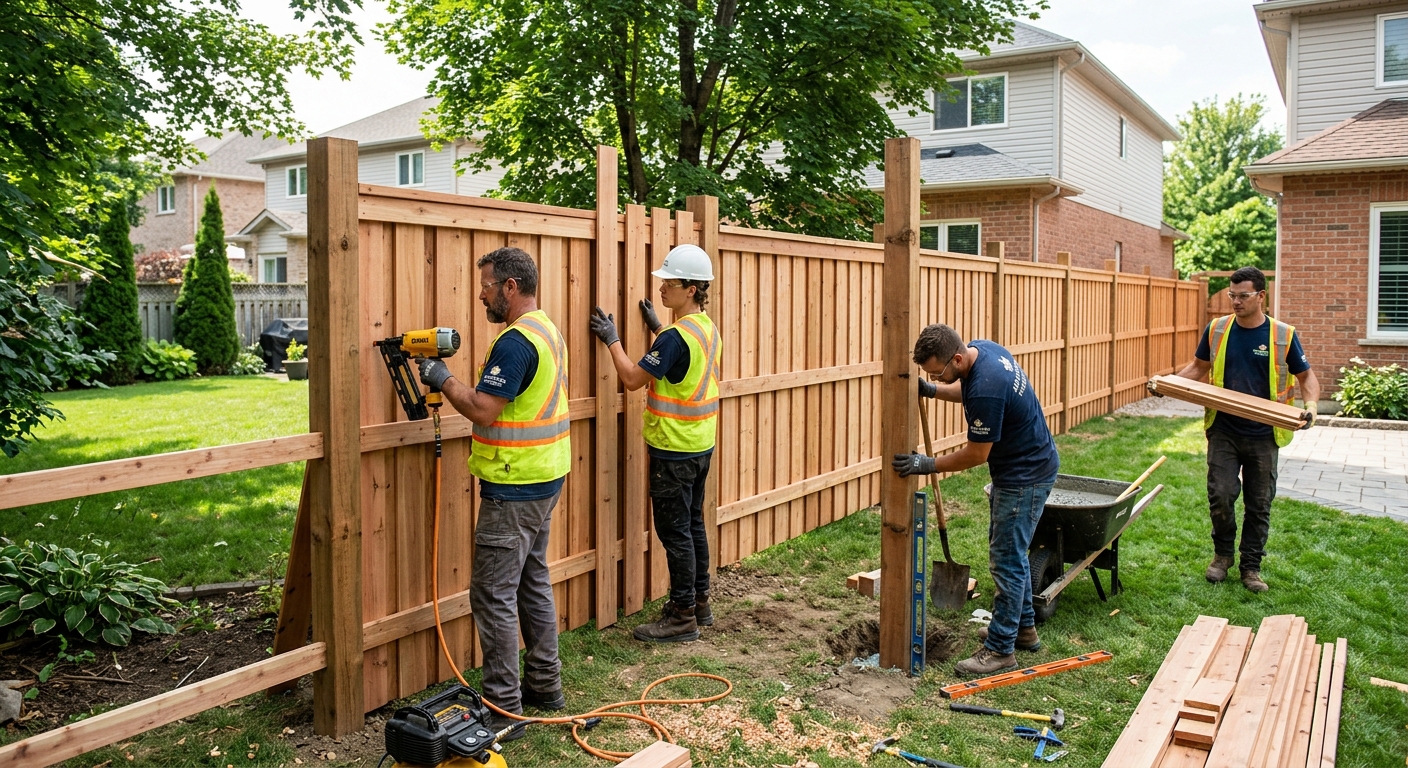
Fencing options and costs in Black Creek
In Black Creek, homeowners are often planning for both privacy and curb appeal, especially as the community continues to grow—there are 21,737 people in the area (Statistics Canada, 2021 Census). With so many local households housed in detached and family-oriented properties, fencing demand stays steady because a fence isn’t just a boundary; it’s part of day-to-day living. Toronto-area population pressure also means fast-growing contractor schedules, which can affect availability and pricing during peak season.
Pricing here is heavily shaped by Southern Ontario freeze–thaw cycles. The frost line in the broader Toronto region is commonly taken at about 42"–48", so posts for taller privacy fences typically need to be set at least 3.5–4 feet deep to help prevent frost heave. On top of that, many yards in and around areas like Schomberg Road and the residential pockets closer to commuter corridors have mixed soils and occasional clay pockets, which make concrete-set posts the safer long-term choice for 6–8 ft fences.
That climate-driven construction standard is one reason you’ll often see Toronto pricing sit at the higher end of typical provincial ranges, even when material choice stays similar. If you’re comparing quotes, the real differences are usually in post type, post depth, concrete/courier-ready mix costs, gate framing, and how removal and disposal are handled. Use the comparison below to anchor your expectations before you start negotiating scope and line items.
| Material |
Lifespan |
Maintenance |
Privacy Rating |
Price per Linear Foot |
| Pressure-treated pine (standard wood) |
10–15 years |
Stain/seal every 2–3 years |
High (solid boards) |
$20 – $35 |
| Cedar (natural rot resistance) |
15–25 years |
Seal/stain every 3–4 years |
High (solid boards) |
$25 – $45 |
| Vinyl / PVC (no-maintenance) |
20–30 years |
Rinse as needed; avoid impact |
High (solid panels) |
$26 – $48 |
| Chain-link (galvanized steel) |
20–40 years |
Occasional rinse; tighten where needed |
Low–Medium (open mesh) |
$15 – $26 |
| Aluminum ornamental |
25–40 years |
Wash as needed; no rust |
Low (decorative pickets) |
$24 – $45 |
| Composite / recycled material |
20–30 years |
Minimal; clean and inspect fasteners |
Medium–High (solid styles) |
$28 – $55 |
Prices are estimates only and vary by project scope, site access and material selection.
What affects the price of fencing in Black Creek
In Black Creek, the same “8 ft privacy fence” can land 30–50% apart across quotes because fencing is labour- and foundation-driven, not just material-driven. Two contractors may quote the same wood or vinyl style, but one might include deeper concrete-set holes, heavier posts, better panel bracing, and proper hardware while the other uses lighter framing or a faster (and less stable) post method. In the Toronto economic region, demand can also mean scheduling differences—premium timing and quicker turnarounds can come with higher labour day rates.
Climate is the biggest driver. The frost line is commonly taken at about 42"–48" in Southern Ontario, so posts usually need to be set roughly 4–6 inches below that design frost depth to reduce the risk of heaving. In practical terms, that often means posts go 1.5–2.0 m into the ground, using longer posts and concrete setting. That increases both materials (longer posts, additional hardware) and labour (excavation, rebar/anchors where used, and ready-mix handling). Wind matters even without Prairies-level exposure: taller solid fences need closer post spacing and stronger rails to prevent racking and uplift. For contrast, coastal BC’s wet rot issues aren’t the same here, but Ontario’s freeze–thaw still punishes poorly protected wood.
Concrete examples from Black Creek projects: (1) clay-heavy pockets can require more careful excavation and larger hole volumes for concrete-set posts, raising labour time; (2) replacing an existing fence often increases cost because removal and hauling add dump fees and extra labour; (3) yards near busier corridors sometimes have tougher access for skid-steer or delivery, which can move you from the lower to upper end of typical bands—wood installation often sits around $65 – $120, while vinyl frequently lands in the $75 – $130 territory depending on framing and gate count.
So even when you choose the “same material,” your total cost is shaped by post depth, setting method, terrain, and how much work is wrapped into the scope.
| Price Factor |
Why It Matters |
Cost Impact |
| Fence length in linear feet |
Most charges scale directly with footage |
Highest single driver |
| Post depth required |
Frost line determines hole depth and post length |
Can add material + concrete and hours |
| Post setting method |
Concrete-set posts vs gravel pack vs driven posts |
Concrete setting increases cost but improves stability |
| Material choice |
Vinyl/cedar have higher material costs than chain-link/pressure-treated |
Shifts you between wood, vinyl and metal price bands |
| Gate count and type |
Gates require heavier framing, hinges, latches |
Each gate can meaningfully raise the total |
| Grade and terrain |
Slope needs raked/stepped panels or special layout |
More labour and more offcuts/adjustment |
| Old fence removal and disposal |
Hauling and disposal aren’t always included |
Can add dump fees and extra crew time |
| Permit fees and survey / property line locate |
Ensures compliance and avoids boundary disputes |
Varies by scope; can add a meaningful line item |
Permits & regulations in Ontario
In Ontario, fence permitting can apply when you’re installing higher fences—commonly, rear yards around 2.0 m (6.5 ft) and front/corner areas around 1.0–1.2 m (3–4 ft) may trigger a building permit requirement, depending on how your local municipality administers its by-laws. Regardless of height, you must keep the fence on your property line and respect any municipal setback rules that may apply to your lot.
Before any post holes are dug, call for utility locates through Ontario One Call. This is non-negotiable for safety and schedule—missing even a single service line can create shutdowns and rework. If you don’t already have a reliable survey, get a locate of your property pins (or a professional property line locate) so the fence doesn’t creep into a neighbour’s space. Shared fence ownership rules are generally governed by Ontario’s line-fences framework, which affects how disputes are handled if something goes wrong.
What typically requires a permit: fences above height thresholds (especially rear-yard privacy heights), and any project your municipality specifically flags for review. What typically does not: small replacement sections that stay within allowed height limits and don’t alter the overall location/footprint—though you should still confirm the height/location with the permit office if you’re replacing a whole boundary.
To verify an Ontario contractor for your Black Creek project, check: (1) their Ontario business registry presence and any applicable trade/designation they claim, (2) certificate of liability insurance that matches your job value and includes fence installation risk, (3) WSIB/WCB coverage proof (or acceptable exemption documentation if they’re legitimately not required). Ask for the certificate directly and verify the coverage is current before work starts. Clearance letters should be available on request if your situation requires them.
Choosing the right fence material for Black Creek
Choosing the right material in Black Creek is mostly about matching performance to your priorities: privacy, low maintenance, budget, and lifespan. Pressure-treated pine is the budget-friendly choice, but it needs proper staining or sealing every 2–3 years to slow down grey weathering and surface checking from freeze–thaw. Cedar costs more upfront but typically looks better longer and resists rot naturally; you still need periodic sealing to keep it looking its best.
Vinyl/PVC is the low-maintenance option homeowners like most—no staining, just rinse and inspection—but it can crack if installers don’t frame it correctly or if impact forces aren’t managed. Chain-link is usually the lowest cost and longest-life per dollar, but privacy will be low unless you add slats, landscaping, or a privacy screen. Aluminum ornamental fencing won’t rust, offers excellent longevity, and suits curb appeal, but it’s inherently not a “solid privacy” solution. Composite/recycled materials often land between wood and vinyl on performance and price, with strong resistance to rot and a more consistent appearance.
Because Ontario’s frost line commonly lands around 42"–48", your post depth matters as much as the material. For 6–8 ft privacy fences, concrete-set posts are generally the best practice so the posts stay stable through freeze heave; driven posts without adequate footing often struggle long-term in mixed soils. Taller, more solid styles also need wind-aware framing and closer post spacing to reduce racking during gusty days.
Here’s a practical way to justify the cost: if you choose vinyl for a privacy run that might otherwise be cedar or pressure-treated, the higher installed band cost—often around $75 – $130 versus wood’s $65 – $120—can make sense when you value time saved on staining and the expectation of 20+ year performance with minimal upkeep.
| Material |
Cold Tolerance |
Lifespan |
Annual Maintenance |
Best For |
Price Band |
| Pressure-treated pine |
Good if sealed; protects against freeze–thaw |
10–15 years |
Light cleaning; plan 2–3 year stain/seal |
Budget privacy with higher upkeep willingness |
$65 – $120 |
| Cedar |
Very good; rot resistance helps in wet/dry cycles |
15–25 years |
Seasonal inspection; seal/stain about every 3–4 years |
Attractive privacy with moderate upkeep |
$75 – $130 |
| Vinyl / PVC |
Good; can be brittle if poorly installed/impacted |
20–30 years |
Rinse as needed; inspect posts and anchors |
Low-maintenance solid privacy |
$75 – $130 |
| Chain-link |
Excellent; galvanized steel tolerates cold well |
20–40 years |
Occasional rinse; check tension |
Security and long-term durability |
$45 – $85 |
| Aluminum ornamental |
Excellent; no rust from freeze–thaw salts |
25–40 years |
Wash/clean as needed |
Decorative boundaries and curb appeal |
$90 – $160 |
| Composite / recycled |
Good; stable appearance in freeze–thaw cycles |
20–30 years |
Low—inspect fasteners and clean periodically |
Solid privacy with minimal rot risk |
$85 – $145 |
How to choose a fencing contractor in Black Creek
Start by verifying the contractor can legally and responsibly do the work in Ontario. Ask for their certificate of liability insurance and confirm the policy is current and includes fencing/installation activities; you can also ask for the insurer and contact info on the COI. Next, verify WSIB/WCB status: request proof of coverage (or documentation if they are exempt under a valid circumstance) so you’re not left holding the bill if a worker is injured on your property. Finally, confirm they’re properly registered to do business and can provide a clear point of contact for warranty items after installation.
Get 2–3 itemised written quotes—avoid “lump sum only” proposals. The best quotes break down labour and materials separately, show post depth and setting method (concrete vs gravel pack vs other), list hardware grade, and specify panel spacing and gate hardware. Confirm whether the price includes demolition of old fencing, disposal/hauling, and any required locates/survey work. If a permit is needed, the quote should state who pulls it and whether permit fees are included or an add-on.
For warranty, ask for workmanship coverage length (typically covering posts/rails and fastening failures), the manufacturer warranty for materials, and whether it’s transferable if you sell the property. For payments, a sensible schedule keeps risk low: never pay more than 10–15% upfront, and hold back a portion until the finish work is complete and you’ve walked the line with the installer. Also request a start date and completion estimate in writing, including what weather conditions could delay the schedule.
- Confirm concrete-set post depth details (don’t accept “standard depth” language).
- Ask for a site plan showing panel layout, gate locations, and post spacing.
- Check that the quote includes demolition and disposal, or states it clearly as excluded.
- Request the exact hardware (hinges, latches, fasteners) and gate frame specs.
- Verify liability insurance is active and ask for coverage amounts on the COI.
- Verify WSIB/WCB proof for workers assigned to your job.
- Confirm whether they will do utility locates and who pays if locates are required.
- Make sure the scope states grading approach for sloped yards (stepped vs raked).
- Require clear warranty terms for workmanship and material defects.
- Avoid paying large deposits—keep upfront at 10–15% max.
- Ensure the quote includes cleanup and final line inspection.
- Ask for photos of similar nearby installs (same fence style, not just general work).
Common red flags I see in Black Creek: quotes that don’t specify post depth or setting method, promises to “drive posts” for a privacy fence without addressing frost stability, missing disposal language for old fencing, vague warranty wording (no dates or what’s covered), and payment terms that demand a large upfront deposit before any measurements or layout work.
Frequently asked questions — fencing in Black Creek
How tall can my fence be in Black Creek?
In Ontario, fence height limits depend on whether the fence is in a front/corner side area or a rear yard, and on how the municipality administers its by-laws. A common rule of thumb homeowners run into is that rear-yard privacy fences around 2.0 m (6.5 ft) and front/corner fences around 1.0–1.2 m (3–4 ft) may require a building permit and can trigger additional review. Before you order material, confirm the height and location relative to your property line and any setbacks for your lot in Black Creek. Also note that even if your fence “fits” in height, wind-rated construction is still important for 6–8 ft solid fences—strong posts and rails are what keep the line straight through Ontario freeze–thaw seasons.
Should fence posts be set in concrete here?
For most 6–8 ft privacy fences in Black Creek and across the Toronto region, yes—concrete-set posts are usually the best practice. Ontario’s frost line is commonly estimated at about 42"–48", and posts are typically set about 4–6 inches below the design frost depth to reduce heaving. That often puts post holes in the 1.5–2.0 m range, which is hard to achieve reliably with simple driven posts. Concrete setting increases labour and ready-mix costs, but it’s what prevents fence posts from shifting after freeze–thaw cycles in mixed soils. If you’re keeping costs controlled, you can still compare materials in the typical wood band ($65 – $120) versus vinyl ($75 – $130) while keeping the right foundation approach.
What's the best fence for privacy?
For true privacy in Black Creek, solid panel fences with close board spacing—wood (pressure-treated or cedar), vinyl/PVC, or composite—tend to deliver the best results. Chain-link is secure but usually won’t give privacy on its own unless you add slats, screening, or dense landscaping. The bigger privacy “win” isn’t only the material; it’s the installation details: correct post depth, solid rails, and proper gate framing so the fence doesn’t rack or open up over winter. Because Ontario freeze–thaw can stress weak structures, solid fences with heavier bracing and appropriate post sizing last longer. If you want low maintenance, vinyl often justifies the investment versus wood; if you want the most traditional look, cedar is a great middle ground.
How do I compare fencing quotes?
Comparing quotes is less about the total and more about the scope. Ask for an itemised breakdown that shows labour and materials separately, plus post depth and post setting method. Make sure each quote specifies the same fence height, panel style, post spacing, gate count, and hardware type—especially for latches and hinges. Confirm whether removal and disposal are included, whether concrete/ready-mix is included, and whether any permit work is included or excluded. Also check whether the quote uses the same footing approach for your soil conditions; in Southern Ontario, “standard depth” language is a common way costs get pushed later through change orders. A well-prepared comparison will keep you within realistic bands like wood at $65 – $120 or vinyl at $75 – $130—but only if the foundations and gates are equivalent.
How long does fence installation take in Black Creek?
Typical installation timing depends on footage, access, and whether you’re removing an existing fence. For a new run with straightforward access, crews can often complete a mid-sized project within a few days of active work, with additional time for layout, post setting/curing (when concrete-set posts are used), and final adjustments. In Ontario winter-to-spring transitions, schedules can shift because excavation and concrete work are weather-sensitive. If you have gates, slopes, or a lot of grade changes requiring raked/stepped panels, expect extra time. Removal and hauling can also extend timelines. When you request quotes in Black Creek, ask for a start date, a completion estimate, and what weather factors could delay the work so you can plan around Ontario seasonal conditions.
Can I install a fence on a slope in Black Creek?
Yes, but you need the right layout method. On sloped yards in Black Creek, contractors typically use stepped panels (each panel level steps down/up) or raked panels (top rail follows the slope with consistent panel height). Which approach works best depends on your fence style, rail system, and how much height variation you have over the run. The slope also affects how deep each post hole must be and where the fence line sits relative to the grade—this is another reason post depth and setting method must be clearly defined in your quote. Done correctly, a slope installation won’t compromise frost stability or leave gaps that worsen in freeze–thaw cycles. If you’re comparing options, ensure both quotes address the slope method, not just the fence height.