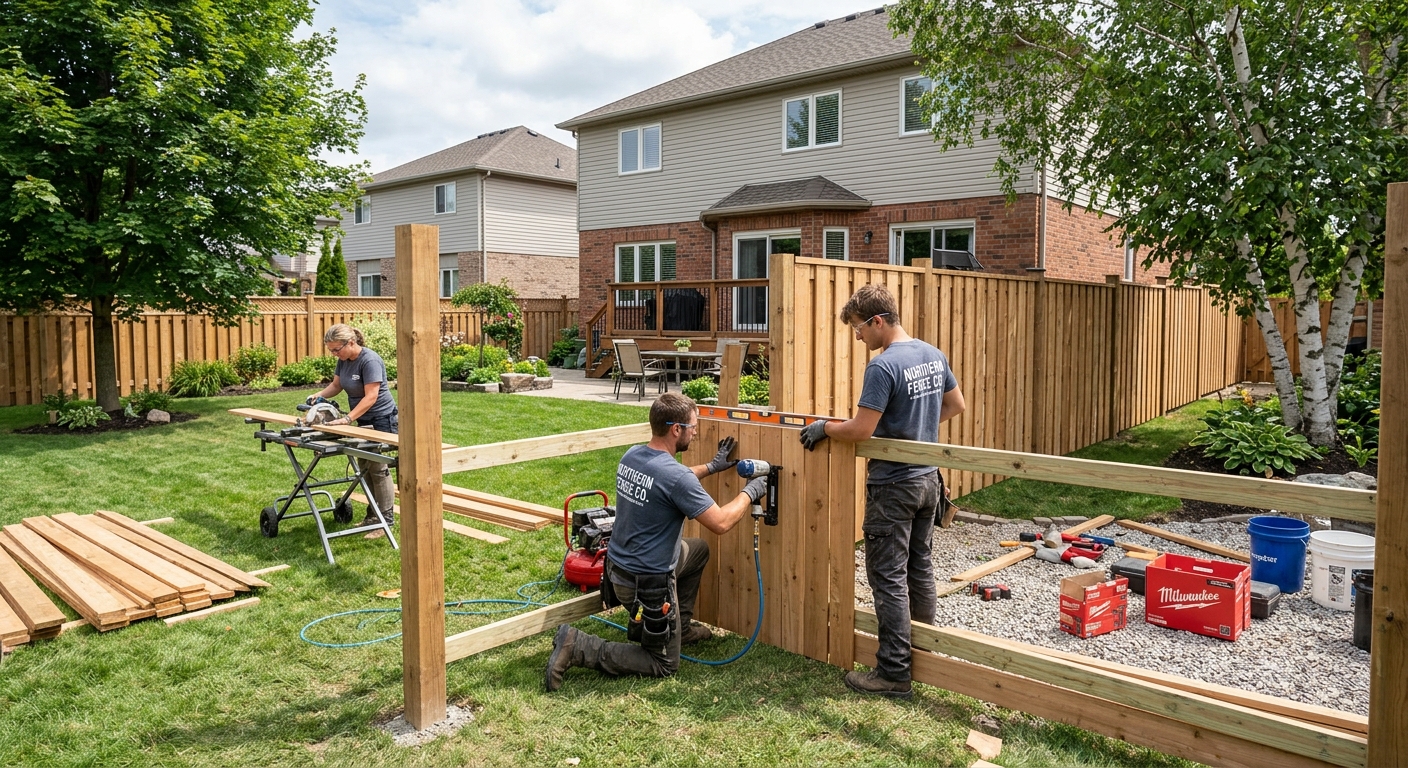
Fencing options and costs in Cambridge
Cambridge homeowners typically choose fencing based on privacy, upkeep, and how well the fence holds up through Ontario’s freeze–thaw cycle. With 56.8% of dwellings being single-detached homes and a strong homeownership base (68.9% of households own), there’s steady demand for yard privacy and perimeter security. Most projects in Cambridge also involve streets with mature neighbourhoods built before 1981 (48.4% of homes), where lots often have established grading, older utility corridors, and sometimes an existing fence that needs removal.
In the Kitchener–Waterloo–Barrie region, costs are shaped by cold-season ground movement: the frost line generally means deeper post holes, and for most 6 ft privacy runs, concrete-set posts are standard to reduce heaving and leaning. Wind across open stretches and newer subdivisions with limited tree cover can also increase labour time because contractors may tighten post spacing (often 6–8 ft centres) and use sturdier rails to prevent racking and blow-outs. Pricing in Cambridge usually lands in the mid-range of Ontario-wide averages, but your final number can swing depending on how many posts need concrete, how many sections require reinforcement, and whether gates or removals are included.
If you’re comparing options, use the table below as a practical starting point for typical installed ranges, then match the material to your maintenance tolerance and privacy needs in your Cambridge area—many crews stay busiest around Galt and the Preston-style residential pockets where backyards are deeper and privacy fencing is common.
| Material |
Lifespan |
Maintenance |
Privacy Rating |
Price per Linear Foot |
Price Range |
| Pressure-treated pine (standard wood) |
10–15 years |
Stain/seal every 2–3 years |
High (full privacy) |
$22–$35 |
$2,500–$6,000 |
| Cedar (natural rot resistance) |
15–25 years |
Seal/stain every 3 years (or as needed) |
High (full privacy) |
$26–$42 |
$3,000–$7,500 |
| Vinyl / PVC (no-maintenance) |
20–30 years |
Rinse only; inspect posts/gates |
High (lattice variations available) |
$28–$50 |
$3,500–$9,000 |
| Chain-link (galvanized steel) |
20–30 years |
Occasional rinse; tighten fittings |
Low (security only) |
$16–$30 |
$1,800–$4,500 |
| Aluminum ornamental |
25–40 years |
Rinse; rare touch-up |
Medium (semi-privacy) |
$24–$48 |
$3,000–$9,500 |
| Composite / recycled material |
20–30 years |
Minimal; wash and spot-check |
High (boards/panels) |
$30–$55 |
$3,800–$10,500 |
Prices are estimates only and vary by project scope, site access and material selection.
What affects the price of fencing in Cambridge
In Cambridge and across the Kitchener–Waterloo–Barrie region, fence quotes for the same “look” can differ by 30–50% because the real drivers are ground conditions, post installation method, and the amount of extra labour needed to keep the fence straight and plumb. A 40 ft run of 6 ft privacy fencing can be straightforward on level ground, but it becomes a different job when posts must go deeper for freeze protection, old fence removal is required, or multiple gates are involved. Labour rates and materials are broadly aligned with Ontario-wide pricing bands—wood installation often lands around the mid range (for example, the wood backbone of $45–$70 per unit of installed work and vinyl around $55–$90)—yet the “in-between” details swing the total.
Frost line depth is the biggest hidden cost: in cold Ontario, crews typically set posts approximately 4–6 inches below the design frost depth to help prevent heaving. Practically, that often means posts must be set roughly 1.5–2.0 m into the ground for a 6 ft privacy fence, with concrete-set posts becoming the norm. This increases material cost (more concrete and often longer boards/posts) and labour time (deeper augering, more handling).
Local examples in Cambridge that push prices up include: (1) an older backlot with compacted soil where augering takes longer and more concrete is needed per hole; (2) sloped properties near established neighbourhood pockets where contractors must step or rake panels, increasing rails and labour; and (3) new subdivisions where wind exposure and wider yard openings lead to tighter post spacing and heavier framing. Costs can come down when the run is short, the site is level, and there’s no removal or special gating—so your quote may land closer to chain-link economics (often the $35–$60 style band for installed work) when you choose a simpler, open security fence.
| Price Factor |
Why It Matters |
Cost Impact |
| Fence length in linear feet |
More sections = more posts, rails, and fittings |
Major; typically the primary cost driver |
| Post depth required |
Frost line determines hole depth and required post length |
Major; deeper holes increase auger time and concrete |
| Post setting method |
Concrete vs. gravel pack vs. driven posts affects stability |
Major; concrete-set is standard in cold seasons |
| Material choice |
Vinyl, cedar, and chain-link have different material and install rates |
Medium to major; vinyl often costs more upfront |
| Gate count and type |
Gates require heavier framing, hardware, and alignment work |
Medium; double drive-through gates add significant labour |
| Grade and terrain |
Slopes require stepped frames or raked panel systems |
Medium; can add posts/rails and time |
| Old fence removal and disposal |
Hauling and disposal add labour and dump fees |
Low to major; depends on length and condition |
| Permit fees and survey / property line locate |
Locates reduce the risk of encroachment and rework |
Low to medium; varies by project and scope |
Permits & regulations in Ontario
In Ontario, the height of your fence can determine whether a permit is required. As a general rule for many residential situations, fences above roughly 2.0 m (6.5 ft) at the rear and 1.0–1.2 m (3–4 ft) at the front or corner often trigger a building permit process. Even when permits aren’t required, fences must still respect property lines and municipal setback bylaws. If you’re planning a tall privacy fence along a corner lot, don’t assume “everyone has one”—confirm the height and location before materials are ordered.
Before any post hole is dug, you should call for utility locates through Ontario One Call (or your local equivalent service area). It’s also wise to obtain a survey or confirm your property pins before installing, because fencing placed over the line can lead to expensive rework and neighbour disputes. Shared fence ownership rules are handled under Ontario’s line-fences legislation, so document who is responsible for which sections if it’s a boundary fence.
To verify a contractor in Cambridge, ask for: (1) proof of Ontario licence/registration where applicable for the trade scope; (2) a current certificate of liability insurance; and (3) WSIB coverage (or a clearance letter where relevant). Where to look: the contractor’s online presence/registry listings for business status, and their insurance certificate directly from the broker/insurer. If they can’t produce current documents promptly, that’s a major risk—especially when posts are being excavated near utilities.
Choosing the right fence material for Cambridge
Choosing the right fencing material in Cambridge is mostly about matching your priorities—privacy, low maintenance, budget, and how long you want to wait before the next major refresh—to local weather reality. Cambridge’s winter freeze–thaw cycle means wood needs reliable post setting and good board treatment, while products like vinyl can perform well but must be installed correctly to avoid issues in extreme cold snaps. For backyard privacy, pressure-treated pine is usually the budget-friendly route, but it typically needs staining or sealing every 2–3 years to prevent greying and surface wear. Cedar looks better and resists rot naturally, but it still benefits from periodic sealing. Vinyl/PVC offers no-scrape, low-maintenance living, though it’s higher upfront and can be more sensitive to improper fastening in very cold conditions. If you want a long-life perimeter with the lowest initial cost, chain-link is hard to beat—just remember it won’t provide privacy unless you add slats or screening. Aluminum ornamental gives you a clean, rust-resistant look and is often a solid option for front yard boundaries.
On post depth: in the Kitchener–Waterloo–Barrie region, deeper post holes are needed to reduce heaving. In practice, many privacy installs use concrete-set posts because it’s more stable through Ontario winters. That matters most for 6 ft privacy fences where heavier boards and wind load can exaggerate movement if the base isn’t stable.
A concrete example: if a typical 6 ft wood privacy installation is priced closer to the wood band, say $45–$70, upgrading from pressure-treated pine to cedar often adds meaningful cost, but it can be justified because cedar can last longer (often 15–25 years) and usually holds its appearance better. If you’re staying budget-first and plan for maintenance, pressure-treated pine can make sense; if you want lower ongoing work and are okay paying more upfront, vinyl or composite can be the better long-term value—especially in a busy household where fence upkeep isn’t on your weekend calendar.
| Material |
Cold Tolerance |
Lifespan |
Annual Maintenance |
Best For |
Price Band |
| Pressure-treated pine |
Good with concrete-set posts and proper staining |
10–15 years |
Low (inspect, then stain/seal every 2–3 years) |
Budget privacy with planned upkeep |
$45–$70 |
| Cedar |
Very good; performs well when base and airflow are correct |
15–25 years |
Low to moderate (seal/stain about every 3 years) |
Privacy + appearance in Cambridge yards |
$55–$85 |
| Vinyl / PVC |
Good; needs correct installation to handle cold |
20–30 years |
Very low (rinse/inspect; no staining) |
Low-maintenance privacy |
$55–$90 |
| Chain-link |
Excellent (galvanized resists corrosion) |
20–30 years |
Low (tighten/replace fasteners as needed) |
Security perimeter on a budget |
$35–$60 |
| Aluminum ornamental |
Excellent; non-rusting frame |
25–40 years |
Very low (rinse/occasional check) |
Front yard boundaries with curb appeal |
$60–$110 |
| Composite / recycled |
Good; stable in cold when installed as per manufacturer |
20–30 years |
Low (wash/spot-check) |
Privacy with minimal long-term work |
$65–$100 |
How to choose a fencing contractor in Cambridge
Choosing the right fence contractor in Cambridge starts with verifying they can legally and financially stand behind the job. Ask for proof of their Ontario licence/registration where applicable for fencing trade scope, plus current liability insurance (certificate of insurance naming you if required by contract) and WSIB coverage or a clearance letter where relevant. To check: confirm the insurer certificate matches the contractor’s legal name, and request WSIB documentation directly—don’t rely on a photo of a lapsed document. For the workmanship side, a real fence company should be able to explain exactly how posts will be set for Ontario freeze conditions (typically concrete-set for privacy fences).
Next, request 2–3 itemised written quotes. You want a breakdown that shows labour and materials separately, including line items for posts, rails, fasteners, gates, and removal/disposal if applicable. Scrutinize what’s excluded: permit pulling, utility locate costs, survey/locate fees, and disposal. Warranty details should be explicit: the workmanship warranty length, the product/manufacturer warranty, and whether it’s transferable if you sell the home. For payment, avoid paying large deposits—keep upfront around 10–15% maximum—and use a holdback until the fence is complete and cleaned up. Finally, get the start date and the completion estimate in writing so you’re not guessing during winter scheduling.
- Confirm they can provide proof of insurance and WSIB/clearance letter before work begins.
- Ask whether posts will be concrete-set and how deep the holes will be for cold-season stability.
- Require an itemised quote (not a single lump sum) for materials, labour, and gates.
- Verify whether they include utility locates or if you must arrange it.
- Clarify disposal of old fence and whether dump fees are included.
- Check if the quote includes permit pulling (where required for height) or if you’re responsible.
- Request warranty terms in writing for both workmanship and product.
- Confirm gate hardware brand/type and whether it matches your usage needs (double vs. walk-through).
- Ask how they handle sloped yards—stepped vs. raked systems—and whether it affects pricing.
- Ensure the quote specifies panel spacing, post spacing, and rail configuration.
- Set the payment schedule in writing; avoid large upfront payments.
- Get a written start date and a realistic completion timeline that accounts for curing time with concrete.
Red flags I commonly see in Cambridge when homeowners get burned: (1) contractors who won’t show insurance and WSIB/clearance documentation; (2) quotes that omit post depth and concrete setting details; (3) “lowest price” bids that don’t include removal/disposal and then add it later; (4) vague warranty language (no term length or who it covers); and (5) payment demands that exceed about 10–15% upfront without a signed agreement.
Frequently asked questions — fencing in Cambridge
What's the best fence for privacy?
For privacy in Cambridge, most homeowners choose a 6 ft wood privacy fence (pressure-treated pine or cedar) or a vinyl/PVC privacy system. Wood remains the most common because it fits the look of many single-detached neighbourhoods and is flexible for stepped layouts on sloped yards. That said, Ontario’s freeze–thaw cycle means privacy fences need stable foundations—typically concrete-set posts—so you get a fence that stays straight rather than leaning over time. If you’re comparing budget and longevity, pressure-treated pine often fits the lower end of the wood pricing band (around $45–$70 installed work), while cedar usually costs more upfront but offers improved rot resistance and appearance. If you want the lowest ongoing upkeep, vinyl/PVC is a strong alternative, with many projects priced higher than wood but with fewer maintenance tasks.
How do I compare fencing quotes?
When comparing quotes in Cambridge, insist on itemised details rather than just “installed price.” Compare: post spacing and whether the contractor plans concrete-set posts; the actual fence height (and whether it includes any decorative top rails); gate count and hardware; and whether old fence removal and disposal are included. Also check whether utility locates and permit pulling (when needed for taller installations) are covered or excluded. Prices can swing because deeper frost-protected post holes increase concrete and augering time. As a quick sanity check, wood installations often fall in the $45–$70 range, vinyl/PVC commonly runs higher (roughly $55–$90), and chain-link tends to be lower (about $35–$60). If one quote is far below these while using the same materials and scope, ask what they’re leaving out.
How long does fence installation take in Cambridge?
Most fence installations in Cambridge take 1–3 days on site, but the timeline depends heavily on length, how many gates you’re adding, and whether an existing fence must be removed. For privacy fences, deeper post holes often mean more augering time, and concrete-set posts require proper curing before gates are fully adjusted. On a typical backyard privacy run (around 40–60 linear feet) with level ground and no major obstructions, many crews can complete framing and panel installation within a couple of days. If you need stepped sections on a slope, encounter mature roots, or have more complex alignment near property lines, plan for additional time. If winter is in the forecast, confirm scheduling because concrete and staining/sealing requirements can change near cold snaps.
Can I install a fence on a slope in Cambridge?
Yes—you can install a fence on a slope in Cambridge, but the method matters for both appearance and durability. Most privacy fences are installed using either stepped framing (each section changes height in increments) or raked panels (continuous slope adjustment). Your choice impacts material use (especially rails) and labour time. The contractor should explain how they’ll keep the fence visually straight and structurally sound with proper post setting, because frozen ground movement can exaggerate any weak base. A good contractor will also account for snow load and runoff patterns so the bottom clearance and panel alignment don’t trap moisture. In cold Ontario conditions, consistent post depth and correct base compaction are especially important on sloped yards, where the ground can vary quickly along the run.
What is the most weather-resistant fence for Cambridge's climate?
“Most weather-resistant” usually means best long-term performance through freeze–thaw, moisture, and wind. In Cambridge, aluminum and vinyl/PVC tend to be the most durable with the least maintenance, because they don’t rot the way untreated wood can over time. Aluminum ornamental is excellent for corrosion resistance and longevity, while vinyl/PVC is very popular for low-maintenance privacy. If you prefer wood, cedar can outperform standard pressure-treated pine in appearance and rot resistance, but it still requires maintenance and proper post setting. Whatever you choose, the foundation details drive performance: concrete-set posts for cold-season stability are standard for most 6 ft privacy installs. For price context, aluminum projects often fall toward the higher Ontario band (roughly $60–$110), while vinyl/PVC is commonly in the $55–$90 range.
How do I prevent wood fence rot in Cambridge?
To prevent rot in Cambridge, focus on two things: keeping wood dry and ensuring the posts are stable in freeze–thaw conditions. Use quality pressure-treated lumber rated for ground contact, and have posts set properly—concrete-set posts are typically the right approach in cold Ontario to reduce shifting and leaning that traps moisture and widens gaps. Avoid leaving wood in direct contact with soil; a consistent post base plus correct clearance helps. For the boards, apply a stain/seal schedule (pressure-treated pine commonly needs staining every 2–3 years) and inspect annually for damaged sections, loose fasteners, and end-grain exposure where rot starts. Also confirm good airflow behind the fence. Neighbourly boundary and line-fence issues can complicate repairs—so make sure you’re installing within property lines and that any shared responsibilities are understood from day one.