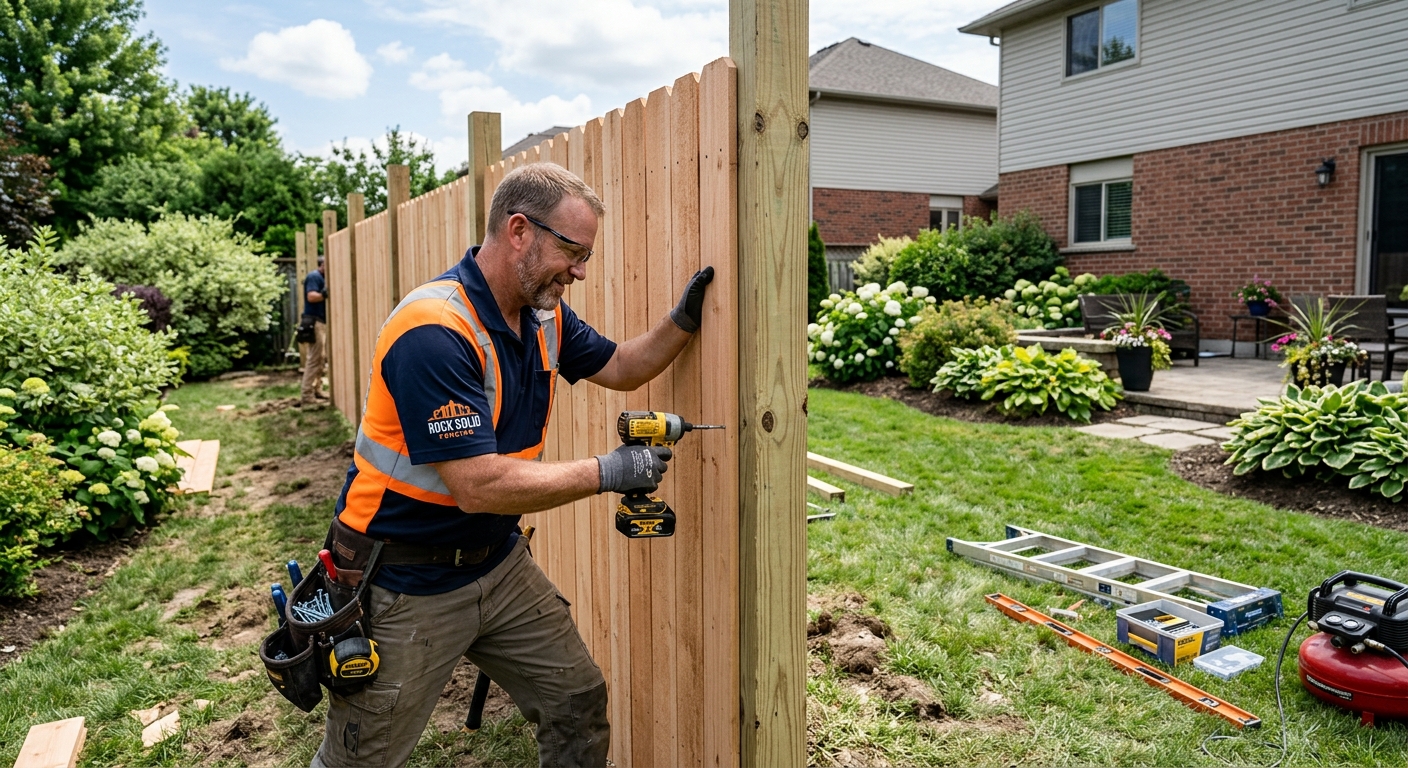
Fencing options and costs in Acton
In Acton, choosing a fence is usually the fastest way to upgrade curb appeal and protect privacy, and the market responds quickly to demand. With a population of 9,377 (Statistics Canada, 2021 Census), Acton is small enough that repeat customers and referrals matter—yet it still pulls contractors from across the Toronto economic region when neighbourhoods need upgrades. In practical terms, every detached home is a potential fencing customer, and the GTA’s dense housing stock keeps crews busy for seasonal installs.
Pricing here is shaped by Southern Ontario frost depth assumptions and the local preference for stable post foundations. Contractors typically set posts deep enough to avoid frost heave, especially for 6–8 ft privacy fences, which increases concrete, hole depth, and labour time. Toronto-area wind and racking resistance also influence post size and spacing for solid fences; a fence that’s “cheap on paper” can cost more if it needs beefier framing or hardware to stay plumb. If you’re in a high-visibility pocket—like along the more established residential strips near downtown Acton—expect steady demand for privacy upgrades and gate installs, and that can affect scheduling.
Below are common material options you’ll see in Acton quotes, with realistic price bands per linear foot to help you compare apples-to-apples before you meet a contractor. Use the maintenance and lifespan columns to match the option to how long you want to “set it and forget it,” then confirm post depth and concrete-setting details in your itemized scope.
| Material |
Lifespan |
Maintenance |
Privacy Rating |
Price per Linear Foot |
Price Range |
| Pressure-treated pine (standard wood) |
10–15 years |
Stain/paint every 2–3 years |
High (solid panels) |
$65–$120 |
$65–$120 |
| Cedar (natural rot resistance) |
15–25 years |
Light staining every 3–4 years |
High (solid panels) |
$75–$130 |
$75–$130 |
| Vinyl / PVC (no-maintenance) |
20–30 years |
Rinse as needed; no staining |
High (solid styles) |
$75–$130 |
$75–$130 |
| Chain-link (galvanized steel) |
25+ years |
Occasional rinse; straighten where needed |
Low (see-through) |
$45–$85 |
$45–$85 |
| Aluminum ornamental |
25–40 years |
Wash; repaint only if customized coating is damaged |
Low–Medium (ornamental pickets) |
$90–$160 |
$90–$160 |
| Composite / recycled material |
20–30 years |
Minimal cleaning; inspect fasteners |
High (solid boards) |
$75–$130 |
$75–$130 |
Prices are estimates only and vary by project scope, site access and material selection.
What affects the price of fencing in Acton
In Acton and the wider Toronto economic region, two quotes for the “same” fence can differ by 30–50% because frost depth, post design, and framing choices are often treated as extras instead of baseline requirements. In practice, contractors price around risk: if the soil is clay-heavy, if access is tight, or if a yard is sloped, crews must build a sturdier fence to prevent leaning and racking—both of which show up after freeze-thaw cycles.
Toronto’s frost-line planning is a major driver. While a common Southern Ontario assumption is roughly 42"–48" for frost depth, posts usually must be set about 4–6 inches below that design line to reduce the chance of heaving. For 6–8 ft privacy fences, that often means posts going about 1.5–2.0 m into the ground with concrete-set installation. That directly increases material cost (ready-mix) and labour time (deeper holes, additional setting time), pushing wood installations toward the upper part of the $65–$120 band. If you choose vinyl/PVC instead, you still pay for deep footings, and your total can land in the $75–$130 band because the higher material price stacks on top of foundation labour.
Wind and uplift aren’t as extreme as the Prairies, but local neighbourhoods with more exposure can require closer post spacing and heavier hardware. Concrete examples that commonly raise cost in Acton include: (1) clay/mixed soils that don’t compact well without proper backfill and careful post-setting, (2) sloped backyards where contractors must step/rake panels and add extra framing lumber, and (3) gate-heavy designs where double gates need stronger posts and hinges.
Conversely, costs can be lower when you have a straight run with clear access, minimal grading, and no old fence removal. A clean, linear installation is the simplest way to keep your quote closer to the low end of the material band.
| Price Factor |
Why It Matters |
Cost Impact |
| Fence length in linear feet |
The total number of rails, pickets/panels, posts, and fasteners scales with length. |
Usually the biggest driver; longer runs increase both material and labour. |
| Post depth required |
Frost planning determines how long the posts need to be and how deep the holes must go. |
Deeper holes mean more labour and more concrete; can shift price by tens of percent. |
| Post setting method |
Concrete-set posts improve stability versus simple gravel pack or driven posts. |
Concrete vs gravel can add notable material and labour time; driven posts reduce excavation. |
| Material choice |
Vinyl and cedar cost more upfront; chain-link and treated pine are cheaper but different in performance. |
Material bands determine the baseline (e.g., vinyl typically runs higher than chain-link). |
| Gate count and type |
Gates require stronger posts, hardware, and alignment time. |
Adding one gate can increase cost significantly; double gates are more expensive. |
| Grade and terrain |
Slopes require stepped or raked panels and additional framing adjustments. |
Often adds labour and hardware; can push your job toward the high end. |
| Old fence removal and disposal |
Demolition, hauling, and possible salvage time affect the schedule. |
Can add material handling cost and additional hours, especially with concrete posts. |
| Permit fees and survey / property line locate |
Some installations require formal approvals or a locate to avoid boundary disputes. |
Direct added fees; avoids costly rework later. |
Permits & regulations in Ontario
In Ontario, fence permits are typically tied to height and location. As a general rule used across many municipalities in Ontario, fences above about 2.0 m (6.5 ft) at the rear and around 1.0–1.2 m (3–4 ft) at the front or corner often require a building permit. Even when a permit isn’t required, every fence must respect property lines and municipal setback bylaws, which can vary by area.
Before digging any post hole, get utility locates. In Ontario you can use Ontario One Call to request utility markings so your crew doesn’t hit buried services. Next, confirm your property line—either with a survey or by locating your property pins/markers—so the finished fence doesn’t encroach. Boundary issues are one of the most common reasons fencing work gets paused for revisions.
Shared fence ownership and maintenance follow the provincial line-fences framework: typically, there’s an expectation of co-operation between property owners on shared segments, and responsibilities can be shared based on agreement and circumstances.
Contractor paperwork checklist (step-by-step): (1) Ask for the contractor’s Ontario licence information (and any business registration details they provide). (2) Request a certificate of insurance (COI) showing liability coverage for fence construction work, and verify it’s current. (3) Confirm workplace coverage for workers—WSIB clearance where applicable—before work begins. (4) Get the COI details and clearance letter dates in writing, and keep copies for your records.
If you’re unsure whether your height/location needs a permit in Acton, ask your contractor to specify the permit responsibility in the quote and confirm with the municipality before materials are ordered.
Choosing the right fence material for Acton
Choosing a fence material in Acton is really about matching your priorities to the realities of Southern Ontario weather—freeze-thaw cycles, damp shoulder seasons, and the need for solid post stability. Pressure-treated pine is the budget-friendly option, but it’s a maintenance material: you’ll typically need staining or painting every 2–3 years to slow grey weathering and keep water out of the wood grain. Cedar looks better for longer and has natural rot resistance, but it still benefits from periodic maintenance to keep colour even and prevent surface cracking.
Vinyl/PVC is the lowest-effort option day-to-day: no staining, easy rinse-down, and consistent colour. The trade-off is that vinyl can become brittle in extreme cold; with Ontario’s normal winter temperatures, this is usually manageable, but quality installation and proper expansion considerations matter. Chain-link is the longest-life and often the cheapest per foot, but it offers little privacy without slats or plant screening. Aluminum ornamental fencing adds durability and appearance without rust, though it’s not a privacy fence. Composite/recycled boards offer a good middle ground for privacy with reduced maintenance, but it’s important to use the right fasteners and inspect periodically.
For Toronto-area frost planning, tall fences still require deep, stable posts—often concrete-set posts with holes deep enough to stay below frost heave risk. That foundation work makes material comparisons real: for example, if you’re deciding between pressure-treated pine ($65–$120) and vinyl/PVC ($75–$130) for a 50 ft run, the vinyl price premium can be justified when you want to avoid staining costs and labour every couple of years, especially if your yard is inconvenient to access. Wind and snow load considerations also influence how robust the framing must be; solid panels generally need closer post spacing to limit racking.
Bottom line: pick the material that matches your willingness to maintain and your desired privacy level, then confirm your post depth and concrete setting are included so your budget survives winter.
| Material |
Cold Tolerance |
Lifespan |
Annual Maintenance |
Best For |
Price Band |
| Pressure-treated pine |
Good; needs protection from trapped moisture |
10–15 years |
Seal/stain or paint every 2–3 years (small touch-ups as needed) |
Lowest upfront cost for privacy |
$65–$120 |
| Cedar |
Good; naturally resists rot in wet seasons |
15–25 years |
Light staining every 3–4 years |
Better look with moderate maintenance |
$75–$130 |
| Vinyl / PVC |
Generally good with quality installation |
20–30 years |
Rinse as needed; inspect for impact damage |
Low-maintenance privacy |
$75–$130 |
| Chain-link |
Excellent |
25+ years |
Minimal; straighten and wash if needed |
Security on a budget |
$45–$85 |
| Aluminum ornamental |
Excellent |
25–40 years |
Wash; occasional coating touch-up if damaged |
Durability and curb appeal |
$90–$160 |
| Composite / recycled |
Good; depends on board quality and fasteners |
20–30 years |
Low—clean and inspect fasteners periodically |
Privacy with reduced upkeep |
$75–$130 |
How to choose a fencing contractor in Acton
In Acton, the best contractor isn’t the one with the cheapest per-foot number—it’s the one who proves they’re insured, scheduled, and aligned with Ontario expectations for safe work. Start by verifying liability insurance: ask for a current certificate of insurance (COI) that lists fence construction coverage. Next, confirm workplace coverage where applicable (WSIB clearance). You can usually verify WSIB status through the WSIB clearance process referenced by the contractor and by ensuring the clearance documentation is current at the time work starts. If crews are doing the work, make sure the contractor’s coverage aligns with the workers on site.
Then get 2–3 written itemized quotes. “Itemized” matters: labour and materials should be broken down (posts, rails, panels/pickets, gates, concrete, hardware, and disposal). Avoid lump sums that hide whether concrete-set posts are included or whether it’s only gravel backfill. Also ask whether permits are included—permit handling is sometimes on the homeowner, sometimes on the contractor, depending on scope and local requirements.
Read warranty terms carefully. You want a clear workmanship warranty length (often for fence build quality) plus any product/manufacturer warranty. Ask if warranties are transferable to the homeowner and what conditions void coverage (like improper cleaning, impacts, or unauthorized repairs).
Payment schedule: never pay more than 10–15% upfront. Hold back the remainder until the job is complete, cleaned up, and gate hardware is adjusted. Finally, insist on a start date and a completion estimate in writing so you’re not left guessing through Ontario’s weather swings.
- Confirm COI liability coverage is current and includes fence installation activities.
- Ask for WSIB clearance documentation (or the contractor’s workplace coverage statement) dated for your start month.
- Verify the quote includes post depth and the setting method (concrete-set vs gravel pack).
- Request an itemized breakdown: labour, materials, concrete, hardware, gates, and disposal.
- Confirm whether old fence removal and dumping are included, including buried post extraction.
- Ask how they handle sloped yards (stepped vs raked panels) and whether it’s included in the price.
- Confirm gate specs: number of hinges, latch type, and whether double gates need heavier posts.
- Make sure the quote states who is pulling any required permit and scheduling inspections (if applicable).
- Check the workmanship warranty length and what it covers (post stability, leaning, rack resistance).
- Ask whether product/manufacturer warranties apply to installed components and are transferable.
- Use a payment schedule with a small deposit only (10–15%) and a holdback until completion.
- Get a written start/completion timeline and a cleanup/removal plan for debris.
Red flags I see in Acton: (1) quotes that don’t specify post depth or concrete-set requirements, (2) no proof of insurance/WSIB coverage, (3) “cash only” pressure with large upfront payments, (4) vague scope language like “standard hardware” without gate details, and (5) refusing to put the timeline and warranty in writing.
Frequently asked questions — fencing in Acton
Do I need a permit to build a fence in Ontario?
In Ontario, many fences do not need a permit, but height thresholds often trigger permit requirements. As a common guideline used by many municipalities, fences above about 2.0 m (6.5 ft) at the rear and around 1.0–1.2 m (3–4 ft) at the front or corner may require a building permit. Even when a permit isn’t required, your fence must respect municipal setback bylaws and stay within property lines. For Acton homeowners, the safest approach is to ask your contractor to clarify whether your exact fence height/location triggers a permit and to spell out in the quote who pulls it. Also remember: always call for Ontario One Call utility locates before any post holes are dug.
How long does a wood fence last in Acton?
A wood fence lifespan in Acton is strongly tied to maintenance, drainage, and how deep the posts are set. With pressure-treated pine, most homeowners plan for roughly 10–15 years, especially if staining is skipped or delayed. Cedar typically lasts longer—often 15–25 years—because it’s naturally more resistant to rot in damp seasons. In Toronto-area freeze-thaw cycles, concrete-set posts (set below frost risk) help prevent heaving that can shorten a fence’s life. If your wood fence is built with proper post depth and annual inspection, it’s more likely to last near the top end. Budgeting within the $65–$120 band for treated pine often still means you’ll spend again on staining every 2–3 years.
Who owns and maintains a shared fence?
Shared fence ownership in Ontario generally follows provincial line-fences rules, which can require cooperation between neighbours and may define who pays for what depending on the situation and agreements. In practice in Acton, many shared segments are maintained jointly, but disputes arise when one side changes materials, height, or alignment without discussion. The best step is to confirm who owns the boundary segment and what the neighbours agreed to historically—then ensure your contractor’s work plan matches that boundary. For solid privacy fences, even small differences in post placement can become contentious, so confirm property line location before installation. If you’re replacing an existing shared fence, ask your contractor to document the baseline condition and alignment in writing.
How do I find my property line before fencing?
Before you fence in Acton, you should confirm the property line—ideally with a survey, or at minimum by locating property pins/markers. A survey provides the clearest boundary documentation and helps avoid encroachment issues that can lead to costly removals. If you don’t have a current survey, ask your contractor whether they recommend obtaining one or performing a locate based on existing pins. Then, before any digging starts, call Ontario One Call to mark utilities so you can fence without hitting buried services. The combination of a verified boundary and utility locates protects you both legally and practically—especially when you’re placing posts deep enough to manage frost heave risk in Southern Ontario.
What's the most low-maintenance fence?
For most Acton homeowners, vinyl/PVC is the most low-maintenance choice: it doesn’t need staining and typically just requires an occasional rinse and visual inspection for impact damage. Vinyl usually falls in the $75–$130 per-foot range, depending on style and installation requirements, but you’re buying time saved. Composite/recycled materials are also low-maintenance for privacy-style fences. Chain-link is low maintenance too (often the easiest to live with), but it won’t give privacy without slats, and it may not match the look you want. Wood can be made to last, but it’s rarely truly “no work”—pressure-treated pine often needs staining every 2–3 years, and cedar usually needs attention every few years.
How tall can my fence be in Acton?
Fence height rules depend on whether the fence is at the front, corner, or rear and on municipal setback bylaws. A common Ontario guideline is that rear fences may be allowed up to around 2.0 m (6.5 ft) without triggering special steps, while front or corner sections are often closer to 1.0–1.2 m (3–4 ft). Because your exact location on the lot can change what’s allowed, don’t rely on a neighbour’s fence height as the rule for your property. In Acton, confirm with your contractor whether your height/location requires a permit and whether a property line locate is needed before installation. Also consider that taller solid fences require sturdier posts and tighter spacing to resist racking and wind stress, which affects total installed cost.