Fencing options and costs in Maple Leaf
In Maple Leaf, Ontario, the right fence choice is usually about balancing privacy, upkeep, and how long you need it to last through Toronto-area freeze–thaw cycles. With a population of 10,111 (Statistics Canada, 2021 Census), local demand isn’t massive compared to the core GTA, but the surrounding Toronto region still pulls in steady contractor activity, especially in family neighbourhoods where backyard living is a priority. Every detached and semi-detached backyard is essentially a potential fencing project, and ownership density is what keeps installers busy year-round. (Statistics Canada, 2021 Census)
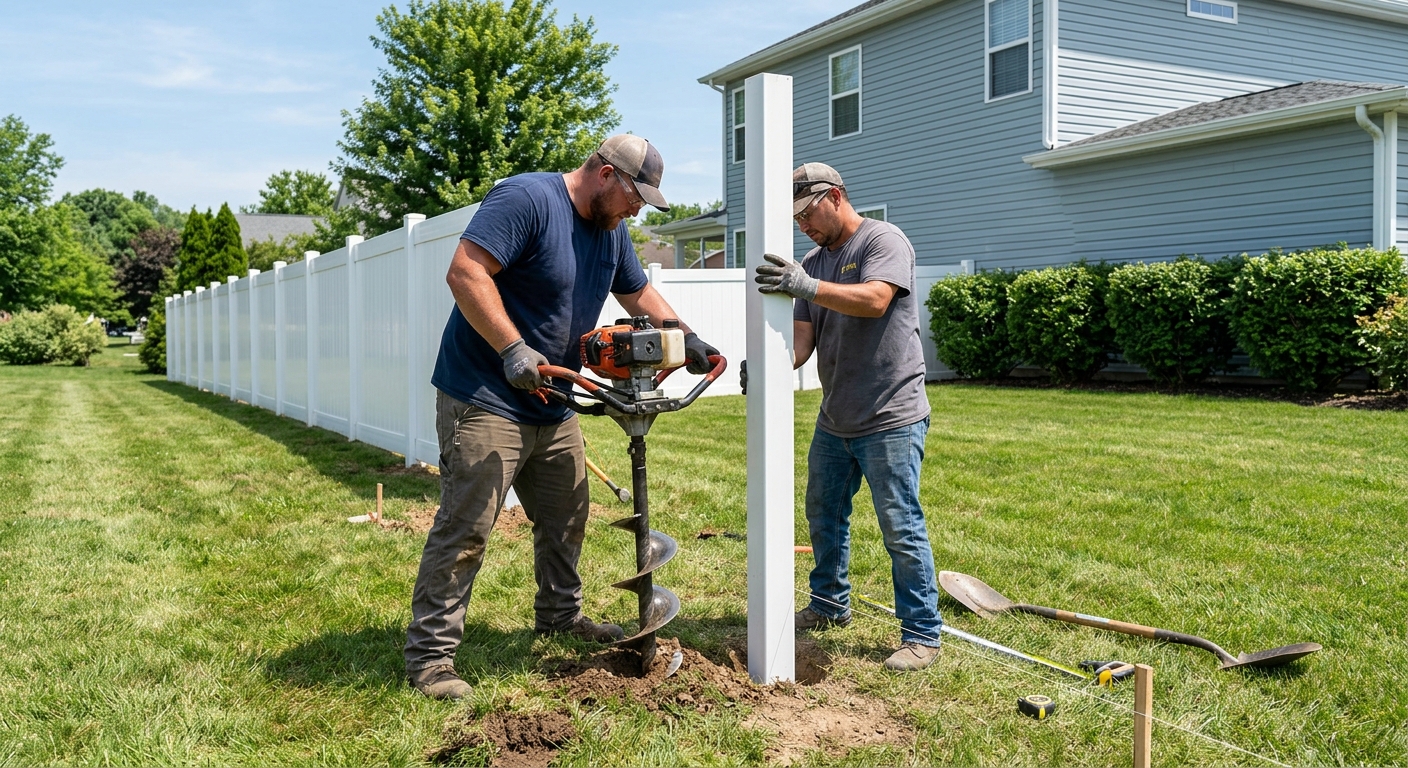
Toronto-area fencing costs are shaped heavily by climate and common site conditions. Frost in Southern Ontario is commonly managed by setting posts deep enough to avoid frost heave; many contractors plan for posts set about 42"–48" down, with a practical installation depth of roughly 3.5–4 ft for typical privacy-fence heights. Because Maple Leaf-area soils can be clay-mixed, most crews recommend concrete-set posts for 6–8 ft wood and vinyl privacy fences to reduce long-term leaning and panel racking. You’ll also see demand spikes around east-end and north-side corridors, and areas closer to ravines or busy arterial roads where wind exposure makes sturdier hardware and heavier posts worthwhile.
Below is a homeowner-friendly comparison of common materials and typical pricing for Maple Leaf projects, so you can sanity-check quotes before you book a site visit.
| Material |
Lifespan |
Maintenance |
Privacy Rating |
Price per Linear Foot |
| Pressure-treated pine (standard wood) |
10–15 years |
Stain/seal every 2–3 years; fastener checks |
High (solid panels) |
$65–$120 |
| Cedar (natural rot resistance) |
15–25 years |
Seal/stain as needed (often every 2–4 years) |
High (solid panels) |
$80–$140 |
| Vinyl / PVC (no-maintenance) |
20–30 years |
Occasional wash; inspect for impact damage |
High (solid or semi-solid styles) |
$75–$130 |
| Chain-link (galvanized steel) |
20–40 years |
Minimal; periodic coating/repair |
Low (privacy requires additions) |
$45–$85 |
| Aluminum ornamental |
25–40 years |
Wash yearly; touch-up if damaged |
Low–Medium (depends on infill) |
$90–$160 |
| Composite / recycled material |
20–30 years |
Low; rinse as needed |
High (solid plank styles) |
$110–$180 |
Prices are estimates only and vary by project scope, site access and material selection.
What affects the price of fencing in Maple Leaf
In Maple Leaf, you can see the same fence design priced 30–50% differently across Toronto and Ontario because the big variables aren’t just “material.” They’re site conditions (soil and grade), how deep and how accurately posts must be set, the wind-rated hardware needed to prevent racking, and whether your quote includes demolition, hauling, and any required property-line work. Two crews can install “6 ft wood privacy” and end up with different post depth, different spacing, and different rail/bracing—so the labour and material quantities change fast.
Frost line depth is the deciding factor for post cost in Southern Ontario. Contractors commonly plan holes about 4–6 inches below the design frost depth, which translates to roughly 1.5–2.0 m of embedment in cold seasons. That usually means longer posts and concrete-set work (not just driven posts), increasing both ready-mix costs and installation time. In practical Maple Leaf terms, a concrete-set privacy fence can be closer to the upper end of the wood and vinyl bands (for example, the wood installation band often reads around $65–$120 per linear foot, while vinyl/PVC commonly falls in the $75–$130 band), largely due to concrete volume and post length.
Local conditions also push costs up or down. Example one: clay-heavy yards that stay wet require a different footing prep and slower digging for clean post holes. Example two: homes backing onto open corners or near busier corridors may need tighter spacing and heavier posts to handle gust loads and uplift. Example three: if you’re replacing an older chain-link run, removal can add labour but the new materials may stay in the chain-link range of about $45–$85 per linear foot.
Finally, housing age matters: older properties sometimes have less predictable fence locations (pin uncertainty) and more buried debris, which can add a few hours and change the hardware package—so “short runs” can still land in mid-range pricing rather than the low end.
| Price Factor |
Why It Matters |
Cost Impact |
| Fence length in linear feet |
The number of posts, rails, panels and fasteners scales directly with length. |
Largest driver (often 50–70% of total). |
| Post depth required |
Frost management dictates embedment; deeper holes mean longer posts and more excavation. |
Can add 10–25% depending on depth and soil. |
| Post setting method |
Concrete-set posts cost more than gravel pack or driven posts, but perform better in freeze–thaw. |
Concrete typically increases labour + materials. |
| Material choice |
Vinyl, cedar, chain-link and aluminum carry different material costs and installation labour rates. |
Can swing overall price by 20–40%. |
| Gate count and type |
Gates require stronger frames, hinges, latch hardware and sometimes additional bracing. |
Each gate can add a noticeable bump (often several hundred to over a thousand dollars). |
| Grade and terrain |
Slopes require stepped or raked panels and more layout time to keep a level look. |
Adds labour; can increase material cutting waste. |
| Old fence removal and disposal |
Hauling and demolition time increases when fencing is old, twisted or partly embedded. |
Can add 5–20% depending on condition. |
| Permit fees and survey / property line locate |
Some fence heights or locations may require approvals; locating pins protects against encroachment. |
Variable, but often $200–$1,000+ combined. |
Permits & regulations in Ontario
In Ontario, fence permitting is usually driven by height and location. As a practical rule in many municipalities around the Toronto area, fences above about 2.0 m (6.5 ft) at the rear and roughly 1.0–1.2 m (3–4 ft) at the front or corner often need a building permit. Setbacks and property line rules still apply, so even a “permitted” height can be an issue if it crosses the property line or violates municipal setback bylaws.
Before any post holes are dug in Maple Leaf, call for utility locates through Ontario One Call. That’s not optional—hitting hydro, gas or communication lines is costly and unsafe. Next, verify your boundary using a survey or by locating the property pins. This protects you from the most common dispute I see: where the installed line ends up offset from what neighbours believe is the boundary.
Shared fence ownership is governed by Ontario’s line-fences legislation, so if your fence is along a shared boundary, confirm who owns which side and what the cost-sharing expectations are before construction starts.
How to check contractor compliance (step-by-step): (1) Licensing—confirm the contractor’s business details and any applicable registration through the appropriate provincial resources and their own documentation; (2) Liability insurance—ask for a current Certificate of Insurance with your address listed where applicable; (3) WSIB/WCB/WCA—obtain proof of coverage or clearance letter so you’re not left holding the risk for injuries. Then insist the quote states responsibilities for permits (if required) and disposal.
Choosing the right fence material for Maple Leaf
Choosing the right fence material in Maple Leaf comes down to your priorities: privacy, low maintenance, and how reliably the fence handles Toronto-area freeze–thaw. Pressure-treated pine is the budget-friendly workhorse, but it typically needs staining or sealing every 2–3 years to reduce grey weathering and to keep boards looking consistent. Cedar has better natural rot resistance and a richer appearance, yet it still benefits from periodic sealing to maintain colour and slow surface checking.
Vinyl/PVC is popular because it’s near “no-maintenance” for homeowners—wash it occasionally and inspect for impact damage. The upfront cost is higher than standard wood, and extreme cold can make some panels less forgiving, which is why proper post depth, spacing and correct hardware installation matter in Ontario. Chain-link is the lowest-cost option with the longest service life, but it provides minimal privacy unless you add privacy slats, screens or plantings. Aluminum ornamental is good for durability and curb appeal with no rust, but it’s not designed for full privacy; it’s typically a visual barrier with open areas.
For post depth: because frost management is central in Southern Ontario, Toronto-area installations often require concrete-set posts with roughly 1.5–2.0 m embedment for typical privacy fence heights. That’s not the place to “cut corners,” especially on solid panel styles where racking can happen during freeze–thaw and wind gusts. If you’re deciding between wood and vinyl, a real-world justification is: spending closer to the vinyl band (around $75–$130 per linear foot) can make sense when you want fewer annual chores and better long-term appearance, particularly if you plan to stay in the home for 10+ years.
| Material |
Cold Tolerance |
Lifespan |
Annual Maintenance |
Best For |
Price Band |
| Pressure-treated pine |
Good when properly sealed and built with concrete-set posts |
10–15 years |
Light inspection; stain/seal every 2–3 years |
Budget privacy with a realistic upkeep plan |
$65–$120 |
| Cedar |
Good; responds well to regular sealing in Ontario winters |
15–25 years |
Seal/stain as needed (often every 2–4 years) |
Longer-lasting privacy and better natural look |
$80–$140 |
| Vinyl / PVC |
Very good; holds up if installed with correct hardware and spacing |
20–30 years |
Occasional wash; check for impact |
Low-maintenance privacy in freeze–thaw conditions |
$75–$130 |
| Chain-link |
Excellent; galvanized steel tolerates cold well |
20–40 years |
Minimal—periodic tension and coating checks |
Security and containment on a tight budget |
$45–$85 |
| Aluminum ornamental |
Excellent; powder-coated systems resist Ontario weather |
25–40 years |
Yearly wash; touch-up if needed |
Durability and curb appeal (not full privacy) |
$90–$160 |
| Composite / recycled |
Good; performs well when anchored and aligned correctly |
20–30 years |
Low—rinse/clean as needed |
Privacy with reduced upkeep |
$110–$180 |
How to choose a fencing contractor in Maple Leaf
Choosing the right contractor in Maple Leaf starts with proof, not promises. First, verify Ontario licensing/business credentials where applicable, then confirm liability insurance—ask for a Certificate of Insurance that matches the work being performed. Next, check WSIB/WCB coverage: request proof of clearance or coverage documentation so you’re protected if a worker is injured on your property. Don’t accept “we have it” verbally; ask for documents and keep copies for your records.
When requesting quotes, insist on 2–3 itemised written estimates. A good fence quote breaks down labour and materials (posts, rails, panels, concrete/footings, hardware, gates) rather than using one lump sum. Read the scope carefully: is permit pulling included (if required for your height/location), is old fence removal and disposal included, and what’s excluded (site grading, trimming landscaping, extra concrete beyond X cubic yards)?
Warranty is another differentiator. You want a workmanship warranty stated in writing (often for installation defects) and a manufacturer/product warranty for materials. Confirm whether the warranty is transferable to future owners, and what conditions void it—like missing maintenance requirements.
Payment schedule matters. Never pay more than 10–15% upfront; hold back the remainder until the job is complete and cleaned up. For timing, ask for a start date and realistic completion estimate in writing, including contingencies for weather and cure time for concrete-set posts.
- Ask for proof of liability insurance and WSIB/WCB coverage before signing.
- Use an itemised quote: labour, posts/rails, concrete, hardware, gates, and disposal.
- Confirm post depth plan for frost protection (concrete-set where appropriate).
- Verify panel spacing and post sizing for your fence height and style.
- Check whether the quote includes utility locate call coordination.
- Confirm whether permit pulling is included if your fence height triggers it.
- Make sure removal of the old fence and debris hauling is explicitly included.
- Get gate hardware details (hinge type, latch type, swing direction) in writing.
- Ask about warranty duration for workmanship and product.
- Confirm the exact payment schedule and holdback amount.
- Request start/completion dates and how weather delays are handled.
- Look for a clear plan for slopes: stepped vs. racked sections must be specified.
Common red flags in Maple Leaf include: “all-in” lump-sum quotes with no post-depth or disposal detail, contractors who can’t show insurance/coverage documents, missing or vague warranty terms, unwillingness to put start dates and scope in writing, and pricing that seems too low compared with the typical Toronto-region bands (for example, quoting far below $65–$120 per linear foot for wood privacy without explaining different footing depth or material grade).
Frequently asked questions — fencing in Maple Leaf
How tall can my fence be in Maple Leaf?
In Ontario, maximum fence heights typically depend on where the fence sits (front/corner vs rear) and on municipal bylaws. A common practical benchmark in the Toronto area is that fences higher than about 2.0 m (6.5 ft) at the rear, or around 1.0–1.2 m (3–4 ft) near the front or corner, may trigger a building permit requirement. Even if a fence height is allowed, setbacks from property lines still matter, and solid privacy styles can have extra scrutiny because they affect views and wind loading. For your exact Maple Leaf lot, ask your contractor to confirm the applicable height rules and whether a permit is needed before any posts are set.
Should fence posts be set in concrete here?
For most privacy fences in Maple Leaf and the wider Toronto region, concrete-set posts are the safer default because freeze–thaw can push poorly founded posts out of plumb. Southern Ontario frost management commonly leads contractors to plan embedment around 1.5–2.0 m into the ground, which is why many crews use concrete footings rather than simple driven posts. This is especially true for 6–8 ft solid panel fences where wind can rack the frame. If your contractor is proposing driven posts only, ask how they’re handling frost depth and soil conditions. Concrete work is one reason wood installs often land in the $65–$120 per linear foot band and vinyl/PVC commonly falls around $75–$130.
What's the best fence for privacy?
For privacy in Maple Leaf, the best-performing options are solid-panel wood, cedar, vinyl/PVC, or composite privacy fences with tight picket/plank spacing and properly sized posts. Chain-link can work for containment, but it won’t provide real privacy unless you add slats or screens, and aluminum ornamental is typically more decorative than private. The key is structural stability: correct post depth for Ontario frost cycles, appropriate spacing (often tighter on taller solid fences), and good bracing/hardware to prevent racking. If you want low upkeep, vinyl/PVC is often the easiest long-term choice; if you want a more budget approach, pressure-treated wood can fit, but it usually needs staining/sealing every 2–3 years.
How do I compare fencing quotes?
Compare quotes the way you’d compare flooring installs: line-by-line. Ask for itemised breakdowns—labour, materials, post depth/footing method, concrete quantity (if used), hardware quality, gate count, and disposal/hauling of the old fence. Make sure the scope addresses your grade situation (stepped vs raked panels), and confirm whether permits and property line locate work are included. A quote that’s “cheaper” may use different post embedment, looser spacing, thinner rails, or omit removal—those differences can swing results by 30–50%. As a quick benchmark for Maple Leaf, wood privacy installs often appear in the $65–$120 per linear foot range, while vinyl/PVC tends to sit around $75–$130.
How long does fence installation take in Maple Leaf?
Timing depends on fence length, number of gates, and how much prep is needed. For typical Maple Leaf backyards, a straightforward run can take a few days once material is on-site, but bigger projects (multiple sections, gates, or slope work) can stretch longer due to layout, removals, and curing time for concrete-set posts. Weather matters: rain can slow excavation and footing prep, and freezing conditions can affect concrete curing and production schedules. In your written estimate, ask for a start date and completion timeline that includes cure/weather contingencies, and confirm whether the contractor will schedule a follow-up for adjustments after settlement or inspection. A well-prepared site usually installs faster and looks cleaner.
Can I install a fence on a slope in Maple Leaf?
Yes, you can install a fence on a slope in Maple Leaf, but the construction method must be planned. You typically choose between “stepped” panels (each section changes height gradually) or “raked” panels (one continuous angle), and the choice affects both appearance and structural stress. If frost movement is a concern, consistent footing depth and careful concrete setting are important so posts don’t end up uneven or under-supported after the freeze–thaw cycle. Sloped yards can add labour because layout takes longer and some boards/pickets may need more cutting. Make sure your contractor includes slope strategy in the scope, since switching methods midway can change material waste and total cost.