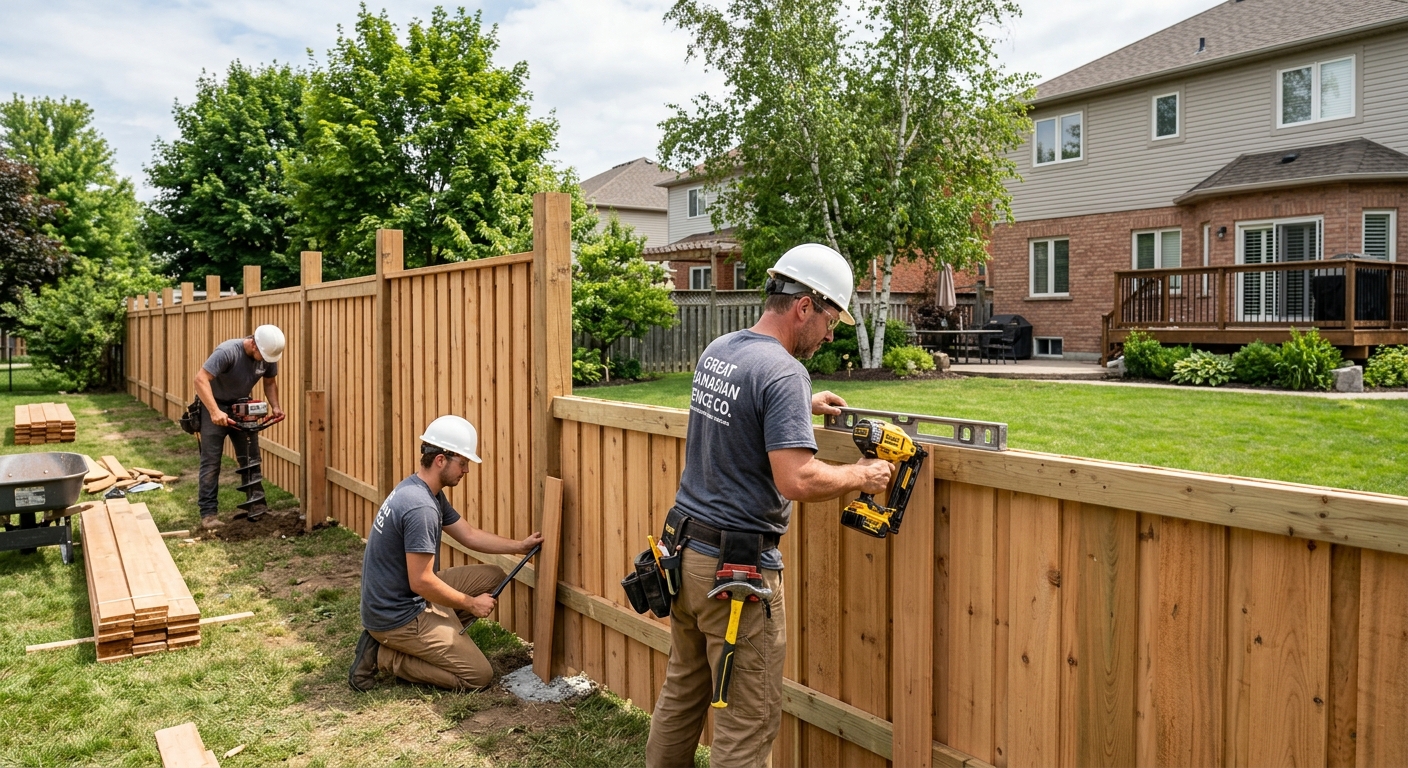
Fencing options and costs in Pelmo Park-Humberlea
Pelmo Park-Humberlea is a family-oriented pocket of Toronto where fencing tends to be both functional and neighbourhood-polished. With a population of 10,722 (Statistics Canada, 2021 Census), there’s a steady baseline of owner-occupied homes—meaning fence refreshes, privacy upgrades, and yard boundary fixes are common in the local trade cycle. In the Toronto economic region, pricing is shaped less by “what you can build” and more by what it must survive: frost movement, freeze–thaw cycles, and wind-loading on tall panels. That’s why many Toronto-area estimates land in a similar range, but your final number can still move significantly depending on post depth, concrete-set requirements, and gate hardware. For 6–8 ft privacy fences, crews typically set posts deeper to reduce heaving—often about 3.5–4 ft to the bottom of the footing—and that adds labour, excavation time, and concrete/ready-mix costs.
In Pelmo Park-Humberlea—especially around the busy residential blocks closer to local arterials—contractors often see demand for solid wood privacy, vinyl privacy, and sturdy gate repairs. If you’re comparing options now, the fastest way is to look at the material “shape” (lifespan and maintenance) and the installed linear-foot pricing. Use the table below as your backbone, then we can fine-tune based on length, terrain, access, and whether you’re removing an existing fence.
| Material |
Lifespan |
Maintenance |
Privacy Rating |
Price per Linear Foot |
| Pressure-treated pine (standard wood) |
10–15 years |
Stain/seal every 2–3 years to reduce grey weathering |
High (solid board) |
$20 – $32 |
| Cedar (natural rot resistance) |
15–25 years |
Light staining every 2–3 years; periodic fastener checks |
High (solid board) |
$26 – $42 |
| Vinyl / PVC (no-maintenance) |
25–35 years |
Occasional wash only; inspect hinges/latches |
High (privacy panels) |
$25 – $40 |
| Chain-link (galvanized steel) |
20–30 years |
Minimal; rinse and check tension/rails |
Low to Medium (typical) |
$12 – $18 |
| Aluminum ornamental |
25–40 years |
Minimal; occasional cleaning |
Low to Medium (open picket) |
$18 – $28 |
| Composite / recycled material |
20–35 years |
Low; clean seasonally, check panel fit |
High (privacy styles) |
$28 – $46 |
Prices are estimates only and vary by project scope, site access and material selection.
What affects the price of fencing in Pelmo Park-Humberlea
Homeowners in Pelmo Park-Humberlea can see quotes for the “same” fence swing by 30–50% across the Toronto area because Toronto pricing is built on risk management: frost-proofing, wind bracing, and how difficult your specific yard is to build in. Two backyards can have identical linear footage, but one has easy access and flat grade while the other has a steep slope, tree roots, and a gate where a driver must stage material. In the GTA, concrete-set posts are common practice due to Southern Ontario frost movement. The frost line is commonly taken at about 42"–48", so crews plan for posts set deeper—often around 3.5–4 ft—so you avoid heaving that can rack panels or loosen rails. That depth typically means longer posts, deeper holes, and more labour plus ready-mix costs, particularly for taller 6–8 ft privacy fences.
Here are a few concrete examples of how local conditions raise or lower cost in Pelmo Park-Humberlea. First, upgrading a privacy fence from chain-link (often $45–$85 per linear foot installed depending on scope) to vinyl/PVC privacy ($75–$130) costs more upfront because rails and heavier framing require additional hardware and sometimes closer post spacing. Second, a switch from “driven” posts to concrete-set posts can add several hundred dollars on a small run and more on longer lengths because it changes excavation, material quantities, and install time. Third, a sloped yard can increase labour for stepped or raked sections—small changes in grade can add $500–$1,200+ to the job on a typical mid-sized yard due to adjustments, custom trimming, and additional alignment time. Finally, if you need removal and disposal, demolition often becomes the hidden driver: extra truck time, dump fees, and hauling can push total cost toward the top of the applicable wood or vinyl band.
| Price Factor |
Why It Matters |
Cost Impact |
| Fence length in linear feet |
The primary driver; most costs scale directly with footage |
Higher runs can move totals by thousands |
| Post depth required |
Frost movement sets footing depth and hole size |
More depth increases concrete, labour and post length |
| Post setting method |
Concrete vs. gravel pack vs. driven posts affects stability |
Concrete-set usually costs more but reduces heaving/racking |
| Material choice |
Different hardware, framing, and panel weight change install time |
Vinyl/PVC and cedar typically land above treated pine; chain-link is lowest |
| Gate count and type |
Gates need heavier framing, hinges, and latches |
Each gate commonly adds a meaningful fixed premium |
| Grade and terrain |
Slope requires stepped posts/panels or raked rails |
Can add labour and material waste |
| Old fence removal and disposal |
Demolition time and hauling/landfill fees |
Often adds hundreds to over a thousand depending on condition |
| Permit fees and survey / property line locate |
Administrative and verification steps protect against encroachment |
Small but not trivial; can add measurable project overhead |
Permits & regulations in Ontario
In Ontario, fences are not “one-size-fits-all,” but height and placement commonly trigger permit requirements. As a practical rule homeowners use in Pelmo Park-Humberlea: rear fences often fall under permit consideration when they exceed about 2.0 m (6.5 ft), while front yard or corner-side fences commonly draw attention when above roughly 1.0–1.2 m (3–4 ft). Your local municipal bylaw still governs setbacks from property lines and how the fence is allowed to sit relative to easements, driveways, and visibility triangles. Before any post hole gets dug, you should call for utility locates using Ontario One Call. That locate step is important because fencing work intersects with hydro, low-voltage lines, and sometimes irrigation or gas laterals.
Step-by-step, here’s how a homeowner can verify a contractor’s credentials in Ontario. Start with the contractor’s business details and licence information through the appropriate online registry used for Ontario’s licensing framework (confirm the company name matches the quote/contract). Ask for a current certificate of insurance for general liability and ensure the work coverage includes fencing installation, not just “general construction.” For worker coverage, request WSIB documentation/clearance letter (or proof they are registered and compliant). If the contractor won’t provide current certificates promptly, treat it as a red flag.
What typically does not require a permit is minor, like-for-like replacement in the same location and height. What does typically require a permit or formal review is new fencing that exceeds common height thresholds, any fence on/near property lines where setbacks or easements must be confirmed, and situations that involve major changes to placement or structure. When in doubt, request the permit plan in writing before construction begins.
Choosing the right fence material for Pelmo Park-Humberlea
Choosing fencing in Pelmo Park-Humberlea is mostly about matching material to your priorities—privacy, low maintenance, budget, and how long you want the fence to look “installed” rather than weathered. Pressure-treated pine is the budget-friendly path, but in Toronto’s freeze–thaw climate it usually needs staining or sealing about every 2–3 years to avoid grey weathering and surface checking. Cedar is more forgiving aesthetically; it naturally resists rot better and often looks richer over time, but it still benefits from periodic maintenance. If you want the cleanest “set it and forget it” experience, vinyl/PVC is a strong option: it typically won’t need staining, but in extreme cold it can become brittle at very low temperatures—proper installation, good post alignment, and correct expansion considerations matter.
For cold Ontario conditions, post depth is a bigger deal than the material type. With Toronto frost movement (commonly planned around a 42"–48" frost line), crews commonly set fence posts about 3.5–4 ft deep for 6–8 ft privacy fences using concrete-set footings to prevent heaving. That extra stability helps wood and vinyl racks less when the ground moves. Wind and snow load considerations also favour sturdier framing—especially for tall solid panels—so taller privacy fences need heavier posts (or larger framing) and closer spacing to resist uplift/racking in gusts. In practice, many Pelmo Park-Humberlea projects use heavier posts and rails even when homeowners start with a lower material budget.
Where the price difference is justified: if treated pine privacy is in the $65–$120 wood band installed, switching to cedar can land above it, but cedar often delays replacement and keeps the fence looking better longer. Meanwhile, vinyl/PVC privacy (often $75–$130 in this region) can be worth it if you want to reduce maintenance visits and staining timelines—particularly for longer backyards where upkeep is a recurring headache.
| Material |
Cold Tolerance |
Lifespan |
Annual Maintenance |
Best For |
Price Band |
| Pressure-treated pine |
Good with correct concrete-set posts and proper sealing |
10–15 years |
Light inspection; stain/seal every 2–3 years |
Budget privacy with planned maintenance |
$65 – $120 |
| Cedar |
Good; naturally handles moisture better in Ontario winters |
15–25 years |
Light staining/sealing every 2–3 years |
Better look over time with moderate upkeep |
$75 – $130 |
| Vinyl / PVC |
Good; needs proper fastening/expansion considerations |
25–35 years |
Occasional wash and hardware checks |
Low maintenance privacy |
$75 – $130 |
| Chain-link |
Excellent durability in freeze–thaw with good tensioning |
20–30 years |
Minimal; occasional rinse and tension checks |
Security and boundary definition |
$45 – $85 |
| Aluminum ornamental |
Excellent; won’t rust like steel and handles winter well |
25–40 years |
Minimal; clean as needed |
Curb appeal with partial boundary visibility |
$90 – $160 |
| Composite / recycled |
Good; stable boards with correct fastening |
20–35 years |
Low; seasonal cleaning |
Long-term privacy with reduced maintenance |
$95 – $160 |
How to choose a fencing contractor in Pelmo Park-Humberlea
Choosing the right fencing contractor in Pelmo Park-Humberlea starts with proof of compliance and workmanship accountability. First, verify Ontario coverage. Ask for a current certificate of insurance (general liability) and make sure it names your property/address or includes your municipality in coverage conditions. Next, request WSIB documentation or a clearance letter showing the company is registered and in good standing for worker coverage. In addition, confirm the contractor’s Ontario business registration/licence details and that the company name on the quote matches what you verify online. If you can’t get these documents quickly, it’s hard to feel confident in scheduling or payment protection.
Then get 2–3 itemised written quotes. You want a breakdown that separates labour, post excavation and setting method, materials, gate hardware, and any disposal/demolition. Avoid “lump sum” only quotes unless the scope is very clear—fence pricing changes fast in the GTA based on concrete-set post requirements, panel spacing, and terrain. Check what’s excluded: permit pulls, utility locate fees, survey/locate costs, removal of old fencing, stump/tree root adjustments, and restoration of disturbed ground (topsoil/grass seed). Warranty matters too: ask for a workmanship warranty length (for example, on posts, rails, and alignment) and confirm the product/manufacturer warranty applies to materials like vinyl boards or composite panels. Clarify whether the warranty is transferable to future owners.
For payment schedule, keep deposits conservative—never pay more than 10–15% upfront—and hold back a portion until the job is complete and verified. Ask for a start date and an estimated completion window in writing.
- Provide licence/business details and match them to the quote and contract.
- Supply a current certificate of insurance (general liability) before work starts.
- Provide WSIB clearance/coverage proof for worker protection.
- Quote includes post setting method (concrete-set vs. gravel pack vs. driven).
- Itemised line items for labour, materials, and gate hardware.
- Shows fence layout measurements and how setbacks/property line are confirmed.
- States whether permit pull is included and who applies (and how fees are handled).
- Includes utility locate timing and whether it’s coordinated by the contractor.
- Lists demolition/removal and disposal fees if replacing an old fence.
- Includes grade/terrain plan (stepped vs. raked panels on slopes).
- Warranty written clearly: workmanship duration and product warranty terms.
- Payment terms: maximum 10–15% deposit; remaining balance after completion.
Red flags in Pelmo Park-Humberlea: (1) a quote that uses “driven posts” for a tall privacy fence without explaining stability in frost conditions; (2) refusing to show insurance/WSIB documentation; (3) vague scope language like “materials included” without listing type/grade; (4) asking for large upfront payments (beyond ~15%); and (5) no written start/completion window or no clear warranty terms.
Frequently asked questions — fencing in Pelmo Park-Humberlea
How much does a fence cost in Pelmo Park-Humberlea?
In Pelmo Park-Humberlea, total fencing cost depends mostly on linear footage, fence height, and how posts are set for frost stability. In the Toronto economic region, homeowners often see wood privacy installed in the $65 – $120 band, vinyl/PVC privacy commonly in the $75 – $130 band, and chain-link as the lower-cost option at roughly $45 – $85. Taller solid fences also tend to require sturdier framing and closer post spacing, which shifts labour time. If your job includes old fence removal, disposal, gate installation, or a sloped yard that needs raked/stepped panels, the final total can land toward the higher end of the band. For the most accurate estimate, ask for an itemised quote with post depth and setting method clearly stated.
How deep should fence posts be for Pelmo Park-Humberlea's frost?
For Pelmo Park-Humberlea and the broader Southern Ontario area, contractors typically plan for a design frost line around 42"–48", then set fence posts deeper to resist frost heave. Best practice commonly means a minimum of about 3.5–4 ft down for privacy fences, especially for 6–8 ft heights where the wind load and racking forces are higher. In practical terms, that depth usually translates into concrete-set posts rather than simply driving posts, particularly where you have heavier panel systems or clay/mixed soils that hold moisture and expand/contract with freeze–thaw. If a contractor proposes shallow holes for a tall privacy fence, ask them to explain how they’re addressing frost movement and post stability. You want the estimate to specify excavation depth and footing/cement details in writing.
Wood vs vinyl vs aluminum fence — which is best?
“Best” depends on what you value most in your Pelmo Park-Humberlea yard. Wood (pressure-treated pine) is usually the most budget-friendly but generally needs staining or sealing every 2–3 years to keep it looking consistent in Toronto’s wet winters and freeze–thaw cycles. Cedar costs more but resists rot better and often stays visually appealing longer. Vinyl/PVC is the lowest-maintenance option; it’s frequently chosen when homeowners want to avoid periodic staining, and it commonly fits privacy styles well. Aluminum ornamental is excellent for curb appeal and longevity, but it’s typically not as private because it’s open-picket design. If you want privacy, vinyl or wood/certain composite systems usually make more sense. If you want a long-life boundary with light visibility, aluminum can be the smarter choice—just don’t expect the same privacy rating as a solid board fence.
Do I need a permit to build a fence in Ontario?
In Ontario, permits depend on height, location, and sometimes placement relative to property lines and other constraints. A common practical threshold many homeowners work with is that rear fences often require a permit when they exceed about 2.0 m (6.5 ft), while front yard or corner-side fences may be subject to review when they exceed roughly 1.0–1.2 m (3–4 ft). Municipal setback bylaws still apply, and easements or visibility requirements can affect where the fence can sit. Before digging, you should arrange utility locates through Ontario One Call. Also, avoid encroachment issues by confirming your property line through pins/survey if there’s any doubt. For Pelmo Park-Humberlea projects, ask your contractor whether permit pull is included and request the plan in writing so you know who applies and who pays the fees.
How long does a wood fence last in Pelmo Park-Humberlea?
In Pelmo Park-Humberlea’s freeze–thaw climate, wood fence lifespan depends heavily on post setting, moisture management, and maintenance. Pressure-treated pine typically lasts about 10–15 years when posts are set properly (often concrete-set for frost stability), boards are installed with appropriate spacing, and the fence is stained or sealed every 2–3 years. If you skip sealing for long periods, you may see faster greying, surface checking, and faster deterioration around fasteners. Cedar generally lasts longer—often 15–25 years—because it resists rot better. Most early failures come from heaving posts, poor drainage at the base, or fasteners rusting sooner than expected. If you want wood durability, insist on the quote specifying post depth and concrete-set method for tall privacy sections, not just “standard installation.”
Who owns and maintains a shared fence?
Shared fence ownership in Ontario is governed by the provincial line-fences framework, and it can vary depending on your specific agreement and how the fence was originally constructed and maintained. In general, if a fence is treated as a common boundary structure, both property owners may share responsibilities for maintenance and costs—but the exact obligations can depend on whether your fence is truly on the boundary line, who built it, and what the arrangement is. For a Pelmo Park-Humberlea homeowner, the first step is confirming the fence location relative to property pins or a survey, because disputes often start when a fence is actually on one side of the boundary. Then review any past agreements, invoices, or correspondence about repairs. When replacing a shared fence, request a written cost split plan and scope so everyone understands which parts are being repaired or upgraded and who performs the work.