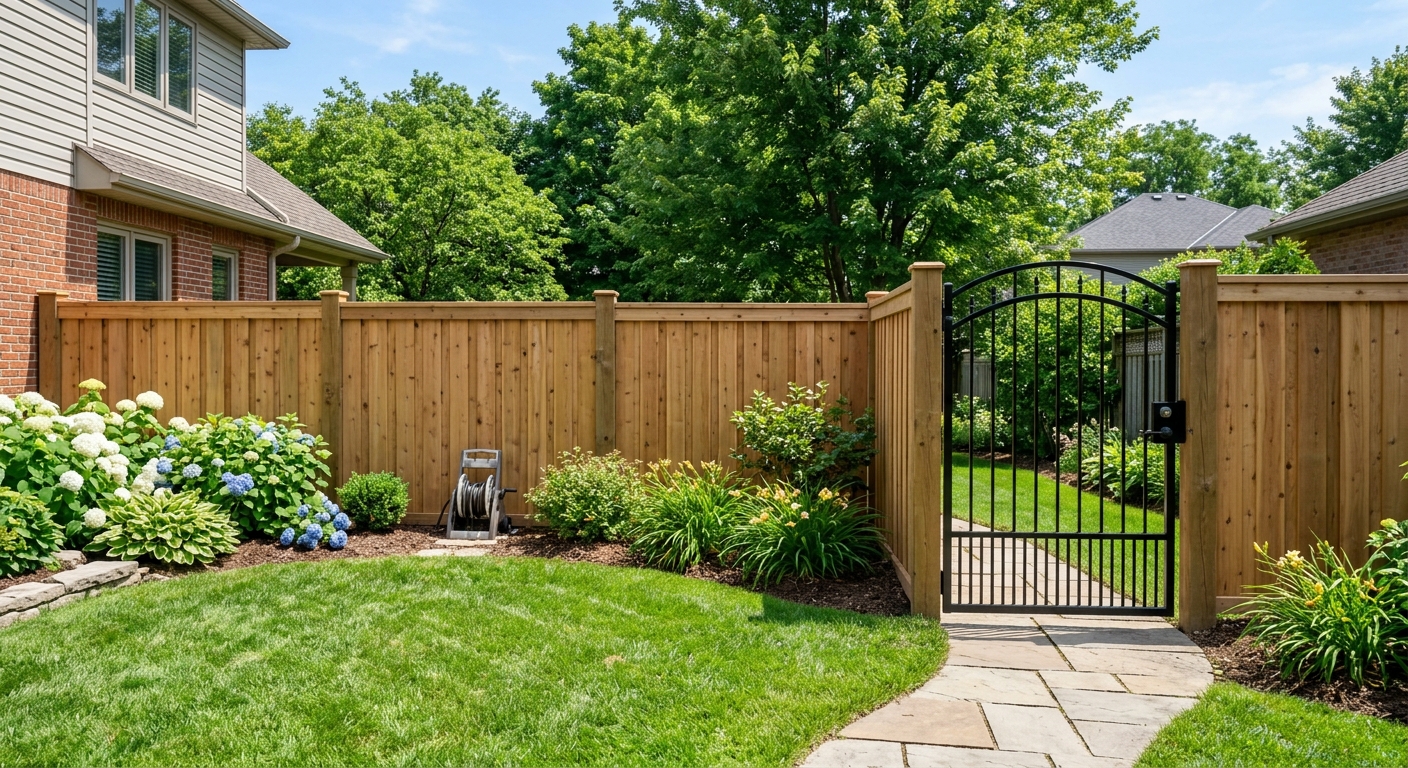
Fencing options and costs in King East
In King East, fencing demand tracks closely with the area’s housing stock: with a population of 2,040 (Statistics Canada, 2021 Census), most homeowners are on private lots where a new privacy fence, dog run, or boundary upgrade is a practical long-term improvement. In the Toronto economic region, the strongest driver of what you’ll pay is how much fencing you need and how deep your posts must be set for stability in freeze–thaw weather. For King East lots around 6–8 ft privacy heights, contractors typically plan for concrete-set posts, because the frost line in Southern Ontario is commonly estimated around 42"–48". That depth requirement—plus clay/mixed soils—means more excavation, more concrete, and often longer posts.
Cost can also swing based on whether you’re in a windier pocket of the neighbourhood, how easy it is to access the back yard (walkways, driveways, gates), and whether you need old fence removal. In King East, trades are especially busy around established residential streets near the community’s schools and parks, where families often replace older, sagging panels with straight privacy layouts. If you’re getting quotes right now, use the table below to sanity-check whether you’re being priced for the right material and the right “type” of fence.
| Material |
Lifespan |
Maintenance |
Privacy Rating |
Price per Linear Foot |
| Pressure-treated pine (standard wood) |
10–15 years |
Stain or seal every 2–3 years |
High (solid privacy) |
$18 – $30 |
| Cedar (natural rot resistance) |
15–25 years |
Light staining/maintenance every 2–4 years |
High (solid privacy) |
$22 – $40 |
| Vinyl / PVC (no-maintenance) |
20–30 years |
Rinse annually; no staining |
High (solid panels) |
$23 – $42 |
| Chain-link (galvanized steel) |
20–30 years |
Occasional cleaning; replace fabric if needed |
Low–Medium (visibility) |
$12 – $20 |
| Aluminum ornamental |
25–40 years |
Wash as needed; no rust |
Low (decorative) |
$22 – $45 |
| Composite / recycled material |
20–30 years |
Rinse annually; minor cleaning |
High (solid styles) |
$20 – $40 |
Prices are estimates only and vary by project scope, site access and material selection.
What affects the price of fencing in King East
In King East and across the Toronto economic region, it’s common to see fencing quotes for the “same” job come in 30–50% apart because the scope details hidden in the estimate drive real labour time: post excavation style, concrete quantities, rail/panel build quality, gate hardware, and how much material you actually need for corners and setbacks. Two yards that both measure “about 60 ft” can end up with different installed totals once you account for sags, property-line offsets, and whether the contractor is building to a solid, straight privacy run or a more flexible layout.
Climate matters here more than most homeowners expect. Southern Ontario freeze–thaw means posts must be protected from heaving; frost depth is commonly taken around 42"–48", and crews typically set posts roughly 4–6 inches below the design frost depth to reduce movement. Practically, that often puts post setting depth in the 1.5–2.0 m range for many 6–8 ft fences. Concrete-set posts (rather than simple driven posts) raise costs due to concrete, longer posts, and extra labour. In King East, clay and mixed soils also make clean holes and good compaction important—poor footing work shows up as lean and racking within a few winters.
Here are a few realistic ways local conditions shift cost:
- Extra excavation: if you hit hard clay or roots, expect longer labour days and sometimes more concrete—often pushing wood privacy projects toward the upper end of the $65–$120 range.
- Gate count: a second walk gate can add materials and reinforcement, which is why privacy upgrades often land closer to the vinyl/PVC $75–$130 band.
- Long straight runs: fewer corners usually reduces labour and alignment time; that’s one reason chain-link can stay closer to the $45–$85 band.
Finally, neighbourhood conditions can be similar block-to-block, but tall solid fences can act like sails in gusty spots; that’s why heavier posts and closer spacing are sometimes recommended even when your lot “doesn’t feel windy.”
| Price Factor |
Why It Matters |
Cost Impact |
| Fence length in linear feet |
More fencing means more posts, rails, panels, and labour |
Highest driver; can swing the total by thousands |
| Post depth required |
Frost protection dictates how deep and how long posts must be set |
Adds concrete, longer materials, and excavation time |
| Post setting method |
Concrete-set posts resist movement better than gravel pack or driving |
Concrete setting increases cost but reduces early failures |
| Material choice |
Vinyl/PVC and cedar cost more upfront than pressure-treated pine or chain-link |
Often shifts you between wood/vinyl/metal price bands |
| Gate count and type |
Gates require stronger framing, hinges, latches, and sometimes heavier posts |
Each additional gate can add meaningful labour and hardware |
| Grade and terrain |
Slope requires stepped builds or raked rails for consistent height |
More measuring, cutting, and alignment time |
| Old fence removal and disposal |
Demolition, hauling, and disposal add labour and dump fees |
Can add a noticeable “mobilization” cost to the project |
| Permit fees and survey / property line locate |
Locates prevent encroachment disputes and rework |
May add fees; avoids costly redo work |
Permits & regulations in Ontario
In Ontario, whether you need a building permit depends largely on fence height and location. Many homeowners run into permit requirements when upgrading fences above typical thresholds—often around 2.0 m (6.5 ft) in the rear yard and roughly 1.0–1.2 m (3–4 ft) at the front or corner. Even when a permit is not required, fences must follow property line rules and municipal setback bylaws; a “same height everywhere” layout can still violate a corner-side requirement.
Before digging any post holes in King East, you should also arrange utility locates through Ontario One Call. This is not optional—hitting buried service lines is dangerous and can stop your project. If you want to avoid neighbour disputes and costly corrections, get a survey or at minimum a property line locate to confirm where pins are before you install posts and rails.
Shared fence ownership is handled under Ontario’s line-fences principles. In practice, that means clarity on who maintains what portion matters, especially where both properties contribute to a shared boundary.
What typically requires a permit: installing or replacing a fence that exceeds common height thresholds, especially in the rear yard and near corners, and any situation where height/location triggers municipal review.
What typically does NOT require a permit: replacing like-for-like fencing that stays under common height limits and does not affect setbacks or encroach on property lines (always confirm with your municipality).
For contractor verification in Ontario: check the contractor’s licensing (where applicable through the relevant Ontario consumer/business registry and municipal trade requirements), request a current certificate of insurance (liability), and confirm workers are covered for WSIB (Workplace Safety and Insurance Board). Ask for the certificate of insurance and a WSIB clearance letter or equivalent evidence—then verify the policy is active for your project dates.
Choosing the right fence material for King East
Choosing a fence material in King East is mostly about matching what you want (privacy, low maintenance, longevity, and budget) to how Toronto-area winters treat your posts and pickets. Pressure-treated pine is the budget-friendly route, but it still needs proactive staining or sealing about every 2–3 years to limit grey weathering and surface cracking. Cedar looks great and resists rot better thanks to its natural oils, but it isn’t “maintenance-free”—it benefits from periodic stain to keep colour and help the surface shed moisture.
Vinyl/PVC is a strong “set it and forget it” option for homeowners who don’t want maintenance: you typically rinse it seasonally and skip staining. However, extreme cold snaps can make low-quality or poorly installed vinyl more prone to cracking, so you want solid post spacing and proper fastening. Chain-link is the lowest upfront cost and can last a long time, but privacy is limited unless you add slats, screening, or privacy mesh. Aluminum ornamental fencing offers rust resistance and a clean look, but it’s generally not designed for full privacy.
For Toronto’s frost regime, most homeowners installing 6–8 ft privacy fences should assume concrete-set posts are necessary. Setting depth and post size are what prevent post heave, racking, and sagging—more than the “pretty face” material. In wind-exposed sections, taller solid fences can act like sails, so heavier posts and closer centres (often 6–8 ft) improve performance against uplift and panel twisting under snow loading.
To see where the price difference is justified: if wood privacy comes in around the middle of the $65–$120 per linear foot band (scope-dependent), upgrading to vinyl often moves you toward the $75–$130 band because you’re paying more upfront for lower maintenance and longer life. If you plan to stay in the home for a long time and don’t want to restain, the vinyl jump is frequently the most “hands-off” value.
| Material |
Cold Tolerance |
Lifespan |
Annual Maintenance |
Best For |
Price Band |
| Pressure-treated pine |
Good (with proper post depth and sealing) |
10–15 years |
Stain/seal every 2–3 years |
Budget privacy runs |
$65 – $120 |
| Cedar |
Good (better rot resistance) |
15–25 years |
Stain or seal every 2–4 years |
Natural look with premium feel |
$75 – $130 |
| Vinyl / PVC |
Very good (best with proper installation) |
20–30 years |
Rinse annually |
Low-maintenance privacy |
$75 – $130 |
| Chain-link |
Excellent (steel + coating) |
20–30 years |
Occasional cleaning; spot repair |
Security and boundary definition |
$45 – $85 |
| Aluminum ornamental |
Excellent (no rust) |
25–40 years |
Wash as needed |
Decorative perimeter |
$90 – $160 |
| Composite / recycled |
Good (depends on product quality) |
20–30 years |
Rinse annually |
Privacy with long-term durability |
$75 – $130 |
How to choose a fencing contractor in King East
Choosing the right contractor in King East comes down to proof: proof they can build to Toronto-area freeze–thaw realities, and proof they’re properly insured. In Ontario, verify three things before you sign: (1) liability insurance, (2) WSIB coverage for workers, and (3) business legitimacy/credentials relevant to the work they’re performing. Ask for a current certificate of insurance and confirm the policy is active for your start/end dates. For WSIB, request evidence of clearance or current account coverage and make sure it includes fencing installation work (not just office work). If they can’t provide documents promptly, that’s a major red flag.
Next, get 2–3 itemised written quotes—separate labour from materials, and break down posts, concrete volume/quantity, rails, hardware, and gate components. Avoid “lump sum” estimates without scope details; they often hide differences in post depth, post size, and whether disposal is included. Confirm: Is permit pull included (if required)? Is old fence removal included? Who hauls debris? Are utilities locates included or is that your responsibility?
Warranty matters too: ask for the workmanship warranty length and what it covers (e.g., post movement within a period, panel replacement). Also confirm whether the product/manufacturer warranty is the installer’s responsibility to register—sometimes warranties are tied to original purchasers and may be transferable.
For payment, never agree to more than about 10–15% upfront. Hold back a portion until completion and final walkthrough. Get a written start date and a realistic completion estimate; weather and excavation depth can affect timelines, but you should still receive a schedule in writing.
- Request proof of liability insurance and verify coverage is active for your job dates.
- Ask for WSIB clearance/evidence in writing.
- Get 2–3 itemised quotes (labour, materials, hardware, gates, and disposal separately).
- Confirm post size and post depth plan for frost protection (concrete-set for taller privacy fences).
- Check whether the quote includes utility locates or clearly states who arranges them.
- Verify whether demolition/removal and dump fees are included.
- Ensure the quote lists the gate count and exact gate type (walk vs. double drive-through).
- Ask how they handle slope: stepped vs. raked panels, and how height consistency is maintained.
- Confirm the hardware brand/type (hinges, latches, tension/fasteners for rails).
- Review warranty terms for workmanship and product coverage, including transferability.
- Payment schedule: only 10–15% upfront, and holdback until punch list completion.
- Get start and completion timelines in the contract, not just “as soon as possible.”
In King East, I commonly see these red flags: missing insurance/WSIB paperwork, quotes that don’t specify post depth or setting method, “lowball” pricing that omits disposal or utility locates, vague warranty wording (no time period or unclear coverage), and refusing to provide itemised line items or a signed scope sheet.
Frequently asked questions — fencing in King East
What's the best fence for privacy?
For privacy in King East, a solid-panel wood, cedar, or vinyl/PVC privacy fence is usually the best match because it blocks sightlines while still handling Toronto-area freeze–thaw. The “best” option depends on whether you want low maintenance: vinyl/PVC typically costs more upfront (often aligned with the $75–$130 band) but you can rinse it instead of restaining. Wood can be more budget-friendly (frequently within the $65–$120 band), yet it generally needs staining or sealing every 2–3 years to limit weathering. Whatever you choose, make sure the contractor plans for concrete-set posts and proper post depth so your privacy panels don’t lean after winters.
How do I compare fencing quotes?
To compare quotes in King East fairly, demand itemised line items rather than only a final total. Check that each quote specifies post depth (frost protection), post setting method (concrete vs gravel pack), and the actual materials used (wood species, board thickness, vinyl grade, hardware types). Verify gate count and hardware quality, because gates can materially change the price. Also confirm what’s included: demolition/removal, disposal, utility locates, permits (if required), and any slope handling. If one quote is significantly cheaper than the others, look for missing excavation, concrete volume, or disposal—those omissions are often what create the gap.
How long does fence installation take in King East?
Most straightforward residential fence installs in King East take about 1–3 days once materials are on site, but the schedule depends heavily on excavation conditions and access. Concrete-set posts add time because the holes must be dug accurately and posts need proper placement and bracing. If you have multiple gates, corners, and slope, expect a longer timeline. Weather can also affect excavation and finishing—heavy rain or frozen ground can slow post-hole digging. A good contractor will give a written start date and completion estimate based on your linear footage, gate count, and whether removal/disposal is included.
Can I install a fence on a slope in King East?
Yes—many King East yards are sloped enough to require special construction. The two common approaches are stepped panels (best when you want consistent fence height in sections) or raked rails (more gradual transitions). Your contractor should measure the run and propose the method that keeps privacy height consistent without creating weak gaps or over-stressing rails in winter. Slopes can also increase labour time because more cutting and layout work is required. Make sure your quote explicitly states how they will handle grade and whether the fence will be “stepped” or “raked,” since that detail is a frequent source of misunderstandings.
What is the most weather-resistant fence for King East's climate?
For Ontario’s freeze–thaw cycles, the most weather-resistant choices are typically vinyl/PVC (if installed correctly with proper post spacing and fastening) or aluminum for longevity, with chain-link also performing well due to galvanized coatings. That said, “weather-resistant” depends just as much on the foundation: concrete-set posts at appropriate depth are key to preventing frost heave and leaning. Wood can absolutely last in King East, but it’s more sensitive to moisture and requires regular sealing/staining; pressure-treated pine often needs more frequent upkeep than cedar. If you’re deciding between options, compare upfront cost (for example, wood in the $65–$120 band versus vinyl/PVC often in the $75–$130 band) against how much maintenance you’re willing to do.
How do I prevent wood fence rot in King East?
Wood rot prevention in King East is mostly about stopping moisture from staying trapped at the right spots. Ensure posts are set in a stable, frost-safe way (commonly concrete-set for taller fences) so wood isn’t relying on movement-prone ground. Use pressure-treated or cedar properly: cedar has better natural rot resistance, but it still benefits from periodic staining to shed water. Avoid burying untreated ends and make sure any bottom gaps and drainage are correct so water doesn’t pool against rails. Finally, pick a contractor who builds straight and level—warped boards and sagging panels hold water longer. With consistent maintenance, wood can perform well through Toronto-area winters.