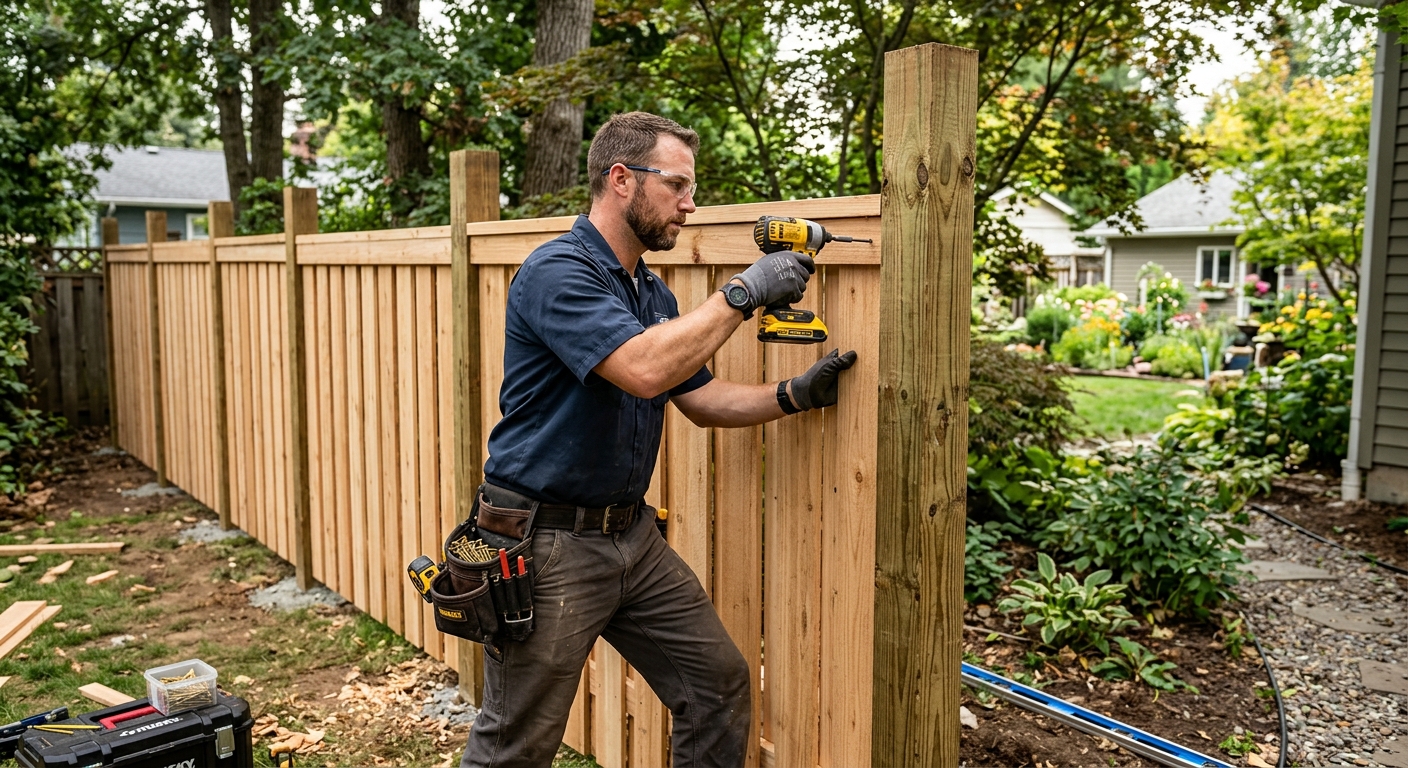
Fencing options and costs in Kingsville
Kingsville homeowners typically start their fencing project with a simple question: “What will it cost, and what will last?” With a population of 22,119 (Statistics Canada, 2021 Census) and 83.0% of dwellings being single-detached houses (Statistics Canada, 2021 Census), the demand for backyard privacy, side-yard containment for pets, and pool-safe gates is consistent across the town—especially in older neighbourhood pockets where fencing is due for replacement. In many areas near the Lake Erie corridor, more gusty days and heavier winter freeze–thaw cycles mean we design for southern Ontario’s frost line and plan for deeper post embedment to prevent heaving. That depth is a major local cost driver because it increases hole digging time, concrete volume, and labour, even before you consider hardware, gates, and removal of an aging fence.
Within the Windsor–Sarnia corridor, contractor availability also affects pricing. When crews are booked for multiple installs in the same week (LaSalle, Kingsville, and the Chatham-Kent side), homeowners often see tighter scheduling and fewer mobilisation charges. Conversely, tight-lot access near busier streets or properties with trees/utility conflicts tends to raise labour time and disposal costs. If you’re after privacy on a corner lot or near open farm fields—where wind can hit harder—we often recommend more open panel options or heavier posts, which can move the project into a higher price band.
To make comparisons easier, use the table below as a realistic range for Kingsville installs, then we’ll help you narrow the right option based on your yard layout, gate needs, and how much maintenance you want to take on.
| Material |
Lifespan |
Maintenance |
Privacy Rating |
Price per Linear Foot |
Price Range |
| Pressure-treated pine (standard wood) |
10–15 years |
Stain/seal every 2–3 years |
High (solid board) |
$16–$26 |
$45 – $80 |
| Cedar (natural rot resistance) |
15–20 years |
Stain every 2–4 years |
High (solid board) |
$22–$35 |
$55 – $95 |
| Vinyl / PVC (no-maintenance) |
20–30 years |
Rinse only; inspect fasteners |
High (privacy panels) |
$23–$38 |
$65 – $110 |
| Chain-link (galvanized steel) |
20–25 years |
Occasional rinse/straighten |
Low–medium (no solid privacy) |
$12–$20 |
$30 – $55 |
| Aluminum ornamental |
25–35 years |
Wash 1–2 times/year |
Low–medium (open pickets) |
$25–$42 |
$70 – $130 |
| Composite / recycled material |
20–30 years |
Low; occasional wash |
High (board-on-board styles) |
$24–$40 |
$75 – $125 |
Prices are estimates only and vary by project scope, site access and material selection.
What affects the price of fencing in Kingsville
In Kingsville, two “similar” fence jobs can come in 30–50% apart across the broader Windsor–Sarnia area and Ontario, mainly because the final price is driven by installation complexity—not just the material you pick. A standard-looking 6 ft privacy fence becomes more expensive when posts must be set below the freeze line, when concrete is required, or when the job includes gates, removal, and careful layout near utilities. In practice, wood installs can be competitive, while vinyl and aluminum tend to move up in price due to higher material cost and the need for precise installation in cold weather conditions.
Locally, southern Ontario’s frost line is roughly 1.2 m (about 4 ft). To avoid frost heave, our posts typically need at least 3 ft embedment, and in exposed or clay-heavy soils we often recommend 4 ft of embedment. That means longer posts, deeper hole digging, and more concrete when we set footings below frost-prone ground. Even a modest change in post depth can add labour time and materials in the Windsor–Sarnia corridor because the digging and concrete work scales directly with fence length.
Wind also matters, especially for properties closer to open fields or near the Lake Erie side where gusts can be more persistent. We tighten post spacing and choose structures that don’t behave like solid sails—sometimes using board-on-board or lighter visual picket patterns for aluminum. By contrast, a sheltered backyard with sandier soil and an existing, straightforward line can keep pricing nearer the lower end of the $45 – $80 wood band or the $65 – $110 vinyl band. For example, replacing a fence along a fenced-in corner lot with two gates usually costs more than a straight run because gate frames require heavier posts and better anchoring. Another example: if your yard is on older clay (common in parts of Kingsville with many pre-1981 homes), the heavier embedment and footings can push excavation and concrete volume up, even when the overall length is the same.
Use the table below to see the exact cost levers we price into every quote.
| Price Factor |
Why It Matters |
Cost Impact |
| Fence length in linear feet |
Everything scales with footage: posts, rails, labour hours, and waste |
Typically the #1 driver |
| Post depth required |
Frost line determines how far below the ground the post must sit to prevent heaving |
Higher depth = more digging and longer posts |
| Post setting method |
Concrete footings add stability but increase material and labour |
Concrete-set often costs more than gravel pack |
| Material choice |
Vinyl, cedar, chain-link and aluminum vary widely in material cost and labour intensity |
Can swing totals by 20–40% |
| Gate count and type |
Double drive gates require heavier hardware and stronger framing |
Each gate can add a significant lump of cost |
| Grade and terrain |
Sloped yards require stepped panels or raked sections, changing material and labour |
Often adds labour time and adjustments |
| Old fence removal and disposal |
Demolition, hauling, and landfilling fees vary by fence type and condition |
Can add 10–25% depending on access |
| Permit fees and survey / property line locate |
Administrative steps and locate work reduce risk of encroachment disputes |
Costs vary, often modest but important |
Permits & regulations in Ontario
In Ontario, the permit requirement depends largely on fence height and where the fence sits (rear yard versus front/corner areas). A common rule of thumb we work with is that fences above a height threshold—often around 2.0 m (6.5 ft) in the rear yard and roughly 1.0–1.2 m (3–4 ft) in the front or corner—may require a building permit, especially when the fence could affect sightlines. Regardless of height, every fence must respect property lines and municipal setback bylaws, and the location of posts matters because encroachment disputes are usually about “where the fence actually went,” not what the homeowner intended.
Before any digging, you must get utility locates. In Ontario this is done through Ontario One Call to mark buried services so your post holes don’t become a repair job. If you’re replacing an older fence, it’s still smart to obtain a survey or at minimum a property pin locate so your new line matches the actual lot boundaries. Shared fence ownership is governed by provincial line-fences legislation, which generally applies when parties share a boundary; it’s worth confirming responsibilities for maintenance and replacement before you order materials.
Contractor due diligence matters too. Ask for proof your installer is licensed where required, carries liability insurance, and has WSIB coverage (if applicable for workers). To verify, check the licensing registry where relevant, review the certificate of insurance for current limits and the named insured, and request WSIB clearance/coverage documentation before work starts.
Choosing the right fence material for Kingsville
Choosing the right fencing material in Kingsville is about matching your priorities—privacy, low maintenance, upfront budget, and lifespan—to a climate that brings freeze–thaw cycles and periodic gusty weather. Pressure-treated pine is often the budget starting point, but it needs staining or sealing every 2–3 years to slow grey weathering and keep boards looking clean. Cedar naturally resists rot and looks better as it ages, yet it still benefits from periodic staining, especially on the windward side. Vinyl/PVC offers the “rinse-and-forget” advantage and generally stays attractive longer, but in extreme cold we focus on proper installation so panels and posts don’t stress at the fasteners.
Chain-link is the lowest upfront cost and has excellent durability, but it won’t provide true privacy unless you add an insert or privacy screen. Aluminum ornamental fences are rust-resistant and maintain their look with minimal upkeep, making them a strong pick when you want curb appeal and a clear boundary without blocking views.
Frost and post depth are part of every material choice. In the Windsor–Sarnia corridor, southern Ontario’s frost line is roughly 1.2 m, and we typically embed posts about 3 ft, or up to 4 ft in exposed or clay-heavy ground, often using concrete-set methods to reduce heaving risk. Concrete-set posts can be necessary for long-term stability; it’s not optional “extras” if your soil holds moisture or your line is exposed to wind.
As a quick cost justification example: if a cedar privacy fence is coming in at the upper end of the wood range—say near the $45 – $80 band for wood in simpler runs—upgrading to vinyl might shift you toward the $65 – $110 band, but homeowners do it when they want fewer maintenance trips and a cleaner look in the long run. If your yard is shaded and protected, wood can be a smarter value; if you’re exposed to wind and want stable appearance, vinyl or composite often pays off.
| Material |
Cold Tolerance |
Lifespan |
Annual Maintenance |
Best For |
Price Band |
| Pressure-treated pine |
Good (with proper staining and weatherproofing) |
10–15 years |
1–2 short maintenance sessions/year |
Budget-friendly privacy with a natural look |
$45 – $80 |
| Cedar |
Good (rot resistance but still affected by freeze–thaw) |
15–20 years |
Light upkeep 1x/year; stain every 2–4 years |
Attractive wood look with better natural performance |
$55 – $95 |
| Vinyl / PVC |
Very good (when installed correctly for cold flex) |
20–30 years |
Rinse 1x/year |
Low maintenance and consistent appearance |
$65 – $110 |
| Chain-link |
Good (galvanized steel resists winter corrosion) |
20–25 years |
Rinse/straighten as needed |
Security and pet containment with open visibility |
$30 – $55 |
| Aluminum ornamental |
Excellent (powder-coated in winter conditions) |
25–35 years |
Wash 1x/year |
Curb appeal, boundary definition, open fencing |
$70 – $130 |
| Composite / recycled |
Very good (designed for freeze–thaw exposure) |
20–30 years |
Rinse 1x/year; inspect fasteners |
Privacy with low maintenance and minimal warping |
$75 – $125 |
How to choose a fencing contractor in Kingsville
Choosing the right fencing contractor in Kingsville starts with proof—not promises. First, verify Ontario licensing where applicable for fencing work, and make sure the contractor has current liability insurance. Then confirm WSIB coverage for workers (or equivalent coverage where required by Ontario rules). You should be able to see the certificate of insurance, including the effective dates and coverage limits, and obtain evidence of WSIB clearance/documentation before work begins. If you don’t get these up front, that’s a red flag.
Get 2–3 itemised written quotes that clearly break down labour and materials, including how many posts, what post spacing they’re using, and whether footings are set in concrete. Ask if permit pull (when required) is included, and confirm what’s excluded—things like tree removal, utility-marking fees, replacement of damaged curbs/sidewalk edges, and disposal of an old fence. For warranty, request both the workmanship warranty length and the manufacturer’s product warranty, and confirm whether the warranty is transferable to you if you sell the home.
For payment schedule, protect yourself: never pay more than 10–15% upfront. Use a holdback until the final walkthrough is complete and gates/alignments are confirmed. Also require a start date and an estimated completion window in writing, since Ontario winter conditions can affect access and footing work if delays occur.
- Provide written proof of liability insurance (COI with dates and limits)
- Show WSIB coverage documentation/clearance where applicable
- Itemised quote: labour, materials, hardware, and equipment line items
- Confirm post depth plan for southern Ontario’s frost conditions
- State post setting method (concrete vs gravel pack vs driven) in writing
- List number and type of gates, including latches and hinges
- Identify what’s included in fence straightness/leveling on slopes
- Specify disposal and hauling of old fencing
- Confirm utility locate responsibility and whether Ontario One Call is arranged
- Clarify permits: who pulls them and what happens if a permit is needed
- Provide warranty details for labour and for each material type
- Limit deposits to 10–15% and confirm a final holdback
Red flags I see in Kingsville include contractors who: (1) won’t show insurance/WSIB documentation before scheduling, (2) quote only a lump sum without specifying post embedment depth or setting method, (3) start digging without confirming utility locates, (4) pressure you for a large upfront payment, and (5) skip a clear gate hardware plan (the most common “fix later” item).
Frequently asked questions — fencing in Kingsville
Wood vs vinyl vs aluminum fence — which is best?
For most Kingsville homeowners, “best” depends on how much maintenance you want to do. Wood (pressure-treated pine) can be a strong value for privacy runs, typically landing in the $45 – $80 range when the line is straightforward. Vinyl/PVC is often the best choice for low-maintenance households—usually more like the $65 – $110 band—because you can rinse and move on. Aluminum is ideal if you want a clean, rust-resistant boundary with curb appeal, but it won’t give the same privacy as a solid wood or vinyl privacy panel. Whatever you choose, we still design around Ontario’s freeze–thaw conditions: proper post depth and setting method matter more than the fence “name” alone.
Do I need a permit to build a fence in Ontario?
In Ontario, many fences do not require a permit, but height and location can change the requirement. As a general rule we see applied in practice, fences above about 2.0 m (6.5 ft) at the rear and around 1.0–1.2 m (3–4 ft) at the front or on a corner lot may require a building permit, and municipal setback rules always apply. The safest approach is to confirm with the municipal requirements for Kingsville before installation, especially for taller privacy fences, gates that affect sightlines, or unusual layouts. Also remember: utility locates must be done before any post holes. A good contractor will tell you early whether they’re including permit pull (when needed) and will not start digging until utilities are marked.
How long does a wood fence last in Kingsville?
A properly installed pressure-treated wood fence in Kingsville commonly lasts about 10–15 years, assuming the posts are set correctly for Ontario frost conditions and the boards are maintained. The freeze–thaw cycle can cause heaving if embedment is too shallow, which is why we typically plan for around 3 ft embedment and often up to 4 ft in exposed or clay-heavy soil. Maintenance is the second big driver: staining/sealing every 2–3 years helps prevent early greying and cracking at board ends. If you choose cedar, many homeowners see a longer service life—often 15–20 years—because it has natural rot resistance. Regardless of species, gates and corners typically need more attention and hardware checks over time.
Who owns and maintains a shared fence?
Shared fence ownership and responsibilities are typically governed by provincial line-fences legislation, rather than just a contract. In plain terms, if a fence is on or near a boundary and is considered shared, the duties to maintain, repair, or replace can be split between adjoining owners depending on circumstances and agreements. For Kingsville homeowners, the best practice is to confirm whether the existing boundary fence is actually on the property line (survey pins/locates help) and whether there’s any prior agreement about maintenance. Before you replace a fence, talk with your neighbour and keep documentation (photos, proposed scope, and a written plan). A contractor can help with measurements and placement accuracy, but the ownership and cost-sharing decision stays with the adjoining owners under the legislation.
How do I find my property line before fencing?
Start with any existing survey documents and your property pins. In Kingsville, the reliable method is to get a survey or have pins located so you can confirm the exact boundary before posts are installed. Many disputes happen when a fence is built “by eye” from an old fence line that may have shifted over time. Before digging, ensure utilities are marked through Ontario One Call so you can safely verify locations near services. When you get quotes, ask the contractor how they confirm line placement and whether they recommend a locate or survey for your situation. A good fence plan will include a layout that respects setbacks and avoids encroachment. If you want the smoothest process, resolve property line questions before ordering materials.
What's the most low-maintenance fence?
In Kingsville, the lowest-maintenance options are usually vinyl/PVC and aluminum. Vinyl privacy panels are designed for weather exposure and generally need only rinsing and occasional inspections of rails and fasteners; there’s typically no staining like wood. Aluminum ornamental fences also have minimal upkeep because powder-coated finishes resist rust, and a yearly wash is usually enough. Chain-link can also be low maintenance, but it won’t provide privacy without a privacy insert or a secondary solution. Wood can be made to last well, but it requires periodic staining/sealing—often every 2–3 years—to keep it looking good in southern Ontario’s winter cycling. If you want “set it and forget it,” vinyl in the $65 – $110 band is commonly the best match.