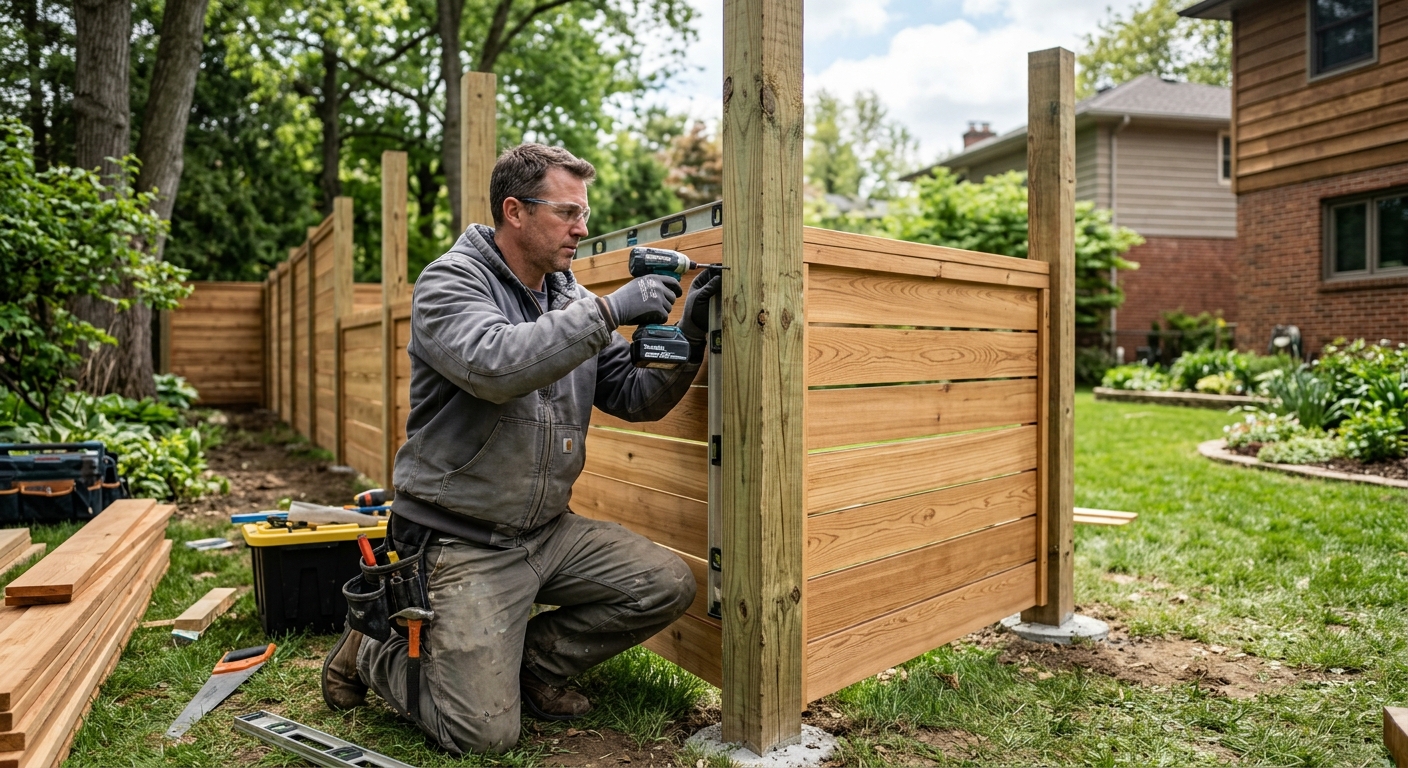
Fencing options and costs in Clairlea-Birchmount
Clairlea-Birchmount is a busy, mature neighbourhood in Toronto with a lot of backyard fencing, and that demand shows up in steady install availability and competitive pricing. With a population of 26,984 (Statistics Canada, 2021 Census), many homeowners are maintaining existing fences or replacing sections damaged by freeze–thaw cycles. The local housing mix also means frequent property boundary work—every detached lot can become a fencing project, especially around family-friendly pockets like Midland Avenue and the back lanes closer to Brimley Road.
In the Toronto economic region, fencing costs are shaped less by “one-size-fits-all” material pricing and more by how your posts are built for Ontario’s winter conditions. The common rule of thumb is that design frost depth in Southern Ontario is about 42"–48", so posts are usually set 3.5–4 ft deep to reduce the risk of frost heave—particularly for taller 6–8 ft privacy fences. That deeper excavation generally pushes you toward concrete-set posts (labour time plus ready-mix cost), and it affects the total price more than many people expect. Wind and sun exposure in the GTA also influence material and post sizing to prevent racking and loosened rails over time.
Below is a practical comparison of common fence types for Clairlea-Birchmount, including lifespan, upkeep expectations, and the typical installed price per linear foot you’ll see in Toronto bids. Use it as a starting point before you request a written, itemised quote.
| Material |
Lifespan |
Maintenance |
Privacy Rating |
Price per Linear Foot |
Price Range |
| Pressure-treated pine (standard wood) |
10–15 years |
Stain/seal every 2–3 years; inspect posts and rails annually |
High (solid boards/panels) |
$65–$120 |
$65 – $120 |
| Cedar (natural rot resistance) |
15–20 years |
Seal/stain every 2–3 years (often less picky than pine) |
High (solid boards/panels) |
$75–$130 |
$75 – $130 |
| Vinyl / PVC (no-maintenance) |
20–30 years |
Occasional rinse; replace damaged sections only |
High (solid styles) |
$75–$130 |
$75 – $130 |
| Chain-link (galvanized steel) |
20–35 years |
Minimal; rinse off salt/dust; tighten posts as needed |
Low (see-through) |
$45–$85 |
$45 – $85 |
| Aluminum ornamental |
25–40 years |
No rust; wash as needed; inspect gates/hardware |
Medium–low (open pickets) |
$90–$160 |
$90 – $160 |
| Composite / recycled material |
20–30 years |
Low; clean as needed; replace boards if they get impact damage |
High (solid boards/panels) |
$90–$160 |
$90 – $160 |
Prices are estimates only and vary by project scope, site access and material selection.
What affects the price of fencing in Clairlea-Birchmount
Homeowners often notice that two quotes for what sounds like the “same” fence can differ by 30–50% across the Toronto economic region and Ontario, even when material brands are similar. The biggest reason is that fencing isn’t just a shopping list; it’s excavation, labour, and the engineering decisions needed to keep the line straight through Toronto winters. In Clairlea-Birchmount, mature neighbourhood lots and established landscaping also change access—tight gates, mature trees, and rear-lane constraints can slow crews and increase setup time.
Ontario frost is a major pricing driver. The frost line is commonly taken at about 42"–48" in Southern Ontario, so posts are typically set 3.5–4 ft deep (often 4–6 inches below design frost depth) to reduce heaving. In practical terms, that means longer posts and deeper holes, plus concrete-set installation rather than driven posts. Taller 6–8 ft privacy fences need heavier posts and closer panel spacing (commonly 6–8 ft centres) to resist uplift and racking; that adds both materials and labour. While the Prairies have the most extreme winds, wind gusts still matter locally, especially on open corners and yards with more exposure.
Concrete examples for Clairlea-Birchmount: (1) A 60 ft run of pressure-treated pine with gravel backfill might land near the wood band of $65–$120 per foot, but switching to concrete-set posts to meet frost concerns can push the labour-heavy portion upward. (2) Replacing a damaged board-only section is cheaper, but full line replacement with heavier hardware and new gates can move you toward the $75–$130 vinyl/PVC or cedar bands. The local climate—regular freeze–thaw and snow loading—also shortens the “acceptable” service life of poorly set posts, so contractors price for longevity rather than minimum upfront cost.
In short, you’re paying for a fence that stays plumb for decades, not just a fence that looks straight on install day.
| Price Factor |
Why It Matters |
Cost Impact |
| Fence length in linear feet |
Most labour and materials scale directly with length |
Highest impact (often 50–70% of total job cost) |
| Post depth required |
Frost line determines hole depth, post length, and excavation time |
Commonly +10–25% on total if deeper/concrete-set is required |
| Post setting method |
Concrete-set posts add mixing, pour time, and curing coordination |
Concrete vs gravel pack can shift costs noticeably (+8–20%) |
| Material choice |
Vinyl/PVC and cedar are higher upfront than chain-link; aluminum/ornamental costs more |
Ranges can move you from ~$45–$85 to ~$75–$130 or $90–$160 per foot |
| Gate count and type |
Gates require stronger framing, hinges, latch hardware, and alignment |
Each gate often adds several hundred to over a thousand depending on size/material |
| Grade and terrain |
Slopes require stepped rails, raked panels, and additional layout time |
Typically +5–15% for layout and extra labour |
| Old fence removal and disposal |
Demolition, hauling, and possible extra labour for stubborn posts |
Often adds +10–30% depending on condition/access |
| Permit fees and survey / property line locate |
Some fence heights and situations need permitting and accurate boundary confirmation |
Variable; can add +0–10% but prevents costly rework |
Permits & regulations in Ontario
In Ontario, fences above a typical height threshold—often 2.0 m (6.5 ft) at the rear and about 1.0–1.2 m (3–4 ft) at the front or corner—may require a building permit, depending on location and municipal rules. Regardless of height, fences must respect property lines and municipal setback bylaws. If you’re planning a solid privacy fence in Clairlea-Birchmount (especially around rear yards), it’s wise to confirm whether you’re crossing the permit threshold before any posts go in the ground.
Before digging any post hole, call for utility locates through Ontario One Call. This is not optional: it protects you from accidental strikes to buried services. Also, obtain a survey or at least confirm your property pins/locators before installing—property line disputes are one of the most common sources of fencing rework.
Shared fence ownership rules are handled under Ontario line-fences legislation, so if you’re on a shared boundary, clarifying responsibilities and costs early can prevent neighbour conflicts.
What does require a permit (typical situations): installing or significantly altering a fence that exceeds the common height thresholds (especially in front/corner or certain rear placements). What typically does not: minor repairs (board replacements) or keeping a fence at an existing, already-compliant height—though you should still confirm if you’re making “like-for-like” changes.
When hiring, verify the contractor’s Ontario licence (if applicable to their business model), request a certificate of liability insurance, and confirm they carry WSIB/WCB coverage where required for their workers. Ask for an insurance certificate that shows your jobsite address or at least their policy active dates, and request the clearance letter/coverage confirmation if they provide services through subcontractors.
Choosing the right fence material for Clairlea-Birchmount
Choosing the right fence material in Clairlea-Birchmount comes down to matching your priorities—privacy, low maintenance, lifespan, and budget—to Toronto’s winter reality. In this area, posts are commonly set about 3.5–4 ft deep to manage the 42"–48" frost line, which makes a “good fence build” as important as the board or panel itself. With that in mind, pressure-treated pine is often the budget entry point, but it’s also the one that needs the most attention: plan on staining or sealing every 2–3 years to slow grey weathering and protect against rot at the board edges.
Cedar looks great and has better natural rot resistance than pine, but it still needs maintenance. Vinyl/PVC is popular for homeowners who want low upkeep—no annual sealing—but it can become brittle if installed without proper post spacing and hardware planning in extreme cold snaps. Chain-link is the longest-lived and usually the cheapest way to fence a yard, but it won’t provide privacy unless you add slats or plant screening. Aluminum ornamental is a clean, rust-resistant option with mid-range cost and long service life, but it’s not ideal if you need full privacy.
Concrete-set posts are strongly recommended for tall 6–8 ft privacy fences because frost heave is the long-term risk. Wind matters too: heavier styles (solid wood/vinyl) need sturdier posts and closer spacing to prevent racking and uplift around winter storms.
Dollar example: upgrading from pressure-treated pine (typical wood band $65–$120 per linear foot) to vinyl/PVC (typical $75–$130) can be justified when you want 20+ years with minimal maintenance. If you’re already paying for deeper concrete-set posts, spending a bit more on a lower-maintenance panel often costs less over time than re-staining and reworking boards repeatedly.
| Material |
Cold Tolerance |
Lifespan |
Annual Maintenance |
Best For |
Price Band |
| Pressure-treated pine |
Good (with proper post depth and sealing) |
10–15 years |
Low–moderate (stain/seal every 2–3 years) |
Lowest upfront privacy fencing |
$65–$120 |
| Cedar |
Good (resists rot better than pine) |
15–20 years |
Low–moderate (seal/stain every 2–3 years) |
Attractive privacy with better natural durability |
$75–$130 |
| Vinyl / PVC |
Very good (avoid improper spacing/hardware) |
20–30 years |
Very low (rinsing/spot checks) |
Low-maintenance privacy in freeze–thaw cycles |
$75–$130 |
| Chain-link |
Excellent (galvanized steel resists weather) |
20–35 years |
Minimal (tighten/inspect hardware) |
Security fencing with the lowest maintenance |
$45–$85 |
| Aluminum ornamental |
Excellent (no rust, good hardware) |
25–40 years |
Very low (wash/inspect gates) |
Modern curb appeal and long-term durability |
$90–$160 |
| Composite / recycled material |
Very good (designed for cold climates) |
20–30 years |
Low (cleaning, occasional board replacement) |
Privacy fencing with reduced upkeep |
$90–$160 |
How to choose a fencing contractor in Clairlea-Birchmount
Choosing the right fencing contractor in Clairlea-Birchmount starts with verification. First, ask for proof of liability insurance (certificate of insurance) and confirm it’s active and includes the appropriate coverage limits for construction work. Next, confirm WSIB/WCB coverage (or clearance documentation) for their workers—if they subcontract, you should ask for coverage proof from the subcontractors as well. You should also request a copy of their business details and check the appropriate Ontario registry information so you know who is actually performing the work.
For pricing, insist on 2–3 itemised written quotes. A strong quote separates labour and materials: post excavation and concrete, rails and hardware, panel/board quantities, gate build cost, and—if you want it—old fence demolition and disposal. Avoid any quote that only provides one lump sum with no line items, because that makes it impossible to compare whether they’re using concrete-set posts, proper post spacing, or the same fence height/style.
Read the scope carefully: what’s excluded (site restoration, uneven-grade adjustments, survey locate, or disposal)? Is permit paperwork included if required? Is the fence set on concrete footings or only gravel pack? Finally, check warranty terms. You want a clear workmanship warranty (how long they stand behind install), plus the manufacturer warranty on materials; also ask whether the manufacturer warranty is transferable to your home.
Payment schedule matters: never pay more than 10–15% upfront. Use staged payments tied to milestones, and hold back a portion until completion and final walk-through. Get a written start date and a completion estimate so you’re not relying on verbal timelines during Toronto’s seasonal construction windows.
- Ask for certificate of liability insurance and verify the policy dates.
- Confirm WSIB/WCB coverage and request clearance documentation if applicable.
- Request an itemised quote (posts, concrete, rails, panels, gates, hardware, demolition).
- Ensure the quote specifies post depth consistent with Southern Ontario frost rules.
- Confirm concrete-set vs gravel pack vs driven posts and where each is used.
- Ask how they handle slopes (stepped vs raked panels) and confirm the method in writing.
- Verify disposal is included if old fence removal is part of the scope.
- Confirm whether they locate/measure for property line alignment (or if you must provide a survey).
- Check warranty: workmanship length, who provides it, and whether it covers post settlement.
- Ask about gate hardware upgrades (hinges, latches, reinforcement) and warranty on those parts.
- Use a payment plan with no more than 10–15% upfront and a holdback until completion.
- Get the start date, target completion date, and weather-related contingencies in writing.
Concrete red flags I look for in Clairlea-Birchmount: (1) a quote that doesn’t mention post depth or concrete setting for 6–8 ft fences, (2) “lump sum only” pricing without quantities or disposal details, (3) refusal to provide insurance/WSIB/WCB clearance documents, (4) vague warranty language that doesn’t specify workmanship coverage, and (5) asking for large upfront deposits (beyond 10–15%) without milestones.
Frequently asked questions — fencing in Clairlea-Birchmount
How long does fence installation take in Clairlea-Birchmount?
Most residential fence installs in Clairlea-Birchmount take anywhere from 1 to 3 days, depending on length, gate count, and whether you’re removing an existing fence. A straightforward run with standard post spacing and no heavy demolition is often quickest; however, deeper concrete-set posts typically mean more excavation time and careful alignment checks, which can add half a day. If your yard has mature landscaping, tight rear-lane access near Brimley Road or Midland Avenue, or a slope that needs stepped/raked sections, plan for extra layout and trimming time. Taller privacy fences also require extra bracing and hardware verification so panels don’t rack in wind gusts.
Can I install a fence on a slope in Clairlea-Birchmount?
Yes—you can install a fence on a slope in Clairlea-Birchmount, and good contractors will build it to match your grade so the top line stays consistent and the fence doesn’t “dip” or create awkward gaps. The two common approaches are stepped panels (each section changes height at post lines) or raked panels (continuous slope following the ground). Stepped fencing usually looks cleaner for uneven yards, while raked panels can work well when the slope is gradual and the system is designed for it. The key is proper post hole depth and frost-safe setting, not just cosmetic alignment. Your quote should explicitly state whether they will step or rake and how they’ll handle transitions near gates.
What is the most weather-resistant fence for Clairlea-Birchmount's climate?
For long-term performance in Ontario freeze–thaw conditions, vinyl/PVC and well-built cedar or pressure-treated wood all hold up well when posts are set correctly for the frost line. Vinyl/PVC typically performs best for low maintenance because it avoids regular staining cycles; in Toronto bids, you’ll often see vinyl installed in the $75–$130 per linear foot range. Cedar can be more naturally rot-resistant than pine but still needs periodic sealing to protect against weathering and moisture at board edges. The most critical factor isn’t only the material—it’s concrete-set post installation at the right depth and spacing, plus sturdy rails and gate hardware to resist winter wind and spring thaw movement.
How do I prevent wood fence rot in Clairlea-Birchmount?
To prevent wood fence rot in Clairlea-Birchmount, focus on the “failure points”: post bottoms, rail joints, and end grain. First, ensure your contractor uses frost-safe post depth (commonly 3.5–4 ft deep in Southern Ontario) and typically concrete-set posts rather than simply driving or using shallow gravel. Second, request proper ventilation and drainage details—boards should not trap standing water, and hardware should be corrosion-rated. Third, maintain the finish: stain/seal pressure-treated pine every 2–3 years to limit water penetration and grey weathering. Finally, do annual inspections after winter: look for loose rails, soft boards, and missing caulking at joints; small repairs are much cheaper than replacing entire sections later.
What is the cost per linear foot for fencing in Clairlea-Birchmount?
In Clairlea-Birchmount, many Toronto-area installs land within the common city tier bands. For example, pressure-treated wood privacy fences typically price around $65–$120 per linear foot, while vinyl/PVC privacy often sits around $75–$130 per linear foot. Chain-link is generally lower, about $45–$85 per linear foot, and aluminum ornamental is usually higher at $90–$160 per linear foot. Your final number depends heavily on how many feet you’re fencing, gate count, accessibility, whether the project includes old fence removal, and—most importantly—how deep and what method is used for posts due to the frost line (about 42"–48" in Southern Ontario). Always compare quotes using an itemised breakdown.
Should I repair or replace my old fence in Clairlea-Birchmount?
Repair is often worth considering when only a few boards or sections are failing, posts are solid, and the fence line is still mostly plumb. Replacement usually makes more sense when rot has spread into rails, multiple posts have loosened after freeze–thaw, or hardware corrosion is widespread—because those issues usually indicate the underlying support system is compromised. In Clairlea-Birchmount, I commonly recommend replacement if you’re already paying to remove old components and you want a long service life; otherwise, repaired sections can look uneven once new boards age differently. Compare the scope: if you’re looking at a full privacy line, budgets may shift into the wood $65–$120 band or vinyl $75–$130 band, but you’ll avoid repeat labour for future fixes. A contractor should inspect post stability, not just the surface boards.