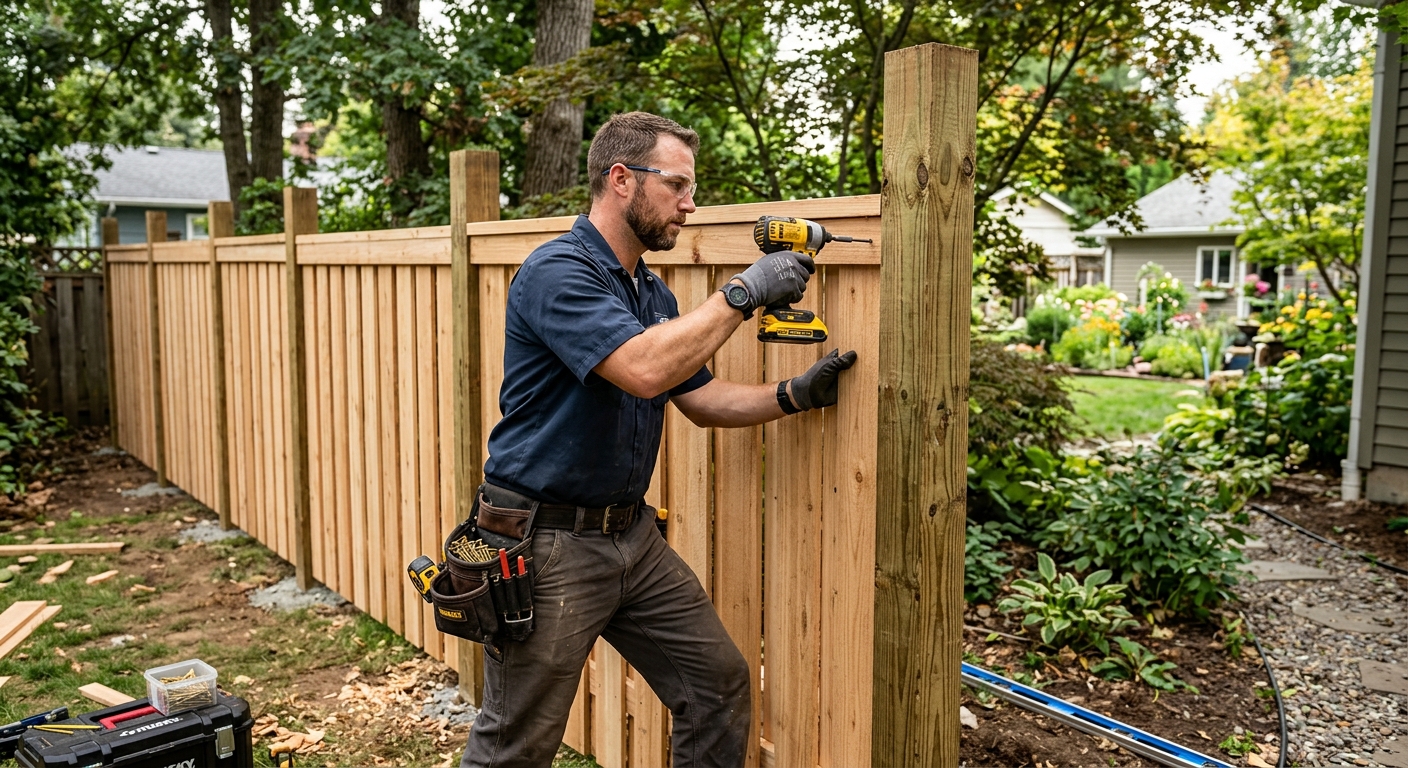
Fencing options and costs in Humber Heights-Westmount
In Humber Heights-Westmount, Ontario, choosing the right fence usually comes down to privacy needs, maintenance tolerance, and how your yard will handle Toronto’s freeze–thaw cycles. With a local population of 10,948 residents (Statistics Canada, 2021 Census), there’s steady demand from homeowners who want reliable boundary protection as older properties get upgrades. The neighbourhood’s mix of family homes and long-established lots also means many projects replace aging runs—so demolition and post replacement can be a meaningful part of the total.
In the Toronto economic region, frost management is a cost driver. Contractors typically set posts at least 3.5–4 feet deep for 6–8 ft privacy fences to reduce frost heave, which is especially important in Southern Ontario’s clay and mixed soils. That deeper excavation and concrete setting increases labour time and material volume compared with simple driven-post methods. At the same time, Humber Heights-Westmount yards close to busier streets and open corners can see higher local wind loads, pushing many installers to use heavier framing and tighter post spacing—both of which influence final pricing.
Trade activity is particularly noticeable around the Humber Heights area where backyards and side-yard lines are commonly upgraded for privacy and seasonal snow comfort. From there, you can compare common materials and realistic price expectations, then refine with an itemised quote tailored to your fence length, gate count, and accessibility.
| Material |
Lifespan |
Maintenance |
Privacy Rating |
Price per Linear Foot |
| Pressure-treated pine (standard wood) |
10–15 years |
Stain or seal every 2–3 years; fastener checks |
High (solid/board style) |
$16 – $28 |
| Cedar (natural rot resistance) |
15–20 years |
Light staining/sealing every 2–4 years |
High (solid/board style) |
$20 – $34 |
| Vinyl / PVC (no-maintenance) |
20–30 years |
Rinse as needed; inspect panels in freeze/cold snaps |
High (solid privacy style) |
$22 – $38 |
| Chain-link (galvanized steel) |
20–30+ years |
Occasional rust check at cut ends; tension checks |
Low–Medium (privacy slats optional) |
$14 – $22 |
| Aluminum ornamental |
25–35 years |
Wash annually or as needed |
Low–Medium (lattice/spacing dependent) |
$25 – $44 |
| Composite / recycled material |
20–30 years |
Minimal cleaning; hardware inspection |
High (solid styles) |
$28 – $48 |
Prices are estimates only and vary by project scope, site access and material selection.
What affects the price of fencing in Humber Heights-Westmount
In Humber Heights-Westmount, two quotes for what looks like the same fence can vary by 30–50% because contractors price for the real site conditions—not just the linear footage. Toronto’s labour market, excavation difficulty, and how installers build for frost and wind all change the “hidden” costs. That’s why a 60 ft run can land in one range for a straightforward backyard install, then shift upward once you add deeper concrete-set posts, gate hardware, property-line verification, or removal of an old fence.
Frost depth is the biggest technical reason pricing diverges. In Southern Ontario, the design frost line is commonly referenced at about 42"–48", and best practice is typically to set posts roughly 4–6 inches below that design depth to prevent heaving. Practically, that often means posts go 1.5–2.0 m into the ground, and holes are dug deeper and wider for proper concrete. Deeper holes and more concrete raise both material and labour cost. If you’re comparing wood at the lower end (for example, Toronto wood installation commonly referenced in the $65,XXX – $120 band per linear foot across common scopes) versus heavier privacy vinyl or PVC in the $75,XXX – $130 band, the difference isn’t just the sheet material—it’s also how much framing and post support is required.
Wind and snow considerations also matter locally. While the GTA isn’t exposed like open Prairies sites, taller solid privacy fences can still rack in gusts, especially near open corners or along side yards that funnel wind. In those situations, crews tighten spacing (often 6–8 ft centres) and use heavier posts.
Concrete examples from this area: (1) yards with clay-heavy soil typically require more excavation and concrete volume than sandy backfills, adding cost; (2) sloped lots near the edges of Humber Heights often mean stepped panels or raked rails, which increases labour; (3) replacing a rotted post line under existing overgrowth can require extra rework of ground access, raising the spend even if fence length looks unchanged.
| Price Factor |
Why It Matters |
Cost Impact |
| Fence length in linear feet |
Primary driver—every additional foot adds labour, posts, rails, and material |
High (often the largest single contributor) |
| Post depth required |
Toronto frost protection typically needs deeper excavation for stability |
Medium–High |
| Post setting method |
Concrete-set posts cost more than gravel packs or driven posts |
Medium–High |
| Material choice |
Vinyl/PVC generally costs more upfront; chain-link is usually lower |
Medium |
| Gate count and type |
Walk-through gates require framing and latch systems; drive-through doubles add weight |
Medium–High |
| Grade and terrain |
Slopes may require stepped panels, raked rails, or extra labour and fittings |
Medium |
| Old fence removal and disposal |
Haul-away, disposal fees, and additional labour if posts are set deep |
Medium |
| Permit fees and survey / property line locate |
Some projects need permits; inaccurate boundaries can trigger change orders |
Low–Medium (but can prevent costly disputes) |
Permits & regulations in Ontario
For fencing in Ontario, permit requirements are usually triggered by fence height thresholds. In many municipalities across Ontario, fences above a typical rear height threshold of about 2.0 m (6.5 ft) often require a building permit, while front or corner fences may be limited around 1.0–1.2 m (3–4 ft). Exact thresholds and any special bylaws can vary by location, so the safest approach for a Humber Heights-Westmount homeowner is to confirm the applicable municipal fence bylaw before you schedule excavation. Regardless of permit status, fences must be built within property lines and respect setback rules.
Before any post hole is dug, you must call for utility locates through Ontario One Call. That locate protects you from damaging buried services like gas, hydro, and telecom lines. Also, verify your boundary—either by obtaining a survey or using a property locate to find your pins—so the new fence doesn’t creep onto a neighbour’s property.
Shared fence ownership follows provincial line-fences legislation. If it’s a shared boundary, discuss responsibility for cost, repairs, and replacement before demolition begins to avoid neighbour disputes.
To verify a contractor in Ontario, start with their Ontario licence status (if applicable for your trade scope), request a current certificate of insurance, and confirm WSIB coverage (or the equivalent WCB coverage applicable to the contractor’s workforce). Ask for a clearance letter where available. Ensure the insurance names the correct legal business and that it includes liability coverage for installation work, including excavation-related risks.
Choosing the right fence material for Humber Heights-Westmount
In Humber Heights-Westmount, the best fence material is the one that matches your priorities—privacy, low maintenance, budget, and how long you want to wait before the next replacement. Toronto’s freeze–thaw weather and periodic ice storms mean your posts and rails matter as much as the picket or panel material. In practice, most privacy fences here use concrete-set posts because deeper holes and solid footing help resist heaving and keep panels plumb through winter.
Pressure-treated pine is often the budget-friendly option, but it needs attention. Even with treatment, wood can grey and weather, and you’ll typically want staining or sealing about every 2–3 years to reduce water penetration and uneven fading. Cedar looks great and resists rot better than standard pine, but it’s not maintenance-free; plan on periodic sealing, especially where runoff repeatedly hits the boards.
Vinyl/PVC offers true low maintenance—no yearly staining—and it tends to hold colour longer. The trade-off is upfront cost, and in extreme cold snaps you want proper installation so panels aren’t stressed during expansion/contraction. Chain-link is usually the lowest cost and can last decades, but privacy is limited unless you add slats or a privacy screen. Aluminum ornamental is attractive and won’t rust, but it’s generally a mid-range option and doesn’t provide high privacy unless you choose a taller design or add privacy infill.
Concrete example: if a pressure-treated pine privacy fence prices near the lower end of Toronto’s wood band (commonly referenced around the $65–$120 per linear foot range depending on height and scope) and vinyl runs closer to the $75–$130 band, the extra you pay for vinyl can be justified if you want fewer maintenance visits over the years—especially if your yard has sprinklers, heavy leaf drop, or shaded areas that keep wood damp longer.
Given Toronto frost line conditions (often referenced at about 42"–48"), concrete-set posts are usually necessary for stable 6–8 ft privacy fences. With snow and seasonal ice, wind-tight construction matters too: heavier posts and closer spacing help reduce racking and uplift, particularly on side yards that catch gusts between houses.
| Material |
Cold Tolerance |
Lifespan |
Annual Maintenance |
Best For |
Price Band |
| Pressure-treated pine |
Good if boards are sealed and posts are concreted |
10–15 years |
Stain/seal every 2–3 years; seasonal fastener checks |
Budget privacy with a willingness to maintain |
$65 – $120 |
| Cedar |
Good; performs well in damp cycles with proper build |
15–20 years |
Light sealing/inspection every 2–4 years |
Premium look with manageable maintenance |
$70 – $125 |
| Vinyl / PVC |
Very good in cold; needs correct installation to avoid stress |
20–30 years |
Rinse as needed; check hardware after harsh winters |
Low maintenance privacy |
$75 – $130 |
| Chain-link |
Excellent; metal endures freeze–thaw |
20–30+ years |
Occasional tension and rust-end inspection |
Security/perimeter where privacy isn’t essential |
$45 – $85 |
| Aluminum ornamental |
Excellent; powder-coated performance |
25–35 years |
Wash annually or as needed |
Front-yard appeal and long-term durability |
$90 – $160 |
| Composite / recycled |
Good; resists rot in wet and snowy conditions |
20–30 years |
Minimal cleaning; hardware inspection |
“Wood look” with low rot risk |
$85 – $150 |
How to choose a fencing contractor in Humber Heights-Westmount
Choosing the right fencing contractor in Humber Heights-Westmount starts with proof—licensing where applicable, liability insurance, and worker coverage (WSIB/WCB). For liability, ask for a certificate of insurance showing general liability limits and the correct business name. For worker coverage, request the WSIB clearance letter where the contractor employs workers in the province, or the applicable WCB documentation depending on their coverage arrangement. If they can’t provide these documents promptly, that’s a major warning sign for homeowners before you sign anything.
Next, get 2–3 itemised written quotes. You want a breakdown that shows labour and materials separately, including line-items for posts, concrete, rails, hardware, and any picket/panel components. Make sure the quote specifies post depth and setting method—concrete-set posts versus gravel packs—and includes gate type and number. Avoid quotes that only list a single lump sum with no details; fencing scope is where change orders are born.
Read scope inclusions carefully: is permit pulling included (where required), are utility locates arranged, and is old fence removal and disposal part of the price? Also confirm warranties: a workmanship warranty length (for installation), a manufacturer/product warranty, and whether the warranty is transferable if you sell your home. For payment, never pay more than about 10–15% upfront; hold back the remainder until the job is complete and reviewed. Finally, insist on a start date and completion estimate in writing so winter scheduling and concrete curing are clear.
- Provide certificate of insurance and WSIB/WCB clearance or equivalent coverage documentation before scheduling.
- Quote includes post depth, post size, and whether posts are concrete-set for frost protection.
- Itemised line-items for labour, materials, concrete, rails, and hardware.
- Specifies gate hardware quality (latches, hinges, reinforcement) and gate count.
- Includes disposal or removal of old fence (with hauling noted) if demolition is required.
- States how property lines are verified (survey locate vs. assumptions).
- Describes how slope is handled (stepped vs. raked) if your yard isn’t level.
- Lists permit responsibility: who pulls it if the height threshold triggers a permit.
- Clear warranty terms for workmanship and product components, including length and transferability.
- Payment schedule capped at 10–15% upfront and holdback until final walkthrough.
- Includes start date, target completion date, and curing/weather notes for concrete posts.
- Shows how they protect landscaping and how they handle buried utilities after Ontario One Call locates.
Red flags I often see around Humber Heights-Westmount: a contractor refuses to document WSIB/WCB or insurance; quotes don’t specify post depth or setting method for winter stability; they give a lump-sum price without material grades, gate hardware, or disposal details; they start digging before utility locates; or they ask for most payment upfront without a signed scope and timeline.
Frequently asked questions — fencing in Humber Heights-Westmount
How do I compare fencing quotes?
To compare quotes in Humber Heights-Westmount, insist on like-for-like scope. Ask every contractor for an itemised breakdown: linear footage, number of posts, post size, concrete quantities (or the setting method), gate count and type, and disposal/haul-away for any old fence. Also verify that they’re building for Toronto frost conditions—posts for typical 6–8 ft privacy fences are commonly set about 3.5–4 feet deep to reduce frost heave risk. If you compare materials, check that the quote specifies pressure-treated pine or cedar grade, vinyl thickness/grade, and fencing style (solid vs. spaced). Finally, read exclusions: permit pulling, utility locates, and survey/property-line locate can change the real cost quickly. A quote that’s “cheaper” but skips these items often ends up costing more after change orders.
How long does fence installation take in Humber Heights-Westmount?
Typical fence installs in Ontario’s GTA often take 1–3 days of active labour for smaller yards, but total timeline depends on concrete curing and weather. With concrete-set posts (common for 6–8 ft privacy fences due to frost risk), crews may set posts on day one and then complete rails/panels as the work progresses, with final completion usually within the next day or two. If your project includes old fence demolition and disposal, expect additional time for dismantling and hauling. For longer runs with multiple gates, more complex grades, or property-line verification steps, planning can take longer. The key is whether your contractor schedules excavation/setting around curing conditions and provides a written completion estimate rather than a vague “we’ll be done soon” timeframe.
Can I install a fence on a slope in Humber Heights-Westmount?
Yes, but it needs the right layout method. In Humber Heights-Westmount, sloped yards are common enough that most good installers plan for either stepped panels or raked rails so the fence stays plumb and visually consistent. Stepped construction reduces panel distortion by changing height in increments, while raked rails follow the slope more continuously. Both methods increase labour and require extra careful measurement, which can shift pricing even if the linear footage stays the same. Also, deeper post holes may be needed at the lower side of the slope to maintain consistent embedment for frost protection. Before you book work, confirm the quote includes how they’ll handle grade changes and whether they’ll adjust for drainage patterns and nearby landscaping.
What is the most weather-resistant fence for Humber Heights-Westmount's climate?
For Toronto-area weather, the “most weather-resistant” often depends on what you mean by resistance: rot resistance, low maintenance, or structural stability through frost and wind. In practice, concrete-set posts plus a rot-resistant material is the winning combination. Vinyl/PVC is very good for rot resistance and typically needs little more than rinsing, while cedar is strong against decay and holds up better than basic pressure-treated pine where moisture persists. Chain-link with galvanized steel is also extremely durable in freeze–thaw cycles, though it won’t provide much privacy unless you add slats. The bigger factor is the post footing strategy: skipping concrete-set posts can lead to movement over winter. Most homeowners chasing long-term stability pick vinyl (often referenced around the $75–$130 per linear foot band) or cedar with proper build details.
How do I prevent wood fence rot in Humber Heights-Westmount?
To prevent rot in Humber Heights-Westmount, focus on what keeps moisture away from the wood and what keeps the structure stable in winter. First, ensure posts are set correctly for frost protection—concrete-set posts with proper embedment reduce shifting that can trap water and loosen boards. Second, choose materials like cedar or properly pressure-treated pine, and use quality fasteners designed for outdoor use. Third, staining or sealing matters: pressure-treated pine generally needs staining/sealing about every 2–3 years, while cedar still benefits from periodic sealing to limit moisture cycling. Also, improve drainage near the fence line; water pooling around the base accelerates decay. Finally, keep the bottom edge from staying wet year-round—leaf buildup and sprinkler overspray can shorten lifespan significantly.
What is the cost per linear foot for fencing in Humber Heights-Westmount?
In Humber Heights-Westmount and the broader Toronto economic region, fencing pricing commonly falls within the material bands contractors use for budgeting. As a quick reference, wood installation is often around $65 – $120 per linear foot depending on height, style, and whether the scope includes concrete-set posts and gate hardware. Vinyl/PVC privacy fences are commonly around $75 – $130 per linear foot. Chain-link fencing is often lower at about $45 – $85, while aluminum/metal fencing is typically higher at about $90 – $160. Your actual quote will vary based on length, terrain, post depth required for frost stability (commonly needing deep embedment), and whether removal/disposal and permits are included.