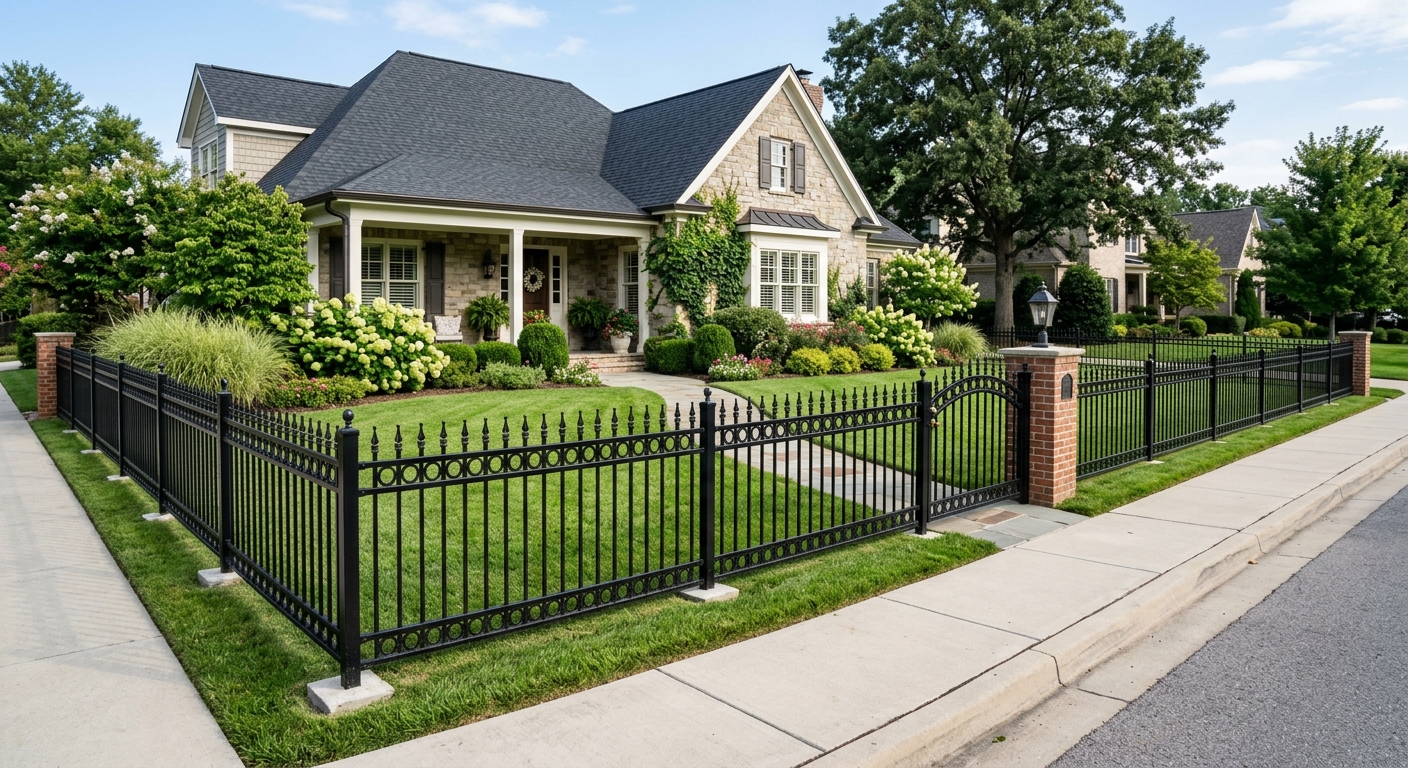
Fencing options and costs in Playter Estates-Danforth
In Playter Estates-Danforth, choosing a fence is less about “one size fits all” and more about matching material and build method to Toronto’s freeze–thaw cycles and the kind of properties you’re fencing around. With a local population of 7,804 (Statistics Canada, 2021 Census), the neighbourhood has steady demand from homeowners protecting backyards, driveways, and garden spaces. The strongest predictor of local fencing activity is the mix of detached homes in the wider Toronto market—detached properties typically need longer runs for privacy and boundary definition—so you’ll often see crews busy in established residential pocket areas.
Toronto pricing is also shaped by ground conditions. In Southern Ontario, the frost line is commonly planned around 42"–48", which pushes most contractors to set posts about 3.5–4 feet deep for 6–8 ft privacy fences. That concrete-set requirement increases labour time and ready-mix use, even before you consider hardware upgrades for wind resistance and panel racking. In Playter Estates-Danforth, this trade is especially in demand around Danforth Avenue corridors and the surrounding residential streets where backyards are larger and fence lines are often long and irregular.
Below is a practical side-by-side comparison of common materials you’ll see quoted in Playter Estates-Danforth, with typical lifespan and maintenance expectations. Use the table as a baseline, then we’ll walk through the exact factors that swing quotes up or down by thousands.
| Material |
Lifespan |
Maintenance |
Privacy Rating |
Price per Linear Foot |
| Pressure-treated pine (standard wood) |
10–15 years |
Stain/seal every 2–3 years |
High (solid boards) |
$65 – $120 |
| Cedar (natural rot resistance) |
15–25 years |
Stain/seal every 2–4 years |
High (solid boards) |
$75 – $130 |
| Vinyl / PVC (no-maintenance) |
20–30 years |
Rinse/wash as needed; no staining |
High (solid privacy panels) |
$75 – $130 |
| Chain-link (galvanized steel) |
20–30 years |
Occasional wash; tighten hardware |
Low to Medium (open weave) |
$45 – $85 |
| Aluminum ornamental |
25–40 years |
Wash as needed |
Low (ornamental spacing) |
$90 – $160 |
| Composite / recycled material |
20–30 years |
Minimal; wash and inspect posts/hardware |
High (solid options available) |
$75 – $130 |
Prices are estimates only and vary by project scope, site access and material selection.
What affects the price of fencing in Playter Estates-Danforth
In the Toronto economic region, two neighbours can receive fence quotes that look wildly different—often 30–50% apart—because the “same” fence on paper still changes once you account for ground depth, post setting, wind bracing needs, and how crews can access the backyard. Labour also varies: some sites need longer carry distances from the driveway, extra time for layout, or stepped builds to follow existing grade. On top of that, materials themselves move with demand—wood and cedar pricing can tighten seasonally, while vinyl and aluminum pricing is steadier but often higher upfront.
Toronto’s cold-weather performance requirements are the big driver. Contractors plan post holes based on the frost line (commonly 42"–48" in Southern Ontario). In practice that means setting posts roughly 4–6 inches below the design frost depth so you don’t get frost heave. For many 6–8 ft fences, that’s often 1.5–2.0 m into the ground, which increases both the hole depth and the length of posts you have to buy. Concrete-set posts are common because clay and mixed soils can shift; this raises costs versus simple gravel or driven methods.
Local examples in Playter Estates-Danforth: (1) on clay-heavy lots, we often see heavier concrete footings recommended for privacy fences to prevent leaning over freeze–thaw cycles; that can add substantial labour and ready-mix cost. (2) where fence lines sit near open laneways or more exposed corners, hardware upgrades and tighter spacing help resist racking, nudging wood and vinyl options toward the upper end of the $65 – $120 (wood) or $75 – $130 (vinyl/PVC) ranges. (3) if you’re replacing an older fence, disposal and post removal can push the total higher even when the new material choice is unchanged. Those are also why an older backyard that’s been landscaped and re-levelled may cost more—stepped or raked sections require more layout time.
| Price Factor |
Why It Matters |
Cost Impact |
| Fence length in linear feet — the primary cost driver |
Every extra foot adds posts, rails, and labour time |
Can change total by thousands on typical backyard runs |
| Post depth required — frost line determines post length and hole depth |
Deeper holes require longer posts and more excavation |
Often adds 10–25% for privacy-height fences |
| Post setting method — concrete vs. gravel pack vs. driven posts |
Concrete increases stability in freeze–thaw soils |
Concrete-set usually increases labour and materials costs |
| Material choice — vinyl vs. cedar vs. chain-link |
Different material costs and build methods |
Ranges from economical to premium installation totals |
| Gate count and type — walk-through vs. drive-through (double) |
Gates require stronger frames, hinges and latching |
1 extra gate can add significant hardware and framing time |
| Grade and terrain — sloped yards require stepped or raked panels |
More layout cuts and custom assembly are needed |
Can add 5–20% depending on slope complexity |
| Old fence removal and disposal |
Time for tear-down, hauling and proper disposal |
Often 5–15%+ if posts are concreted in |
| Permit fees and survey / property line locate |
Height and exact placement can trigger paperwork |
May add a few hundred to over $1,000+ on some lots |
Permits & regulations in Ontario
In Ontario, permits are commonly required when a fence exceeds typical height thresholds—often around 2.0 m (6.5 ft) at the rear and about 1.0–1.2 m (3–4 ft) at the front or corner, depending on location and municipal rules. Even when a permit is not required, the fence must still respect property lines and local setback requirements. Before you dig any post holes, call for utility locates through Ontario One Call to prevent damage to buried services. Also, get a survey or at least a property pin locate before you install—especially in older Toronto neighbourhoods where fence lines can be less consistent with modern property markers.
If you’re replacing a shared boundary fence, line-fence expectations are governed by provincial line-fences legislation, so clarifying responsibility early helps avoid disputes. For your Playter Estates-Danforth project, here’s a practical verification routine:
- Confirm the work will match what the contractor promised for permit scope (if required).
- Verify the contractor’s Ontario business credentials on their official listing and request documentation before starting.
- Ask for a current certificate of liability insurance (COI) naming you as an additional insured where applicable.
- Request proof of WSIB coverage for workers (or coverage clearance letter, if that applies to the contractor’s circumstances).
- Ensure the contractor provides a written scope that states whether they handle permits/locates or you do.
What typically DOES require a permit: installing a new tall privacy fence that exceeds the common rear/yard thresholds, and any fence work that may affect setbacks or involve special conditions. What typically does NOT: shorter decorative fences that clearly fall below thresholds and routine replacements on the same footprint—though you should confirm in writing.
Choosing the right fence material for Playter Estates-Danforth
Choosing the right fence material in Playter Estates-Danforth is about aligning your priorities—privacy, low maintenance, budget, and lifespan—with Toronto’s freeze–thaw winter cycles and spring thaw. Pressure-treated pine is usually the budget-friendly choice, but you should expect grey weathering if you don’t stain; most owners plan staining every 2–3 years. Cedar looks better longer and resists rot naturally, but it still benefits from periodic staining to keep colour and reduce surface cracking. Vinyl/PVC is popular for low upkeep and stays looking clean without painting, but extremely cold snaps can make posts and panels more brittle if the installation isn’t done with proper post spacing and hardware. Chain-link is the lowest-cost long-life option, yet it provides little privacy unless you add privacy slats or climbing screening. Aluminum ornamental fencing is rust-resistant and attractive, but it’s not a true privacy solution due to open spacing.
Post depth and installation method matter as much as material here. With Toronto’s frost line commonly estimated around 42"–48", most privacy fence builds use concrete-set posts set roughly 3.5–4 feet deep to avoid frost heave. That reduces movement in clay and mixed soils and helps prevent rails from loosening. Wind and snow loads aren’t extreme like some prairie exposure, but tall solid fences can rack, so panel bracing and post size/spacing are still important.
To make the price decision real: if you’re considering a wood privacy fence around $65 – $120 per linear foot versus vinyl around $75 – $130, the extra cost can be justified if you want to avoid staining and reduce long-term maintenance visits. If you’re budget-tight and comfortable with upkeep, cedar or pressure-treated pine can make sense—just ensure the posts are properly set for Toronto winters.
| Material |
Cold Tolerance |
Lifespan |
Annual Maintenance |
Best For |
Price Band |
| Pressure-treated pine |
Good if posts are concrete-set and kept sealed/stained |
10–15 years |
Inspect annually; stain/seal every 2–3 years |
Budget privacy with manageable maintenance |
$65 – $120 |
| Cedar |
Very good; handles moisture swings better than many softwoods |
15–25 years |
Inspect annually; stain/seal every 2–4 years |
Better appearance and rot resistance |
$75 – $130 |
| Vinyl / PVC |
Good; stable when installed with correct spacing and hardware |
20–30 years |
Rinse/wash; check posts/hardware after extreme cold snaps |
Low maintenance privacy |
$75 – $130 |
| Chain-link |
Excellent; galvanized steel resists winter corrosion |
20–30 years |
Wash as needed; tighten ties |
Security on a tighter budget (with optional slats) |
$45 – $85 |
| Aluminum ornamental |
Excellent; powder-coated systems handle cold well |
25–40 years |
Wash as needed; periodic hardware check |
Front-yard aesthetics and containment |
$90 – $160 |
| Composite / recycled |
Good; best performance with correct post spacing and alignment |
20–30 years |
Minimal; wash and inspect fasteners |
Long-life privacy with less upkeep |
$75 – $130 |
How to choose a fencing contractor in Playter Estates-Danforth
When you’re hiring a fencing contractor in Playter Estates-Danforth, verify credentials before you ever compare “bottom line” pricing. In Ontario, ask for proof of the contractor’s Ontario business registration/standing, liability insurance, and WSIB coverage for workers. To check liability insurance, request an up-to-date certificate of insurance (COI) showing coverage limits and expiry date. For WSIB/WCB, ask for WSIB clearance documentation where applicable; if they’re using subcontractors, require proof for each trade involved. If a contractor can’t provide paperwork quickly, that’s a serious operational red flag for a job that depends on accurate layout and safe excavation.
Then, get 2–3 itemised written quotes. You want labour and materials broken down, not a single lump sum—especially for posts, rails, concrete, hardware, gates, and removal/disposal. Read exclusions carefully: will the price include permit pulls (if required), utility locate coordination, and hauling away the old fence? Ask about warranty terms in writing: workmanship warranty length, product/manufacturer warranty coverage, and whether warranty is transferable if you sell your home. For payment, keep it fair—never more than about 10–15% upfront; hold back a portion until completion checks pass. Finally, insist on a written timeline with a start date window and a realistic completion estimate.
- Confirm the fence layout matches a survey/property pins or a formal locate.
- Ask who is responsible for Ontario One Call locate and the marking process.
- Request post-depth details (concrete-set vs gravel vs driven) for Toronto winter stability.
- Verify whether the quote includes concrete and rebar/anchors if required for privacy height.
- Ensure gate hardware specs are listed (hinge type, latch quality, frame reinforcement).
- Check if the quote includes stepped/raked panels for slope and how they’ll measure.
- Confirm old fence removal: tear-down, haul-away, and disposal charges included.
- Look for labour line items, not only “materials supply.”
- Make sure site protection (driveway covering, lawn protection) is addressed.
- Confirm warranty: workmanship + manufacturer coverage, with dates and scope.
- Set payment schedule in writing; avoid large upfront deposits.
- Get start/completion dates and a contact person for change-order decisions.
Concrete red flags I see in Playter Estates-Danforth: (1) quotes that don’t specify post depth or post setting method despite Toronto frost requirements; (2) no written scope for gate construction or hardware quality; (3) missing or expired COI/WSIB paperwork when requested; (4) lump-sum pricing with no allowance for disposal, concrete, or site access; (5) vague warranties that only cover “materials” or have no workmanship term.
Frequently asked questions — fencing in Playter Estates-Danforth
What's the best fence for privacy?
For privacy in Playter Estates-Danforth, a solid-panel fence is usually the best fit—typically wood (pressure-treated pine or cedar) or vinyl/PVC privacy systems. The “best” choice depends on whether you want to maintain the fence or prefer a low-maintenance finish. Because Toronto winters can cause heaving if posts aren’t installed correctly, the biggest privacy upgrade isn’t only the material—it’s concrete-set posts set deep enough for the frost line. If you want a realistic budget baseline, many homeowners land in the wood range of $65 – $120 per linear foot for installed privacy fences, while vinyl privacy often trends closer to the upper part of $75 – $130 due to higher material and framing/hardware needs.
How do I compare fencing quotes?
Compare quotes like-for-like: total linear footage, fence height, exact material (pressure-treated pine vs cedar; vinyl type), rail count, and whether the quote specifies post depth and concrete-set installation for frost stability. Ask whether the price includes gate count and whether gates are single walk-through or a double drive-through—gates change labour and hardware. Also confirm inclusions/exclusions: old fence removal and disposal, utility locate coordination, and whether permits are part of the scope if your height triggers them. In Ontario, a rear fence above the common ~2.0 m threshold often needs permitting, so the contractor should say who handles that in writing. If one quote is much lower, it’s usually omitting concrete, not specifying post setting, or leaving disposal/grade work out.
How long does fence installation take in Playter Estates-Danforth?
Timing depends on the length of the run, gate count, and how complex the ground is. For a typical backyard privacy fence, installation is often completed over 2–5 days of on-site work, plus additional time if old fence removal is included. The concrete-set method requires careful placement; crews usually plan around curing and layout accuracy rather than rushing post-setting. If your yard is sloped and needs stepped or raked panels, expect extra measuring, cutting, and fitting time. In Playter Estates-Danforth, access also matters—narrow driveways, landscaped beds, and long carry distances can add labour hours. Ask your contractor for a written start date window, completion estimate, and a schedule that includes material delivery timing.
Can I install a fence on a slope in Playter Estates-Danforth?
Yes, fencing on a slope is very common in older Toronto neighbourhoods, and it’s manageable with the right approach. You can install stepped panels (most consistent look) or raked panels (one continuous grade angle) depending on the fence style and the amount of slope. The key is that posts still must be set to proper depth for frost stability—even if the top line changes grade. Contractors should specify how they’ll measure and mark the fence line to avoid gaps or uneven spacing. For taller privacy fences, stepped sections often reduce stress on rails and help resist wind racking. Make sure your quote explicitly mentions stepped/raked work; otherwise, you can be surprised by additional layout and material waste.
What is the most weather-resistant fence for Playter Estates-Danforth's climate?
In Toronto’s cold winters and wet spring conditions, the most weather-resistant options are usually vinyl/PVC privacy (for low maintenance) or properly built wood with concrete-set posts, and galvanized chain-link where security is the priority. Vinyl tends to hold its shape and finish longer without staining, but it still relies on correct post spacing and solid installation. Galvanized chain-link is very durable against corrosion, though it doesn’t provide privacy by itself. Wood can be extremely resilient if you choose cedar and maintain it—yet it requires stain/seal cycles to prevent weathering. In pricing terms, you’ll often see wood privacy in the $65 – $120 range and vinyl/PVC privacy in the $75 – $130 range; the higher materials cost can pay off in less upkeep over the life of the fence.
How do I prevent wood fence rot in Playter Estates-Danforth?
Wood rot is typically driven by moisture trapped at joints and untreated exposure at the board ends and around posts. To prevent rot in Ontario, start with correct installation: use concrete-set posts set deep enough for frost stability, keep the bottom of boards off the soil where possible, and ensure drainage around the base. Choose rot-resistant materials where practical—cedar has natural rot resistance compared to many softwoods. Then commit to maintenance: stain/seal on a schedule (often every 2–3 years for pressure-treated pine, depending on sun exposure) and inspect after freeze–thaw seasons for loose fasteners, cracked boards, or gaps where water can sit. Also, use exterior-rated hardware (corrosion-resistant screws/nails) and don’t let sprinklers directly wet fence rails for long periods.