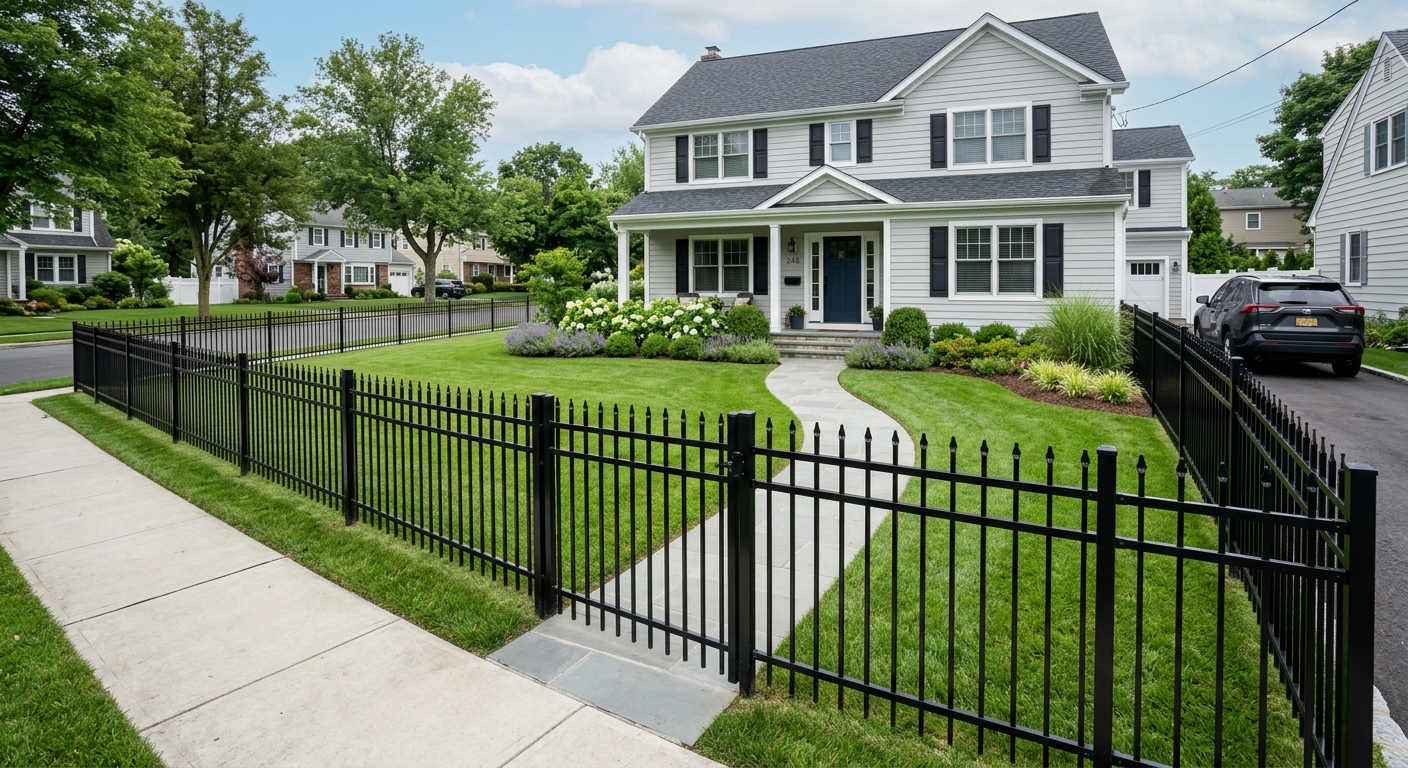
Fencing options and costs in Kennedy Park
Kennedy Park, Ontario is the kind of neighbourhood where a solid fence does double duty: it defines property lines and helps homeowners manage privacy close to busy roads and neighbouring lots. With a population of 17,123 (Statistics Canada, 2021 Census), the Toronto region has steady demand for installed fencing, especially among detached homeowners who are often upgrading backyards for kids, pets, and outdoor living. It’s also a community where mature lots and older streetscapes mean many properties already have an existing fence—so demolition and replacement work is common.
In the Toronto economic region, the cost of fencing isn’t just material—it’s driven by Ontario’s freeze/thaw cycle. Contractors typically set posts using concrete and install them deep enough to resist frost heave; for 6–8 ft privacy fences, that usually means longer posts and deeper footings than many people expect. Vinyl and metal can look “easy,” but winter performance still depends on correct post spacing and robust hardware to reduce racking during wind and snow loads. In practice, availability of experienced crews in Toronto, plus soil conditions (often clay or mixed soils), pushes labour and ready-mix concrete use up compared with simpler, driven-post installs.
In Kennedy Park, fencing work is especially in demand around the more built-up residential corridors where properties are closer together and privacy upgrades are frequent. Use the table below to compare typical options and price ranges before you request an itemised quote.
| Material |
Lifespan |
Maintenance |
Privacy Rating |
Price per Linear Foot |
| Pressure-treated pine (standard wood) |
10–15 years |
Stain or seal every 2–3 years |
High (solid boards) |
$65–$120 |
| Cedar (natural rot resistance) |
15–25 years |
Light staining/finishing every 2–4 years |
High (solid boards) |
$85–$130 |
| Vinyl / PVC (no-maintenance) |
20–30 years |
Rinse only; occasional fastener check |
High (solid privacy styles) |
$75–$130 |
| Chain-link (galvanized steel) |
20–30 years |
Minimal; wash and straighten as needed |
Low–Medium (can add privacy slats) |
$45–$85 |
| Aluminum ornamental |
25–40 years |
Low; occasional cleaning |
Low–Medium (spaced pickets) |
$90–$160 |
| Composite / recycled material |
20–30 years |
Low; no traditional staining |
Medium–High (solid or semi-solid) |
$95–$155 |
Prices are estimates only and vary by project scope, site access and material selection.
What affects the price of fencing in Kennedy Park
In Kennedy Park and across the broader Toronto area, you’ll often see quotes for the “same” fence land 30–50% apart. That gap usually comes down to how deep and how well the posts are installed, the quality of the hardware, and whether the contractor accounts for site realities like clay soils, grade changes, and removal of an older fence. In a high-demand region like Toronto, labour rates and crew scheduling also affect turnaround and pricing, particularly during peak spring installation windows.
Most homeowner surprises are tied to frost protection. Ontario’s commonly used design frost line for the south is roughly 42–48 inches, so posts typically need to be set about 4–6 inches below that design depth to reduce frost heave risk. For a 6–8 ft privacy fence, this often means setting posts around 1.5–2.0 m into the ground, using longer posts and concrete setting—both of which raise material and labour costs compared with shallow or driven-post approaches. Wind loading still matters, even though Toronto is not as severe as prairie or coastal exposure: taller solid fences can rack, so we plan panel style, post size, and spacing (often 6–8 ft centres) to keep the fence straight and secure.
In Kennedy Park specifically, costs can rise when (1) clay-heavy soils require extra excavation time, (2) properties have sloped backyards that force stepped or raked panels, and (3) an existing fence needs full demolition and haul-away. Costs can be lower when the yard is level, access is straightforward for a trailer or small skid, and the line is unobstructed. As a quick reference, solid wood and cedar privacy fences often land in the $65–$120 per-foot band for standard scopes, while vinyl privacy frequently approaches the $75–$130 range depending on post depth, style, and gate hardware.
| Price Factor |
Why It Matters |
Cost Impact |
| Fence length in linear feet — the primary cost driver |
More panels and more posts means more materials and more labour hours |
High (often the biggest single line item) |
| Post depth required — frost line determines post length and hole depth |
Deeper holes and longer posts increase excavation time and ready-mix usage |
High in Southern Ontario installations |
| Post setting method — concrete vs. gravel pack vs. driven posts |
Concrete-set posts improve long-term stability in freeze/thaw conditions |
Medium–High (concrete and labour added) |
| Material choice — vinyl vs. cedar vs. chain-link |
Material cost and hardware requirements vary widely |
Medium (choice can shift total substantially) |
| Gate count and type — walk-through vs. drive-through (double) |
Gates need heavier frames, hinges, latches, and often reinforced posts |
Medium–High depending on size and number |
| Grade and terrain — sloped yards require stepped or raked panels |
More layout time and more custom cutting can reduce speed |
Medium |
| Old fence removal and disposal |
Haul-away and teardown add labour and disposal fees |
Medium (can materially change totals) |
| Permit fees and survey / property line locate |
Locates and documentation help avoid encroachment disputes and rework |
Low–Medium (project dependent) |
Permits & regulations in Ontario
In Ontario, fence rules are tied to height and location (front, rear, and corner lots), plus property line and setback requirements. As a practical guideline, fences above a height threshold—commonly around 2.0 m (6.5 ft) at the rear and roughly 1.0–1.2 m (3–4 ft) at the front or corner—often require a building permit. Exact thresholds can vary by local bylaw, so Kennedy Park homeowners should confirm the numbers with their city office or permitting portal before ordering materials.
Before you dig any post holes, call for utility locates through Ontario One Call to mark buried services. Then verify the property line: if you don’t have a recent survey, consider a property pin locate so the fence doesn’t creep onto a neighbour’s land. Ontario also governs shared fence ownership and responsibilities through line-fences principles, so it’s important to understand whether you’re building entirely on your land or partially on a boundary.
What typically DOES require a permit: larger-height solid fences (especially at rear, but also depending on front/corner placement), major modifications to boundary fencing, and projects that can affect visibility or setbacks. What typically does NOT: replacing like-for-like on the same footprint and staying under the applicable height thresholds (still requires checking with your local bylaw).
To verify a contractor for Kennedy Park projects, check: (1) Ontario licence/registration info through the contractor registry where applicable, (2) liability insurance certificate of insurance showing your contractor is insured for fencing work, and (3) WSIB/WCB coverage for workers—request the clearance letter or coverage confirmation, and ensure the certificate details match the legal business name.
Choosing the right fence material for Kennedy Park
Choosing the right fence material in Kennedy Park comes down to matching your priorities—privacy, low maintenance, budget, and lifespan—to the realities of Toronto-area winters. Posts must be set deep enough for freeze/thaw stability, and solid fences must resist racking during wind and snow loading. That means even “budget” material benefits from a proper installation plan.
Pressure-treated pine is the common entry option and typically fits homeowners who want to manage upfront costs, but it needs staining or sealing every 2–3 years to prevent grey weathering and help slow moisture damage. Cedar offers better natural rot resistance and tends to look nicer longer, yet it still benefits from periodic finishing. Vinyl/PVC is a strong low-maintenance choice—no staining required—but in extreme cold it’s more sensitive to installation details; you need correct post support and spacing so panels don’t warp or crack. Chain-link is the lowest-cost and longest-life option for durability, but it won’t provide true privacy unless you add slats or a privacy screen. Aluminum ornamental is rust-resistant and clean-looking, yet it’s more suited to decorative boundaries than full privacy.
For Toronto frost performance, post depth usually follows frost-line best practice, so concrete-set posts are typically recommended rather than driven posts. If you’re building a solid privacy line, the installed stability often matters more than minor material differences. For example, if you’re choosing between a standard pressure-treated pine privacy fence and vinyl privacy in the $65–$120 versus $75–$130 bands, that extra vinyl budget can be justified when you want to avoid recurring staining and you expect to stay in the home through the long service life.
| Material |
Cold Tolerance |
Lifespan |
Annual Maintenance |
Best For |
Price Band |
| Pressure-treated pine |
Good when posts are set for frost stability |
10–15 years |
Low to moderate (stain/seal cycle every 2–3 years) |
Budget-friendly privacy with classic look |
$65–$120 |
| Cedar |
Good; performs well with correct airflow and finishes |
15–25 years |
Low to moderate (finish every 2–4 years) |
Better curb appeal and natural rot resistance |
$85–$130 |
| Vinyl / PVC |
Very good; needs proper post support and spacing |
20–30 years |
Very low (rinse as needed; check hardware) |
Low maintenance privacy in Toronto winters |
$75–$130 |
| Chain-link |
Excellent; galvanized steel handles freeze cycles well |
20–30 years |
Low (wash and straighten occasional sections) |
Security with minimal visual mass |
$45–$85 |
| Aluminum ornamental |
Excellent (no rust from wet winters) |
25–40 years |
Low (periodic cleaning) |
Decorative boundaries with durability |
$90–$160 |
| Composite / recycled |
Good; stable in cold when installed correctly |
20–30 years |
Low (wash; inspect posts and fasteners) |
Long-life privacy with reduced upkeep |
$95–$155 |
How to choose a fencing contractor in Kennedy Park
Start by verifying that your contractor is properly set up for work in Ontario. Ask for a certificate of liability insurance (it should include fencing installation activities and match the contractor’s legal name). For worker coverage, request proof of WSIB/WCB clearance or current coverage documentation—don’t accept “we have coverage” without seeing the certificate or clearance confirmation. Also confirm the contractor’s Ontario registration/licensing information where applicable and that their contact details and business address are legitimate.
Next, get 2–3 itemised written quotes. “Itemised” matters: you want labour broken out from materials, and you want clarity on post installation method (concrete-set vs other), post depth allowance, fence type, gate hardware, and the exact panel and rail layout. Avoid lump-sum quotes that don’t state what’s included in demolition, disposal, and any required line locates or survey assistance.
Scope details prevent expensive surprises. Ask whether permit pull (when required for height or placement), utility locate coordination, and haul-away are included. Review warranty terms: a workmanship warranty (often covering labour for a defined period) should be written clearly, and product manufacturer warranties should be listed with duration and conditions. If coverage is transferable to future owners, ask—some manufacturers restrict the transfer.
For payment, never pay more than 10–15% upfront. Hold back the remainder until the job is complete and the fence line is verified. Also require a start date and a realistic completion estimate in writing, because weather and crew scheduling can affect install timelines around Kennedy Park.
- Confirm liability insurance certificate matches the legal business name and jobsite.
- Request WSIB/WCB clearance or proof of current coverage before work begins.
- Verify the Ontario registration/licensing details and address (no “mobile-only” arrangements).
- Get itemised quotes: posts, rails, panels, hardware, gates, and labour separated.
- Ask specifically what post setting method they use for freeze/thaw stability.
- Confirm estimated post depth/footing approach in writing (no vague “to code”).
- Clarify demolition and disposal: included haul-away or separate charge?
- Ensure utility locate process is coordinated and included (call-before-you-dig).
- Ask how they handle sloped yards: stepped vs raked panels, and how pricing adjusts.
- Confirm gate type hardware (hinges, latches, reinforcement) and whether it’s rated for winter use.
- Require an execution timeline: start date, milestones, and completion window.
- Pay in staged draws (max 10–15% upfront) and hold back until final walkthrough.
Red flags in Kennedy Park include: a contractor who won’t show insurance/coverage documents, quotes that ignore frost-depth post setting, “free” upgrades without a written scope and warranty term, aggressive upfront payment requests, and vague lump-sum pricing with no line-by-line materials breakdown.
Frequently asked questions — fencing in Kennedy Park
How much does a fence cost in Kennedy Park?
In Kennedy Park, fencing costs typically follow the Toronto market bands, and the biggest swing comes from fence length, gate count, and how posts are set for Ontario freeze/thaw. For planning, wood privacy fences commonly fall in the $65–$120 per linear foot range for standard installations, while vinyl/PVC privacy often lands in the $75–$130 band depending on post support and style. Chain-link is generally lower at about $45–$85 per foot, and aluminum ornamental is commonly in the $90–$160 range. If you’re replacing an older fence, demolition and haul-away can also shift totals. For a reliable number, ask for an itemised quote that specifies post depth/setting method, number of posts, and whether gates are included.
How deep should fence posts be for Kennedy Park's frost?
For Southern Ontario, a common design frost line is roughly 42–48 inches, and best practice is to set posts about 4–6 inches below the design frost depth to reduce frost heave risk. In practical terms, that often means posts set around 1.5–2.0 m into the ground for many privacy fence installs in the Toronto area, especially for taller 6–8 ft fences. The exact depth can vary with soil type, drainage, and your fence height, so a good contractor will state post depth and setting method in writing. In Kennedy Park’s clay and mixed soils, concrete-set posts are typically recommended rather than driven posts, because freeze/thaw movement can loosen shallow supports over time.
Wood vs vinyl vs aluminum fence — which is best?
“Best” depends on what you’re buying for: privacy, upkeep, or appearance. For privacy in Ontario winters, wood (pressure-treated pine or cedar) and vinyl are both strong choices, but vinyl is usually the best pick if you want very low maintenance—no staining cycle. Wood can look excellent when finished well, but it typically needs staining or sealing every 2–3 years to prevent weathering. Aluminum ornamental is the durability winner for looks and rust resistance, but it’s usually spaced, so it’s not ideal for full privacy. Cost-wise, wood privacy frequently fits the $65–$120 band, while vinyl privacy often sits closer to $75–$130. No matter the material, the post depth and hardware matter as much as the panel choice in Kennedy Park’s freeze/thaw conditions.
Do I need a permit to build a fence in Ontario?
Often, yes—if your fence is above the applicable height thresholds or placed in areas where visibility and setbacks are regulated. As a common guideline, fences above about 2.0 m (6.5 ft) at the rear and around 1.0–1.2 m (3–4 ft) at the front or corner may require a building permit in Ontario, though the exact rules can vary by local bylaw. If your plan affects a corner lot, creates sightline issues, or involves higher solid privacy fencing, assume you’ll need to check first. Also remember: utility locates are required before digging. The safest approach in Kennedy Park is to ask your contractor to confirm whether a permit is expected for your specific height and placement, and to list that in the written scope.
How long does a wood fence last in Kennedy Park?
A wood fence in Kennedy Park can last roughly 10–15 years for standard pressure-treated pine and 15–25 years for cedar, assuming proper installation and finishing. The Toronto-area freeze/thaw cycle is hard on shallow posts, so lifespan drops when contractors use insufficient post depth or avoid concrete-set stability. Soil type matters too; mixed soils and drainage issues can increase movement around posts. Maintenance is the other big driver: plan on staining or sealing pressure-treated pine every 2–3 years, and cedar every 2–4 years. If you want the longest service life, choose solid privacy construction with good hardware, set posts using frost-aware depth, and keep top caps and fasteners in good condition to limit moisture pathways.
Who owns and maintains a shared fence?
In Ontario, shared fence ownership and responsibilities are addressed through line-fences principles and the specific circumstances of your property boundary. In many cases, if a fence is built directly on or along a boundary, neighbours may share responsibilities for maintenance and replacement. The practical reality in Kennedy Park is that homeowners sometimes inherit older fences with unclear ownership, so it’s wise to confirm where the fence sits relative to property pins or survey information. If the fence is entirely on your land, you generally maintain it; if it’s on the boundary, maintenance and cost-sharing can apply depending on local interpretation and agreements. Before replacing a shared fence, I recommend documenting the line (survey/locate if needed) and discussing scope and costs in writing to avoid disputes.