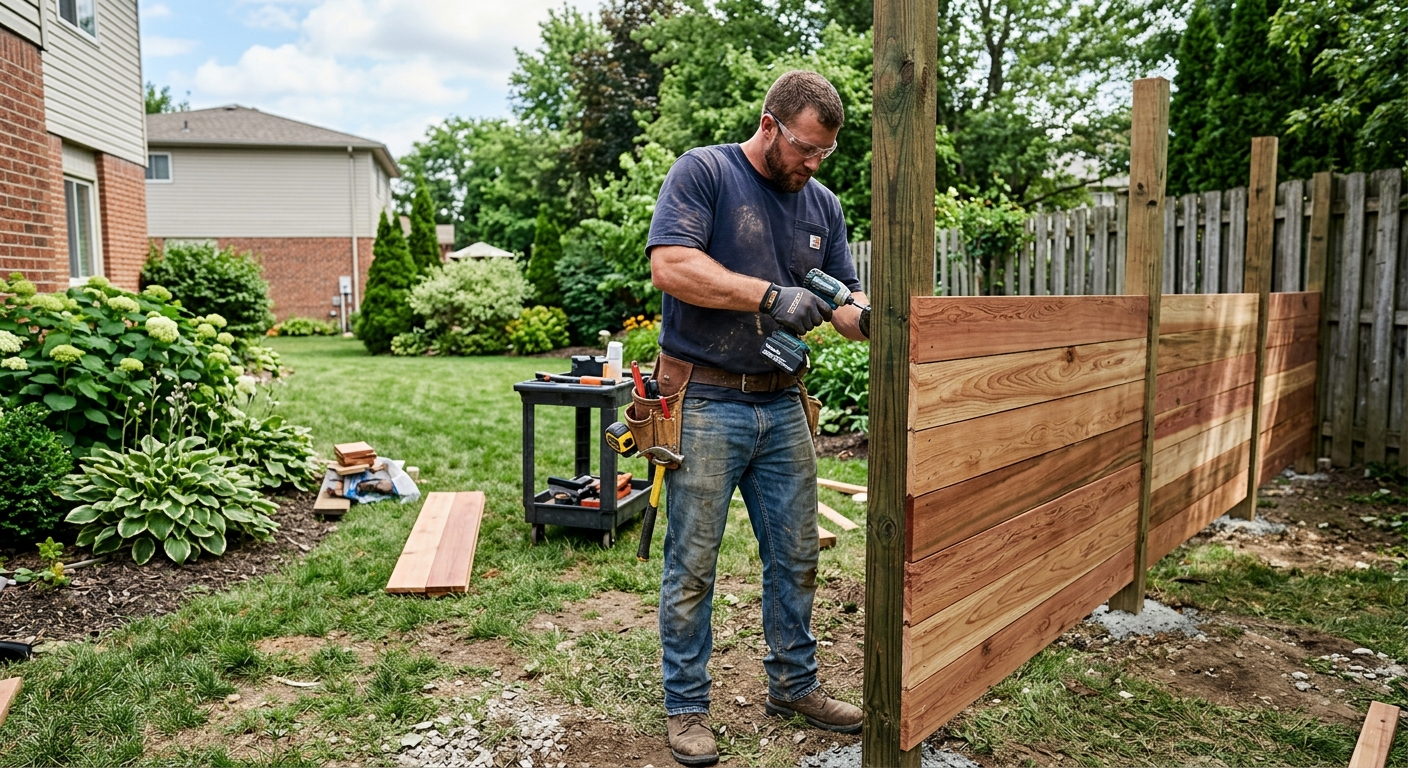
Fencing options and costs in Port Hope
In Port Hope, choosing the right fence usually starts with the same question: what will it cost, and what will last through our freeze–thaw cycles? With Port Hope’s housing mix—72.2% single-detached homes (Statistics Canada, 2021 Census)—there’s steady local demand, especially on larger lots where people want privacy, pet safety, or clearer yard boundaries. Homeownership is also high at 78.3% of households owning, which tends to translate into more planned upgrades like new fence runs and gate replacements (Statistics Canada, 2021 Census). One more practical factor for homeowners: 63.7% of homes were built before 1981, so many properties have older lot lines, mature landscaping, and sometimes older fence remnants that must be removed or worked around.
In the Muskoka–Kawarthas region, the biggest cost driver is ground conditions and winter depth. Frost in this part of Ontario is roughy 4 ft, so posts need to be set deep (often 42–48" or more depending on design) to prevent heaving and future leaning—this increases excavation time, concrete use, and the length of posts. Access matters too: in older neighbourhoods with narrower right-of-ways, contractors may spend extra time on careful digging and haul-away. Areas where we commonly see fence work include the downtown core and surrounding established residential streets off Ward Street, where backyards can be tighter and gate access is crucial.
Below is a realistic comparison of common fence materials for Port Hope, assuming an installed project (materials plus labour). Use it as a starting point, then we can tighten pricing once we measure your linear footage, post spacing, and site conditions for your exact run.
| Material |
Lifespan |
Maintenance |
Privacy Rating |
Price per Linear Foot |
| Pressure-treated pine (standard wood) |
10–15 years |
Stain or seal every 2–3 years; check posts after storms |
Medium–High (solid panels typical) |
$55–$80 |
| Cedar (natural rot resistance) |
15–25 years |
Light staining/sealing every 2–3 years; inspect annually |
High (solid privacy styles) |
$65–$95 |
| Vinyl / PVC (no-maintenance) |
20–30 years |
Minimal: wash as needed; replace cracked sections if extreme cold impacts panels |
Medium–High (solid or semi-privacy pickets) |
$65–$95 |
| Chain-link (galvanized steel) |
20–35 years |
Occasional rinse; tighten hardware over time |
Low (security only) |
$40–$65 |
| Aluminum ornamental |
25–40 years |
Occasional wash; check alignment after major wind |
Low–Medium (ornamental spacing) |
$70–$110 |
| Composite / recycled material |
20–30 years |
Low: periodic cleaning; minor panel replacement if damaged |
High (modern privacy boards) |
$70–$105 |
Prices are estimates only and vary by project scope, site access and material selection.
What affects the price of fencing in Port Hope
Even when two homeowners describe the “same fence,” Port Hope quotes can still vary by 30–50% across Muskoka–Kawarthas and other parts of Ontario because the true variables aren’t the fence style—they’re the ground and the build conditions. A 60 ft run on level ground with easy access is priced very differently from a 60 ft run that includes bedrock near the post line, removing an old fence, or installing through narrow gates where equipment can’t reach. In practice, that means your cost per linear foot can swing within the typical band ranges: wood and vinyl often land closer to $55–$95 per foot depending on style, while chain-link is usually the lowest at roughly $40–$65 per foot when the site is straightforward.
In cold Ontario, the frost line is a major driver. A good rule is to set posts 4–6 inches below the design frost depth to prevent heaving and leaning. If frost depth is about 4 ft, many installs require posts set roughly 42–48" deep (often deeper based on local design and soil), which raises the labour and concrete quantities and can increase material cost because you need longer posts and heavier hardware. Wind exposure can also push costs: even though prairie-level winds aren’t typical, open lots and lake-adjacent properties around the region can benefit from tighter post spacing and stronger rails so privacy panels don’t act like sails.
Concrete examples from Port Hope-area sites: (1) properties with clay pockets often need slower excavation to keep holes true, which adds time and labour; (2) yards with roots or occasional rock add augering/hand-digging time, pushing projects toward the upper end of wood and vinyl ranges; (3) removing an older fence that’s partially embedded or leaning can add disposal and rework, sometimes making a “budget” option end up costing more than expected. Add in that many Port Hope homes are older (63.7% built before 1981, Statistics Canada, 2021 Census), and it’s common to encounter mature plantings and older fence lines that complicate layout—those details show up directly in your quote.
| Price Factor |
Why It Matters |
Cost Impact |
| Fence length in linear feet |
Every component—posts, rails, caps and pickets—scales with linear footage |
Largest swing; often sets the base of your final price |
| Post depth required |
Frost line determines hole depth to prevent heaving and leaning over time |
Deeper installs mean more labour + more concrete per post |
| Post setting method |
Concrete vs. gravel pack vs. driven posts changes materials, time, and long-term stability |
Concrete-set posts typically cost more but perform best in cold freezes |
| Material choice |
Vinyl, cedar, and chain-link have different rail/post requirements, hardware, and costs |
Switching materials can shift the total into a different price band |
| Gate count and type |
Double-drive gates require more hardware, stronger frames, and careful alignment |
Gates can add a noticeable premium over straight runs |
| Grade and terrain |
Sloped yards need stepped or raked panels; this affects layout and material usage |
More cuts and more time for posts and rails |
| Old fence removal and disposal |
Haul-away, demolition, and handling embedded posts increase labour and costs |
Often adds 10–25% depending on condition and access |
| Permit fees and survey / property line locate |
Ontario can require permits above certain heights, and line locate prevents encroachment disputes |
Variable administrative costs; protects you from redesign disputes |
Permits & regulations in Ontario
In Ontario, fence rules are usually a combination of municipal bylaw limits and provincial line-fences principles. As a practical baseline, fences above a height threshold—often around 2.0 m (6.5 ft) at the rear and roughly 1.0–1.2 m (3–4 ft) at the front or corner—may require a building permit, depending on the municipality and exact location on your property. Regardless of permit requirements, all fences must respect property lines and local setback/bylaw requirements.
Before you dig any post holes, you must arrange utility locates. In Ontario, call Ontario One Call to mark buried utilities, and keep those markings visible before excavation. If your property line is unclear—or you’re working near a hedge, shared drive, or older boundary—getting a survey or property line locate using your pins can prevent costly disputes. Shared fence ownership rules in Ontario are governed by provincial line-fences legislation, so documenting what’s existing and where it sits matters.
What typically DOES require a permit: installing or significantly increasing fence height beyond common thresholds, and projects that fall under local “accessory structure” height controls. What typically does NOT: replacing a fence in the same location and similar height, or installing standard-height sections within bylaw limits (still confirm with the municipality or your contractor).
To verify an Ontario contractor, ask for: an Ontario licence (if applicable for their trade scope), a current certificate of liability insurance showing your address/jobsite coverage, and proof of workplace coverage (WSIB) or appropriate coverage documentation for their workers. Request the clearance letter directly if they claim coverage, and keep copies with your written contract.
Choosing the right fence material for Port Hope
The best fence in Port Hope matches your priorities—privacy, low maintenance, budget, and how long you want to keep the same appearance—while also handling our frost depth and wet-to-freeze seasonal swings. With frost in the Muskoka–Kawarthas region around 4 ft, posts are typically set deep (often 42–48" or deeper) and concrete-set posts are common for stability, especially for privacy fences where wind pressure can stress rails and panels. That means “cheap materials” can still cost more if your design needs heavier posts, tighter spacing, or more robust gate hardware.
Pressure-treated pine is a budget-friendly option, but it usually needs staining or sealing every 2–3 years to avoid greying and weathering. Cedar offers better natural rot resistance and a more attractive look, and it still benefits from periodic staining for long-term colour and even aging. Vinyl/PVC is popular for low maintenance—wash occasionally—but in extreme cold it can be more susceptible to cracking if panels are not installed with correct expansion allowances and robust post spacing. Chain-link is usually the lowest upfront and lasts a long time, but it won’t provide privacy. Aluminum ornamental is mid-range to higher, and it resists rust without the staining work of wood.
Here’s where the dollar difference can be justified: if a cedar privacy fence lands in the $65–$95 per foot range versus pressure-treated pine at roughly $55–$80 per foot, that extra cost is often worth it when you want a warmer look and better long-term performance in damp seasons. On open lots where gusts increase panel stress, investing in stronger rails and correct post depth can matter more than switching material—because the failure point is usually the post/footing system, not the decorative surface.
| Material |
Cold Tolerance |
Lifespan |
Annual Maintenance |
Best For |
Price Band |
| Pressure-treated pine |
Good (when posts are deep-set for frost) |
10–15 years |
Seasonal inspection; stain/seal every 2–3 years |
Budget privacy on typical in-town lots |
$55–$80 |
| Cedar |
Very good (naturally resistant to rot) |
15–25 years |
Inspect and stain/seal every 2–3 years |
Appearance + longevity |
$65–$95 |
| Vinyl / PVC |
Good (avoid panel tightness; allow for expansion) |
20–30 years |
Low: rinse/wash as needed |
Low maintenance and clean lines |
$65–$95 |
| Chain-link |
Excellent (steel with proper galvanizing) |
20–35 years |
Low: periodic tightening; wash off debris |
Security, pets, and cost control |
$40–$65 |
| Aluminum ornamental |
Excellent (powder-coated) |
25–40 years |
Low: occasional wash |
Front yard aesthetics with durability |
$70–$110 |
| Composite / recycled |
Good (installation quality matters) |
20–30 years |
Low: clean as needed; check fasteners annually |
Modern privacy with low upkeep |
$70–$105 |
How to choose a fencing contractor in Port Hope
Choosing the right fencing contractor in Port Hope is mostly about verifying coverage, matching the quote to the real scope, and ensuring the crew builds for our frost depth and winter stresses. Start by asking for proof of Ontario workplace coverage (WSIB or appropriate documentation for their workers) and current liability insurance. Request the certificate of insurance and confirm it names the right insureds and covers fence-installation work at your address. If they mention worker coverage, ask for a WSIB clearance letter and keep it with your contract.
Next, get 2–3 itemised written quotes. You want a breakdown that separates labour, materials, post-and-footing method (concrete-set versus other methods), gate hardware, and any allowances for slopes, ledge/rock, or access constraints. A lump-sum number without details often leads to change orders—especially on older Port Hope properties where there can be buried services, mature shrubs, or older fence posts that complicate removal.
Read the exclusions line by line: are permits included, are utility locates included, and is disposal/hauling away the old fence part of the base price? Clarify warranty terms: confirm workmanship warranty length, product/manufacturer warranty coverage, and whether warranties are transferable to you if you sell the home. For payment, avoid large upfront payments—generally keep deposits around 10–15% and use progress payments tied to visible milestones. Finally, require a written timeline with a start date and completion estimate; a good fence crew plans for weather and curing time for concrete-set posts.
- Ask for certificate of liability insurance and confirm it’s current for your project dates.
- Verify WSIB clearance letter (or applicable worker coverage documentation) before work starts.
- Request an itemised quote with labour + materials, not just a total linear-foot price.
- Ensure the footing method is written: post depth, concrete-set requirements, and spacing.
- Confirm whether old fence removal and disposal are included.
- Ask who calls for utility locates and whether Ontario One Call marks are included in the schedule.
- Clarify gate pricing: walk-through vs double gates, hinges, latches, and access reinforcement.
- Get details on how slopes/grades will be handled (stepped vs raked vs custom panels).
- Check the warranty: workmanship length, exclusions (e.g., storm damage), and product coverage.
- Request coloured hardware and fence colour selection in writing before fabrication begins.
- Limit upfront payments to 10–15% and hold a portion until final completion and punch-list items.
- Get a start date, weather contingency note, and estimated completion time in writing.
In Port Hope, red flags include: quotes that don’t specify post depth/concrete setting; promises to “match any price” without a site visit; missing or vague insurance/WSIB documentation; poorly defined scope for permits and disposal; and payment schedules that request most funds up front before materials are ordered or footings are complete.
Frequently asked questions — fencing in Port Hope
How do I handle a fence dispute with a neighbour in Ontario?
Fence disputes in Ontario usually come down to property lines, height/location rules, and who is responsible for shared fencing. Start by confirming where your property line actually runs—ideally with a survey or locate using your lot pins—because “everyone’s been using it that way” isn’t enough if a boundary is unclear. Document the existing fence condition with photos and dates, and keep written notes about any damage or agreed repairs. If the fence is shared, Ontario line-fences principles can apply, so it’s important to understand shared ownership before you act. Before spending money, ask your contractor to mark the proposed fence line on-site with measurements. In Port Hope, where many homes are older (63.7% built before 1981, Statistics Canada, 2021 Census), offsets from previous owners are common, so a locate can prevent repeating someone else’s boundary assumptions.
What fence style offers the best wind resistance in Port Hope?
In Port Hope and the wider Muskoka–Kawarthas region, wind and snow loads become practical for any solid privacy fence, especially on more exposed lots. The most wind-resistant choices are typically those that don’t trap high pressure—chain-link and aluminum with open spacing allow gusts to pass through, reducing sail effect. For maximum privacy, you can still do wood or vinyl, but the build needs to be stronger: deeper, correctly set posts (commonly around 42–48" deep to address frost heave), tighter post spacing, and sturdier rails and hardware. On exposed runs, we also recommend using wind-rated gate hardware so the fence doesn’t rack and loosen at latch points. If you’re weighing budget options, remember chain-link often comes in around $40–$65 per linear foot installed, while privacy wood/vinyl typically sit higher.
How much does a fence cost in Port Hope?
In Port Hope, a common installed range depends on material and site conditions. For example, chain-link fencing often prices around $40–$65 per linear foot installed, while vinyl/PVC commonly lands around $65–$95 per linear foot depending on privacy style and gate complexity. Wood installations (pressure-treated pine) frequently track roughly $55–$80 per linear foot installed when the site is straightforward. Your final total usually reflects linear footage, post depth for frost, access constraints, and whether there’s old fence removal. Because frost in this region can be about 4 ft, posts often must be set deep and concrete-set to prevent heaving and leaning, which adds labour and concrete cost even when materials are budget-friendly. For an accurate estimate, we’d measure your linear run, count gates, and review soil/rock and access before quoting.
How deep should fence posts be for Port Hope's frost?
Port Hope’s winter conditions are why post depth matters. In the Muskoka–Kawarthas region, the frost line is roughly 4 ft, so posts are typically set about 4–6 inches below the design frost depth to help prevent frost heave and future leaning. That often works out to roughly 42–48" deep, though actual depth can vary based on soil type, fence height, and engineering considerations for privacy panels or heavier gates. This is why you’ll see higher labour and concrete costs in cold regions: deeper holes require more digging/auger time and longer posts. If your quote doesn’t specify depth and footing method, ask for it in writing before proceeding. A fence installed with shallow posts may look fine initially but can shift after freeze–thaw cycles.
Wood vs vinyl vs aluminum fence — which is best?
“Best” depends on what you value most in Port Hope: appearance, low maintenance, or cost control. Wood (often pressure-treated pine) can be a good balance for budget privacy, commonly around $55–$80 per linear foot installed, but it needs staining/sealing every 2–3 years to reduce grey weathering and protect the boards. Cedar looks better longer and resists rot naturally, with typical pricing around $65–$95 per linear foot for installed privacy styles, though it still benefits from periodic maintenance. Vinyl/PVC is popular for low maintenance—often also in the $65–$95 per linear foot range—but it must be installed correctly for cold expansion and with strong post spacing. Aluminum is durable and doesn’t rust; its ornamental look is great for front yards, typically around $70–$110 per linear foot installed, but it won’t provide the same privacy as solid wood or vinyl. For exposed lots, open styles (aluminum/chain-link) can handle wind stresses better.
Do I need a permit to build a fence in Ontario?
Sometimes, yes—especially if you’re planning a taller fence or one in a front/corner location. In Ontario, many municipalities treat fences over common thresholds (often around 2.0 m at the rear and roughly 1.0–1.2 m at the front or corner) as requiring a building permit, depending on local rules. Even when a permit isn’t required, you still must follow property line location and municipal setback/bylaw requirements. Before digging, you should also arrange utility locates through Ontario One Call. Because Port Hope properties include older lots and sometimes unclear historical boundary placements, we strongly recommend verifying your line with a survey/locate before installation, especially if your fence is close to a shared boundary or gate. The permit requirement itself is usually the homeowner’s responsibility, so confirm with the municipality or ask your contractor to include permit pull details in the written scope.