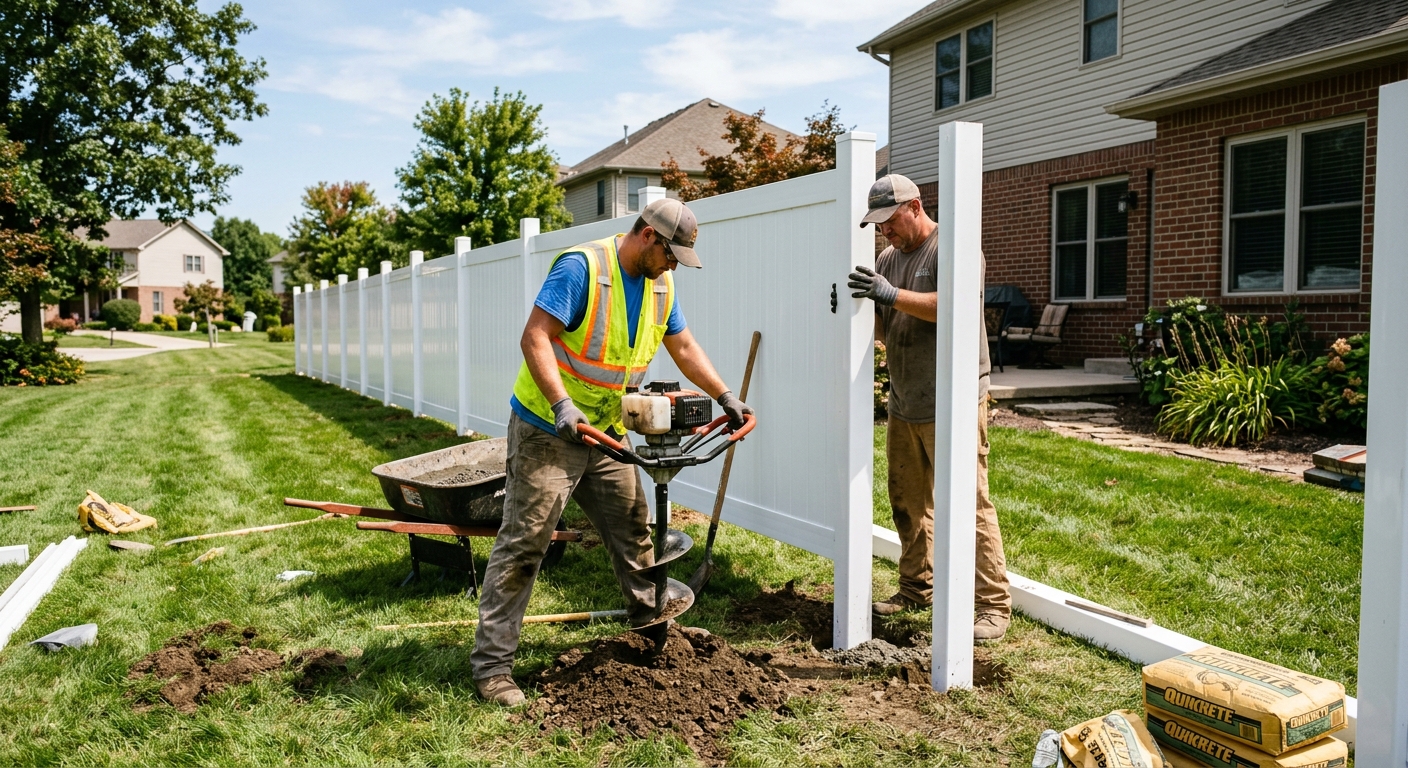
Fencing options and costs in Alliston
Alliston homeowners have plenty of choices when it comes to fencing, and the right pick usually comes down to privacy, upkeep, and budget. With a population of 18,809 in the 2021 Census, Alliston is a steady market for home improvements, and fencing demand tracks closely with household growth and property turnover (Statistics Canada, 2021 Census). If you’re in a neighbourhood with lots of detached homes—common around the Cookstown Road corridor and the edges of town—you’ll often see fence upgrades during the spring construction window.
Costs in the Toronto economic region are shaped heavily by Southern Ontario weather and standard building practice. The frost line is commonly treated at about 42"–48", which means most contractors plan for post holes deeper than a simple cosmetic install. For 6–8 ft privacy fences, concrete-set posts are often recommended to reduce long-term movement from frost heave, especially in clay and mixed soils. That adds labour and ready-mix expense, but it typically prevents the “leaning panel” problem that shows up after a couple winters. Wind still matters too—though we’re not dealing with the Prairies’ exposure or BC’s coastal storm loads, solid panels in taller heights can rack, so spacing and hardware choices affect both stability and cost.
Below is a practical cost comparison using typical Toronto-area installation ranges, then you can narrow down what fits your priorities and your lot conditions before calling for an itemised quote.
| Material |
Lifespan |
Maintenance |
Privacy Rating |
Price per Linear Foot |
Price Range |
| Pressure-treated pine (standard wood) |
10–15 years |
Stain/seal every 2–3 years to slow grey weathering and cracking |
High (solid sections) |
$10–$20 |
$65 – $120 |
| Cedar (natural rot resistance) |
15–25 years |
Annual inspection; stain or oil every 2–4 years depending on finish |
High (solid sections) |
$12–$24 |
$75 – $135 |
| Vinyl / PVC (no-maintenance) |
20–30 years |
Rinse as needed; check posts and caps periodically |
High (privacy styles available) |
$14–$26 |
$75 – $130 |
| Chain-link (galvanized steel) |
20–35 years |
Occasional rinse; tighten tension wire as needed |
Low to Medium (privacy slats optional) |
$7–$14 |
$45 – $85 |
| Aluminum ornamental |
25–40 years |
Wash and inspect fasteners every couple of years |
Low (open pickets) |
$12–$28 |
$90 – $160 |
| Composite / recycled material |
20–30 years |
Wash when needed; inspect for warping and post movement |
Medium to High (solid boards) |
$13–$27 |
$85 – $150 |
Prices are estimates only and vary by project scope, site access and material selection.
What affects the price of fencing in Alliston
In Alliston and the wider Toronto economic region, you can see the same “type” of fence quote swing by 30–50% because the differences often sit in the fundamentals: how deep posts go, whether concrete is used, the panel style (solid vs picket), and how hard your yard is to work in. Labour availability and material sourcing also vary across the busy spring months, so two contractors pricing the same length can still come back far apart once they calculate excavation time and how many crews’ hours are needed for your access conditions.
Here’s the key driver most homeowners underestimate: frost line depth. In cold Ontario conditions, posts typically need to be set about 1.5–2.0 m into the ground (or roughly 4–6 inches below the design frost depth), which requires longer posts, deeper holes, and usually concrete-set installation for 6–8 ft privacy fences. That raises material costs and makes the labour component heavier—so a wooden privacy fence that lands near the lower end of the $65 – $120 band can jump if your soil is clay and excavation is slow.
Local examples that often increase cost in Alliston include: (1) clay-mixed soils that don’t drain well, making post holes wetter and harder to stabilize; (2) sloped backyards where we “step” panels, which increases layout labour and sometimes reduces usable board yield; and (3) frequent gate builds for backyards with side access, where hardware and alignment take extra time. On the other hand, your quote can soften if you’re replacing an old run with straight alignment, easy access for a skid-steer, and minimal grade change—factors that can keep you closer to the $45 – $85 chain-link style band.
As a reference point for timing and budgeting, many Alliston upgrades are happening in mature residential lots where old fencing removal is common—demolition, hauling, and disposal are real cost adders, especially when posts are concreted in from previous installs.
| Price Factor |
Why It Matters |
Cost Impact |
| Fence length in linear feet |
Every material and labour line item scales directly with length |
Largest driver; can account for most of the total variation |
| Post depth required |
Frost line determines required embedment to prevent heaving |
Deeper holes increase labour time and concrete/ready-mix use |
| Post setting method |
Concrete vs gravel pack vs driven posts affects stability and manpower |
Concrete-set typically adds cost but reduces long-term movement |
| Material choice |
Vinyl, cedar, and chain-link differ in unit price and installation details |
Can shift you between wood, vinyl, and chain-link price bands |
| Gate count and type |
Walk-through vs drive-through (double) changes hardware and reinforcement |
Gates often add the equivalent of several fence sections |
| Grade and terrain |
Slopes require stepping or raked panels and careful line control |
More layout time and potential material waste |
| Old fence removal and disposal |
Cutting, pulling, hauling, and dump fees vary by what’s in the ground |
Concrete-set old posts can significantly increase time and equipment use |
| Permit fees and survey / property line locate |
Some heights require permits and locating pins protects you from encroachment risk |
Small to moderate adders depending on your property circumstances |
Permits & regulations in Ontario
In Ontario, permits can apply when you build a fence over common height thresholds, often around 2.0 m (6.5 ft) at the rear and 1.0–1.2 m (3–4 ft) at the front or corner. That said, municipal bylaws in your area can refine requirements, so in Alliston you should treat “height” plus “location on the lot” as the deciding factors—not just the total fence height. Before any post hole gets dug, call for utility locates through Ontario One Call so you don’t hit buried services. Also, obtain a survey or locate your property pins before installing: it’s one of the simplest ways to prevent disputes with neighbours.
Shared fence ownership typically follows provincial line-fences legislation principles, but the practical details (like who maintains which side and how replacement is handled) are often resolved through an agreement or local practice. For homeowner steps, start by: (1) confirming the exact fence height you’re planning, (2) verifying where it sits relative to front yard and side yard rules, and (3) ensuring you have a clear property line reference.
Contractor checks are equally important. Ask to see an Ontario business licence if applicable, a current certificate of insurance (liability coverage), and WSIB/WCB coverage if they have employees. You can verify: (a) licensing details through the provincial/municipal registration portal or the contractor’s own listing, and (b) insurance paperwork by reviewing the certificate directly and matching it to the legal name on the quote. For coverage verification, your best move is to request written proof—then keep it with your contract file.
Choosing the right fence material for Alliston
The best fence material for Alliston is the one that matches your priorities to our freeze-thaw reality. Toronto-area frost conditions mean most taller privacy fences need concrete-set posts and solid bracing, so material choice should start with stability, not just colour. Pressure-treated pine is usually the budget-friendly pick, but it requires staining or sealing every 2–3 years to reduce grey weathering and surface checking. Cedar looks better from the start and resists rot naturally, but it still needs maintenance—think periodic oil or stain—especially when panels receive heavy driving rain or snow melt.
Vinyl/PVC offers the “set it and forget it” promise: low maintenance, straight-looking panels, and fewer routine coating jobs. The trade-off is that you still need proper post embedment and hardware planning; in extreme cold, brittle behaviour can happen if panels aren’t installed correctly or spacing is off. Chain-link is the longest-life, lowest-cost option and handles our seasons well, but privacy depends on slats or adding greenery. Aluminum ornamental is attractive and won’t rust, but it’s primarily a security/definition fence rather than a privacy barrier.
In most Alliston privacy builds, concrete-set posts are strongly preferred for the reasons above—because post movement from frost heave causes racking and gaps. A good example of “value justification”: if vinyl lands closer to the $75 – $130 band while pressure-treated pine might sit nearer the $65 – $120 band, the extra upfront cost can still make sense if you’d rather avoid repeated staining work every few years and want longer straight-line aesthetics through winters and thaw cycles.
| Material |
Cold Tolerance |
Lifespan |
Annual Maintenance |
Best For |
Price Band |
| Pressure-treated pine |
Good if properly post-set and sealed |
10–15 years |
Inspect yearly; stain/seal every 2–3 years |
Budget privacy with higher upkeep willingness |
$65 – $120 |
| Cedar |
Good; performs well with correct fasteners and staining |
15–25 years |
Inspect yearly; oil/stain every 2–4 years |
Natural look and better rot resistance |
$75 – $135 |
| Vinyl / PVC |
Very good when installed with proper spacing and hardware |
20–30 years |
Low: rinse and inspect caps/posts as needed |
Low-maintenance privacy |
$75 – $130 |
| Chain-link |
Excellent; resilient through freeze-thaw |
20–35 years |
Low: occasional rinse/tension checks |
Security, pet containment, and long service life |
$45 – $85 |
| Aluminum ornamental |
Excellent; doesn’t rust in wet winters |
25–40 years |
Low: wash and inspect fasteners |
Attractive front-yard definition and durability |
$90 – $160 |
| Composite / recycled material |
Good with secure posts and correct installation clearances |
20–30 years |
Low to moderate: wash; inspect for warping |
Privacy with lower upkeep than wood |
$85 – $150 |
How to choose a fencing contractor in Alliston
Choosing a contractor is where homeowners in Alliston either protect their investment or lose money to rework. Start by verifying licensing and safety coverage. For liability, request a certificate of insurance that lists the correct business name and coverage limits; don’t accept a screenshot—ask for a current COI. If the contractor has employees, WSIB coverage (or WCB equivalent coverage) should be active and reflected on documentation you can review. Where to look: the contractor’s insurance certificate for proof, and their business registration/identification details for consistency with the quote and invoice. If anything doesn’t match the legal entity, pause and clarify.
Next, get 2–3 itemised written quotes that separate labour from materials and clearly list: post depth, post setting method (concrete vs gravel pack), panel style, gate hardware, and disposal. Avoid lump-sum estimates that don’t spell out exclusions. Ask whether permit pull (if required) and utility locate are included, and who handles survey/locate costs if you don’t already have pins.
Warranty matters too. Require both a workmanship warranty (how long they stand behind installation) and product/manufacturer warranty (what the material covers). Confirm whether warranties are transferable if you sell the home.
For payment schedule, keep deposits modest: never pay more than 10–15% upfront, and hold back a portion until completion and final walk-through. Finally, insist on a start date and an end-date estimate in writing, tied to material lead times.
- Ask for proof of liability insurance and confirm the named insured matches the quote.
- Request WSIB/WCB clearance documentation if they have workers.
- Verify they specify post depth and embedment in the written scope (not just “standard posts”).
- Confirm whether posts are concrete-set versus driven, especially for 6–8 ft privacy fences.
- Make sure the quote includes gate frames, hinges, latches, and reinforcement details.
- Require a line item for old fence removal and disposal, including concrete post removal if applicable.
- Ask if permits and inspections are included when fences exceed typical Ontario height thresholds.
- Confirm who does utility locates and when they’ll do them before digging.
- Check whether they use level/grade-appropriate methods (stepped panels on slopes).
- Look for clear start and completion dates and a weather contingency note.
- Ensure the warranty terms include both workmanship and product coverage.
- Watch payment terms—avoid full payment upfront and require final acceptance.
Red flags I commonly see in Alliston include: contractors who won’t put post depth or setting method in writing, quotes that exclude disposal while assuming “it’s included,” vague warranty language (“best effort” only), pressure for large deposits, and missing or mismatched insurance/coverage documents.
Frequently asked questions — fencing in Alliston
Who owns and maintains a shared fence?
In Ontario, shared fence situations are governed by line-fences principles, but ownership and maintenance can still depend on how the fence was originally built and what agreements exist between neighbours. In practice in Alliston, many shared fences are treated as a joint responsibility: each property owner maintains “their side” of the fence, especially if there’s no written agreement. Before you replace fencing, confirm whether the neighbour agrees on material and height and whether costs are split. If you’re planning a higher privacy fence that may fall into permit-height territory (often based on whether it’s rear versus front/corner), coordinate early so you don’t end up redoing work. For budgeting, remember that even simple chain-link can land around the $45 – $85 band, while privacy options typically move you into higher labour and post-setting costs.
How do I find my property line before fencing?
The safest approach is to confirm your property pins with a survey or a property line locate before digging. In Alliston, where lots are sometimes irregular due to older subdivisions, a “looks right on the ground” guess can cause expensive disputes. If you don’t have a recent survey, hire a surveyor or ask for a pin/locate service to identify the boundary markers. Once you know the line, mark it out for the contractor so post placement is intentional. Also call Ontario One Call for utility locates prior to any post holes—this is about protecting services, not just avoiding damage costs. If you’re replacing an existing fence, don’t assume it’s perfectly on the property line; many older fences drift over time. Keep documentation (survey, locate photos, and your final layout) with your contract file.
What's the most low-maintenance fence?
For lowest day-to-day upkeep in Ontario, vinyl/PVC privacy or aluminum ornamental generally win. Vinyl is popular in Alliston because it typically needs little more than occasional rinsing, and it doesn’t rot like untreated wood. Aluminum also resists rust in wet winter conditions, and you’re usually just inspecting for secure fittings. Chain-link is also low maintenance, but it won’t provide privacy unless you add slats or screening. Even “low-maintenance” fences depend on correct post embedment: in Southern Ontario, posts are commonly set deeper to resist frost heave, and concrete-set posts are often recommended for tall privacy runs. That’s part of why vinyl projects can sit in the $75 – $130 range even when the material seems straightforward—labour time and excavation aren’t optional for long-term stability.
How tall can my fence be in Alliston?
Fence height rules in Ontario typically vary based on where the fence sits on your property and the threshold that triggers a permit. As a general guideline homeowners plan around: rear fences may be treated at or around 2.0 m (6.5 ft) and front or corner locations at roughly 1.0–1.2 m (3–4 ft), but municipal specifics can refine these requirements in your area. In Alliston, the practical takeaway is to measure the plan against the rear vs front location and verify whether a permit is required before you buy materials. A contractor should ask you for the intended height and placement before finalising the scope. If your fence is going taller for privacy, also factor that taller solid panels may require heavier posts and closer spacing to reduce racking and uplift in winter wind gusts.
Should fence posts be set in concrete here?
For most tall privacy fences in Southern Ontario, yes—concrete-set posts are commonly recommended because frost heave can move posts that aren’t deeply embedded or properly stabilised. The typical approach uses embedment that accounts for the frost line (often treated around 42"–48" in Southern Ontario), which frequently means holes roughly 4–6 inches below that depth. For 6–8 ft fences in Alliston, that usually translates to setting posts about 1.5–2.0 m into the ground and using concrete rather than relying only on gravel or driven methods, particularly in clay and mixed soils. Concrete-set installation costs more upfront (extra labour and ready-mix), but it helps prevent leaning panels after freeze-thaw cycles. If you want the lowest upfront price, chain-link can reduce cost, often near the $45 – $85 band, but for privacy fences stability still matters most.
What's the best fence for privacy?
The best privacy fence is usually a solid-panel style installed with the right structural approach for our climate. In Alliston, solid wood (cedar or pressure-treated), vinyl/PVC privacy, and composite privacy styles all work well when posts are embedded for frost resistance and the fence is braced to reduce racking. Vinyl privacy is often chosen by homeowners who want minimal upkeep; wood offers a classic look but needs staining or sealing on a schedule. Cedar can last longer than standard pressure-treated pine due to natural rot resistance, but cedar still benefits from maintenance for best appearance. If budget is the main factor, you can sometimes get a better “privacy per dollar” result using pressure-treated pine, commonly referenced within the $65 – $120 band, but plan for periodic refinishing. Avoid “privacy” solutions that rely on lightweight rails without proper post spacing if you expect winter wind and heavy snow buildup on tall sections.