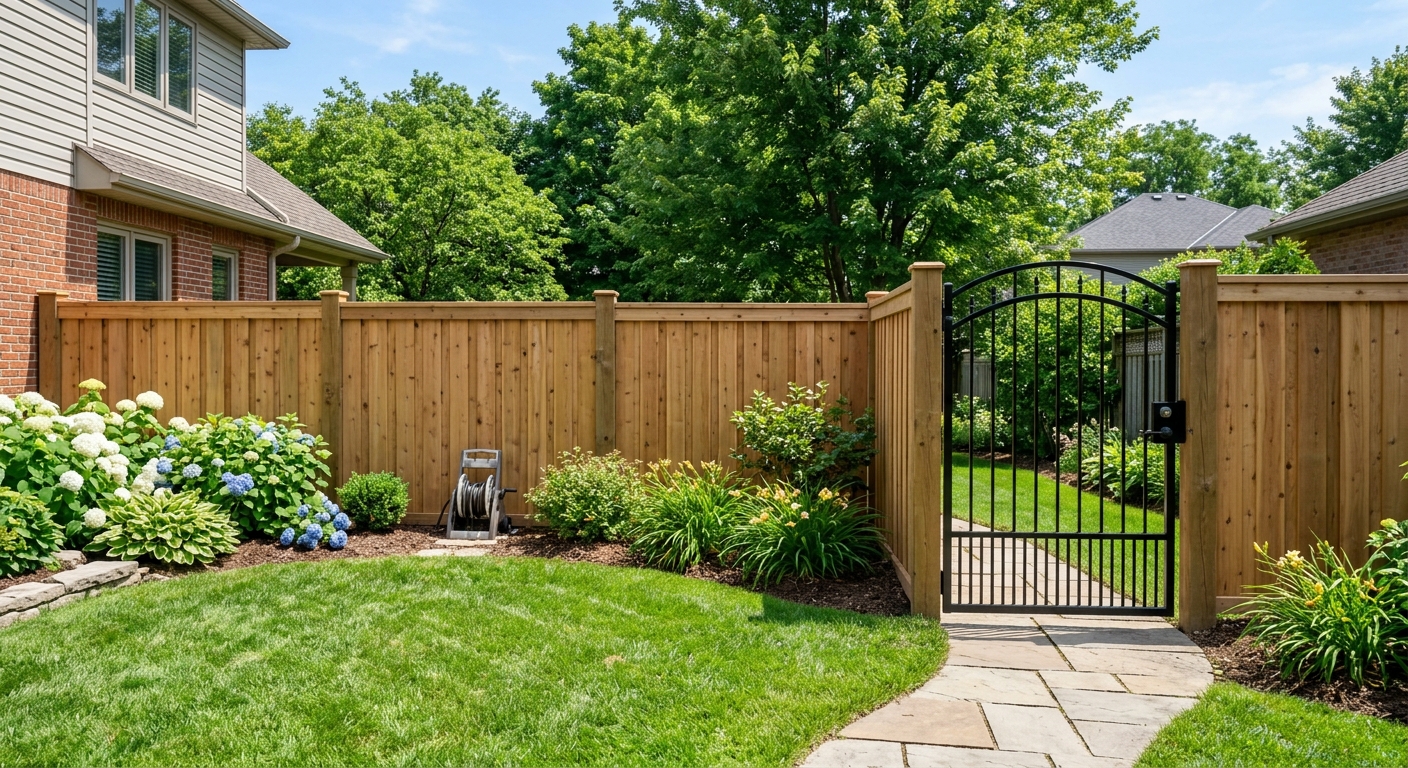
Fencing options and costs in Geraldton
Fencing in Geraldton is a practical investment for privacy, pets, and boundary clarity—especially for a town of about 1,761 residents (Statistics Canada, 2021 Census). Even though demand varies lot-to-lot, detached homes remain a strong predictor of fence projects because they typically have more perimeter to secure and maintain. In Northwest Ontario, contractors often see repeat work around open stretches and school and community corridors where yards are more exposed to wind-driven debris and snow. That means material choice and installation method carry more weight here than in milder parts of Ontario.
Northwest frost conditions also push costs upward. Compared with southern Ontario, frost penetrates deeper, so posts are commonly set about 4 ft (1.2 m+) below grade (often with concrete) to reduce the risk of frost heave and leaning panels. Soil conditions—clay and mixed ground in the region—can further influence footing design and excavation time. On top of that, wind exposure encourages tighter layouts and sturdier construction, particularly for solid privacy fences. Availability can affect lead times as well: crews that can handle deeper post holes and heavier bracing are in higher demand around busier neighbourhood pockets such as downtown Geraldton and the Highway 11 corridor, where access is frequent but yard set-backs and utility locations still require extra care.
Below is a practical price and performance comparison to help you map options to your budget, privacy goals, and maintenance tolerance, before you request a detailed quote.
| Material |
Lifespan |
Maintenance |
Privacy Rating |
Price per Linear Foot |
| Pressure-treated pine (standard wood) |
10–15 years |
Stain/seal every 2–3 years; inspect posts after freeze–thaw |
High (solid board); Medium (lattice/open styles) |
$55 – $90 |
| Cedar (natural rot resistance) |
15–25 years |
Light staining as needed (typically every 3 years) |
High (solid board) |
$70 – $105 |
| Vinyl / PVC (no-maintenance) |
20–30 years |
Rinse annually; check fasteners after extreme cold |
High (solid panels) |
$70 – $110 |
| Chain-link (galvanized steel) |
25–35 years |
Occasional rinse; replace tension parts as needed |
Low (security only; limited privacy) |
$35 – $65 |
| Aluminum ornamental |
30–40 years |
Wash annually; inspect hardware |
Low–Medium (decorative pickets) |
$80 – $140 |
| Composite / recycled material |
20–30 years |
Minimal; clean with water, address surface marks |
Medium–High (depends on board design) |
$85 – $125 |
Prices are estimates only and vary by project scope, site access and material selection.
What affects the price of fencing in Geraldton
In Geraldton, two quotes for the “same” fence can easily vary by 30–50% because the install details change with the ground, exposure, and access—not just the material. Northwest Ontario’s cold sets the pace: deeper frost means posts must be set well below grade (commonly 4 ft / 1.2 m+), often with concrete to reduce frost heave and movement. That increases excavation time, concrete volume, and labour, and it can push total project costs toward the higher end of local bands (for example, wood installations often land anywhere from $55–$90 per linear foot depending on embedment and bracing needs). Wind exposure then influences structure: heavier panels and tighter post spacing can be required on open rural lots or highway-facing sides.
To make it concrete, here are examples of how local conditions raise or lower cost in Geraldton:
- Clay/mixed soils: harder digging and wider footings can add labour hours, especially on gate runs where the fence sees extra tension.
- Uneven grade: sloped yards typically require stepped or raked panel layouts; that means more posts and more cutting.
- Utility proximity: locating and carefully hand-digging near services can slow the job, even if linear length is the same.
You’ll also see pricing respond to housing age and yard layout. Older properties may have more buried debris, old post remnants, or irregular boundaries, which can add removal and disposal time. If you’re replacing an old privacy fence, removal can be a meaningful line item; if you can keep the line and reuse sound posts, vinyl (often $70–$110) or cedar (often higher than basic treated pine) can become more cost-justified because you’re paying for fewer rebuild variables.
| Price Factor |
Why It Matters |
Cost Impact |
| Fence length in linear feet |
Most materials and labour scale directly with total perimeter |
Largest variable; often the biggest driver of final price |
| Post depth required |
Frost conditions determine embedment depth and post length |
Deeper posts increase material, concrete, and excavation labour |
| Post setting method |
Concrete vs. gravel pack vs. driven posts changes stability and time |
Concrete setting usually increases cost but reduces movement risk |
| Material choice |
Vinyl, cedar, chain-link, and aluminum vary in supply cost and hardware |
Typical spread can align with local bands (e.g., chain-link lower; aluminum higher) |
| Gate count and type |
Double drive gates require stronger posts, hinges, and alignment |
Can add significant labour and hardware beyond the fence run |
| Grade and terrain |
Slope requires stepping, raking, or additional posts |
Adds layout time, cutting, and sometimes extra framing |
| Old fence removal and disposal |
Hauling, debris handling, and hidden fasteners add time |
Often increases cost substantially versus install-only quotes |
| Permit fees and survey / property line locate |
Compliance steps and accurate boundary work reduce disputes |
Variable but can materially affect timeline and total budget |
Permits & regulations in Ontario
In Ontario, fences aren’t “one-size-fits-all” by height. In many Ontario municipalities, fences above a threshold—commonly 2.0 m (6.5 ft) at the rear and 1.0–1.2 m (3–4 ft) at the front or corner—often trigger a building permit requirement. Even when a permit isn’t required, your fence must respect property lines and the applicable setback bylaws for your location in Geraldton.
Before any digging, call for utility locates so you can install posts safely: Ontario One Call. Also, have your property pins located (via survey or locate service) or obtain a survey if there’s any uncertainty—this prevents encroachment disputes, especially where older fences drifted over time.
Shared fence ownership is handled by provincial line-fences legislation, but the practical takeaway is simple: confirm who is responsible for costs, and keep your agreement in writing (even if the neighbour is friendly).
What typically requires a permit: higher fences that exceed the local height threshold and any installation plans that alter drainage/structures near rules boundaries (exact thresholds can vary by municipality). What typically does NOT require a permit: low, in-bounds fence replacements that stay within usual height limits and don’t require changes to utilities or structures—however, you should confirm the threshold with your municipal office before signing.
To verify a contractor’s credentials in Ontario, ask for: (1) licence details—check the relevant Ontario registry or the contractor’s business information publicly available online; (2) liability insurance—request a current certificate of insurance and confirm limits and that fencing work is covered; and (3) WSIB coverage for workers—ask for a clearance letter and verify it’s current (or confirm if the contractor is properly registered for the scope).
Choosing the right fence material for Geraldton
Choosing fencing in Geraldton is mostly about matching material to how your yard performs in Northwest Ontario winters. Pressure-treated pine is usually the budget choice, but in our freeze–thaw cycles it needs staining or sealing every 2–3 years to prevent grey weathering and to keep boards from drying out unevenly. Cedar is a popular mid-to-premium option because it resists rot better and often looks better longer; however, cedar still benefits from maintenance to preserve its finish. Vinyl/PVC offers low maintenance and high privacy with solid panels, but in extreme cold it can become brittle at the edges if installed with poor hardware spacing—so it must be properly fastened and not forced to “fit” tight. Chain-link is the lowest cost and longest-lived option for security, but it provides little privacy unless you add vegetation or privacy slats. Aluminum ornamental provides a clean, no-rust profile and handles moisture well, but it’s decorative rather than private.
Post depth matters across materials. Because frost penetrates deeper here, posts generally need to be set roughly 4 ft (1.2 m+) down (often with concrete setting) to reduce heaving risk. That’s true for wood, vinyl and composite, and it becomes especially important for heavier wind-facing runs. Wind and snow load also affect bracket strength and panel spacing; in exposed areas you’ll typically see closer spacing between posts and more robust top rails.
Where is the price difference justified? If you’re comparing a chain-link run (often roughly $35–$65 per linear foot) to a privacy fence (often around $70–$110 for vinyl/PVC or $55–$90 for standard wood), the premium makes sense when you need windbreak, visual screening, and pet/patio control—features chain-link won’t deliver. If your main goal is boundary demarcation and access control, chain-link can be a smart value.
| Material |
Cold Tolerance |
Lifespan |
Annual Maintenance |
Best For |
Price Band |
| Pressure-treated pine |
Good (if properly sealed and installed on deep posts) |
10–15 years |
Check posts and hardware; stain/seal every 2–3 years |
Budget privacy when you’re willing to maintain |
$55 – $90 |
| Cedar |
Very good (naturally rot-resistant in wet winters) |
15–25 years |
Rinse/inspect; light stain or finish every ~3 years |
Appearance-focused privacy with better natural durability |
$70 – $105 |
| Vinyl / PVC |
Good to very good (requires correct cold-weather installation) |
20–30 years |
Minimal—rinse and inspect fasteners |
Low-maintenance privacy and clean curb appeal |
$70 – $110 |
| Chain-link |
Excellent (galvanized steel resists cold) |
25–35 years |
Occasional wash and tension/anchor checks |
Security, containment, and low-cost perimeter fencing |
$35 – $65 |
| Aluminum ornamental |
Excellent (no rust; stable in wet snow) |
30–40 years |
Wash annually; inspect hardware |
Decorative front yards and wind-exposed aesthetics |
$80 – $140 |
| Composite / recycled |
Good (varies by board; proper substructure is key) |
20–30 years |
Low—clean and inspect surface joints |
Low-maintenance privacy with wood-like look |
$85 – $125 |
How to choose a fencing contractor in Geraldton
When you’re hiring in Geraldton, start by verifying Ontario compliance and job-ready capacity. First, confirm the contractor has the right Ontario business credentials for fencing work (ask for business details and licence information where applicable). Second, request liability insurance: get the certificate of insurance and confirm the coverage is current and specifically includes fencing/installation activities. Third, ask for WSIB coverage (or the correct documentation) and a clearance letter if they use covered workers—this should match the project timing and scope. Don’t accept “we’re covered” without paperwork.
Then get 2–3 itemised written quotes so you can compare apples to apples: labour and materials should be broken out (posts, rails, panels, hardware, concrete, gates, and removal/disposal). Ask whether the quote includes utility locate costs, permit pull, and haul-away. Look for exclusions like “site conditions not accounted for,” which often means extra charges for rock excavation, extra-deep frost embedment, or difficult access. A good contractor will describe how they handle depth requirements (commonly about 4 ft / 1.2 m+ or deeper below grade in Northwest conditions).
Warranty matters too: confirm workmanship warranty length, the manufacturer/product warranty for the fencing components, and whether the warranty is transferable to future owners. For payments, never pay more than 10–15% upfront; hold back a portion until the job is complete and site cleanup is finished. Finally, insist on a written start date and a completion estimate.
- Ask for deep-post installation details (embedment depth and concrete setting method).
- Request an itemised breakdown: posts, rails, pickets/boards, fasteners, concrete, gates, and removal.
- Confirm whether utility locates are included or billed separately.
- Verify property line approach (survey/locate method) before digging.
- Check insurance certificate dates and liability limits.
- Request WSIB clearance documentation and confirm it covers workers on your project.
- Ask how they handle clay/mixed soils and whether they adjust footings for stability.
- Confirm gate hardware quality (hinges/latches) and whether posts are reinforced.
- Ensure the quote includes proper wind/bracing approach for exposed runs.
- Confirm disposal/haul-away is included for old materials and excavated debris.
- Get the permit responsibility clearly stated (who pulls it, if required, and what’s included).
- Request a clear warranty statement: workmanship duration, product warranty, and transferability.
Red flags I’ve seen on Geraldton fence projects include: vague quotes that don’t itemise materials and depth/concrete details, refusing to show WSIB/insurance paperwork, starting excavation without utility locates, and promising “one-size-fits-all” post depth in freeze-prone ground.
Frequently asked questions — fencing in Geraldton
Should I repair or replace my old fence in Geraldton?
In Geraldton, the decision usually comes down to post stability and whether the fence line has shifted. If your posts are still solid (no major leaning after freeze–thaw) and the rails are intact, a repair—replacing a few damaged boards, re-tightening hardware, and upgrading fasteners—can be worthwhile. But if you’re seeing post heave, widespread rot at board ends, or multiple broken sections after winter, replacement is often safer and more cost-effective over time. A full replacement also lets you correct deeper post embedment to reduce future movement, which is a bigger deal in Northwest Ontario. If your fence is mostly chain-link, repairs may be simpler; if it’s privacy fencing (wood/vinyl), replacing the full run often improves alignment and looks better.
How do I handle a fence dispute with a neighbour in Ontario?
For fence disputes in Ontario, start by documenting the issue: photos, a sketch of the fence line, and any written messages with your neighbour. Next, verify where your property line actually is—use a survey or property-pin locate rather than relying on the existing fence location (older fences drift over time). If the dispute is about responsibility, Ontario’s line-fences rules generally govern shared boundary obligations, but the cleanest approach is to agree in writing on who pays for which portions. If you’re dealing with a contractor, make sure the quote and scope clearly state the intended fence line before any post holes are dug. In cold-weather areas like Geraldton, disputes sometimes worsen when posts shift—so getting stable, deep-set installation details documented helps protect both sides.
What fence style offers the best wind resistance in Geraldton?
For Geraldton’s wind and snow exposure, solid privacy styles typically perform well when they’re built with the right structure: sturdy posts set deeply (often around 4 ft / 1.2 m+ below grade), solid rails, and correct spacing. In exposed areas, heavier panels and closer post spacing reduce “waving” and rack stress on the hardware. Vinyl privacy can be strong, but only if the system is installed with proper bracing and fastener practices for cold temperatures. Wood can also be very effective, provided the boards and substructure are straight and fastened for freeze–thaw durability. Ornamental aluminum and chain-link resist rust and stay structurally stable, but they are more “wind-passing,” meaning less wind resistance and more visibility.
How much does a fence cost in Geraldton?
Fence cost in Geraldton depends mainly on length, gate count, and how deep posts must be set for frost protection. As a practical reference, local installation pricing for wood commonly falls in the range of $55,XXX – $90 per linear foot, while vinyl/PVC commonly runs $70,XXX – $110 per linear foot. Chain-link can be much lower, often in the $35,XXX – $65 range. Higher-end options like aluminum ornamental typically sit around $80,XXX – $140. Your final total may shift upward if you need old fence removal, stepped construction for sloped yards, or additional bracing for wind-exposed runs.
How deep should fence posts be for Geraldton's frost?
In Geraldton and the broader Northwest frost conditions, posts generally need to be set deep enough to sit below the frost-affected zone. A common practice is to install posts about 4 ft (1.2 m+) below grade, and in colder, high-risk spots that can mean deeper embedment depending on soil and local conditions. Because frost penetrates deeper than in southern Ontario, you typically don’t want shallow post holes—frost heave can lift posts and cause fence sagging or leaning over a few winters. For most privacy fences, concrete setting is commonly used to improve stability. The exact depth should be confirmed in your written quote based on your site’s soil, slope, and exposure.
Wood vs vinyl vs aluminum fence — which is best?
There isn’t one “best” in Geraldton—it depends on your priorities and how much maintenance you want. Wood (pressure-treated pine) is often the best budget value, commonly in the $55,XXX – $90 range per linear foot, but it needs staining/sealing every 2–3 years to stay looking good through freeze–thaw. Cedar costs more but typically holds appearance longer and resists rot better. Vinyl/PVC is popular for low maintenance and privacy, often in the $70,XXX – $110 range, but it must be installed correctly for cold snaps so it doesn’t crack at fastener points. Aluminum is a strong long-term option for appearance and rust resistance and usually costs in the $80,XXX – $140 range, though it’s more decorative (lower privacy). If you’re unsure, match your desired privacy level first, then maintenance tolerance.