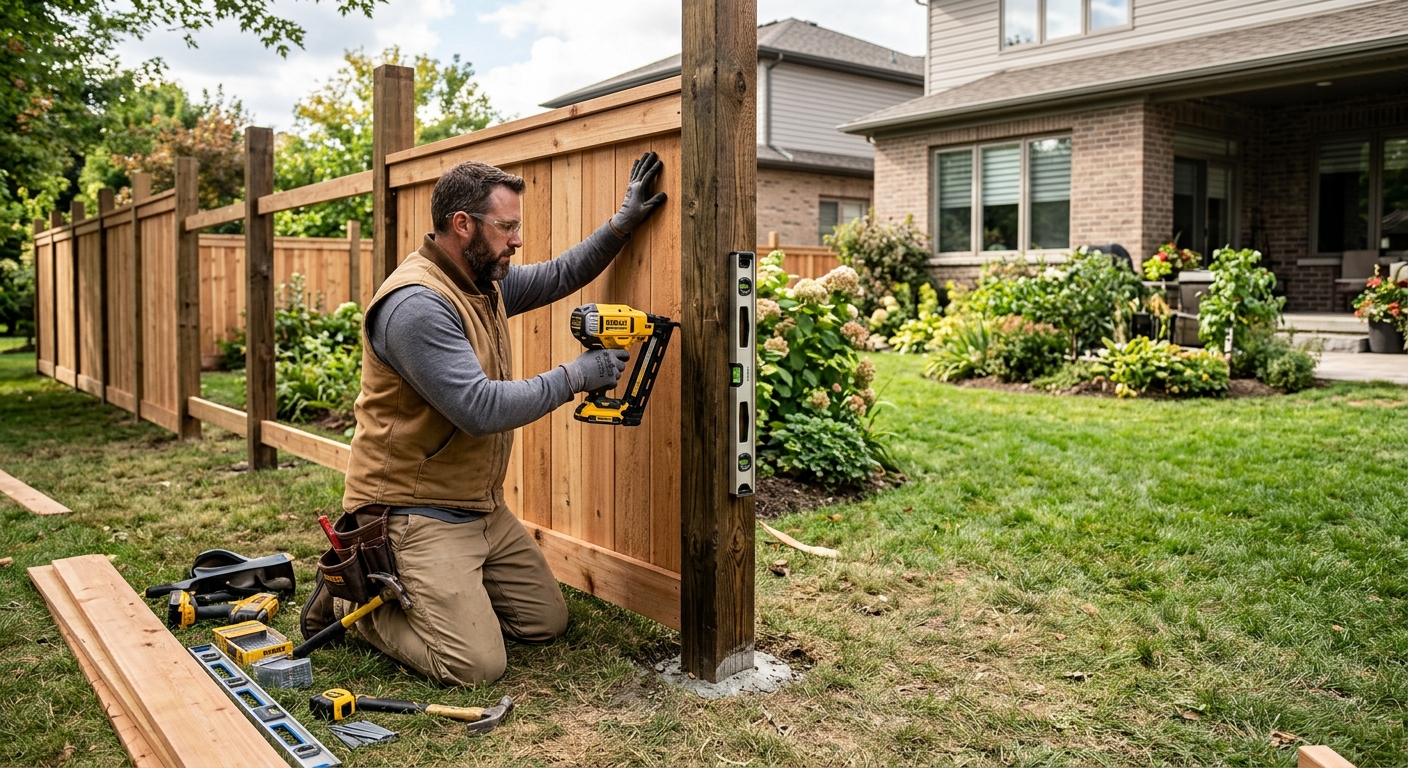
Fencing options and costs in County Park
County Park, Ontario is the kind of place where a good fence does more than mark a boundary—it shapes how your yard feels through hot summers, freeze-thaw winters, and windy spring days. With a small local population of 3,367 (Statistics Canada, 2021 Census), demand can be tightly tied to neighbourhood lots and the age of housing stock—especially in established pockets near major corridors where homeowners routinely refresh front and backyard enclosures. In the Toronto economic region, most fencing projects are driven by detached and semi-detached homeowners who want privacy and pet safety, and that typically means more 6–8 ft runs where solid panels matter.
Pricing in Toronto-area builds is heavily influenced by Southern Ontario frost depth and local installation practice. In practice, crews plan for concrete-set posts instead of simple driven posts because posts usually need to be set roughly 3.5–4 ft down for stability, and that labour + ready-mix time affects every quote. Taller wood and vinyl privacy fences also need heavier post sizing and closer spacing to reduce racking under gusts and snow load.
In County Park, trades are especially busy around the more established residential belts where homeowners replace older pickets with privacy fencing—often near the busier streets that create tighter scheduling windows. If you’re comparing options now, the table below gives realistic cost ranges you can use to benchmark incoming quotes.
| Material |
Lifespan |
Maintenance |
Privacy Rating |
Price per Linear Foot |
| Pressure-treated pine (standard wood) |
10–15 years |
Stain or seal every 2–3 years |
High (solid boards) |
$65–$120 |
| Cedar (natural rot resistance) |
15–25 years |
Light staining every 3–4 years |
High (solid boards) |
$80–$135 |
| Vinyl / PVC (no-maintenance) |
20–30 years |
Occasional rinse; avoid impact |
High (solid styles) |
$75–$130 |
| Chain-link (galvanized steel) |
20–40 years |
Occasional rinse; inspect posts |
Low–Medium (privacy slats optional) |
$45–$85 |
| Aluminum ornamental |
25–40 years |
Minimal; wash as needed |
Low–Medium (decorative pickets) |
$90–$160 |
| Composite / recycled material |
20–30 years |
Low; occasional cleaning |
High (solid composite panels) |
$110–$175 |
Prices are estimates only and vary by project scope, site access and material selection.
What affects the price of fencing in County Park
If you’ve requested a few quotes in Ontario, you may have noticed the same fence line can land 30–50% apart between contractors. The biggest reasons are how each company handles post depth, concrete setting, wind-resistant hardware, and the “extras” homeowners forget to compare—like gate framing, disposal, and property line locating. In the Toronto market, crews also price for efficiency: some teams are set up for faster re-builds on established streets, while others need additional time for heavier materials, haul-away, and careful footing in clay-mixed soils.
In cold Ontario, frost depth drives real costs. Posts are commonly set about 4–6 inches below the design frost depth to prevent heaving, which often translates to roughly 1.5–2.0 m into the ground. When that depth is required, you’re typically looking at longer posts and concrete-set footings, not just gravel packs—raising both material and labour time. Wind still matters in the GTA (even if it’s not Prairies exposure): taller solid wood and vinyl privacy fences need heavier posts (or larger spacing rules) so panels don’t rack, and that can push you toward the mid-to-higher end of the wood and vinyl bands—around $65–$120 for wood projects and $75–$130 for vinyl/PVC.
Two common County Park examples: (1) a 60 ft backyard privacy fence often costs more than homeowners expect when there are 2–3 gates because gate framing and hinges add hardware and time; (2) a similar-length line with clay and poor drainage may require more careful excavation and concrete placement, so concrete-set posts become the safest choice. Conversely, a straight chain-link run through open access can come in closer to the $45–$85 range because it’s lighter and faster to install.
| Price Factor |
Why It Matters |
Cost Impact |
| Fence length in linear feet |
Most materials and labour scale directly with length |
High (primary driver) |
| Post depth required |
Frost line determines hole depth and post length |
High (more digging + more concrete) |
| Post setting method |
Concrete vs. gravel pack vs. driven posts changes labour and stability |
Medium–High |
| Material choice |
Vinyl, cedar, and chain-link differ in supply cost and longevity |
Medium (shifts between bands) |
| Gate count and type |
Walk-through vs. drive-through gates require heavier framing |
Medium–High |
| Grade and terrain |
Sloped yards may require stepped rails or raked panels |
Medium |
| Old fence removal and disposal |
Haul-away and labour add time, especially for set-in posts |
Medium |
| Permit fees and survey / property line locate |
Required paperwork and locating reduce encroachment risk |
Low–Medium (project-dependent) |
Permits & regulations in Ontario
In Ontario, fences may require a building permit when they exceed common height thresholds—typically about 2.0 m (6.5 ft) for rear yards, and around 1.0–1.2 m (3–4 ft) for the front or corner areas (Municipal rules can vary). Even when a permit isn’t required, your fence still must respect property lines and municipal setback bylaws, and it must be installed so posts don’t encroach.
Before digging post holes, call for utility locates (Ontario One Call). This matters even for “simple” fencing because services can run along easements and near driveways. If your property line is unclear (common on older lots), get a survey or at least a property pin locate so you avoid disputes with neighbours.
Shared fence ownership and responsibilities are generally governed by Ontario’s line-fences legislation, which can affect who pays for repairs, replacements, or removal when a shared boundary fence fails.
What typically DOES require a permit: new fencing that exceeds height limits in your applicable yard/corner zones; larger privacy walls; and projects where the municipality flags structural or safety concerns. What typically does NOT: most like-for-like replacements under the height threshold, as long as the fence footprint and location remain the same.
To verify a contractor for County Park, ask for their Ontario licensing number, liability insurance certificate (showing coverage for fencing work), and proof of WSIB/WCB coverage. You should also check online contractor registry details for licence status, then confirm the insurance is current by matching names and address on the certificate. For safety, request a clearance letter where applicable and ensure the certificate lists you or the site as an additional insured if the contractor offers it.
Choosing the right fence material for County Park
In County Park, the best material is the one that matches both your priorities and how Southern Ontario actually behaves. Pressure-treated pine is usually the most budget-friendly way to get privacy, but it needs staining or sealing about every 2–3 years to slow grey weathering and help the top edges shed moisture. Cedar is a step up: it resists rot better and typically looks better longer, but it still benefits from periodic maintenance. Vinyl/PVC delivers low day-to-day work, which is why so many homeowners like it for busy households, but extreme cold can make cheaper panels more brittle—so you want quality profiles and proper post spacing. Chain-link is the least expensive and longest-lived in many cases, but it provides limited privacy unless you add slats or upgrade to a different style. Aluminum is ornamental and rust-resistant, with minimal maintenance, but it won’t deliver the same privacy feel as solid boards.
Because Toronto’s frost line is commonly planned around roughly 42–48 inches for Southern Ontario, posts often need concrete-set installation with holes that go about 3.5–4 feet down for stability. That means whichever material you choose, footing quality matters just as much as board type. For privacy fences, wind and snow load considerations also influence design—heavier solid panels need heavier posts and closer centres to prevent racking.
A practical example: if you’re comparing a standard pine privacy fence and a vinyl option on a typical backyard run, vinyl may be priced in the $75–$130 per linear foot band while wood is often around $65–$120. That $10–$40 gap can be justified if you want to avoid annual/triannual staining labour and you have winter freeze-thaw cycles that punish surface cracking—especially when you plan to stay in the home for the long term.
| Material |
Cold Tolerance |
Lifespan |
Annual Maintenance |
Best For |
Price Band |
| Pressure-treated pine |
Good when sealed; finish cracks can admit moisture |
10–15 years |
Seasonal inspection; stain/seal every 2–3 years |
Budget privacy with willingness to maintain |
$65–$120 |
| Cedar |
Very good; better resistance to rot in wet cycles |
15–25 years |
Light clean and stain every 3–4 years |
Premium look with moderate maintenance |
$80–$135 |
| Vinyl / PVC |
Good; quality matters for impact resistance in cold snaps |
20–30 years |
Rinse/clean as needed |
Low-maintenance privacy |
$75–$130 |
| Chain-link |
Excellent; galvanized resists corrosion in winter road spray |
20–40 years |
Inspect tension and hardware periodically |
Security with minimal visual bulk |
$45–$85 |
| Aluminum ornamental |
Excellent; non-rusting performance |
25–40 years |
Wash as needed |
Attractive boundaries with low upkeep |
$90–$160 |
| Composite / recycled |
Good; resists rot and splintering |
20–30 years |
Low; periodic cleaning |
Privacy with long-life boards |
$110–$175 |
How to choose a fencing contractor in County Park
Start by verifying the contractor’s Ontario credentials. In Ontario, confirm they carry liability insurance appropriate for fencing work (request the certificate of insurance and confirm it’s current), and ask for proof of WSIB/WCB coverage for their crew—this protects you if someone is injured on-site. You can generally check licence status through Ontario’s online contractor/registry resources and cross-check that the name and address match the quote and invoice. If they won’t provide insurance or WSIB/WCB documentation up front, treat that as a major warning sign.
Next, get 2–3 itemised, written quotes that break down labour and material separately. A proper fence quote should list post depth assumptions (frost-safe settings), concrete quantities or footing method, gate hardware, and whether demolition and disposal are included. If permit pulls or property line locating are needed, those should be clearly stated—especially if the scope changes when a locate reveals the fence must be shifted.
Read warranty terms carefully. Ask for the workmanship warranty length (not just the manufacturer product warranty), whether it covers post set failures or only materials, and whether the warranty is transferable if you sell the home. For payment, a sensible schedule is small deposits only: never pay more than about 10–15% upfront, and hold back the final portion until the job is complete and gates operate correctly. Always request a start date and a completion estimate in writing, and ask how weather shutdowns are handled during Toronto’s winter freeze-thaw cycles.
- Request their Ontario licence number and confirm it on the online registry.
- Collect a current liability insurance certificate (and ask about additional insured if offered).
- Verify WSIB/WCB coverage for all workers listed in the quote.
- Ask for a written scope showing fence length, height, and exact material grade (no vague “wood fence”).
- Confirm post depth expectations for frost stability and that concrete-set posts are included where required.
- Ensure gate framing details are listed (hinge type, latch style, and any reinforcement).
- Check whether old fence removal and disposal is included and where debris will be hauled.
- Confirm whether site restoration (levelling, topsoil, sod/seed touch-ups) is part of the scope.
- Ask if a permit is required for your height/yard and who is responsible for the paperwork.
- Verify who calls for utility locates and how they handle marked services.
- Get warranty details in writing: workmanship duration, exclusions, and transferability.
- Use a payment schedule that limits upfront payments to 10–15% and holds the final payment until acceptance.
Red flags I commonly see in County Park: (1) quotes that don’t specify post depth or footing method; (2) “cash only” or refusal to provide proof of WSIB/WCB and insurance; (3) lump-sum pricing with no mention of gates, demolition, or disposal; (4) vague warranties that cover only manufacturer parts; and (5) pressure to pay the full amount before any materials are delivered or post holes are dug.
Frequently asked questions — fencing in County Park
How long does fence installation take in County Park?
For most County Park backyards, a typical fence install is done in about 2–5 working days, depending on length, gate count, and whether old fencing must be removed. The post-setting method is usually the schedule driver: when concrete-set posts are required for frost stability, crews need time for excavation, setting, and proper curing before installing rails and panels. A straight run with chain-link or aluminum can be faster, while solid privacy fences with multiple gates take more layout and hardware work. Weather also matters in Southern Ontario; freeze-thaw periods can slow digging and concrete placement. If your project includes permit steps or a property line locate, add time for scheduling so the foundation work doesn’t get delayed.
Can I install a fence on a slope in County Park?
Yes, you can install a fence on a slope in County Park, but the build method matters to avoid an uneven look or tension issues. Most installers use either stepped panels (best when the grade changes are moderate) or raked rails (when the fence follows the slope more gradually). For privacy styles, raked systems still require careful spacing so panels don’t “pull” away from posts in wind. Your contractor should measure and mark post heights so the finished top line matches your desired profile. Where soil is clay-heavy and excavation is challenging, footings may require extra attention for stability. A good quote should explicitly state whether the fence will be stepped or raked and include the additional time/material allowances that often come with sloped yards.
What is the most weather-resistant fence for County Park's climate?
In Ontario’s freeze-thaw climate, the most weather-resistant option for long-term performance is usually vinyl/PVC or chain-link—provided posts are properly set for frost stability. Vinyl/PVC holds up well against rot and routine moisture cycling, and chain-link with galvanized steel tends to resist corrosion from winter road spray and wet periods. For homeowners wanting privacy, cedar or composite can also perform very well, especially if the design includes proper post depth, good drainage, and regular cleaning/staining where required. Whatever you choose, the biggest factor isn’t just the board—it’s the installation: post depth, concrete setting, and correctly anchored hardware. If you’re shopping price bands, vinyl/PVC often falls around $75–$130 per linear foot, while chain-link is often closer to $45–$85.
How do I prevent wood fence rot in County Park?
Wood rot prevention in County Park starts with installation choices that keep moisture from sitting around posts and board joints. Make sure posts are set deep enough for frost stability (often about 3.5–4 feet down in Southern Ontario practice) and that concrete is used when needed rather than relying only on driven posts. Use end-sealed boards where appropriate and keep water from pooling at the base by ensuring the ground grade drains away from the fence line. Staining and sealing on a schedule is important: pressure-treated pine commonly needs attention every 2–3 years to reduce grey weathering and surface cracking that invites moisture. Cedar resists rot better, but it still benefits from periodic maintenance. Finally, ask your contractor to discuss hardware—coated fasteners and proper rail alignment reduce small gaps that accelerate decay.
What is the cost per linear foot for fencing in County Park?
In County Park and the broader Toronto economic region, typical installed price bands are roughly: wood fencing at $65–$120 per linear foot, vinyl/PVC at $75–$130, chain-link at $45–$85, and aluminum/metal at $90–$160. Your exact number can move based on frost-safe post depth (often requiring concrete-set posts), gate count, and whether old fence removal/disposal is included. Soil conditions matter too; clay and poor drainage can increase excavation and concrete-set labour time. If you have a sloped yard, stepped/raked panel builds can add cost. Always compare itemised quotes rather than only the headline total, because two contractors can price the same length differently based on how they handle posts, gates, and footing details.
Should I repair or replace my old fence in County Park?
Repair can make sense if the fence is structurally sound—meaning posts are not severely leaning, the rails aren’t rotted through, and the damage is limited to a section of boards or a gate latch. In County Park’s winters, however, rot can advance below the surface where you can’t easily see it. If multiple posts show soft wood, if the fence has significant wobble at the base, or if removal is needed for a shifted property line, replacement is usually the safer long-term choice. A good approach is to ask for a section-by-section assessment: identify which posts are salvageable and which footings need concrete-set correction. For budgeting, compare the repair scope against the material/labour bands—wood typically runs $65–$120 per linear foot installed, while vinyl/PVC is commonly $75–$130. If repairs keep expanding, replacement often becomes the better value.