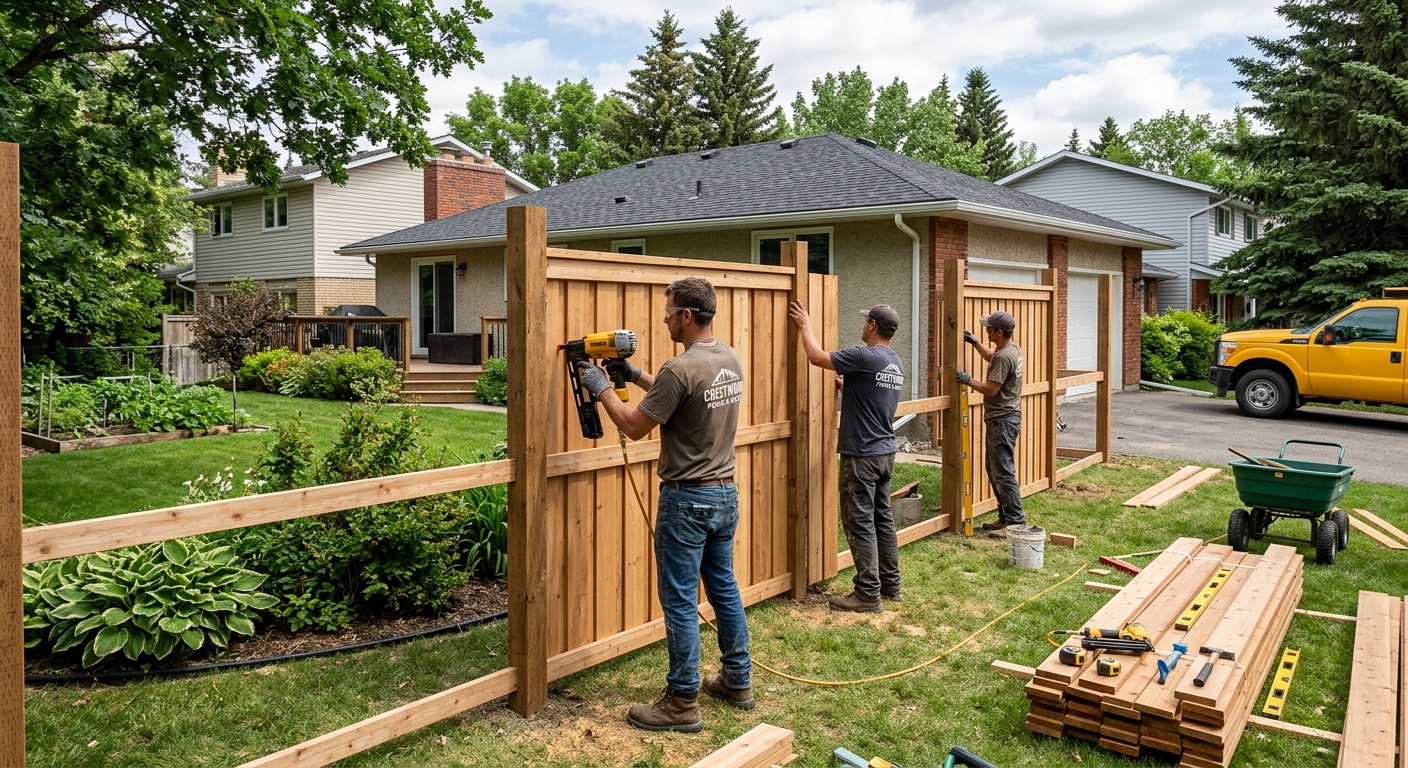
Fencing options and costs in Dryden
Fencing in Dryden is a practical part of homeownership, and with 76.6% of dwellings in the city being single-detached homes, many properties are set up for yard boundaries, privacy screening, and secure side yards. Dryden’s homeowner base is also sizeable—73.1% of households are owner-occupied (Statistics Canada, 2021 Census)—which typically supports steady demand for replacement fences, gate upgrades, and seasonal maintenance. That demand matters because scheduling can tighten during late spring and early summer when crews are busiest.
In Northwest Ontario, the two biggest cost drivers are frost depth and wind exposure. Frost penetrates deeper than in southern Ontario, so posts often must be set around 4 ft (1.2 m+) below grade to reduce the risk of frost heave. On many rural or open lots, wind can push contractors toward heavier panels, tighter post spacing, and more robust footings—especially for solid-board privacy fences. These factors help explain why similar-looking fences can price differently across the region. In Dryden, trade demand is especially common around residential pockets with high turnover and older lots, including the central neighbourhood near downtown/Dryden’s Main Street corridor, where many fences date back to earlier housing stock.
Below is a homeowner-friendly comparison of common fence materials, including realistic price bands you’ll see for a typical installed run in Dryden. Use this table to frame quotes before you compare contractor line-by-line scopes.
| Material |
Lifespan |
Maintenance |
Privacy Rating |
Price per Linear Foot |
| Pressure-treated pine (standard wood) |
10–15 years |
Stain/seal every 2–3 years to reduce greying and cracking |
8/10 (solid-board typical) |
$20 – $30 |
| Cedar (natural rot resistance) |
15–20 years |
Light staining or sealing every 2–4 years depending on sun/ice exposure |
9/10 (solid-board typical) |
$25 – $38 |
| Vinyl / PVC (no-maintenance) |
20–30 years |
Occasional wash; inspect posts after freeze-thaw seasons |
7/10 (solid privacy styles) |
$23 – $42 |
| Chain-link (galvanized steel) |
20–30 years |
Minimal; rinse occasionally and check tension |
2/10 (privacy requires slats/insert options) |
$14 – $24 |
| Aluminum ornamental |
25–40 years |
Minimal cleaning; occasional tightening |
3/10 (ornamental spacing) |
$28 – $50 |
| Composite / recycled material |
20–30 years |
Low maintenance; rinse and check fasteners |
8/10 (solid-board styles) |
$30 – $55 |
Prices are estimates only and vary by project scope, site access and material selection.
What affects the price of fencing in Dryden
In Dryden, you can easily see the same fence “style” quoted 30–50% apart because contractors price different assumptions: how much post material is needed for below-frost embedment, whether the crew will concrete-set, how wind-stable the layout must be, and what labour tasks are included (haul-off, old fence removal, gate hardware, and line locating). The Northwest Ontario climate also compresses timelines—when the ground is workable, crews are booked, and that labour demand can show up as higher install pricing.
Frost is the main reason quotes diverge. To prevent heaving, posts are typically set about 4–6 inches below the design frost depth, and in colder parts of Ontario and Alberta this usually works out to roughly 1.5–2.0 m into the ground using longer posts and more excavation. That increases concrete volume and labour time, and it often pushes customers from cheaper-looking options toward materials with better long-term performance. Wind exposure adds another layer: on open stretches and highway-corridor properties, heavier panels and closer post spacing improve stability, similar to the approach contractors take in more exposed regions where privacy fences need extra rigidity. Coastal BC can accelerate wood rot if not properly treated, but in Dryden the freeze-thaw cycle is the bigger threat to post stability and fasteners.
Concrete examples from Dryden pricing: (1) A 60 ft run with 8x4 gates costs more if gate posts must be braced and embedded deeper (often with concrete), because the hardware load is higher. (2) If your yard has clay/mixed soil, excavation can take longer and may require slightly modified footings for movement resistance. (3) A fence replacement where old posts are still solid can be cheaper than one where everything needs to be extracted and hauled away. As a baseline, many homeowners land in the $55–$90 wood-install range or the $70–$110 vinyl band depending on embedment method and panel type, while chain-link can be a lower-entry option within the $35–$65 band.
| Price Factor |
Why It Matters |
Cost Impact |
| Fence length in linear feet |
Most materials and labour scale directly with total footage |
High: usually the biggest portion of the quote |
| Post depth required |
Frost line determines hole depth, post length, and excavation time |
Medium–high: deeper posts can add significant labour and materials |
| Post setting method |
Concrete vs. gravel pack vs. driven posts changes both labour and longevity |
Medium: concrete setting often increases cost but reduces heave risk |
| Material choice |
Vinyl, cedar, and chain-link have different costs and performance in cold cycles |
High: material price difference drives much of the variation |
| Gate count and type |
Double drive-through gates require heavier framing and hardware |
High: gates can add outsized cost per opening |
| Grade and terrain |
Sloped yards require stepped designs or raked panels |
Medium: increases labour, cutting, and layout time |
| Old fence removal and disposal |
Haul-off, post extraction, and disposal fees vary widely by condition |
Medium: can swing total cost by hundreds to thousands |
| Permit fees and survey / property line locate |
Locates reduce encroachment disputes and help ensure accurate line work |
Low–medium: project-dependent, but important to include |
Permits & regulations in Ontario
In Ontario, fences may require a building permit depending on height and location. A common practical rule of thumb contractors follow in Ontario is that fences above about 2.0 m (6.5 ft) at the rear and around 1.0–1.2 m (3–4 ft) in the front or at corner lots often trigger permit requirements. Municipal setback bylaws and the exact placement relative to property lines also matter, so the correct next step is to confirm requirements before digging. Even when a permit isn’t required, fences still must respect property boundaries and any applicable setbacks.
Before you dig any post holes, call for utility locates (Ontario One Call) so crews don’t strike buried services. For line accuracy, obtain a survey or at minimum a locate of property pins so the fence doesn’t drift into a neighbour’s yard or right-of-way area—this is where disputes most often start. Shared fence ownership rules are governed by Ontario’s line-fences legislation, which can affect who pays for repair or replacement when a boundary fence is involved.
To verify your contractor in Dryden, start with their Ontario business licence (if required locally) and then their insurance documents. Ask for: (1) a certificate of liability insurance (with Dryden address or job listed) and confirm limits; (2) WSIB/WCB coverage proof—request the clearance letter or equivalent account status report; and (3) the Ontario licence/registration details they’re legally required to hold for contracting activity. If any of this is missing or they won’t share documents upfront, that’s a serious warning.
Choosing the right fence material for Dryden
Choosing the right fence material for Dryden comes down to matching the product to how it performs in freeze-thaw cycles, wind, and winter snow load—then balancing budget against how often you’re willing to maintain it. Pressure-treated pine is the lowest-cost “real wood” option, but it typically needs staining or sealing every 2–3 years to slow weathering, cracking, and surface checking. Cedar has better natural rot resistance and usually looks better longer, but it still benefits from periodic maintenance to keep it looking sharp in alternating thaw and refreeze conditions. Vinyl/PVC offers no-sanding convenience, yet in extreme cold it can become brittle if installed with poor alignment or inadequate post support—so post setting depth and bracing are still crucial. Chain-link is durable and budget-friendly with the longest life for the money, but it provides very little privacy unless you add slats or screening. Aluminum ornamental is attractive and rust-resistant, but like chain-link it’s not intended for privacy-heavy yards.
Because Northwest Ontario posts often need embedment around 4 ft (1.2 m+) or deeper to stay below frost effects, concrete-set posts are commonly the safest route for stability. That means materials that rely on thin posts or minimal bracing tend to cost more over time if the fence shifts—especially after hard winters. For wind, heavier panels and closer post spacing are the usual solution for privacy fences on open properties, and that can justify spending within the vinyl or cedar ranges when stability matters.
Example: If you’re comparing a typical wood privacy run versus vinyl privacy, you might see wood installation in the $55–$90 band and vinyl in the $70–$110 band for similar lengths. The extra upfront cost often pays off if you want fewer annual chores and you’re replacing an older fence where the next few seasons of labour would be costly. On the other hand, if your priority is keeping costs down and you’re okay with adding privacy screening, chain-link in the $35–$65 band can be a very practical solution for perimeter security.
| Material |
Cold Tolerance |
Lifespan |
Annual Maintenance |
Best For |
Price Band |
| Pressure-treated pine |
Good with proper seal/stain and solid post embedment |
10–15 years |
Check boards and posts seasonally; stain/seal every 2–3 years |
Budget-friendly privacy where you’ll maintain the finish |
$55 – $90 |
| Cedar |
Very good; resists rot from damp cycles when installed correctly |
15–20 years |
Light maintenance every 2–4 years depending on sun/ice exposure |
Natural look, longer-lasting wood option |
$70 – $110 |
| Vinyl / PVC |
Good; installation quality and post support matter in deep cold |
20–30 years |
Occasional wash; inspect hardware after freeze-thaw seasons |
Low-maintenance privacy with longer service life |
$70 – $110 |
| Chain-link |
Excellent in cold; galvanization handles freeze-thaw well |
20–30 years |
Minimal; tension check and rinse occasionally |
Security on a budget; add slats if you need partial privacy |
$35 – $65 |
| Aluminum ornamental |
Excellent; doesn’t rust when properly coated |
25–40 years |
Minimal cleaning; tightening hardware as needed |
Front-yard curb appeal without the weight of privacy panels |
$80 – $140 |
| Composite / recycled |
Good; stable when posts are set correctly for frost movement |
20–30 years |
Low; rinse and check fasteners |
Privacy where you want wood-like look with less upkeep |
$90 – $140 |
How to choose a fencing contractor in Dryden
When you hire a fencing contractor in Ontario, verify three things up front: licensing/registration (as applicable), liability insurance, and WSIB/WCB coverage. Here’s how: (1) ask for a copy of their WSIB/WCB clearance letter or proof of coverage for the time period covering your job; (2) request a certificate of insurance for general liability (and confirm the policy is active and lists the job address or is set up to cover the work); and (3) confirm they’re operating as a legitimate business with contact details that match their quote and contract. For most homeowners, the fastest approach is to request these documents before signing—any contractor who can’t provide them quickly is a risk.
Next, get 2–3 itemised written quotes. You want a breakdown of labour and materials (posts, rails, panels pickets, concrete quantity if used, gate framing/hardware, and any reinforcement). Avoid lump sums that don’t show what’s included. Read the scope for exclusions: is permit work included or excluded, does removal and disposal of the old fence come with the price, and are utility locates included in the contractor’s workflow? Warranty matters too: confirm workmanship warranty length (labour defects), product/manufacturer warranty length (material defects), and whether the warranty transfers if you sell the home.
Payment schedule should protect you: never pay more than 10–15% upfront. Use a holdback until the job is complete and cleaned up. Finally, demand a written timeline with a start date and estimated completion date, and ask how weather delays are handled—this is important in Dryden where deep freezes can affect excavation and concrete cure times.
- Confirm WSIB/WCB clearance letter or active coverage before work begins
- Request liability insurance certificate and verify coverage limits
- Get 2–3 itemised quotes (labour + materials, not one lump figure)
- Ask whether they concrete-set posts below frost depth in Dryden
- Verify gate construction: frame type, hinges, latch quality, and bracing
- Check if they include utility locates (Ontario One Call) and site protection
- Confirm old fence removal and disposal is included (or priced separately)
- Clarify permit pulling responsibility if your fence height triggers it
- Ensure property line locate/survey costs are identified clearly
- Ask what warranty covers workmanship vs. materials, and for how long
- Use a payment schedule with a holdback until completion and punch-list items
- Get start/completion dates and how they manage freeze-thaw weather delays
Red flags I commonly see in Dryden: they refuse to provide insurance/WSIB paperwork; they quote without measuring line length and gate openings; they exclude post depth/concrete in writing but still plan “below grade” work; they won’t itemise removal/disposal or permit responsibility; and they ask for a large upfront deposit (well beyond 10–15%) without a clear contract and schedule.
Frequently asked questions — fencing in Dryden
Can I install a fence on a slope in Dryden?
Yes, you can install a fence on a slope in Dryden, but the solution affects both cost and how stable the fence remains through freeze-thaw seasons. Most sloped yards are handled with stepped panels (each section steps up/down) or raked panels that follow the slope. Either way, your contractor should plan the layout so the fence line stays visually consistent while still allowing post holes to reach proper embedment below the frost influence. Because frost can penetrate deeply in Northwest Ontario, posts typically still need near 4 ft (1.2 m+)+ grade embedment, even when the yard changes elevation. This can slightly increase labour due to layout time and extra panel cutting. If your fence will be near a property line, also confirm setbacks and whether a permit is required for the height you’re choosing under Ontario rules.
What is the most weather-resistant fence for Dryden's climate?
For Dryden’s deep frost and windy winters, the most weather-resistant options are the ones built for stable posts and durable materials. In practice, a properly installed chain-link fence with galvanized components often performs extremely well because it resists rot and handles freeze-thaw without swelling like wood. If you need privacy, vinyl/PVC privacy styles can be very resilient when posts are correctly set (often concrete-set for stability below frost effects), and when spacing/bracing are planned for wind loads. Wood can also be long-lasting, but pressure-treated pine or cedar must be maintained—otherwise greying and board splitting can accelerate. In terms of typical installed pricing you may see, chain-link commonly lands in the $35–$65 band, while vinyl/PVC is often in the $70–$110 band depending on privacy style and gate hardware. The “best” choice is usually the one that matches your wind exposure and how hands-on you want to be with maintenance.
How do I prevent wood fence rot in Dryden?
Wood rot prevention in Dryden starts with the installation details that interact with moisture: below-grade post stability and water management. First, ensure posts are embedded deeply enough to reduce frost heave and movement—movement opens small gaps where water can sit against wood. In Northwest Ontario, posts are commonly set around 4 ft (1.2 m+) below grade or deeper, with concrete setting used frequently for stability. Second, use the right wood (pressure-treated or cedar) and keep fasteners and interfaces sealed where appropriate. Third, maintenance matters: pressure-treated pine usually needs staining or sealing every 2–3 years to slow weathering and cracking, while cedar should still be monitored and maintained periodically to preserve appearance and reduce surface breakdown. If you’re replacing an older fence from pre-1981 housing stock—still common locally—check that your contractor also addresses damaged posts and not just the top rails. Skipping old post issues can lead to rot showing up again quickly even with new boards.
What is the cost per linear foot for fencing in Dryden?
In Dryden, fencing cost per linear foot depends on material, height, gate count, post depth strategy, and whether removal/disposal is included. As a practical guide, wood installation often prices in the $55–$90 range for many typical projects, while vinyl/PVC is commonly within $70–$110. Chain-link is often the lowest entry point at about $35–$65, and aluminum ornamental usually sits higher, around $80–$140 depending on style and grade. Those bands translate into typical installed “per foot” expectations that can vary with layout complexity: a sloped yard, concrete-set posts, or heavy privacy panels can push the higher end even if the material looks similar on paper. When you compare quotes, insist on itemisation so you can see the per-foot drivers: linear footage, number of posts and embeds, gate hardware, and concrete/haul-off. That’s the quickest way to confirm what you’re paying for.
Should I repair or replace my old fence in Dryden?
Repair vs. replace depends on how much of the fence has lost structural integrity from moisture, freeze-thaw movement, and wind stress. A common situation in older Dryden yards (many homes are older than 1981) is that top boards look salvageable while posts are failing—when posts shift, repairs often don’t last and can cost more overall. If only a few pickets/rails are damaged, repairs can be worthwhile, especially if the line is straight and posts are solid at the correct embedment depth. But if you’re seeing leaning sections, wide gaps at the base, repeated board failures, or multiple rotted posts, replacement is usually the better long-term value because you can reset the fence line and embed posts properly below frost influence. Also, if you’re budgeting for privacy upgrades or adding gates, replacement may simplify the work. Get a contractor to assess (1) post stability, (2) concrete/footing condition where visible, and (3) alignment after a hard winter. That assessment is what determines whether your project should target a repair zone or a full replacement.
How do I handle a fence dispute with a neighbour in Ontario?
If a fence dispute comes up in Ontario, start by focusing on facts: your property line, the fence height/location, and who is responsible for the boundary. Because fences are tied to property lines, get a survey or property line locate (pins) if the boundary is unclear—guesswork is what turns small issues into expensive legal conversations. Review any documentation you have about the fence’s original placement and whether it’s considered a shared boundary fence; Ontario’s line-fences rules govern shared boundary situations. Before taking any action, communicate in writing with photos and measurements, and ask your neighbour to agree on a plan to correct placement or repairs. If your fence height triggers permit requirements, confirm what’s required with the correct local process before changes. In Dryden’s climate, also consider whether movement due to frost is the real cause; sometimes the dispute is about “who damaged it” when the root issue is shifting posts and inadequate embedment depth. A measured, technical approach usually resolves these faster.