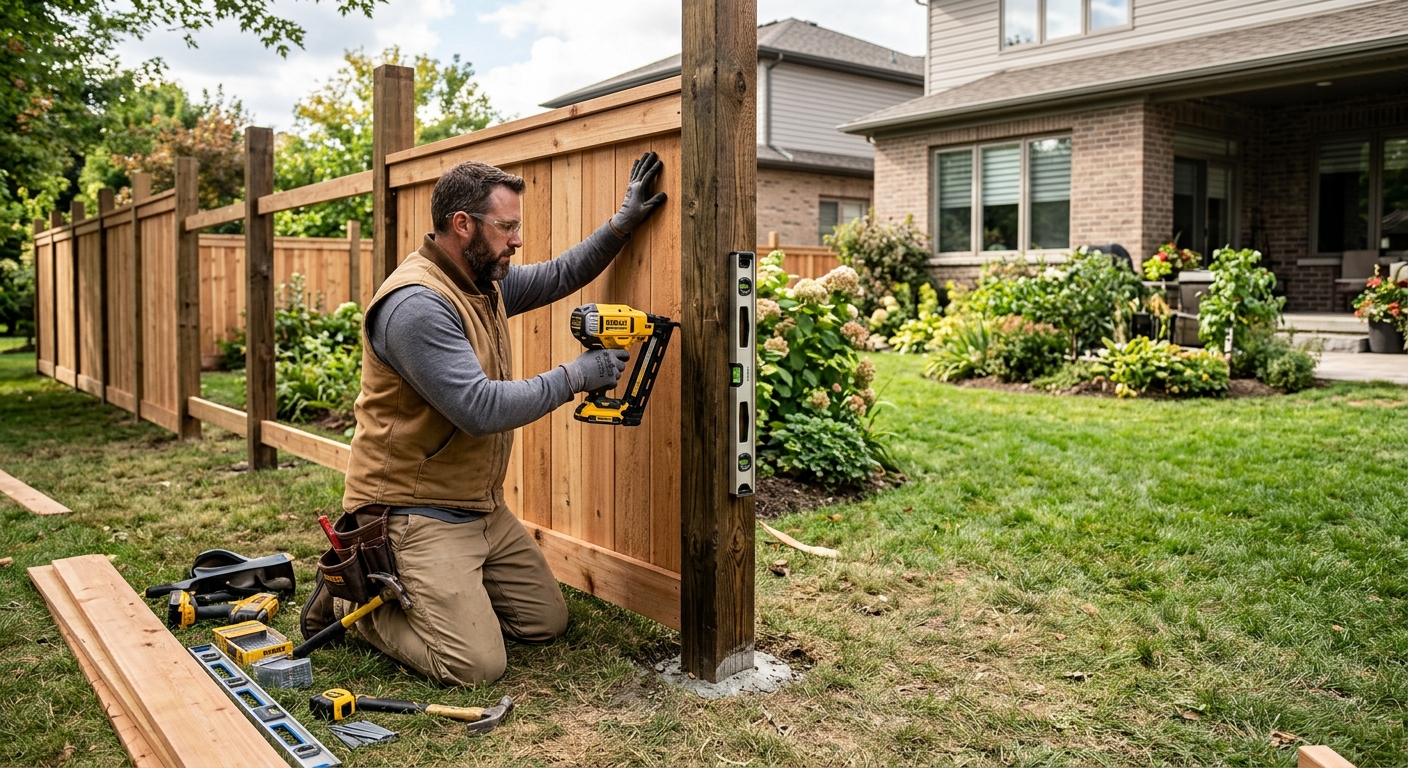
Fencing options and costs in Toronto
Toronto homeowners usually shop for fencing with one goal in mind: clearer property boundaries and better privacy—whether you’re backing onto a busy arterial road in Scarborough or trying to screen a yard in a mature neighbourhood like Forest Hill. With 2,794,356 people in the city and 602,925 homeowner households (51.9% of households own) driving long-term property investment, demand stays steady year-round. In areas with more single-detached housing (23.3% of dwellings), you also see more perimeter fencing for backyards, gardens, and driveway side yards—each one a separate fencing “project” that affects your pricing.
Cost in Toronto isn’t just about material. Winter freeze–thaw cycles and clay/mixed soils mean fence posts need to be set deep enough to resist frost heave. In Southern Ontario, the frost line is commonly estimated around 42"–48", so contractors typically set posts at about 42"–72" below grade (often 3.5–4 ft for 6–8 ft privacy fences) using concrete-set footings. That increases labour time and concrete/aggregate costs compared with simple gravel or driven posts. Wind isn’t as punishing as the Prairies, but taller solid panels still need correct spacing and hardware to prevent racking.
Below is a practical comparison of Toronto-favourite fence types and what they usually cost per linear foot, so you can align your budget before you request an itemised quote.
| Material |
Lifespan |
Maintenance |
Privacy Rating |
Price per Linear Foot |
| Pressure-treated pine (standard wood) |
10–15 years |
Stain or seal every 2–3 years |
High (solid board) |
$65–$120 |
| Cedar (natural rot resistance) |
15–25 years |
Re-stain/seal every 2–3 years (recommended) |
High (solid board) |
$75–$130 |
| Vinyl / PVC (no-maintenance) |
20–30 years |
Occasional wash (no staining) |
High (solid/walled systems) |
$75–$130 |
| Chain-link (galvanized steel) |
20–35 years |
Rinse as needed; replace worn ties |
Low–Medium (add privacy slats if desired) |
$45–$85 |
| Aluminum ornamental |
25–40 years |
Low; wash occasionally |
Low–Medium (ornamental pickets) |
$90–$160 |
| Composite / recycled material |
20–30 years |
Low; occasional cleaning |
High (solid designs) |
$85–$150 |
Prices are estimates only and vary by project scope, site access and material selection.
What affects the price of fencing in Toronto
In Toronto, even “the same” fence can come in 30–50% apart because the quote is driven by site conditions, post construction details, and how the contractor builds for Ontario’s freeze–thaw rhythm. Across the GTA (and beyond), some firms include concrete-set posts, proper post spacing, and hardware upgrades in their base price; others quote a lighter approach that can look similar initially but shifts long-term risk to you. With many Toronto homes built before 1981 (58.1% of dwellings), there are also more established lots with older utility runs, mature landscaping, and tighter access routes—each one affects excavation time and disposal costs.
Frost depth sets how deep posts must be set to prevent heaving. In cold Ontario winters, contractors commonly plan hole depths that land roughly 42"–72" below grade depending on fence height, soil, and post size—so you often see concrete setting and longer posts (which raises both labour and materials). Wind still matters for privacy fences: solid panels can rack, so firms use heavier posts and closer spacing (commonly 6–8 ft centres for tall wood/vinyl privacy styles) rather than the wider spacing you might see elsewhere.
Here are concrete Toronto examples that regularly move price up or down. (1) A 40 ft backyard privacy run that needs concrete-set footings for clay soils will typically land closer to the wood band ($65–$120) but can push toward the higher end once you add heavier posts and extra bracing. (2) A townhouse-style run with short gate spans and easy access may come closer to the low end of chain-link ($45–$85). (3) Old fence removal: if the existing fence boards are fully rotten or the posts are concrete-set, disposal and extra excavation can add significant labour and stump the budget quickly.
Next, it helps to understand which line items are really changing your final number—so you can compare quotes on equal footing.
| Price Factor |
Why It Matters |
Cost Impact |
| Fence length in linear feet |
Most materials and labour scale directly with total run |
Largest driver of final cost |
| Post depth required |
Frost line determines hole depth and post length to prevent heaving |
Concrete + deeper excavation increases cost |
| Post setting method |
Concrete vs gravel pack vs driven posts affects stability and labour |
Concrete-set posts usually raise price |
| Material choice |
Vinyl and cedar cost more than pressure-treated lumber; metal varies by spec |
Shifts you between wood ($65–$120) and metal/vinyl ($75–$160) bands |
| Gate count and type |
Drive-through double gates require extra framing and hardware |
Can add major labour/materials per gate |
| Grade and terrain |
Slopes may require stepped panels or raked sections |
More labour; more custom cutting |
| Old fence removal and disposal |
Rotten boards, concrete footings, and hauling time change workload |
Often increases total by a meaningful margin |
| Permit fees and survey / property line locate |
Required paperwork and accurate layout reduce disputes and rework |
Varies by lot; can add upfront cost |
Permits & regulations in Ontario
In Ontario, fences can trigger permitting requirements depending on height and location. A common rule of thumb used by many Toronto-area homeowners is that fences over about 2.0 m (6.5 ft) at the rear typically require a building permit, while fences around 1.0–1.2 m (3–4 ft) at the front or corner may also fall into permit/approval territory depending on the municipality’s rules and lot context. Regardless of permit status, fences must respect property lines and municipal setback bylaws.
Before you dig any post holes, you must get utility locates through Ontario One Call. The contractor should pull locates for your address (and coordinate with them before excavation). For best results, obtain a survey or locate your property pins so your layout avoids encroachment disputes with neighbours—especially in established Toronto areas where boundaries and older fences aren’t always “square.”
Shared fence ownership is handled through provincial line-fences legislation: adjacent property owners typically share responsibilities for the fence depending on agreement and circumstances, but local bylaws and shared maintenance arrangements can still affect how upkeep is handled in practice.
How to verify an Ontario contractor in Toronto: ask for their Ontario licence/registration details (if applicable to their work scope), request a certificate of liability insurance showing the correct insured party and active coverage, and confirm WSIB coverage (workers’ compensation). For documentation, look for (1) an online registry listing/number, (2) an insurance certificate dated within the last policy term, and (3) a WSIB clearance letter or evidence of current coverage.
Choosing the right fence material for Toronto
Choosing the right material in Toronto comes down to your priorities: privacy, low maintenance, budget, and how long you want the fence to look good without constant touch-ups. Pressure-treated pine is the lowest-budget route, but it typically needs staining or sealing every 2–3 years to limit grey weathering and keep fasteners and boards protected. Cedar looks great and resists rot better, yet it still benefits from regular maintenance to keep colour and reduce surface cracking.
Vinyl/PVC is a strong “set it and forget it” option: it’s low maintenance and doesn’t require staining. The trade-off is upfront cost and the need for correct installation in cold snaps—misaligned posts or undersized bracing can lead to panel stress. Chain-link is usually the most economical and long-lived, but it won’t give you privacy unless you add slats or top screening. Aluminum ornamental offers attractive curb appeal and won’t rust, but it’s not a privacy fence. Composite/recycled materials can provide privacy in solid designs with low upkeep, but the best value depends on the specific system and post hardware.
Toronto’s climate drives construction choices too. With frost-line impacts common in Southern Ontario (often planned around 42"–48"), concrete-set posts are frequently recommended for privacy-height fences. That means your post spec and spacing matter as much as your board material. Taller fences also need proper wind bracing and panel alignment to reduce racking in strong winter storms and spring gusts.
A simple dollar example: if you compare pressure-treated wood at roughly the $65–$120 band to vinyl at about the $75–$130 band, vinyl can cost more upfront, but it can pay back if you don’t want to budget for regular staining and you want colour consistency through Toronto’s wet freeze–thaw cycles.
| Material |
Cold Tolerance |
Lifespan |
Annual Maintenance |
Best For |
Price Band |
| Pressure-treated pine |
Good (with proper post setting) |
10–15 years |
Clean + plan stain/seal every 2–3 years |
Budget privacy with willingness to maintain |
$65–$120 |
| Cedar |
Good (natural rot resistance) |
15–25 years |
Inspect + re-stain/seal every 2–3 years |
Premium look and rot resistance |
$75–$130 |
| Vinyl / PVC |
Very good (avoid undersized bracing) |
20–30 years |
Occasional wash (spring/fall) |
Low maintenance privacy |
$75–$130 |
| Chain-link |
Very good |
20–35 years |
Rinse as needed; tighten hardware |
Security on a budget |
$45–$85 |
| Aluminum ornamental |
Very good |
25–40 years |
Occasional wash |
Curb appeal and boundary definition |
$90–$160 |
| Composite / recycled |
Good (quality system matters) |
20–30 years |
Low; clean as needed |
Solid look with reduced upkeep |
$85–$150 |
How to choose a fencing contractor in Toronto
For fencing in Toronto, strong paperwork and clear quoting matter because freeze–thaw and post stability are labour-and-detail intensive. Start by verifying liability insurance (ask for a current certificate and confirm it covers the work at your address). Next, confirm workers’ compensation coverage (WSIB in Ontario) for anyone who will be installing on-site. Then verify the contractor’s Ontario registration/licensing details that apply to their work scope—use the contractor’s own reference numbers and cross-check them via relevant online registries. If you’re unsure what you should see, ask the contractor to provide the exact certificate and clearance letter wording.
Get 2–3 written, itemised quotes—labour and materials broken out separately. Avoid lump-sum-only proposals that don’t explain post type, spacing, and how they’ll handle Toronto frost conditions. Read the scope carefully: what is included for permit pulls (if needed), utility locating calls, survey/property line locate (if required), and old fence removal/disposal? A reputable fencing company will list exclusions like “rock excavation not included” or “unexpected concrete removal by owner” so you can compare like-for-like.
Warranty should be specific: workmanship warranty length, product/manufacturer warranty terms, and whether coverage is transferable if you sell the home. Keep payments controlled: never pay more than 10–15% upfront, and request a holdback until substantial completion. Finally, ask for a written start date and completion estimate—so winter delays, curing time for concrete, and delivery lead times are understood.
- Written scope with total linear footage and exact fence type (privacy/ornamental/security).
- Post material and diameter listed (e.g., 4x4 vs 6x6) plus spacing (6–8 ft centres for tall privacy where applicable).
- Post setting method specified: concrete-set depth aligned with frost conditions.
- Gate count and gate hardware details (latches, hinges, swing direction) stated in the quote.
- Allowance for removing/hauling existing fence and concrete footings if present.
- Site access notes: driveway work, parking arrangements, and protection of landscaping included or excluded.
- Utility locate responsibility stated (who pays and who pulls locates).
- Permit responsibility clearly identified when fence height triggers approval needs.
- Labour and materials separated (not just one lump sum).
- Warranty terms in writing for workmanship and for product components.
- Clear payment schedule (10–15% max deposit; holdback until completion).
- Start date and estimated completion date included with contact for schedule changes.
Concrete red flags in the Toronto market: a quote that omits post depth and concrete-set details for 6–8 ft privacy fences; promises of “driven posts” in clay without frost-heave planning; vague warranties (“guaranteed for a year” without workmanship specifics); asking for large upfront payments (well beyond 10–15%); and no WSIB/insurance documentation provided when requested.
Frequently asked questions — fencing in Toronto
How much does a fence cost in Toronto?
In Toronto, fencing pricing typically lands inside material-based bands rather than a single universal number. For example, wood fence installation commonly falls around $65,000 – $120,000 per linear foot (final totals are calculated per your run length and gate count), while chain-link is often closer to $45,000 – $85,000 depending on height and hardware. Vinyl/PVC frequently sits near $75,000 – $130,000, and aluminum ornamental can be higher, around $90,000 – $160,000. Prices vary because Toronto’s freeze–thaw conditions usually require concrete-set posts for privacy heights, and older properties may need more excavation and disposal work. Always request an itemised quote so you can compare post depth, spacing, and removal/disposal inclusions.
How deep should fence posts be for Toronto's frost?
Toronto-area installations generally plan post depths around the local Southern Ontario frost line, commonly estimated at about 42"–48". In practice, contractors often set posts about 3.5–4 ft deep for many 6–8 ft privacy fences to reduce frost heave risk, with the exact depth depending on soil type, post size, fence height, and drainage. Because Toronto has clay and mixed soils in many neighbourhoods, concrete-set posts are commonly recommended for long-term stability. If your quote only mentions “standard depth” without numbers and without the setting method, that’s a gap you should question. For any final answer, a contractor should reference your specific fence height and post specification (and ideally account for local grade and any drainage issues).
Wood vs vinyl vs aluminum fence — which is best?
“Best” depends on your priorities. Wood (pressure-treated or cedar) is a strong privacy value, but wood usually requires maintenance—staining or sealing every 2–3 years—to keep it looking good through Toronto’s wet winters and dry summers. Vinyl/PVC provides similar privacy with much lower maintenance; it’s a great choice if you want stable colour and don’t want periodic staining, but it typically costs more upfront (often in the vinyl band). Aluminum ornamental is best for curb appeal and boundary definition; it resists rust well and needs little upkeep, but it’s not a privacy fence. If you want privacy and low maintenance, vinyl commonly wins. If you want the lowest install cost for privacy, pressure-treated wood often wins—provided posts are properly set for frost heave control.
Do I need a permit to build a fence in Ontario?
In Ontario, permits can apply based on fence height and location. A common threshold used for many Toronto-area situations is that fences above about 2.0 m (6.5 ft) at the rear typically require a building permit, while fences nearer the front or corner—often around 1.0–1.2 m (3–4 ft)—may also require approval depending on the municipality and lot context. Even when a permit isn’t required, you still must respect property lines and municipal setback/bylaw rules. Before digging any post holes, utility locates are required (Ontario One Call). It’s also smart to verify your boundary with a survey or property pins to avoid encroachment disputes—especially in older Toronto neighbourhoods where boundary markers and older fences may not align.
How long does a wood fence last in Toronto?
A well-built wood fence in Toronto commonly lasts about 10–15 years for pressure-treated pine and about 15–25 years for cedar, depending on how it’s installed and maintained. The biggest Toronto-specific factor is post stability: because Ontario freezes and unfreezes repeatedly, properly sized posts set deep enough (often concrete-set for privacy heights) help prevent heaving and premature leaning. The second factor is maintenance: wood needs periodic sealing/staining (often every 2–3 years) to reduce grey weathering and protect from surface cracking. If you skip maintenance, you may see faster wear on boards and fasteners, even if the underlying posts were installed correctly. A contractor who details post depth and hardware choices usually helps you achieve the longer end of those ranges.
Who owns and maintains a shared fence?
Shared fence ownership and maintenance in Ontario typically follow provincial line-fences rules, but the exact responsibility depends on circumstances and any agreements between neighbours. Practically in Toronto, many fences are effectively “shared” because they sit along the property boundary; neighbours may share costs for repair or replacement, but disputes can occur if one side believes the fence is solely theirs. Before work begins, confirm whether the fence is on the boundary line and whether there is an existing agreement (written or longstanding practice). Your contractor can help document the location (with the right survey or locate) so you’re not paying to repair what may be outside your property. If you anticipate a replacement involving shared boundary panels, it’s wise to get neighbour agreement in writing on scope, material choice, and cost sharing.