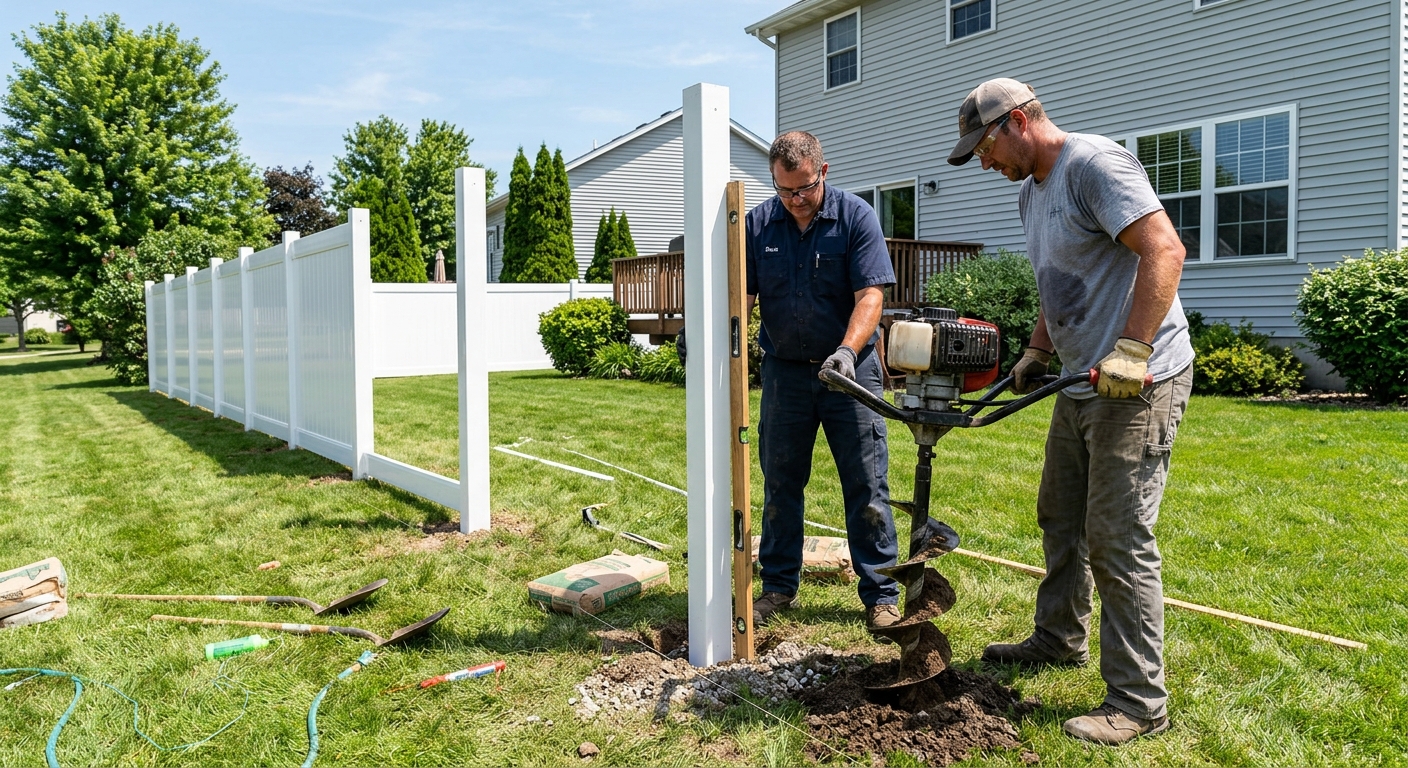
Fencing options and costs in Milton
Milton homeowners typically shop for fencing with one goal in mind: quiet, defined property boundaries that still look good in a freeze-and-thaw climate. With Milton sitting at a population of 132,979 (Statistics Canada, 2021 Census) and 33,085 homeowner households—82.6% of all households owning—the demand for residential fencing is steady year-round, especially as many properties are single-detached homes where fencing defines rear-yard privacy. In fact, single-detached dwellings make up 56.7% of Milton’s housing stock (Statistics Canada, 2021 Census), which often means longer runs and multiple gates.
In the Toronto economic region, pricing is shaped by how we build for frost and how homeowners expect fences to perform through heavy winters. Local best practice treats the design frost line as commonly about 42"–48" in Southern Ontario, so posts are usually concrete-set and set roughly 3.5–4 ft deep for taller privacy fences. That extra digging and concrete work adds labour, but it’s what limits frost heave and keeps panels from leaning over time. Contractor availability also affects cost: neighbourhoods with higher turnover of fences—often around family-oriented areas such as the Acton/“Alton Village” side and established east Milton communities—tend to see quicker scheduling, but higher demand can still move pricing within the bands.
Below is a practical cost comparison to help you budget before we talk about your specific layout, gate count, and whether your yard is level or needs stepped sections.
| Material |
Lifespan |
Maintenance |
Privacy Rating |
Price per Linear Foot |
| Pressure-treated pine (standard wood) |
10–15 years |
Stain/seal every 2–3 years |
High (solid boards) |
$65–$95 |
| Cedar (natural rot resistance) |
15–20 years |
Light staining every 3–4 years |
High (solid boards) |
$85–$120 |
| Vinyl / PVC (no-maintenance) |
20–30 years |
Wash as needed; inspect hardware |
High (solid panels) |
$75–$130 |
| Chain-link (galvanized steel) |
20–30 years |
Minimal (rinse; touch-up as needed) |
Low–Medium (privacy inserts possible) |
$45–$85 |
| Aluminum ornamental |
25–40 years |
Minimal (wash; check gates) |
Low (open pickets) |
$90–$160 |
| Composite / recycled material |
20–30 years |
Wash; no staining |
High (board-style systems) |
$95–$150 |
Prices are estimates only and vary by project scope, site access and material selection.
What affects the price of fencing in Milton
In Milton and across the Toronto economic region, two quotes for the “same” fence can differ by 30–50% because the drivers behind price are rarely identical. Labour intensity changes with how deep we must set posts, what hardware is needed for wind loads, and how many gates are required. Materials also vary: a vinyl privacy fence can land in the $75–$130 per linear foot band, while a pressure-treated wood fence often sits in the lower end of the $65–$120 range for wood installations—assuming similar heights and access.
Frost line depth is the biggest technical reason costs rise. In cold Ontario winters, contractors commonly set posts about 4–6 inches below the design frost depth so the fence doesn’t heave during thaw cycles. Practically, that means holes are often about 1.5–2.0 m into the ground for 6–8 ft privacy fences. Concrete setting (vs. simple driven posts) increases material cost and labour time, but it’s a major reason fences stay straight after multiple winters.
Wind matters too, even though GTA wind exposure isn’t like open Prairie sites or coastal storm regions. Taller solid panels can rack without sufficient post size and tighter spacing—especially near open corners, end-of-run stretches, and yards backing onto wider roads. In BC’s milder but wetter conditions wood can rot faster without proper treatment, but in Milton the bigger risk is structural movement from freeze/thaw, which pushes clients toward concrete-set posts.
Two local examples: (1) a 60 ft run that needs 4 concrete-set corner posts often costs noticeably more than a shorter run with fewer end assemblies; (2) a stepped fence on a slope can require more rails, labour time, and sometimes custom panel ordering, which can push a wood run up toward the mid-to-high end of the wood pricing band. If the fence needs old removal, labour and dump fees add another swing in the total.
| Price Factor |
Why It Matters |
Cost Impact |
| Fence length in linear feet |
Most of the cost scales directly with total run length, including rails and post count |
Highest impact |
| Post depth required |
Frost considerations determine hole depth and post length for stability |
Can add significant labour and material |
| Post setting method |
Concrete-set posts resist frost heave better than gravel pack or driven posts |
Usually increases total cost |
| Material choice |
Vinyl/PVC and cedar typically cost more than pressure-treated pine; chain-link is lowest |
Varies widely by material |
| Gate count and type |
Double drive gates require heavier frames, hinges, and often a level approach |
One gate can materially change the total |
| Grade and terrain |
Slope requires stepped/raked panels and more layout time |
Moderate to high impact |
| Old fence removal and disposal |
Hauling, dismantling, and disposal fees add labour and tipping costs |
Often a noticeable add-on |
| Permit fees and survey / property line locate |
Some fences require a permit; locating pins avoids encroachment disputes |
Can add to the upfront total |
Permits & regulations in Ontario
In Ontario, fence height rules are tied to building permit thresholds and municipal bylaws. In many Milton-area scenarios, fences above a typical height threshold—often about 2.0 m (6.5 ft) at the rear and about 1.0–1.2 m (3–4 ft) at the front or corner—may require a building permit. Even when a permit isn’t required, fences must respect property lines and municipal setbacks. A good contractor should also confirm whether your specific lot requires additional approval based on frontage, corner lot configuration, and any easements.
Before digging any post holes, always get utility locates through Ontario One Call to protect buried hydro, telecom, gas, or irrigation lines. Next, verify your property boundary: many disputes happen when a fence is built even slightly beyond a pin or on a utility easement. Where you don’t already have clear boundary documentation, arrange a survey or a property pin locate before installation.
Shared fence ownership is governed by provincial line-fences principles, so it’s smart to document agreement with your neighbour about maintenance, repairs, and replacement costs for shared sections.
How to verify your contractor before the first hole is dug: ask for their Ontario business licence details (if applicable in your area), proof of liability insurance (request a certificate of insurance naming you as additional insured where possible), and evidence of WSIB/WCB coverage. You can confirm coverage status via the WSIB clearance process for Ontario workers and check the company’s certificate dates and coverage limits directly on their COI.
Choosing the right fence material for Milton
Choosing fencing material in Milton is mostly about matching your priorities—privacy, maintenance level, and lifespan—to the way our winters stress fences. Pressure-treated pine is the budget-friendly entry point, but it typically requires staining or sealing every 2–3 years to prevent grey weathering and to keep boards looking uniform. Cedar offers a more natural look and better rot resistance, but it’s not truly “no-maintenance”; you’ll usually still want periodic staining. Vinyl/PVC delivers low maintenance and a consistent appearance, which many Milton homeowners like, but it can be more expensive upfront and needs properly sized posts and correct installation to avoid flexing in extreme cold.
Chain-link is the lowest-cost option and tends to last a long time, but it provides limited privacy unless you add privacy slats or choose a hybrid approach. Aluminum ornamental looks clean and resists rust without heavy upkeep, but it’s typically mid-range to higher cost and offers lower privacy due to open pickets. Composite/recycled boards can suit privacy needs with less maintenance than traditional wood, but the budget is usually higher than pressure-treated pine.
For all materials, Toronto’s frost line reality pushes most privacy fences toward concrete-set posts. With commonly recommended post depths around 1.5–2.0 m into the ground (for typical 6–8 ft privacy), the stability benefit matters more than the fence surface material. Good panel bracing and post spacing also help manage racking from wind and from snow drifting effects.
To justify price differences with real numbers: if a comparable vinyl privacy fence is quoted at $75–$130 per linear foot versus a pressure-treated pine quote in the $65–$95 band, the added upfront cost can make sense if you want to avoid recurring staining and plan to keep the fence for decades.
| Material |
Cold Tolerance |
Lifespan |
Annual Maintenance |
Best For |
Price Band |
| Pressure-treated pine |
Good when properly sealed and installed on stable posts |
10–15 years |
Low-to-moderate (stain/seal every 2–3 years) |
Budget-first privacy runs |
$65–$95 |
| Cedar |
Good; resists rot better than pine in wet cycles |
15–20 years |
Low-to-moderate (stain every 3–4 years) |
Appearance + longevity for privacy |
$85–$120 |
| Vinyl / PVC |
Good; needs correct post sizing and spacing |
20–30 years |
Very low (wash; inspect hardware) |
Low-maintenance privacy |
$75–$130 |
| Chain-link |
Excellent in freeze/thaw with proper galvanizing |
20–30 years |
Very low |
Security with minimal upkeep |
$45–$85 |
| Aluminum ornamental |
Excellent; won’t rust |
25–40 years |
Very low (wash as needed) |
Front-yard curb appeal |
$90–$160 |
| Composite / recycled |
Good; stable when installed correctly |
20–30 years |
Low (wash; occasional checks) |
Privacy with reduced wood-like maintenance |
$95–$150 |
How to choose a fencing contractor in Milton
When you hire a fencing contractor in Milton, the “cheap bid” is often not cheap—especially once you factor in frost-set posts, proper bracing, and the realities of permit and property line work. Start by verifying Ontario coverage and capacity: request the company’s certificate of liability insurance (confirm it’s current and covers your project type), and ask for proof of WSIB (or WCB) coverage. You’re looking for a clearance letter where applicable and coverage that matches the work being done. If the contractor can’t provide paperwork quickly, that’s a red flag.
Next, get 2–3 written, itemised quotes—labour and materials broken out—rather than one lump sum. Fence pricing should show post depth/setting method, rail count, panel spacing, concrete quantity assumptions, gate frames, hardware, and whether old fence removal and disposal are included. Make sure the scope clearly states what happens with: permit pulls, property line locate/survey reliance, and any required adjustments if the ground isn’t as level as expected.
Warranty matters in fencing. Ask for a workmanship warranty length (how long your installation is guaranteed), plus the product manufacturer warranty (and whether it covers materials like boards, posts, or rails). Confirm if the warranty is transferable to you as the homeowner.
Payment schedule: never pay more than 10–15% upfront. Hold back the remainder until the job is complete and measurements and alignment are verified. Also insist on a written timeline with a start date, estimated completion date, and a plan for weather delays during freeze/thaw periods.
- Ask for proof of WSIB coverage and a current liability insurance certificate.
- Confirm who pulls permits (if required) and whether the fee is included.
- Require itemised pricing for posts, concrete setting, rails, and hardware.
- Ensure the quote states post depth assumptions for frost protection.
- Check that gate frames are included (not just slabs) and that hinges match load.
- Verify removal/disposal of the old fence is included or clearly excluded.
- Confirm panel spacing and bracing approach for wind stability.
- Get the warranty terms in writing for both workmanship and materials.
- Make sure “site conditions” are discussed (rock, soft clay, drainage, slope).
- Set payment milestones tied to inspection and completion, with a holdback.
- Confirm cleanup and debris haul-away is part of the scope.
- Get start/completion dates in writing and an allowance for weather delays.
Common Milton red flags: a contractor won’t show WSIB/liability paperwork, quotes with no post-depth or concrete-set assumptions, vague “we’ll handle permits” wording without confirming who pays, asking for most of the money up front, and a warranty that’s only verbal or missing workmanship coverage.
Frequently asked questions — fencing in Milton
How long does fence installation take in Milton?
In Milton, most standard residential fences can be installed in about 1–3 days, depending on length, fence height, gate count, and whether posts are concrete-set for frost stability. A straight 50–80 ft run with a single walk gate is often a short schedule, but longer perimeter runs, multiple corners, and double drive gates can take longer due to layout, bracing, and hardware setup. If you need old fence removal and disposal, add time for dismantling and haul-away. Weather also matters during Ontario freeze/thaw; crews may adjust scheduling when the ground is too frozen or waterlogged. Your contractor should provide a start date and completion estimate in writing.
Can I install a fence on a slope in Milton?
Yes—sloped yards are common in Milton—but the installation method matters. Typically, fences are installed with stepped sections (stair-step) or raked panels to follow the grade while keeping the top line consistent. A quote should reflect the added layout time and any extra rails or custom panel adjustments. If you have a steep drop, the contractor may need heavier hardware, closer post spacing, or upgraded bracing to reduce racking from wind and from the uneven loading caused by snow drift. Make sure your plan also aligns with property line location and any municipal setback rules, since boundary uncertainty becomes more noticeable on sloped lots.
What is the most weather-resistant fence for Milton's climate?
For Milton’s winters, the “most weather-resistant” usually means the fence that stays structurally straight through freeze/thaw. In practice, that often points to a solid privacy fence with concrete-set posts set to frost-safe depth, regardless of surface material. Vinyl/PVC privacy systems are popular because they resist rot and typically need very little ongoing maintenance; pricing commonly lands in the $75–$130 per linear foot band. Cedar can be highly durable too, especially with correct installation and periodic maintenance, while chain-link is extremely long-lived but won’t provide privacy without inserts. The foundation work—proper post depth, concrete setting, and correct post spacing—often determines performance more than the outer material.
How do I prevent wood fence rot in Milton?
Wood rot is usually about moisture management and correct installation details. In Milton, you can’t avoid wet winters, so the key is to keep boards and fasteners from holding standing water and to protect end grain. Use pressure-treated lumber properly (and don’t skip staining/sealing schedules); most homeowners should plan on staining every 2–3 years to maintain protection and reduce grey weathering. For cedar, you still want periodic care—cedar resists rot better, but it’s not immune. The most important structural step is stable, frost-protected posts: concrete-set posts and correct drainage reduce movement that can create gaps and water pooling at the base. Avoid burying wood directly in soil.
What is the cost per linear foot for fencing in Milton?
In Milton, fencing typically falls into material-based bands for labour and installation. Wood fences often price around $65–$120 per linear foot depending on height and style; pressure-treated pine commonly sits near the lower end when the scope is straightforward. Vinyl/PVC privacy fences are frequently in the $75–$130 range. Chain-link is usually more affordable at $45–$85, while aluminum ornamental is often higher at $90–$160. Your exact per-linear-foot cost depends on total length, gate count, post depth and setting method (concrete-set increases stability), site access, and whether old removal/disposal is included.
Should I repair or replace my old fence in Milton?
It depends on what’s failing. Many Milton homeowners can repair if the damage is limited to a few boards or a gate latch, and if the posts are still solid (no wobble, no leaning, no rot at the base). If the fence is leaning, posts are heaving after freeze/thaw, or rails are separating consistently, replacement is usually the better long-term value because the structure needs frost-safe post setting—not just cosmetic board swaps. Also consider material mismatch: mixed hardware and inconsistent heights can look uneven and can reduce wind stability. Get a contractor to assess post stability, hardware, and bottom rot before deciding. A well-installed replacement with proper post depth is typically the most reliable path for 6–8 ft privacy fences.