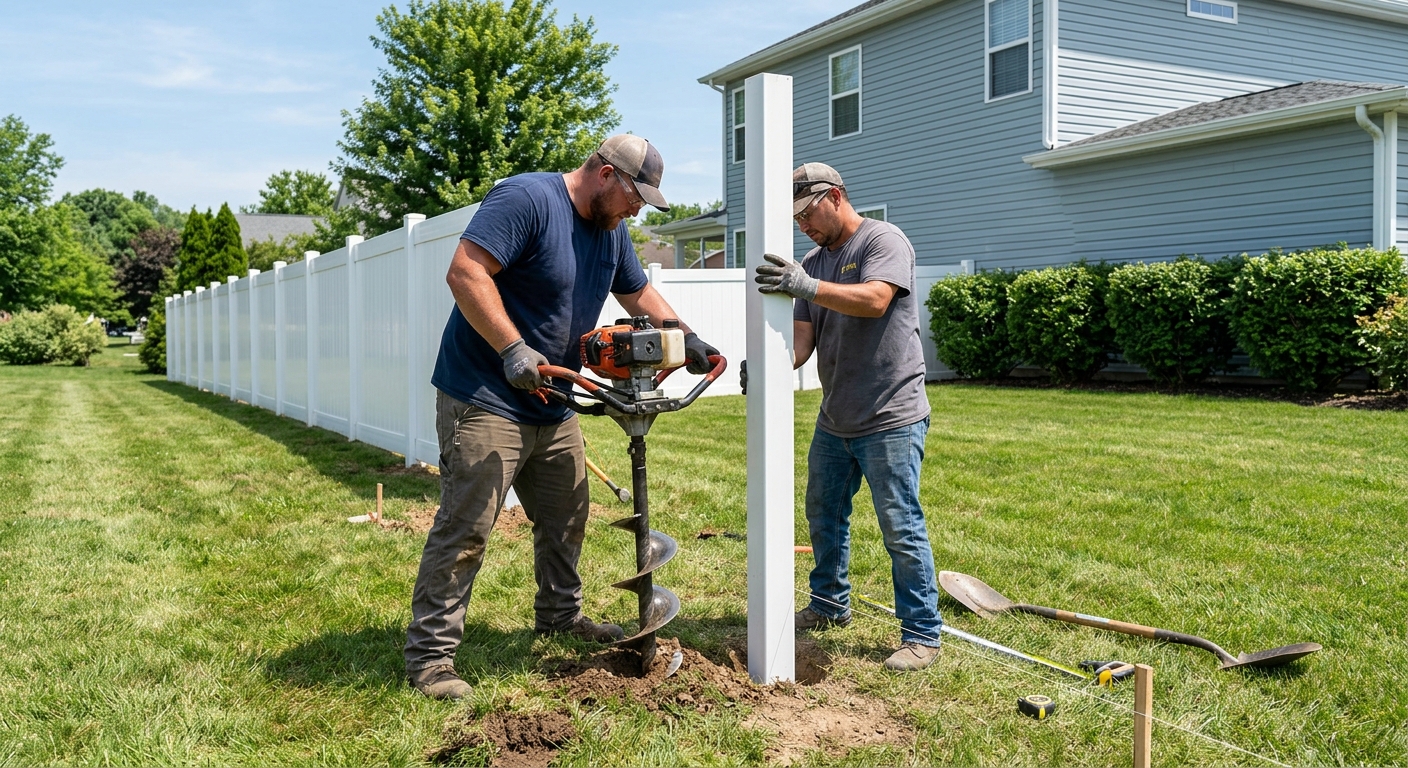
Fencing options and costs in Powassan
Powassan is a small Ontario community with a lot of single-detached homes, which means fences are a regular, practical upgrade for many yards. With 85.0% of households owning their homes and 90.9% of dwellings being single-detached, each detached property is a potential long-term fencing customer (Statistics Canada, 2021 Census). Locally, the mix of established housing—60.2% of homes built before 1981—also influences fencing demand because older lots often have aging boundaries, leaning runs, and posts that no longer hold plumb.
Fencing costs in the Northeast Ontario market are shaped by winter performance requirements and how efficiently crews can work during short shoulder seasons. In Powassan, contractors typically plan for hard freeze–thaw cycles and heavier yard loads (snow push and spring drainage changes), which can mean more concrete setting, better bracing, and careful post spacing. Projects in exposed backyards—especially where the wind funnels between lots or open fields—often require sturdier framing and sometimes a more open fence design so the panel doesn’t act like a sail. Trade availability can also tighten in peak weeks, affecting labour schedules and therefore quote pricing.
If you’re near the more established residential blocks around the Powassan core, we often see demand spike for backyard privacy upgrades, dog runs, and boundary repairs where the existing fence has become unsafe. With that in mind, here’s a practical comparison of common materials and what homeowners typically budget per linear foot in Powassan.
| Material |
Lifespan |
Maintenance |
Privacy Rating |
Price per Linear Foot |
| Pressure-treated pine (standard wood) |
10–15 years |
Stain/seal every 2–3 years; check posts after freeze–thaw |
High (solid panels) |
$80 – $130 |
| Cedar (natural rot resistance) |
15–25 years |
Light stain or protective finish every 3–4 years |
High (solid panels) |
$95 – $140 |
| Vinyl / PVC (no-maintenance) |
20–30 years |
Wash annually; inspect hardware in winter |
High (solid styles) |
$85 – $140 |
| Chain-link (galvanized steel) |
25–35 years |
Occasional rinse; check tension on gates |
Low to medium |
$55 – $90 |
| Aluminum ornamental |
25–35 years |
Wash; inspect for dents |
Low to medium |
$95 – $150 |
| Composite / recycled material |
20–30 years |
Low maintenance; periodic cleaning and hardware checks |
High (depending on slat design) |
$110 – $170 |
Prices are estimates only and vary by project scope, site access and material selection.
What affects the price of fencing in Powassan
Even when homeowners ask for “the same fence,” quotes in and around Northeast Ontario can vary by 30–50% because the real drivers are installation conditions and how much engineering the installer has to do to keep the fence straight for the next decade. In Powassan, the biggest cost swings are typically related to ground conditions (how deep posts must be set), exposure (wind load and panel size), and how much extra work is required for gates, terrain, and removal.
Frost line depth matters because posts must be set below the active freeze–thaw zone to prevent heaving. A common rule of thumb is placing posts about 4–6 inches below the design frost depth; in colder Ontario regions, that often means post holes deep enough that you need longer posts and concrete setting, not just gravel. That adds both material and labour time—especially where crews have to auger deeper, manage spoil, and keep alignment while concrete cures. Wind exposure also raises cost: tighter post spacing and heavier rails cost more, and solid privacy panels may need upgraded framing so they don’t rack under gusts. On the opposite end, chain-link can stay more budget-friendly because it’s lighter and generally resists wind better, while still lasting a long time—often fitting the $55 – $90 per linear foot band.
In Powassan specifically, two concrete examples we see often are: (1) older lots with uneven grade requiring stepped sections, which increases layout time and materials; and (2) yards with poor drainage where contractors may recommend belled footings and concrete-set posts for more stability, pushing some projects closer to the $80 – $130 wood band or higher depending on how many gates are involved. With many homes older than 1981 (Statistics Canada, 2021 Census), it’s common to deal with aged posts and buried obstructions, which can also add removal and rework costs.
| Price Factor |
Why It Matters |
Cost Impact |
| Fence length in linear feet |
Most costs scale directly with metres installed (posts, rails, fabric/panels). |
High (primary driver) |
| Post depth required |
Frost protection determines hole depth and post length; deeper holes need more concrete. |
High |
| Post setting method |
Concrete setting vs gravel pack vs driven posts changes material, labour, and longevity. |
Medium to high |
| Material choice |
Vinyl hardware complexity, cedar finishing, and chain-link labour differences affect totals. |
Medium to high |
| Gate count and type |
Drive-through or double gates require heavier frames, bracing, and alignment work. |
High |
| Grade and terrain |
Sloped yards require raked panels, stepped footings, and more layout time. |
Medium |
| Old fence removal and disposal |
Disconnecting, hauling, and handling damaged posts increases labour and disposal fees. |
Medium |
| Permit fees and survey / property line locate |
Locates and boundary verification reduce encroachment risk and rework. |
Low to medium |
Permits & regulations in Ontario
In Ontario, fence rules depend on local by-laws, but a common threshold homeowners hear is that fences above about 2.0 m (6.5 ft) at the rear and about 1.0–1.2 m (3–4 ft) at the front or corner often trigger a building permit requirement. The key obligation is that your fence must sit on or within your property line and also respect municipal setbacks. For Powassan homeowners, the practical takeaway is simple: if you’re planning a tall privacy fence around the rear yard or any structure that could affect visibility at a corner, confirm the permit requirement before ordering materials.
Before any post holes are dug, call for utility locates using the appropriate one-call service for your province. Even if you think the run is “straightforward,” buried services can be present—locates protect you and your installer. A survey or at least a property pin locate is highly recommended so you avoid neighbour disputes and costly fence moves.
Shared fence ownership and line-fence responsibilities are typically governed by Ontario’s line-fences legislation, so don’t rely on a handshake—document agreements when a neighbour shares costs or approves the location.
To verify an Ontario contractor, check: (1) their Ontario business licence/registration and confirm they’re in good standing via the relevant provincial/agency registry; (2) liability insurance—ask for a certificate of insurance showing adequate limits; and (3) WSIB/WCB coverage—request a clearance letter or coverage confirmation. If they can’t provide current documents, that’s a red flag.
Choosing the right fence material for Powassan
Choosing a fence in Powassan is really about matching your priorities—privacy, low maintenance, budget, and lifespan—to the realities of freeze–thaw weather and winter loads. Pressure-treated pine is the budget-friendly route, but it needs proactive staining or sealing every 2–3 years to slow grey weathering and protect fasteners and end grain. Cedar offers natural rot resistance and a warmer look, but it still benefits from a protective finish to keep it from drying and splitting around rails. Vinyl/PVC gives homeowners the “set it and forget it” advantage—no staining—though in extreme cold the material can become brittle, and you still need correct spacing and hardware so panels expand and contract safely. Chain-link is the lowest-cost and longest-life option for many yards, but it won’t deliver the same privacy rating unless you add slats or a privacy screen. Aluminum ornamental sits in a mid-to-higher budget range, stays rust-resistant, and looks sharp, but it’s not a privacy fence by nature.
Because Northeast Ontario winters can be unforgiving, post depth and setting are often as important as the material. Properly set posts are the difference between a fence that lasts and one that leans after a harsh spring. For many installs, concrete-set posts are common where deeper holes are needed to sit below the active freeze–thaw zone; shallow or gravel-only setups are more likely to shift. Wind also matters: in open pockets, heavier solid panels require sturdier rails and tighter spacing, while more open designs like chain-link usually handle gusts better.
Here’s a typical budget justification: if you’re deciding between pressure-treated pine and vinyl/PVC, vinyl may cost in the $85 – $140 per linear foot band versus wood in the $80 – $130 range. The price gap is often worth it when you want to avoid annual maintenance and want stable colour through repeated winters—especially for homeowners who don’t want to manage re-staining and hardware checks every few years.
| Material |
Cold Tolerance |
Lifespan |
Annual Maintenance |
Best For |
Price Band |
| Pressure-treated pine |
Good (with correct post depth and sealed fasteners) |
10–15 years |
Inspect seasonally; stain/seal every 2–3 years |
Budget-focused privacy with periodic upkeep |
$80 – $130 |
| Cedar |
Good (natural rot resistance) |
15–25 years |
Inspect seasonally; finish every 3–4 years |
Attractive privacy where you want longer service |
$95 – $140 |
| Vinyl / PVC |
Good (avoid poor installation that affects expansion) |
20–30 years |
Wash annually; check hardware after freeze periods |
Low-maintenance privacy in cold climates |
$85 – $140 |
| Chain-link |
Excellent (steel tolerates winter well) |
25–35 years |
Minimal; rinse and check tension |
Secure perimeter where privacy is not critical |
$55 – $90 |
| Aluminum ornamental |
Excellent (powder-coated and rust-resistant) |
25–35 years |
Wash; inspect for dents after impacts |
Neat front boundaries and mixed-use yards |
$95 – $150 |
| Composite / recycled |
Good (depends on panel system and hardware) |
20–30 years |
Low; periodic cleaning and hardware checks |
Long-life privacy with reduced upkeep |
$110 – $170 |
How to choose a fencing contractor in Powassan
To choose a fencing contractor in Powassan the safe way, start by verifying the basics: Ontario licensing/registration, liability insurance, and workers’ compensation coverage (WSIB for most Ontario workers). Ask the contractor to provide a current certificate of insurance showing general liability limits and list you as an additional insured if available. For WSIB, request a clearance letter or coverage confirmation and verify the dates cover your job window—don’t accept “it’s included” without documentation. If you’re hearing vague answers or delays in providing paperwork, move on.
Next, get 2–3 itemised written quotes, not a lump sum. A good fencing quote breaks down labour and materials separately—posts, rails, fabric/panels, concrete/footings, gate hardware, and any traffic control or site prep. Read the scope for exclusions: is permit pull included, is old fence removal and disposal included, and are utility locates part of their process? Watch for “allowance” language that hides the real cost.
Warranty should be specific: workmanship warranty length, what’s covered (posts, alignment, hardware), and whether the product warranty is manufacturer-backed and transferable if you sell your home. Payment schedules matter too—never pay more than about 10–15% upfront. Hold back the remaining balance until the fence is complete, aligned, and walkable/usable.
Finally, demand a written start date and a completion estimate. With Powassan’s cold-season planning, crews that can give you a realistic timeline generally manage equipment and cure times better.
- Request WSIB clearance/coverage confirmation (not verbal).
- Confirm liability insurance via certificate of insurance.
- Check Ontario business registration/licence details and contact info.
- Get 2–3 itemised quotes (labour vs materials, not one total).
- Ensure post depth, setting method, and spacing are written into the scope.
- Ask who provides and schedules utility locates.
- Confirm whether permit pull is included or billed separately.
- Verify who is responsible for property line locate/survey recommendation.
- Ask whether old fence removal and disposal are included.
- Confirm gate type, hardware grade, and opening direction are specified.
- Review warranty: workmanship term, product term, and transferability.
- Set a payment plan: ≤10–15% upfront, holdback until completion.
Red flags in Powassan to watch for: vague “materials included” wording with no post depth details, refusal to show WSIB/liability documents, quotes that only list one lump sum with no breakdown, missing start dates or unclear cure/alignment timelines, and requests for large upfront payments beyond 10–15% without a signed scope.
Frequently asked questions — fencing in Powassan
How do I prevent wood fence rot in Powassan?
To prevent wood rot in Powassan, the biggest wins come from installation details. Use proper post depth and setting—posts should be set below the active freeze–thaw zone (so they don’t heave and open gaps), and concrete setting is common when deeper holes are required for stability. Keep bottom rails and the lowest wood members from sitting in pooled water; adjust grade or add clearance where needed. For pressure-treated pine, apply a quality stain/seal and plan on re-coating every 2–3 years to slow grey weathering and protect fasteners. For cedar, it still benefits from protective finish because cedar can dry out and split even when it resists rot better. Finally, choose corrosion-resistant hardware (galvanized or coated) so metal fasteners don’t accelerate deterioration. (Statistics Canada, 2021 Census)
What is the cost per linear foot for fencing in Powassan?
In Powassan, a realistic planning range for installed fencing commonly falls into the local material bands: chain-link often comes in around $55 – $90 per linear foot, pressure-treated wood around $80 – $130 per linear foot, and vinyl/PVC commonly around $85 – $140 per linear foot depending on style and site conditions. Costs shift when you add gates (especially double/drive-through), steep grades that require stepped or raked sections, and deeper post setting for winter performance. Homeowners also see variation when old fences must be removed and disposed of. If your yard has exposed wind paths, the quote may go up because the contractor tightens post spacing or upgrades rails to keep the fence rigid through storms.
Should I repair or replace my old fence in Powassan?
Repair is usually the better option when only a few sections have damaged rails or minor post movement, and the majority of posts are still solid and plumb. Replacement is typically the smarter move when you see widespread leaning, rot around the post zone, multiple failing boards, or rot at ground contact points—especially in older fencing where 60.2% of homes were built before 1981 and the existing boundary hardware may be aging (Statistics Canada, 2021 Census). In Powassan, a fence that has started to heave or rack after winter can be more expensive to “patch” because each repaired section can transfer stress to the next. Ask for an on-site assessment and a line-by-line scope: sometimes partial replacement plus bracing offers the best value if most posts remain stable.
How do I handle a fence dispute with a neighbour in Ontario?
In Ontario, start by treating it as a boundary and agreement issue, not just a style disagreement. Verify the fence location against your property line and any survey pins you can reasonably access; don’t assume the current fence is exactly on the line. Review whether the fence is shared under Ontario line-fences principles and whether you’ve previously agreed on costs or maintenance. Communicate in writing—photos, dates, and a clear request for remediation help. If the disagreement involves safety or structural failure, document the condition and give a reasonable deadline for inspection. If you and your neighbour can’t resolve it, you may need a mediator or legal advice. In Powassan winter, fences can shift due to freeze–thaw, so the “dispute” might be resolved by correcting post depth and re-aligning panels with a proper installation plan.
What fence style offers the best wind resistance in Powassan?
For wind resistance in Powassan, an open or semi-open design usually performs best because it reduces wind “sail” effect. Chain-link is often the most wind-tolerant and is also budget-friendly at about $55 – $90 per linear foot. If you want visibility and more airflow while still adding security, chain-link with proper tensioning and well-set corner posts is a strong choice. For privacy-focused yards, solid wood or vinyl privacy panels can still work, but the contractor should plan for extra bracing, tighter post spacing, and heavier rails so gusts don’t rack the fence frame. Regardless of style, correct post setting depth and strong gate hardware matter—gates are usually the first components to loosen under repeated wind load.
How much does a fence cost in Powassan?
The total price in Powassan depends on linear feet, the material you choose, terrain, and how many gates you need. To estimate, multiply your fence length by the installed per-linear-foot band for your material. For example, chain-link often lands around $55 – $90 per linear foot, while pressure-treated wood commonly sits around $80 – $130 per linear foot. Add more for double gates, steep slopes that require raked/stepped sections, deep post setting for winter stability, and old fence removal/disposal. Because many homes are older (60.2% pre-1981), you may also encounter buried remnants or uneven ground that increases labour time. For the most accurate number, request an itemised quote that includes post depth, setting method, and whether disposal and any permit or locate steps are included.