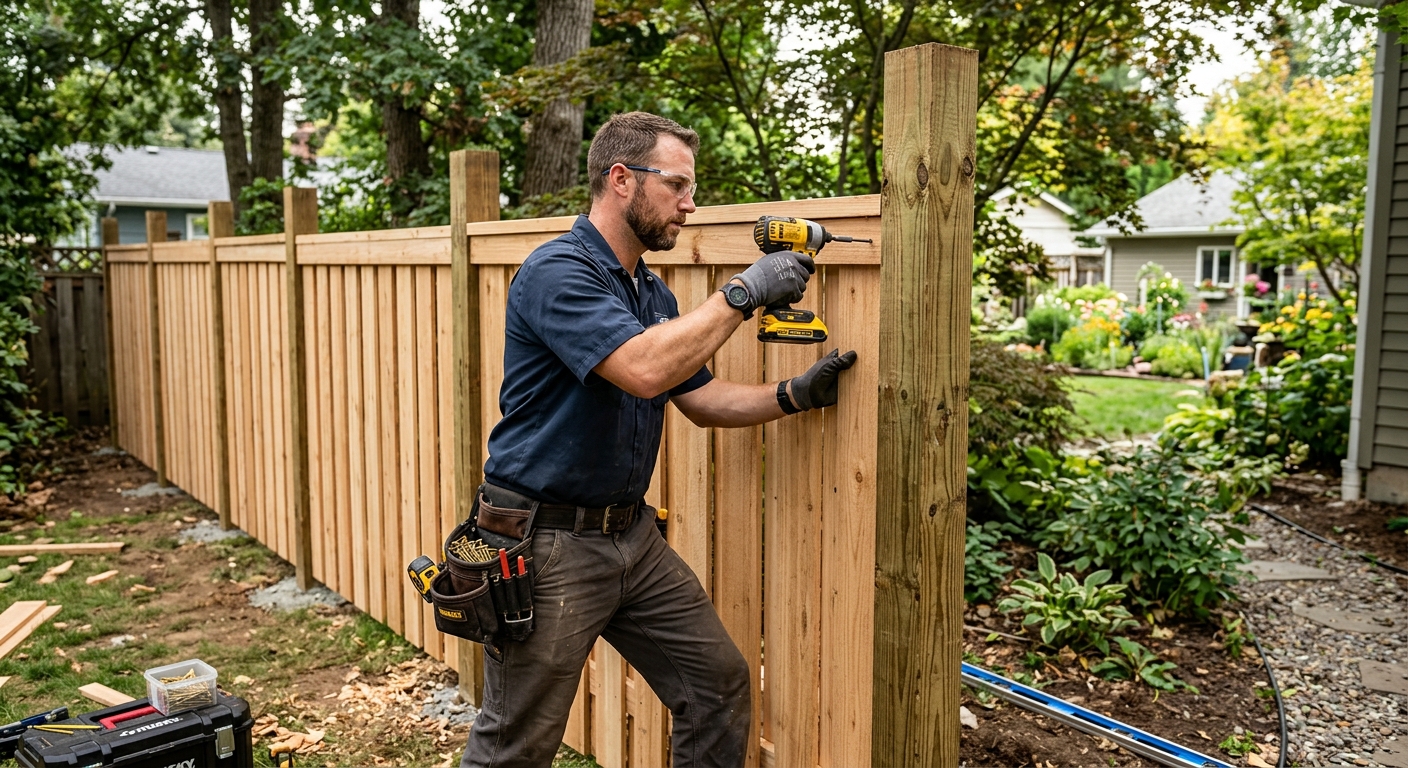
Fencing options and costs in Penetanguishene
Penetanguishene is a place where homeowners tend to value curb appeal and year-round practicality, so fencing choices are rarely “one-size-fits-all.” With 68.0% of local dwellings being single-detached homes (Statistics Canada, 2021 Census), each detached property is effectively a potential fencing project, especially when yards back onto open space or mature ravine-style lots. Demand also stays steady because homeowners represent 75.8% of households (Statistics Canada, 2021 Census), and replacement cycles are common on older wood fences—over half of homes were built before 1981, which often means original fences have reached their maintenance limit.
In the Kitchener–Waterloo–Barrie region, pricing is shaped by Ontario’s freeze–thaw swings and typical frost depth. Contractors generally set posts on a concrete basis for 6 ft privacy runs, because posts need to resist heaving and seasonal shifting. That translates to deeper augers and more labour per corner and gate location. You’ll also see market availability differences: larger suppliers support vinyl and chain-link quickly, while pressure-treated and cedar privacy fences require scheduling around local crews who are set up for heavier post-setting work.
On the ground in Penetanguishene, projects around the waterfront and the newer subdivisions near Barrie Avenue are especially in demand where wind off open areas can stress panels. From there, the next step is comparing materials—see the table for typical lifespan expectations, maintenance effort, privacy performance, and the usual price band you can expect for installed fencing.
| Material |
Lifespan |
Maintenance |
Privacy Rating |
Price per Linear Foot |
| Pressure-treated pine (standard wood) |
10–15 years |
Stain/seal every 2–3 years |
High (privacy-style pickets) |
$45–$70 |
| Cedar (natural rot resistance) |
15–25 years |
Light staining every 2–4 years |
High (privacy-style) |
$55–$85 |
| Vinyl / PVC (no-maintenance) |
20–30 years |
Rinse only (wash as needed) |
High (solid privacy panels) |
$60–$90 |
| Chain-link (galvanized steel) |
25–40 years |
Occasional touch-up after impact |
Low–Medium (security, not privacy) |
$35–$60 |
| Aluminum ornamental |
20–35 years |
Rinse, occasional repaint if desired |
Medium (open pickets) |
$75–$110 |
| Composite / recycled material |
20–30 years |
Wash; no staining like wood |
High (solid composite privacy) |
$70–$95 |
Prices are estimates only and vary by project scope, site access and material selection.
What affects the price of fencing in Penetanguishene
Even when neighbours agree on the “same fence,” bids in and around Kitchener–Waterloo–Barrie can differ by 30–50% because the labour inputs change quickly with site conditions. A fence line that looks straightforward on a map may require extra posts for corners, deeper augers for frost, and careful panel alignment on uneven ground—those details drive cost more than the brand name alone. Material pricing also shifts with seasonal demand, and premium options like vinyl or aluminum tend to have higher upfront costs but less recurring maintenance.
The biggest Ontario driver is frost depth and freeze–thaw. To prevent heaving, posts are typically set about 4–6 inches below the design frost depth, and in cold Ontario regions that often means posts reaching roughly 1.5–2.0 m into the ground. The practical result: deeper holes, longer posts, and more concrete per run—so even a “budget” wood privacy fence can climb toward the upper end of local wood pricing (for example, $45–$70 per linear foot band depending on depth and installation details).
Wind exposure matters too. While Penetanguishene isn’t as wind-torqued as the Prairies, crews still design for gusts by using tighter post spacing (often 6–8 ft centres on privacy fences) and sturdier rails so tall boards don’t rack or “blow-out.” At the same time, colder winters can make concrete-set posts the default rather than the exception—especially for 6 ft privacy installs.
Concrete examples you’ll see locally: (1) a longer backyard run that crosses wet or frost-susceptible soil typically increases concrete volumes and hole diameter; (2) a fence near a slope or drainage swale may require stepped heights and extra posts, raising labour; (3) removing an older fence with embedded posts can add disposal and cutting time, pushing the job toward the mid-to-upper bands seen in vinyl and metal projects (often $55–$90 for vinyl/pvc and $60–$110 for aluminum in this tier). Housing age also plays a role: older lots frequently have irregular property edges and existing infrastructure that slows installation.
| Price Factor |
Why It Matters |
Cost Impact |
| Fence length in linear feet |
More fencing means more posts, rails, hardware and labour time. |
Highest driver; scales directly with total project cost. |
| Post depth required |
Frost line depth determines hole depth and effective post length. |
Deeper posts and more concrete push costs up noticeably. |
| Post setting method |
Concrete-set posts resist heaving better than gravel-only or dry-set in freeze–thaw zones. |
Concrete increases material cost and labour per post. |
| Material choice |
Vinyl, cedar, and chain-link have different rail systems, weight and installation complexity. |
Switching materials can shift the job into a different price band. |
| Gate count and type |
Gates require stronger framing, hinges, latches and often wider post spacing. |
Each gate can materially increase cost beyond straight runs. |
| Grade and terrain |
Sloped yards need stepped or raked sections to keep top lines straight. |
Extra labour and additional materials for alignment and post planning. |
| Old fence removal and disposal |
Embedded posts, concrete footers and haul-away time add work. |
Can add several hours and disposal fees to the quote. |
| Permit fees and survey / property line locate |
Some projects need permits and/or professional locate/survey to avoid encroachment. |
Adds administrative and site verification costs where required. |
Permits & regulations in Ontario
In Ontario, the permit trigger is typically tied to fence height. As a practical rule for many residential situations, fences above about 2.0 m (6.5 ft) at the rear and above about 1.0–1.2 m (3–4 ft) at the front or corner often require a building permit, depending on the exact location and municipal bylaw specifics. Regardless of permit requirements, all fences must respect property lines and applicable municipal setback rules.
Before any post holes are dug in Penetanguishene, you should call for utility locates using Ontario One Call. Hitting hydro, gas, or telecom lines is the kind of risk that stops projects and can become costly—so proper locating is non-negotiable. It’s also wise to obtain a survey or at least verify your property pins/locates before installation, because fencing disputes usually start at the “who owns the line?” stage. Shared fence ownership rules are handled under Ontario’s line fences framework, but your site plan and who maintains what should still be clear in writing.
What usually requires a permit: taller fences, especially when they exceed the common rear/front height thresholds and when municipal rules apply. What typically does not require a permit: lower-height, standard residential fences within typical height limits—though some municipalities still require approval depending on location.
To verify your contractor in Ontario: (1) check the contractor’s licence/registration in the relevant online registry they use for their trade; (2) request a certificate of insurance naming you as an additional insured; and (3) confirm WSIB coverage (or the equivalent clearance documentation they can provide). Ask for document copies before work starts and keep them with your contract.
Choosing the right fence material for Penetanguishene
Choosing a fencing material in Penetanguishene is mostly about matching your lifestyle to the local climate. Winters here support freeze–thaw, and the post-and-concrete approach used in the Kitchener–Waterloo–Barrie region is why privacy fences tend to cost more than people expect—no matter the brand. Pressure-treated pine is usually the best budget choice, but it typically needs staining or sealing every 2–3 years to slow greying and reduce surface breakdown. Cedar is naturally more rot-resistant and often looks better longer, yet it still benefits from periodic maintenance to keep it looking “fresh” and to limit surface checking.
Vinyl/PVC brings true low maintenance: no staining, and most homeowners only rinse seasonally. That said, in extreme cold, vinyl can become brittle at fence corners if the structure isn’t built properly; reputable installers pay close attention to post spacing, rail alignment, and how panels are fastened. Chain-link is the most economical and longest-lasting security solution, but it won’t give you real privacy unless you add privacy slats, trellises or climbing plants (which you should plan for seasonally). Aluminum ornamental offers a clean, no-rust look and works well for boundary definition, but it provides only medium privacy because it’s open style.
For cold tolerance, post depth matters as much as material. In this part of Ontario, deeper set posts—often around 1.5–2.0 m into the ground depending on design frost considerations—are typically the standard for preventing heaving. That usually means concrete-set posts for most wood, vinyl and aluminum privacy installations. Wind and snow load considerations also influence rail selection and panel strength, especially on 6 ft systems.
A realistic dollar example: if you’re comparing pressure-treated privacy at about $45–$70 per linear foot versus vinyl privacy at $55–$90, the vinyl price premium can be justified when you want to eliminate recurring staining and you plan to stay in the home for decades—otherwise the wood fence often wins on initial budget and you can schedule maintenance while it’s still easy to refresh.
| Material |
Cold Tolerance |
Lifespan |
Annual Maintenance |
Best For |
Price Band |
| Pressure-treated pine |
Good (with proper concrete-set posts and end-seal practices) |
10–15 years |
Stain/seal every 2–3 years |
Budget privacy with manageable maintenance |
$45–$70 |
| Cedar |
Good (naturally rot-resistant) |
15–25 years |
Light stain every 2–4 years |
Higher curb appeal privacy |
$55–$85 |
| Vinyl / PVC |
Very good (depends on correct fastening and structure) |
20–30 years |
Wash/rinse as needed |
Low maintenance and long-term appearances |
$60–$90 |
| Chain-link |
Very good |
25–40 years |
Occasional check/touch-up |
Security on a lower budget |
$35–$60 |
| Aluminum ornamental |
Excellent (no rust) |
20–35 years |
Rinse; repaint only if desired |
Clean look with boundary definition |
$75–$110 |
| Composite / recycled |
Good (installed correctly) |
20–30 years |
Wash/rinse as needed |
Privacy with reduced maintenance |
$70–$95 |
How to choose a fencing contractor in Penetanguishene
When you hire a fencing contractor in Penetanguishene, start with proof—not promises. In Ontario, you should verify the contractor’s licensing/registration for their trade category (where applicable), then request liability insurance documentation showing coverage and the ability to work on residential sites. Next, confirm WSIB coverage or provide a clearance letter where they can show good standing. Don’t just accept a photo sent after the fact—ask to review the certificate of insurance and keep a copy for your records.
Then get 2–3 itemised written quotes. A good fence quote breaks labour and materials out separately (posts, rails, panels, concrete, gate hardware, and disposal), instead of one lump sum. Read the scope carefully: ask whether permit pulls are included (when required), whether old fence removal and hauling are part of the price, and what happens if post holes hit rock or underground obstructions after utility locates. Also confirm the warranty: workmanship warranty length and what it covers (for example, panel alignment, leaning caused by improper set depth, or rail fastening), plus the manufacturer warranty on materials. If a warranty is tied to the original purchaser, ask if it is transferable.
For payments, avoid large deposits. A common safe practice is keeping upfront to about 10–15% and using a holdback until the fence is complete and cleaned up. Finally, get a start date and completion estimate in writing so weather days and material lead times are clearly understood.
- Ask for their WSIB clearance letter and confirm it covers the work scope.
- Request certificate of insurance for liability, and ensure you’re named where appropriate.
- Verify their Ontario registration/licence details using the contractor’s stated trade category.
- Insist on itemised quotes with labour and material line items, not just “installed price.”
- Confirm post depth approach for freeze–thaw conditions and whether concrete is included.
- Check how they handle gates: hinges, latch type, and gate frame reinforcement.
- Ask whether the quote includes utility locate coordination (Ontario One Call).
- Clarify if permit pull is included when fence height thresholds require it.
- Confirm property line approach: locate/survey responsibility and how encroachment risk is managed.
- Ask how they deal with sloped grades: stepped vs raked sections, and panel alignment method.
- Confirm removal/disposal is included if replacing an old fence.
- Review warranty details in writing: workmanship duration, exclusions, and transferability.
In Penetanguishene, red flags include quoting without discussing frost-depth post setting, offering only a single lump-sum number, refusing to provide insurance/WSIB documents, starting work without verifying utilities, and giving a vague warranty (“lifetime,” with no workmanship terms or exclusions in writing).
Frequently asked questions — fencing in Penetanguishene
How long does fence installation take in Penetanguishene?
Most residential installs in Penetanguishene are completed in about 1–3 days once materials arrive and access is ready, but timelines depend on fence length, gate count, and whether post holes require extra labour for frost-depth concrete setting. If you’re replacing an older fence, removal and disposal can add time because embedded posts often need careful extraction. Weather can also affect concrete and auger work during heavy rain or freeze events. For reference on scope, a typical privacy run sized for a backyard (including posts, rails, panels, and a gate) often fits into the short end of that window when site conditions are straightforward. Plan longer schedules for sloped yards or multiple corners.
Can I install a fence on a slope in Penetanguishene?
Yes—slope is common around Penetanguishene properties, but the key is how the fence is built so it doesn’t look “wavy” or get structurally weak. Contractors typically use either stepped panels (stair-stepping the height at each section) or raked panels that follow the grade. Stepped designs usually cost a bit more because they require more precise post layout, especially for privacy fences. The deeper post setting used for cold Ontario freeze–thaw still applies, so you’ll want a contractor who plans post lengths and concrete volumes around the grade. In practice, the final cost is often still within the local privacy bands—wood often sits around $45–$70 per linear foot depending on complexity.
What is the most weather-resistant fence for Penetanguishene's climate?
For Penetanguishene’s freeze–thaw winters, the most weather-resistant results usually come from a properly installed fence with correctly set posts (typically concrete-set for most residential privacy installations). Material-wise, cedar and vinyl/ PVC are strong contenders: cedar resists rot and looks great, while vinyl is low maintenance and performs well when fastened and supported correctly in cold weather. Chain-link is extremely durable for security, but it won’t provide privacy. Aluminum is also very resilient and won’t rust. The biggest factor isn’t just the material—it’s the post depth and spacing strategy your contractor uses to resist heaving and racking during Ontario’s temperature swings. This is why reputable installers price the job based on site conditions rather than only fence “height.”
How do I prevent wood fence rot in Penetanguishene?
Preventing wood rot starts at the post holes and continues through the finish. In Penetanguishene, you want posts set to resist moisture and freeze–thaw movement—concrete set posts help reduce shifting that can trap water and loosen rails. For the wood itself, choose rot-resistant practices: use pressure-treated lumber rated for ground contact and ensure cut ends are sealed. Staining/sealing every 2–3 years is also important to limit grey weathering and surface breakdown in our Ontario seasons. Keeping bottom rails and pickets off standing water helps too (grading and drainage matter). If you’re comparing budgets, remember wood’s initial price advantage often pays for itself only if you commit to that maintenance cycle over time.
What is the cost per linear foot for fencing in Penetanguishene?
For Penetanguishene, many local residential fence projects land within these typical installed price bands: pressure-treated wood is commonly about $45–$70 per linear foot, vinyl/ PVC about $55–$90, chain-link about $35–$60, and aluminum ornamental about $60–$110. Your exact number depends on total length, post depth for frost conditions, concrete setting, and how many gates and corners you have. Terrain and fence removal can also shift the cost upward. The best way to confirm your budget is to request an itemised quote that shows post count, setting method, and disposal—so you can compare apples to apples instead of relying on a single lump sum.
Should I repair or replace my old fence in Penetanguishene?
You should repair when the fence posts are sound and the damage is mainly cosmetic—like loose pickets, minor rail rot near the surface, or hardware failures. Replace when posts are leaning, rot has travelled through rails, there’s widespread fastener corrosion, or previous repairs were repeatedly patched without addressing post stability. In Penetanguishene’s climate, a fence that has shifted over freeze–thaw cycles often continues to fail because movement reopens gaps where moisture collects. A quick contractor assessment should include checking post integrity (not just the visible boards), reviewing how the existing posts were set, and estimating realistic repair labour vs replacement. If the old fence is nearing the end of its usable life, replacing can be more cost-effective than repeated touch-ups—especially if you’re already budgeting for disposal and concrete-set post work.