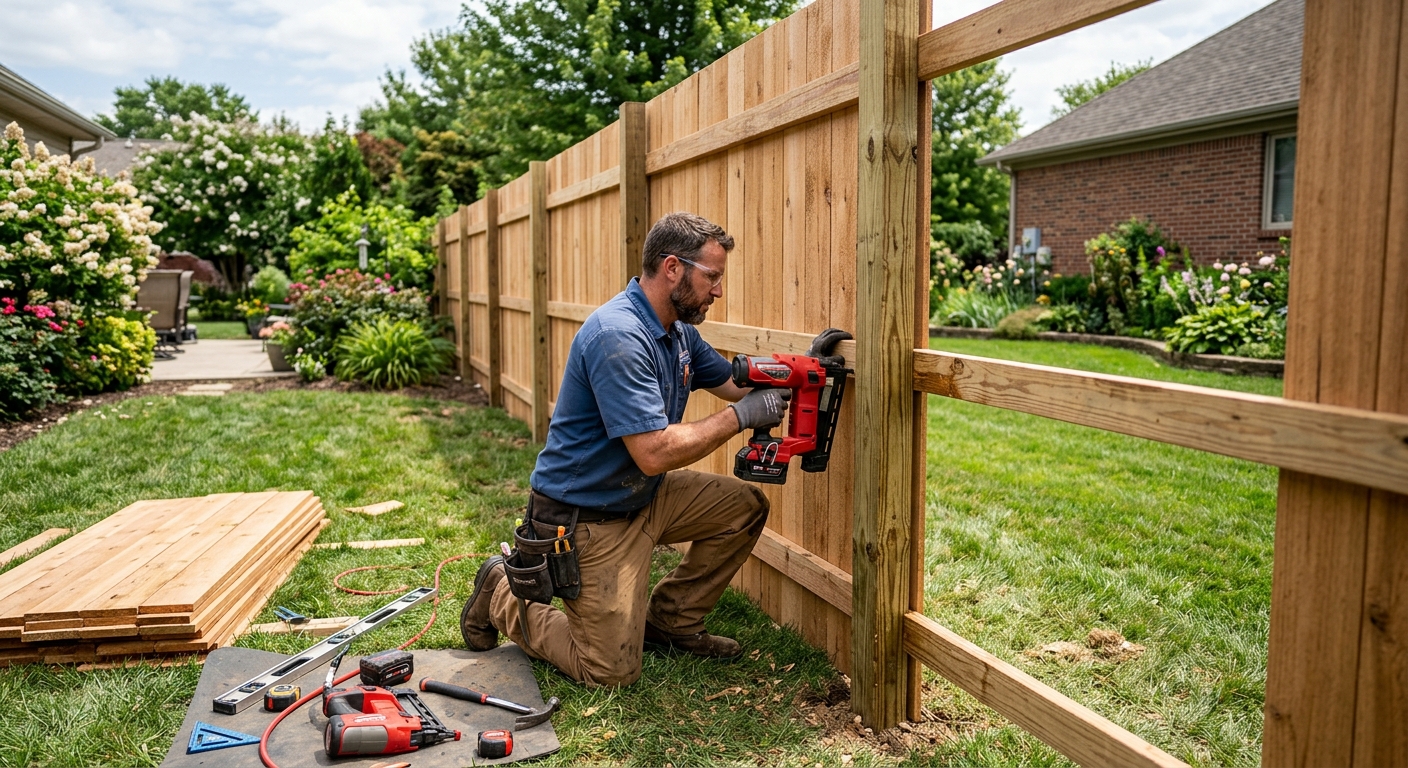
Fencing options and costs in Barrie
Fencing in Barrie comes down to material choice, privacy needs, and how winter affects your posts. With 58.2% of Barrie’s dwellings being single-detached homes (Statistics Canada, 2021 Census), there’s steady local demand for backyard privacy, dog runs, and driveway boundary fencing. Homeownership is also strong—37,435 homeowner households, representing 67.7% of households (Statistics Canada, 2021 Census)—so many projects are renovations and replacement fences, not just new builds. In Barrie’s market, contractors tend to be busiest in the spring and early fall because frost is less of an installation constraint, and post-hole excavation is cleaner.
Across the Kitchener–Waterloo–Barrie region, pricing is heavily shaped by freeze–thaw cycles and the local frost line. For most wood, vinyl, and aluminum fences, posts are commonly concrete-set to reduce heaving and shifting over time; this is especially important for 6 ft privacy layouts. Wind loads are usually less punishing than open Prairie settings, but yards near newer subdivisions and limited-tree blocks can see stronger gusts, which drives tighter post spacing and sturdier rails to limit racking. You’ll also notice crews in areas like East Bayfield and Ardagh working through a lot of replacement work on older boundary fences—Barrie has a meaningful share of homes built before 1981, which often means the existing fence posts are near the end of their service life.
Below is a practical comparison of common fence options you’ll see in Barrie, along with typical lifespan, maintenance level, and per-linear-foot budgeting—then you can use the next sections to understand why quotes can still differ by hundreds or even thousands.
| Material |
Lifespan |
Maintenance |
Privacy Rating |
Price per Linear Foot |
| Pressure-treated pine (standard wood) |
10–15 years |
Stain/paint every 2–3 years |
High |
$45–$70 |
| Cedar (natural rot resistance) |
15–25 years |
Seal/stain every 2–4 years |
High |
$60–$85 |
| Vinyl / PVC (no-maintenance) |
20–30 years |
Rinse annually; occasional spot cleaning |
High |
$55–$90 |
| Chain-link (galvanized steel) |
20–35 years |
Minimal; rinse and inspect tension |
Low to medium |
$35–$60 |
| Aluminum ornamental |
25–40 years |
Wash as needed |
Low to medium |
$60–$110 |
| Composite / recycled material |
20–30 years |
Little to none; rinse and remove debris |
High (solid panels) |
$75–$130 |
Prices are estimates only and vary by project scope, site access and material selection.
What affects the price of fencing in Barrie
Two homeowners in the Kitchener–Waterloo–Barrie region can receive quotes that vary by 30–50% for what looks like the “same fence” because the details that drive labour and installation depth are rarely identical. The biggest swing factor is how your site must be built for freeze–thaw. In Barrie-area conditions, the frost line typically means posts need to be set about 4–6 inches below the design frost depth; in practical terms, that often results in augering holes that take deeper excavation and more concrete per post. Cold Ontario regions commonly push post depth into the 1.5–2.0 m range, so you end up with longer posts and more backfill material—both increase supply and labour. That’s why concrete-set posts are standard for most 6 ft privacy fences, even when a fence might be “lightweight” on paper.
Wind also matters. While Barrie is not as exposed as open prairie settings, gusts can still rack tall panels, especially in subdivisions with fewer mature trees. Contractors then tighten spacing (often 6–8 ft centres for privacy fences) and choose sturdier rails or posts to prevent blow-outs. Coastal BC’s milder but wetter climate changes the equation for wood (rot and staining schedules), but here the freeze–thaw cycle mainly drives foundation design and long-term alignment.
Concrete examples from local jobs: (1) A 30 m run that requires 5 extra posts for tighter spacing is often measurably more than the “basic” quote—more materials, more hole digging, and more alignment time. (2) If you need removal of an old fence with buried posts, disposal and fill can push the total higher than a replacement on clean ground. (3) A cedar privacy install can land in a higher band than pressure-treated pine; the “right” choice is usually the one that minimizes re-staining costs over time—pressure-treated pine might sit around the $45–$70 band, while cedar often trends higher because of material price and desired finish.
To connect this to real housing stock: older properties (Barrie has a meaningful share of homes built before 1981 per Statistics Canada, 2021 Census) frequently have posts that have already shifted, so your contractor may plan for more re-alignment labour and deeper re-set work on replacement sections—one reason the final invoice can exceed a first estimate.
| Price Factor |
Why It Matters |
Cost Impact |
| Fence length in linear feet |
More run length means more posts, rails, fasteners, and labour time. |
Largest driver; scales directly with total cost. |
| Post depth required |
Frost line requirements determine hole depth and post length. |
Deeper posts raise material and excavation costs. |
| Post setting method |
Concrete-set is common for stability through freeze–thaw; gravel-dry can fail sooner. |
Concrete typically increases cost but reduces future leaning. |
| Material choice |
Vinyl, cedar, and chain-link have different material prices and rail/post requirements. |
Can swing the budget by the material’s price band. |
| Gate count and type |
Gates require heavier framing, hinges, latch hardware and often extra support posts. |
Multiple gates add cost quickly; drive-through doubles add more. |
| Grade and terrain |
Sloped yards require step-offs, raked rails, or custom panel adjustments. |
Custom fitting increases labour and sometimes material waste. |
| Old fence removal and disposal |
Pulling old posts and hauling debris takes time and dump fees. |
Usually adds a meaningful one-time charge. |
| Permit fees and survey / property line locate |
Locates and permits affect schedule and may require documentation. |
Small to moderate add-ons depending on situation. |
Permits & regulations in Ontario
In Ontario, fences above a height threshold—often 2.0 m (6.5 ft) at the rear and 1.0–1.2 m (3–4 ft) at the front or corner—commonly trigger permit requirements. Even when a permit is not required, the fence must respect your property lines and municipal setback bylaws, so placement matters as much as height. Before you dig any post hole, arrange utility locates by calling Ontario One Call so marked lines aren’t damaged during excavation.
Step one for Barrie homeowners is confirming the line. If you have a survey, use those pins as your reference. If you don’t, request a property line locate or get a survey to avoid encroachment disputes. Shared fence ownership rules are governed by Ontario’s line-fences legislation; if you’re fencing a shared boundary, confirm who owns which half of the fence, how costs are split, and what each side’s maintenance responsibilities are.
To verify contractor credentials in Ontario, ask for documentation before the quote is finalized: (1) Ontario business/contractor registration details (as applicable for the trade), (2) a certificate of liability insurance naming you as the certificate holder, showing adequate coverage, and (3) evidence of WSIB coverage (or applicable clearance/registration proof, depending on the contractor’s status). You should also request proof that they can pull permits if required, and confirm that the fence will be built to the approved height and location.
Choosing the right fence material for Barrie
Choosing a fence material in Barrie is about matching your priorities—privacy, low maintenance, budget and lifespan—to the reality of local winters. Pressure-treated pine is the most budget-friendly starting point, but it usually needs staining or painting every 2–3 years to reduce grey weathering and surface wear. Cedar naturally resists rot and often holds a nicer look, yet it still benefits from sealing or staining on a similar cycle. Vinyl/PVC is popular because it’s low maintenance—no painting—but extreme cold can make some panels more brittle if they’re not installed with the right clearances and hardware setup. Chain-link is the lowest-cost option and can last decades, but it doesn’t provide privacy unless you add slats or privacy screen mesh. Aluminum ornamental offers a clean, rust-resistant look and low maintenance, though it’s typically more decorative than private.
For post foundations, the Kitchener–Waterloo–Barrie frost-driven approach usually means concrete-set posts are recommended for stability, especially for tall privacy fences. Where deeper setting is required to avoid heaving, longer posts and more concrete per post increase total materials and labour—so a “cheaper” fence can become closer in cost when the install depth is the same. Wind and snow load also influence hardware choices: tall panels and wide spans can rack, so a solid-privacy fence often needs stronger rails and post spacing to keep everything straight through winter.
As a practical example, if you’re comparing pressure-treated pine around the $45–$70 per-linear-foot band to vinyl around the $55–$90 band, the decision often hinges on maintenance time. If you’re not keen on ongoing staining, vinyl’s higher upfront cost can be justified—especially for a long backyard run where maintenance trips become frequent.
| Material |
Cold Tolerance |
Lifespan |
Annual Maintenance |
Best For |
Price Band |
| Pressure-treated pine |
Good when properly set and sealed |
10–15 years |
Seasonal inspection; stain/paint every 2–3 years |
Budget privacy |
$45–$70 |
| Cedar |
Good; performs well with proper finishing |
15–25 years |
Seal/stain every 2–4 years |
Premium look with privacy |
$60–$85 |
| Vinyl / PVC |
Good with correct installation and hardware |
20–30 years |
Light wash/inspection; usually minimal |
Low-maintenance privacy |
$55–$90 |
| Chain-link |
Very good |
20–35 years |
Minimal; periodic tension and rinse |
Security and pet containment |
$35–$60 |
| Aluminum ornamental |
Excellent |
25–40 years |
Occasional wash |
Front yard curb appeal |
$60–$110 |
| Composite / recycled |
Good; depends on product quality and fastening |
20–30 years |
Little to none; rinse and debris removal |
Long-lasting privacy look |
$75–$130 |
How to choose a fencing contractor in Barrie
In Barrie, a good fence install is equal parts carpentry and foundation discipline—so contractor vetting matters. Start with Ontario licensing and proof of work coverage: ask for the contractor’s documentation and check it before work begins. For liability, request a current certificate of insurance and ensure your name/address can be shown as the certificate holder. For worker protection, confirm WSIB coverage (or applicable clearance/registration proof if they’re structured differently). If the contractor won’t provide these documents up front, treat it as a major warning sign.
Next, get 2–3 written, itemised quotes—not a single lump-sum that hides the differences. You want line items for labour, materials, post excavation depth strategy, concrete quantities (when concrete-set posts are included), hardware quality, gate framing, and removal/disposal. Review exclusions: will they pull permits if required, and is a property line locate included or billed separately? Also confirm the warranty: you should receive both a workmanship warranty length and the manufacturer product warranty details, and ask whether warranties are transferable if you sell your home.
Payment schedules should protect you. A common safe approach is paying no more than 10–15% upfront; keep a holdback until completion and final grade/clean-up are confirmed. Get a start date and completion estimate in writing, and ask what happens if weather delays foundation work—especially when freeze–thaw impacts post-hole scheduling.
- Verify insurance: request a certificate of liability (and check it’s current).
- Confirm WSIB coverage (or clearance proof) before they start digging.
- Ask for Ontario registration details relevant to the business and trade scope.
- Get itemised quotes: labour vs. materials vs. hardware vs. concrete vs. disposal.
- Confirm post-depth plan in writing (depth and whether posts are concrete-set).
- Clarify post spacing and rail structure for a tall privacy fence.
- Check if permits/property line locate are included or billed separately.
- Confirm gate construction details (frame type, hinges, latch hardware, number of posts).
- Ask about how they handle sloped yards (stepped vs. raked panels).
- Review warranty terms for workmanship and product—ask for lengths in years.
- Set a payment schedule with a small deposit and retainage until final walk-through.
- Require a written start date, completion estimate, and weather-delay policy.
Red flags I commonly see around Barrie: (1) no insurance certificate or WSIB proof provided when requested, (2) quotes that don’t specify post depth and setting method, (3) “lowest price” bids that lump concrete and disposal into vague totals, (4) no clear warranty terms in writing, and (5) asking for a large upfront payment (well over 10–15%) before work begins.
Frequently asked questions — fencing in Barrie
How do I find my property line before fencing?
If you’re in Barrie and want to avoid boundary disputes, don’t rely on guesswork or old fence positions. First, pull your most recent property documents: a survey (if you have it), or check where your property pins were originally located. If you don’t have a survey, ask for a property line locate/survey update before any post holes are dug—especially since older backyard fences can be slightly off and freeze–thaw can worsen shifting over time. Also call for utility locates through Ontario One Call before excavation. When you get a fence quote, request that the contractor confirms how they’ll verify line placement and whether a locate is included or a separate charge. (Statistics Canada, 2021 Census) shows many homes are single-detached, so shared-boundary decisions and clear placement are common in Barrie neighbourhoods.
What's the most low-maintenance fence?
For low-maintenance in Ontario, vinyl/PVC is usually the easiest day-to-day option: it typically doesn’t need staining and can be rinsed seasonally. Aluminum ornamental is also low maintenance and won’t rust, though it’s usually less private than solid-panel fences. In Barrie, where winter freeze–thaw is a big factor, the real “maintenance win” is often less about the surface and more about correct post setting—concrete-set posts and proper spacing reduce leaning that can force early repairs. Budget-wise, vinyl often fits the $55–$90 per-linear-foot band, while pressure-treated pine may land in the $45–$70 band but requires re-staining every 2–3 years. If you want fewer weekend tasks and long-term alignment, vinyl or aluminum usually makes the most sense.
How tall can my fence be in Barrie?
Fence height rules in Ontario usually depend on where the fence sits (rear yard vs. front yard/corner lot) and can trigger permit requirements above certain thresholds. A common guideline contractors use is that rear fences around 2.0 m (6.5 ft) often require a permit, while front or corner heights may be lower—commonly around 1.0–1.2 m (3–4 ft). Barrie bylaws can also require setbacks and may restrict how tall solid fencing can be in certain locations. Because the exact thresholds can vary with lot layout, always confirm with the municipal requirements before installation. When you request quotes, ask whether the contractor handles permits and whether the height they’re quoting matches the approved plan. If you’re planning a 6 ft privacy fence, this is the question to settle before posts are set.
Should fence posts be set in concrete here?
In Barrie, concrete-set posts are generally recommended for stability because freeze–thaw and the frost line require deeper installation to prevent heaving. Practically, that means posts are often set about 4–6 inches below design frost depth, which commonly results in deeper holes (often in the 1.5–2.0 m range in cold Ontario conditions). When posts aren’t set with concrete in these conditions, they can shift or lean sooner—especially for 6 ft privacy fences with tighter post spacing and heavier panel loads. Some contractors offer gravel pack or dry-set methods, but for tall privacy installs, you should expect a stronger recommendation for concrete-set posts. If your quote is “wood privacy fence” but doesn’t specify post depth and setting method, ask directly—this is where costs can change and long-term performance is determined.
What's the best fence for privacy?
For privacy in Barrie, the best choice is typically a solid-panel fence: pressure-treated pine, cedar, or vinyl/PVC privacy styles. These materials provide high privacy when the design is built with adequate overlap/spacing and proper support rails. Cedar and vinyl often score well because they resist decay and keep a consistent appearance through wet winters and snow cover, while pine can deliver great privacy for less upfront cash but needs more upkeep (staining or painting every 2–3 years). Price-wise, pressure-treated privacy commonly aligns with the $45–$70 band, while vinyl often runs about $55–$90 per linear foot. Privacy performance also depends on installation: tighter post spacing and correct post depth reduce racking during gusty conditions and help the fence stay straight after freeze–thaw cycles.
How do I compare fencing quotes?
To compare quotes in Barrie fairly, start by requesting itemised breakdowns so you can match “apples to apples.” Look for (1) material grade and style (e.g., pressure-treated vs cedar vs vinyl model), (2) post depth and setting method (concrete-set details), (3) post spacing and rail structure, (4) gate size and hardware, and (5) whether removal/disposal is included. Also confirm whether permits/property line locates are included—permit needs can be triggered by height thresholds, and boundary accuracy matters for permit compliance and avoiding encroachment. Check for warranty terms: workmanship duration and manufacturer warranty coverage. Finally, compare payment schedules; a safe approach is usually no more than 10–15% upfront. If one quote is far below the $45–$70 pressure-treated band or the $55–$90 vinyl band, ask what has been reduced—often it’s post depth, concrete, rails, or warranty coverage.