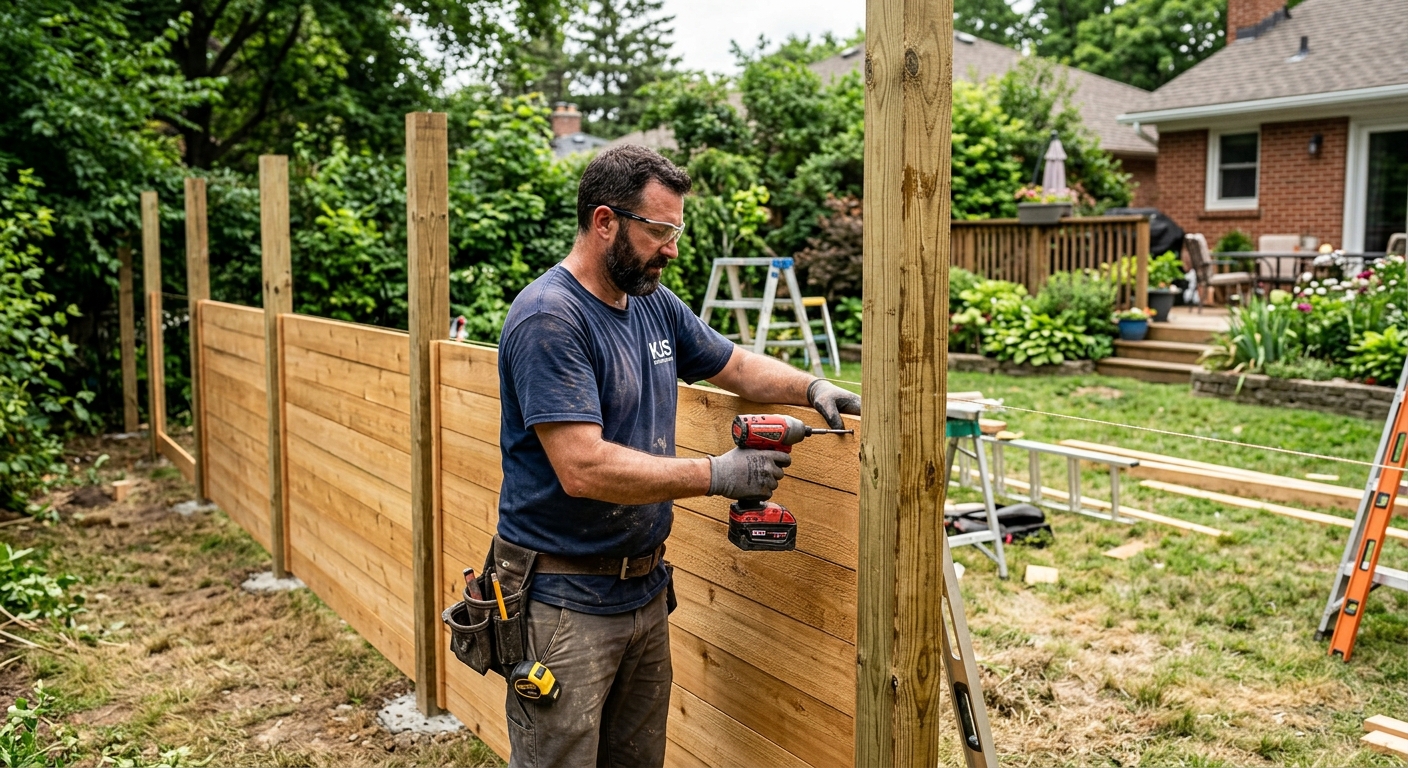
Fencing options and costs in Simcoe
Fencing options in Simcoe range from budget-friendly chain-link to long-lasting cedar and low-maintenance vinyl. With a population of 13,922 (Statistics Canada, 2021 Census), Simcoe still has plenty of detached homes and growing family lots—each property is a potential fencing customer, so contractor availability and material choices can impact timing and pricing. In the Hamilton–Niagara Peninsula economic region, local demand is steady across neighbourhoods such as the north end and around Queen Street West where backyards commonly need privacy or pet containment.
Cost is shaped most by ground conditions and winter. Here, frost penetration is a major driver, so most professional installs require deeper post holes and concrete-set posts for long-term stability. For a typical 6 ft residential fence, contractors commonly set posts deeper than people expect—often in the 36–42 inch depth range—because repeated freeze–thaw cycles can push poorly set posts out of alignment. That means additional drilling time, more concrete and larger post stock than “easy installs” get in milder areas.
Below are common material choices and how they tend to price out in Simcoe, with lifespan and maintenance expectations aligned to Ontario’s freeze–thaw weather and wind/snow loads. Use this table as a baseline, then we’ll narrow it down to your gate count, yard slope, and whether old fencing removal and disposal are included.
| Material |
Lifespan |
Maintenance |
Privacy Rating |
Price per Linear Foot |
| Pressure-treated pine (standard wood) |
10–15 years |
Seal/stain every 2–3 years |
High (solid pickets) |
$45–$80 |
| Cedar (natural rot resistance) |
20–25 years |
Light stain/oil every 2–4 years |
High (solid boards) |
$55–$95 |
| Vinyl / PVC (no-maintenance) |
25–30 years |
Occasional wash only |
High (solid panels) |
$70–$120 |
| Chain-link (galvanized steel) |
20–30 years |
Rinse as needed |
Low–Medium (privacy slats optional) |
$35–$60 |
| Aluminum ornamental |
25–40 years |
Wash/rinse seasonally |
Low–Medium |
$80–$150 |
| Composite / recycled material |
25–35 years |
Minimal cleaning; check fasteners |
Medium–High (board style) |
$90–$140 |
Prices are estimates only and vary by project scope, site access and material selection.
What affects the price of fencing in Simcoe
In Simcoe and across the Hamilton–Niagara Peninsula, two “similar” fence jobs can come in 30–50% apart because the cost is driven by how the site is built, not just the fence style. A linear-foot price might look close on paper, but deeper post requirements, concrete setting, extra labour for gates, and old fence removal can quickly change the total. Ontario’s winter is the biggest consistent factor: frost penetration in southern Ontario is about 1.2 m (4 ft), so posts are typically set 4–6 inches below the design frost depth to reduce heaving and long-term leaning.
For most cold-climate installs, that pushes typical post setting toward about 1.5–2.0 m into the ground. Concrete-set posts are now the norm for long-term stability, which raises labour and concrete mix costs versus tamped-backfill “quick installs.” Materials pricing also shifts: for example, a chain-link job often aligns with the $35–$60 per linear foot band, while vinyl/PVC commonly lands in the $70–$120 per linear foot range because of higher material cost and framing/fastener details.
Local conditions that raise cost in Simcoe include clay-rich soil that needs more drilling time, steep grades that require stepped or raked panel layouts, and utility-locate delays when digging gets tied up with locates or inspection scheduling. Cost can be lower when you have good access for a skid-steer/trailer, straight runs with minimal corners, and no old fence removal. If your yard is relatively level and the run is simple, you often keep labour efficiency high—even when concrete-set posts are required.
| Price Factor |
Why It Matters |
Cost Impact |
| Fence length in linear feet |
The primary driver; more posts and rails scale labour and material |
High (direct proportional increase) |
| Post depth required |
Frost line determines post length and hole depth |
Medium–High |
| Post setting method |
Concrete vs. gravel pack vs. driven posts affects time, materials and longevity |
Medium–High |
| Material choice |
Vinyl vs. cedar vs. chain-link differs in material cost and installation complexity |
High |
| Gate count and type |
Walk-through vs. double drive-through gates require heavier framing/hardware |
Medium |
| Grade and terrain |
Sloped yards require stepped/raked panels and extra layout time |
Medium |
| Old fence removal and disposal |
Demolition, loading, hauling and dump fees can add labour and equipment time |
Medium–High |
| Permit fees and survey / property line locate |
Paperwork, locates and measuring prevent encroachment and rework |
Low–Medium (can be High if delays occur) |
Permits & regulations in Ontario
In Ontario, fencing rules typically hinge on fence height, location, and municipal bylaw requirements. In many cases, fences above a height threshold—commonly around 2.0 m (6.5 ft) at the rear and about 1.0–1.2 m (3–4 ft) at the front or corner—may require a building permit. Even when a fence doesn’t trigger a permit, it still must respect property lines and municipal setback bylaws.
Before digging any post holes, you also need utility locates through Ontario One Call. This is critical because accidental hits can be dangerous and can stop the job until hazards are cleared. Next, confirm your property boundaries with a survey or property pin locate before installing; it’s a common source of disputes when older lots have ambiguous markers or when prior fencing was set “close enough.” Shared fence ownership is governed by Ontario line-fences rules, so if you’re planning along a boundary, confirm responsibilities for costs and repairs before ordering materials.
Typical work that does require a permit: installing fences over the local height thresholds (especially in front/corner areas), and any fencing that triggers additional site requirements based on your municipality’s bylaw. Work that typically does not require a permit: standard-height residential privacy fences within common limits, provided they meet setbacks, stay on your property, and don’t involve structural changes or special conditions.
To verify a contractor for Simcoe homeowners: check their Ontario business details online, request a certificate of insurance (general liability) showing the worksite coverage, confirm WSIB/WCB coverage for the trade (or the relevant proof they operate lawfully), and ask for a clearance letter or account verification evidence if applicable—then match the company name on the COI to the quote and invoice.
Choosing the right fence material for Simcoe
Choosing a fence material in Simcoe is mostly about matching your priorities—privacy, budget, and how much maintenance you’ll tolerate—to Ontario’s winter cycles. Pressure-treated pine is the common budget choice, but it tends to weather grey if you skip staining; most homeowners plan for staining or sealing every 2–3 years to keep it looking good. Cedar offers better natural rot resistance and usually looks more premium, but it still benefits from periodic staining/oiling to maintain colour and prevent surface checking.
Vinyl/PVC is popular because it’s essentially low maintenance—usually just wash-down—yet it can crack if installed improperly or if it’s not rated for cold conditions. In Simcoe’s freeze–thaw climate, post depth still matters: on the Hamilton–Niagara Peninsula, posts should be set below the frost line (often using 36–42 inch depth for typical residential fences, with deeper settings in clay where needed). That usually means concrete-set posts for stability, regardless of whether you choose wood, vinyl, or composite.
Chain-link is the lowest-cost path and can last a long time, but it offers minimal privacy unless you add privacy slats or plant screening. Aluminum ornamental fences resist rust and work well for curb-facing boundaries, but they’re not designed for full privacy. Wind and snow load also influence how you frame and space rails/panels; in hilltop and lakeshore-like conditions, we often use heavier posts and closer spacing to prevent panel wobble.
A practical example: if you’re deciding between pressure-treated pine (often aligning with the $45–$80 band) and vinyl (often $70–$120), the extra upfront cost for vinyl can be justified when you want to avoid repeat staining labour every few years—especially if you’re planning to stay in the home through multiple winters.
| Material |
Cold Tolerance |
Lifespan |
Annual Maintenance |
Best For |
Price Band |
| Pressure-treated pine |
Good (if properly treated and installed) |
10–15 years |
Low–Moderate (plan for staining/sealing every 2–3 years) |
Budget privacy with willingness to maintain |
$45–$80 |
| Cedar |
Good (rot-resistant, but still affected by weathering) |
20–25 years |
Low–Moderate (typically every 2–4 years) |
Natural look + longer-lasting wood privacy |
$55–$95 |
| Vinyl / PVC |
Good (proper installation is key in extreme cold) |
25–30 years |
Very low (wash occasionally) |
Low-maintenance privacy |
$70–$120 |
| Chain-link |
Excellent (steel frame holds up in freeze–thaw) |
20–30 years |
Very low |
Security on a budget; pet containment |
$35–$60 |
| Aluminum ornamental |
Excellent (won’t rust; handles seasonal cycling) |
25–40 years |
Low (rinse/spot clean) |
Curb appeal + boundary definition |
$80–$150 |
| Composite / recycled |
Good (designed for cold climates; best with correct spacing) |
25–35 years |
Low |
Privacy with minimal maintenance |
$90–$140 |
How to choose a fencing contractor in Simcoe
Start with compliance and protection—especially in Ontario winters where frost depth, concrete setting, and workmanship details matter. For licensing, verify the contractor’s business registration details and ensure they operate under the correct Ontario business information. Ask for a certificate of general liability insurance and confirm the coverage limits are appropriate for fencing work, and that it lists your property address or shows jobsite coverage. For workplace coverage, request proof of WSIB/WCB coverage (or the required clearance/statement of account they can provide). Don’t accept “we’re covered” without documentation you can review.
Next, get 2–3 itemised written quotes that separate labour and materials. A fair quote should show post quantity and depth assumptions, rail styles, gate hardware, whether concrete is included, and whether disposal and site clean-up are part of the scope. Carefully read what’s excluded: permit pulls, utility locate fees, survey/property pin locate, stump removal, and topsoil/landscape reinstatement are common gaps that change totals after the fact.
Warranty matters for both product and workmanship. Ask for the workmanship warranty length (how long they stand behind installation), and the manufacturer’s product warranty terms. If you sell your home, confirm whether warranties are transferable or whether they’re tied strictly to the original purchaser.
For payment schedule, never agree to more than 10–15% upfront. Use a holdback until substantial completion so you’re not left chasing fixes. Also insist on a start date and a realistic completion estimate in writing, including weather contingencies due to ground freezing and concrete curing.
- Requests for exact measurements and confirms fence line staking/layout before ordering
- Shows post depth plan consistent with frost considerations (not “shallow tamp-and-go”)
- Specifies post setting method (concrete-set details) rather than vague wording
- Provides itemised pricing for materials, labour, gates, and any removal/disposal
- Lists gate hardware brand/specs and whether hinges are commercial-grade
- Includes utility locate and who pays/when it happens
- States whether permit/locate/survey costs are included or your responsibility
- Documents warranty terms for workmanship and product
- Includes a cleanup plan and disposal fees handling
- Gives an installation timeline with weather/curing allowances
- Uses written contract with scope, change-order process, and payment milestones
- Provides insurance and WSIB/WCB proof before work begins
Red flags I see with some fencing contractors in Simcoe include: refusing to provide insurance/WSIB/WCB documentation, quoting with only a lump sum while omitting post depth and setting method, saying permits are “never needed” without checking your height/location, delaying utility locates until after digging, and demanding large upfront payments beyond 10–15%.
Frequently asked questions — fencing in Simcoe
Should fence posts be set in concrete here?
In Simcoe and across the Hamilton–Niagara Peninsula, concrete-set posts are the safer default for long-term alignment. Frost penetration in southern Ontario is about 1.2 m (4 ft), and repeated freeze–thaw cycles can lift poorly set posts, leading to leaning panels and misaligned gates. That’s why most reputable installs set posts below the effective frost zone (often using deeper settings than “minimum” assumptions) and use concrete to lock the post in place. In clay soils, drilling and achieving proper bearing can take longer, but it usually pays off through fewer repairs. If a contractor proposes shallow tamped backfill to “save money,” ask how they account for heaving risk and whether they’re matching a frost-aware post depth plan.
What's the best fence for privacy?
The best privacy fence in Ontario is typically a solid-panel design using pressure-treated pine, cedar, vinyl/PVC, or composite boards. Privacy rating comes from how much of the fence face blocks sightlines—solid pickets/boards are the most effective. In Simcoe’s climate, all of these should be installed with frost-conscious post depth and proper bracing so the panels don’t bow after winter. If you want maximum privacy with the least maintenance, vinyl/PVC is often a strong fit, and it commonly sits in the $70–$120 per linear foot band for typical residential installs. If you prefer a more natural look and better rot resistance than pine, cedar is durable, but you’ll still plan for periodic staining.
How do I compare fencing quotes?
Compare quotes by scope and assumptions, not just the final total. Ask each contractor for an itemised breakdown: fence length, number of posts, assumed post depth, post setting method (concrete vs gravel pack), rail configuration, and what type/grade of material is included. Also check gates: a double drive-through gate can change cost more than you’d expect due to heavier posts and hardware. Confirm whether old fence removal and disposal are included, plus whether utility locates and site restoration are covered. For a price reality check, many homeowners see chain-link priced around the $35–$60 band, while wood/vinyl privacy options often land higher (for example, vinyl commonly falls around $70–$120). If the quotes aren’t comparable, you’re comparing pricing for different scopes.
How long does fence installation take in Simcoe?
For many average residential backyards in Simcoe, installation is commonly a few days once materials arrive—often 2–5 working days for a straightforward run. The timeline can stretch when there are multiple gates, a lot of corners/steps, steep grading requiring raked panels, or when old fence removal/disposal is included. Concrete curing and drilling time also affect scheduling because frost-aware installs require proper hole excavation and concrete-set posts. Weather plays a role in late fall and winter: once ground is frozen, drilling and concrete work can slow down or require rescheduling. A good contractor will provide a start date and completion estimate in writing, including weather contingencies so you’re not left guessing.
Can I install a fence on a slope in Simcoe?
Yes, you can absolutely install a fence on a slope in Simcoe, and contractors routinely do it using either stepped panels or raked sections (depending on the style and how level you want it). The key is layout: posts must be set at appropriate depths below the frost zone, then the fence height is adjusted to match grade without leaving dangerous gaps or an uneven visual line. Stepped installation is common for wood privacy and composite-style panels, while some styles work better with controlled racking. Be sure the quote addresses slope explicitly—if it doesn’t mention grade work, you may see change orders later. Also plan for gate operation: sloped drives can require adjusted clearances and more careful hardware alignment.
What is the most weather-resistant fence for Simcoe's climate?
For Simcoe’s freeze–thaw and winter weather, weather resistance comes down to both materials and installation method. Vinyl/PVC and composite tend to be the most forgiving for appearance with minimal maintenance, while cedar and properly maintained pressure-treated pine are strong choices when homeowners are willing to stain/clean periodically. The “most weather-resistant” outcome usually pairs a solid privacy design with concrete-set posts and correct post depth to reduce heaving, plus proper bracing for wind loads. If you want a low-maintenance, long-interval approach, vinyl often fits that goal and is commonly in the $70–$120 per linear foot range for typical projects. If you want maximum natural durability, cedar can last 20+ years with maintenance, and chain-link can outlast many options with minimal upkeep but offers limited privacy unless you add slats.