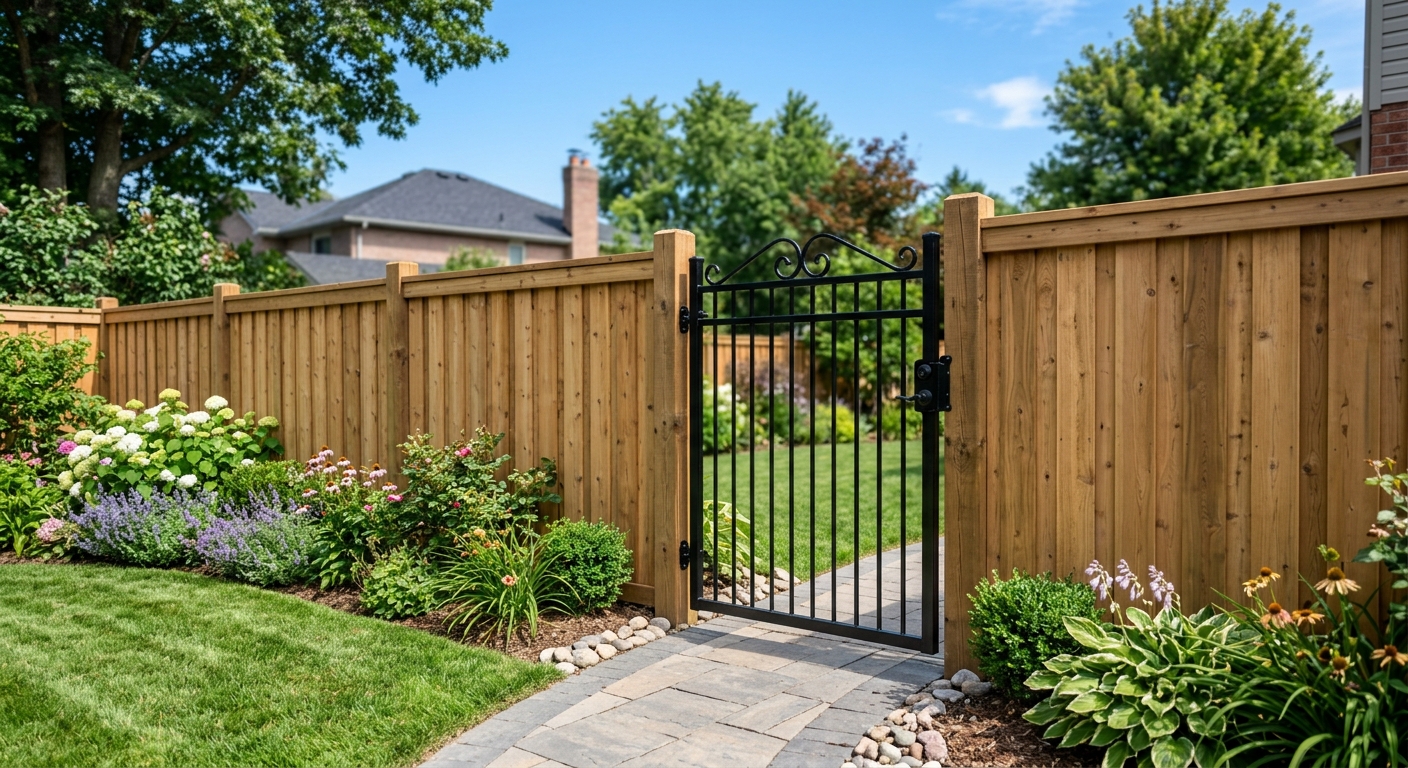
Fencing options and costs in London
In London, Ontario, fencing choices often come down to balancing privacy, upkeep, and how the ground behaves through freeze-thaw cycles. With 48.8% of local dwellings being single-detached homes and 58.1% of households owning, a lot of homeowners consider fencing as both a boundary solution and a long-term yard upgrade. London’s housing mix is also part of the story: 52.3% of homes were built before 1981, which typically means more mature lots, established trees, and older fence lines that may need removal or rework. Those factors can affect excavation time, disposal, and how much labour is required to keep the new fence straight on uneven property edges.
Cost is shaped by frost depth planning. In southern Ontario, fence posts are commonly buried about 3 feet deep, and many contractors will set posts roughly 4–6 inches below the design frost depth to reduce heaving. That usually means longer posts and, more often than homeowners expect, concrete setting for stability in heavier, water-holding soils. If you’re near busier corridors—like North-east London and parts of South London where many families expand yards—contractors can be in higher demand, so early scheduling helps.
Below is a practical cost snapshot for common materials in the London market. Use it to compare options before you request itemised quotes.
| Material |
Lifespan |
Maintenance |
Privacy Rating |
Price per Linear Foot |
| Pressure-treated pine (standard wood) |
10–15 years |
Stain/seal every 2–3 years |
High (good with solid panels) |
$40–$75 |
| Cedar (natural rot resistance) |
15–25 years |
Light staining yearly or every 2 years |
High (solid boards) |
$55–$95 |
| Vinyl / PVC (no-maintenance) |
20–30 years |
Rinse as needed; no staining |
Medium-High (depends on style) |
$45–$80 |
| Chain-link (galvanized steel) |
20–40 years |
Minimal; check tension annually |
Low (add privacy slats if needed) |
$25–$50 |
| Aluminum ornamental |
25–40 years |
Occasional cleaning only |
Low-Medium (open pickets) |
$70–$120 |
| Composite / recycled material |
20–30 years |
Wash yearly; no painting |
High (solid styles available) |
$75–$125 |
Prices are estimates only and vary by project scope, site access and material selection.
What affects the price of fencing in London
In London, Ontario, it’s normal to see fencing quotes for the “same” yard gap swing by 30–50% once contractors price the real conditions. Even a straightforward straight run changes costs when the job involves soil that holds water, mature landscaping that slows access, or multiple gate locations. London’s homeowner base is active—there are many single-detached properties in established neighbourhoods—so labour scheduling and the availability of crews can also affect pricing.
The biggest technical reason for variation is frost-depth planning. In southern Ontario, posts are typically buried about 3 feet deep, and in practice contractors often set them approximately 4–6 inches below the design frost depth to reduce heaving during freeze-thaw. That typically pushes post depth into the 1.5–2.0 m range for many installs. When deeper holes are required, you get higher labour for digging (and spoil removal), plus longer posts and more concrete if you choose concrete setting for stability.
Local ground and yard layout matter. For example, clay-heavy areas can expand and contract, increasing the need for solid footing; that can move you from a “gravel pack” approach to a concrete-set approach. If your yard is near older lots built before 1981, expect more roots and uneven footing along fence lines, which can add time and sometimes replacement of damaged sections. Conversely, if you have a clear access path and straight lines, costs usually land nearer the lower end of the wood or vinyl ranges (for instance, wood often ranges around the $40–$75 band, while chain-link can be closer to $25–$50).
Finally, material and installation complexity stack. A privacy fence with more pickets/solid boards can cost more than a chain-link barrier even when the linear footage is identical.
| Price Factor |
Why It Matters |
Cost Impact |
| Fence length in linear feet |
Most labour and material scale directly with length |
Highest single driver; affects everything from posts to rails |
| Post depth required |
Frost line determines hole depth and post length |
Deeper embeds increase labour, materials, and sometimes concrete |
| Post setting method |
Concrete vs. gravel pack vs. driven posts changes durability |
Concrete setting usually adds cost but improves long-term stability |
| Material choice |
Vinyl, cedar, and chain-link differ in supply cost and longevity |
Material premiums can shift the project across major price bands |
| Gate count and type |
Hinged gates require stronger framing and hardware |
Each gate adds structural labour; drive-through double gates cost more |
| Grade and terrain |
Slopes require stepped or raked sections and extra layout time |
Often adds labour and hardware; increases waste for cutting panels |
| Old fence removal and disposal |
Hauling and demolition time varies by condition |
Can add several hundred dollars or more depending on debris and access |
| Permit fees and survey / property line locate |
Some higher fences and disputes require documentation |
May add fixed costs and can delay start dates if survey is needed |
Permits & regulations in Ontario
In Ontario, many fencing projects are straightforward, but permits can apply depending on height and location. In general terms, fences above a typical threshold of about 2.0 m (6.5 ft) at the rear and roughly 1.0–1.2 m (3–4 ft) at the front or corner often trigger a building permit requirement. Local rules also govern setbacks and how close fencing can sit to property lines or certain municipal areas.
Before any post holes are dug, you also need utility locates. In Ontario, homeowners (and contractors) should call Ontario One Call to mark buried services. This matters in London because mature neighbourhoods frequently have older service lines, and striking a line is an expensive delay. If you’re not sure where your property line sits, obtain a survey or request a locate of your pins so your fence doesn’t encroach. Boundary responsibilities for shared fences are governed by provincial line-fences legislation, so it’s a good idea to confirm expectations with neighbours early.
To verify a contractor in London, ask for:
- Ontario licence status (where applicable): confirm the correct business/contractor credentials through the relevant public registry.
- Liability insurance certificate: request a current Certificate of Insurance naming your address as applicable.
- WSIB coverage: confirm coverage and clearance status through the WSIB.
- Clearance letter or proof documents: these should align with the period the work is scheduled.
Choosing the right fence material for London
Choosing a fencing material in London, Ontario is easiest when you match your priorities—privacy, maintenance, budget, and lifespan—to how local weather affects materials. London sits in a seasonal climate with freeze-thaw cycles, so post stability and proper embed depth matter as much as the surface material. Many southern Ontario installs bury posts about 3 feet deep, and contractors often set posts roughly 4–6 inches below design frost depth to reduce heaving. That means all materials benefit from correct excavation and, in many cases, concrete setting in heavier or water-holding soils.
Pressure-treated pine is usually the budget-friendly route, but it needs staining or sealing every 2–3 years to limit grey weathering and protect the boards. Cedar costs more up front, yet homeowners often find it worth it because it has natural rot resistance and holds up well with lighter maintenance. Vinyl/PVC is popular for low upkeep and can deliver strong privacy in solid styles, but very cold snaps can make some panels feel more brittle if the wrong product is used or if posts are not set correctly. Chain-link is the lowest cost and longest-lasting, but it won’t provide privacy unless you add slats or a privacy screen. Aluminum ornamental looks clean and never rusts, but it’s generally not a privacy solution due to open pickets.
Concrete example: if you’re comparing a budget wood privacy fence at roughly the $40–$75 band versus cedar in the $55–$95 range, cedar can be justified when you want fewer long-term maintenance cycles and a warmer appearance that blends with older London home styles. In contrast, if you simply need boundary security and airflow, chain-link around $25–$50 often makes more sense than paying for higher-end privacy materials.
| Material |
Cold Tolerance |
Lifespan |
Annual Maintenance |
Best For |
Price Band |
| Pressure-treated pine |
Good (when properly stained/sealed) |
10–15 years |
1–2 touch-ups or full stain every 2–3 years |
Budget privacy fences |
$40–$75 |
| Cedar |
Good (naturally resistant to rot) |
15–25 years |
Light stain every 1–2 years as needed |
Longer-lasting privacy with better appearance |
$55–$95 |
| Vinyl / PVC |
Very good (avoid thin/poor-quality profiles) |
20–30 years |
Rinse as needed; check for fastener issues |
Low-maintenance privacy |
$45–$80 |
| Chain-link |
Excellent (galvanized coating) |
20–40 years |
Minimal; tension check 1x per year |
Security with lowest upfront cost |
$25–$50 |
| Aluminum ornamental |
Excellent (powder-coated) |
25–40 years |
Occasional cleaning |
Neat curb appeal, durable boundary |
$70–$120 |
| Composite / recycled |
Good (stability depends on product) |
20–30 years |
Wash yearly; inspect posts and caps |
High privacy with low upkeep |
$75–$125 |
How to choose a fencing contractor in London
Choosing a fencing contractor in London, Ontario starts with proof—then with the details in their paperwork. First, verify licensing/credentials where applicable, and always ask for a Certificate of Liability Insurance and WSIB coverage. For WSIB, the contractor should be enrolled (if required for their work) and able to provide a clearance letter or proof upon request. You can then cross-check the documents you receive against the contractor’s stated business name.
Next, get 2–3 itemised written quotes. Look for a breakdown that separates labour (digging, post setting, rail/panel installation, gate framing) from materials (posts, rails, boards/pickets/mesh, hardware). A good quote also clarifies what’s included: permit pulling (if required), utility locate coordination, old fence removal, and disposal/hauling. If the quote only gives a lump sum without scope detail, you can end up paying change orders for items that should have been visible from the start.
Warranty matters too. Ask for the workmanship warranty length (how long they stand behind straight lines, post stability, and gate alignment), plus the manufacturer warranty on the fence product. Confirm whether warranties are transferable to you as the homeowner.
On payment, never pay more than about 10–15% upfront. Use a holdback until completion and walk-through acceptance. Finally, require a start date and completion estimate in writing—London crews can be booked out during peak landscaping season, so a clear timeline prevents gaps.
- Request a dated Certificate of Liability Insurance (current policy).
- Confirm WSIB coverage and obtain proof/clearance letter.
- Get an itemised quote: labour vs. material vs. hardware.
- Ensure post depth and setting method are specified (frost-proof embed plan).
- Ask whether concrete setting is included and for which post types.
- Confirm gate hardware quality and whether closeers/latches are included.
- Ask how they handle slopes (stepped vs. raked panels) and who measures grade.
- Verify whether old fence removal and disposal are included.
- Check if utility locate steps and marks are coordinated before digging.
- Ask if permits are included and who applies (if your height/location requires one).
- Review warranty terms in writing, including workmanship and manufacturer coverage.
- Use a payment schedule with a holdback until final clean-up and acceptance.
Red flags in the London market include: contractors who won’t provide insurance/WSIB proof, quotes that omit post depth or post-setting method, “lowest price” offers with no written scope, and crews asking for most payment upfront before any site work begins.
Frequently asked questions — fencing in London
How tall can my fence be in London?
In London and across Ontario, fence height rules depend on location (front/corner versus rear) and sometimes the fence’s overall setup. As a practical guideline, fences taller than about 2.0 m (6.5 ft) at the rear and roughly 1.0–1.2 m (3–4 ft) at the front or corner often trigger permit requirements. Even when a permit isn’t needed, the fence must still respect property lines and any municipal setback-by-law requirements. Because London neighbourhoods vary—especially around older lots and mature trees—your best move is to confirm the exact height you want against the local rules before ordering materials. If you already have a line-fence dispute in mind, a property survey can prevent expensive rework.
Should fence posts be set in concrete here?
For most London residential fences, solid post setting is about preventing movement and heaving during freeze-thaw cycles. In southern Ontario, posts are commonly buried about 3 feet deep, and contractors often set them around 4–6 inches below the design frost depth. In many yards—particularly if the soil holds water or the fence is supporting heavier panels—concrete setting helps keep posts stable longer. Concrete isn’t automatically required for every situation, but it is commonly used when contractors want to reduce the risk of post wobble and gaps after winter. If you’re budgeting, concrete setting usually increases labour and material, but it can protect your investment, especially on fences that fall into the mid-range bands like wood around $40–$75 or vinyl around $45–$80.
What's the best fence for privacy?
For privacy in London, the best options are solid-board wood/cedar, vinyl/PVC privacy styles, or composite boards with close spacing. Chain-link provides security but typically offers low privacy unless you add slats or a privacy screen, and aluminum ornamental is usually decorative rather than private. Your choice should also consider maintenance: pressure-treated pine can look great but generally needs staining/sealing every 2–3 years, while cedar offers better natural rot resistance and often holds up well in Ontario’s wet-dry seasonal swings. Vinyl and composite typically reduce ongoing work, though correct post depth and hardware matter so the fence stays rigid through cold snaps and spring thaw. If you want a comparison, many homeowners weigh wood at $40–$75 against vinyl at $45–$80, then decide based on whether they’d rather stain later or pay more upfront for low maintenance.
How do I compare fencing quotes?
Compare London fencing quotes like apples-to-apples by looking at scope, not just the total. Ask each contractor to provide an itemised breakdown: linear footage, number of posts, post depth plan (including frost-depth embed guidance), post-setting method, rail type, panel/board type, and gate count. Also confirm what’s included for removal/disposal of the old fence, utility locate coordination, permit pulling (if required), and site clean-up. Pricing can vary widely because labour increases when excavation is tougher or access is constrained. For example, a cedar privacy fence may land closer to the higher end than a chain-link boundary, and those differences should be reflected in materials and labour, not just “brand pricing.” A credible quote should clearly explain why it costs what it costs, and it should match your intended height, style, and terrain (sloped yards need stepped or raked sections).
How long does fence installation take in London?
Most residential fence installs in London are measured in days, not weeks, assuming standard access and no major surprises. For short runs, a crew can often complete work within 1–2 working days; longer fences with multiple gates can take several days depending on layout complexity, excavation conditions, and cure times if concrete is used. Weather can also affect scheduling because post-hole excavation and setting work are easiest when the ground isn’t frozen solid or overly waterlogged. If your fence involves old removal, landscaping protection, or difficult grading, the timeline stretches because they must re-measure line-of-sight and re-level sections. When you get a quote, ask for a written start date and a completion estimate that accounts for frost-season realities and any permit or locate steps.
Can I install a fence on a slope in London?
Yes, you can install a fence on a slope in London—many yards are naturally uneven—but the method matters for both appearance and durability. Contractors typically use stepped panels (each panel level step) or raked panels (following the slope gradually), depending on the fence type and what your manufacturer allows. On sloped ground, the layout requires more measurements and often more cutting, which can increase labour and material waste. The goal is to keep post embeds consistent below the frost-risk zone while maintaining a straight visual line along the tops. Before quoting, ask how they plan to handle grade, especially for privacy fences where the top alignment is noticeable. If your yard also has heavier clay soil, stable post setting (often including concrete-set holes) becomes even more important to reduce movement after thaw cycles.