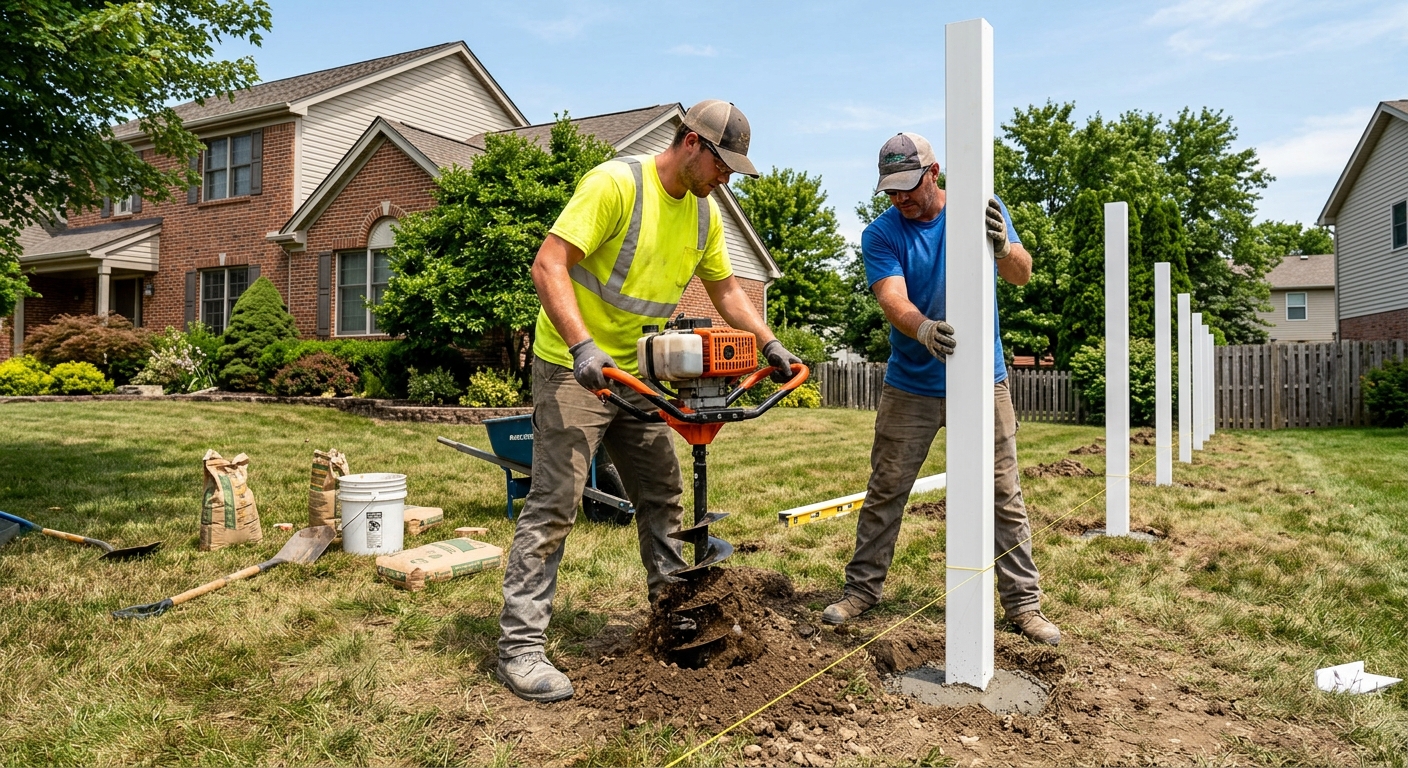
Fencing options and costs in Red Lake
Fencing in Red Lake, Ontario is a practical upgrade for comfort and privacy, but the cost depends heavily on weatherproofing and how deep your posts must go. With 1,280 homeowner households locally (Statistics Canada, 2021 Census) and an 81.5% share of single-detached homes, there’s steady demand for new builds and replacement projects—especially when older fencing meets freeze/thaw cycles. Just as importantly, Red Lake’s housing stock skews older: 67.7% of homes were built before 1981 (Statistics Canada, 2021 Census), so many properties need re-fencing when boundaries, grading, or site drainage have changed over decades.
Northwest Ontario’s climate shapes every estimate. Frost penetrates deeper than in southern Ontario, so posts typically need to be set close to 4 ft (1.2 m+) below grade, often with concrete, to reduce frost heave. That increases excavation time, concrete volume, and the amount of bracing required for straight runs. On open lots or along higher-wind corridors—common around Kinghorn Bay Road and other exposed edges of town—heavier panels, tighter post spacing, and sturdier hardware can also raise installed cost.
Contractors also tend to prioritize the materials and layouts that perform in wind and snow loads, which is why quotes can vary even when the fence height looks the same. Below is a homeowner-friendly comparison of common options you’ll see in Red Lake, along with typical lifespan and pricing guidance. Use it as a starting point before we discuss your exact layout in person.
| Material |
Lifespan |
Maintenance |
Privacy Rating |
Price per Linear Foot |
| Pressure-treated pine (standard wood) |
10–15 years |
Stain/seal every 2–3 years |
High (solid picket/board) |
$55 – $90 |
| Cedar (natural rot resistance) |
15–25 years |
Light staining/finishing every 2–4 years |
High (solid board) |
$70 – $110 |
| Vinyl / PVC (no-maintenance) |
20–30 years |
Rinse annually; no staining |
High (solid panels) |
$70 – $110 |
| Chain-link (galvanized steel) |
25–35 years |
Occasional tightening and rust checks |
Low to medium |
$35 – $65 |
| Aluminum ornamental |
25–40 years |
Wash as needed |
Low (open pickets) |
$80 – $140 |
| Composite / recycled material |
20–30 years |
Rinse and occasional cleaning |
High (board-style) |
$85 – $135 |
Prices are estimates only and vary by project scope, site access and material selection.
What affects the price of fencing in Red Lake
In Red Lake, two quotes for the “same” fence can easily land 30–50% apart because Northwest Ontario fencing pricing is driven by conditions on your site—not just the material on the brochure. Even when homeowners choose similar heights, the quote changes once we factor in below-frost post requirements, excavation difficulty, wind bracing, and whether removal/disposal is included. Labour and mobilization matter too: deeper digging and more concrete setting take longer, which affects total crew hours and machine time.
The biggest technical driver is frost depth. In cold Ontario regions, posts typically must be set about 4–6 inches below the design frost depth to help prevent heaving. That often means posts set roughly 1.5–2.0 m into the ground (depending on local conditions), with concrete setting and longer posts—cost impacts that show up in both materials and labour. Wind exposure influences layout as well: open stretches often require closer spacing and heavier panels to stay plumb through snow load and high gusts. By comparison, coastal British Columbia’s milder frost reduces embedment requirements, but faster wood rot risk makes maintenance quality essential; the net effect is that Red Lake jobs usually price more like the “cold-weather build” end of Ontario.
Local examples that commonly raise costs around Red Lake include: (1) clay-to-mixed soils that don’t compact well in deep holes, which can increase excavation time and concrete volume for stable footings; (2) sloped yards that require stepped or raked sections, increasing labour for alignment and hardware; and (3) older fence removals where posts come out damaged, requiring extra time to cut and reset. On the flip side, a straightforward run with good access and minimal grade change can keep wood work near the $55–$90 band, while adding privacy boards, heavier rails, and reinforced corners can push projects toward the $70–$110 range, even if the total linear footage is the same.
| Price Factor |
Why It Matters |
Cost Impact |
| Fence length in linear feet |
The primary driver of materials, posts, rails and labour |
Major increase with each additional 10–20 ft |
| Post depth required |
Frost line determines post length and hole depth |
Higher embedment increases post material and excavation |
| Post setting method |
Concrete vs. gravel pack vs. driven posts changes footing work |
Concrete-set posts usually cost more but reduce frost-heave risk |
| Material choice |
Vinyl vs. cedar vs. chain-link changes price per panel/post and hardware |
Can swing total budget significantly across material bands |
| Gate count and type |
Drive-through double gates need heavier frames and hinges |
Often adds cost beyond the price per linear foot |
| Grade and terrain |
Sloped yards require stepped or raked panels and extra alignment labour |
More labour, more hardware and sometimes more posts |
| Old fence removal and disposal |
Taking down, loading and hauling adds time and equipment use |
Can add a noticeable lump sum depending on condition |
| Permit fees and survey / property line locate |
Some projects need a permit; boundary confirmation prevents rework |
Small-to-moderate adders depending on what’s already known |
Permits & regulations in Ontario
In Ontario, fences can fall under permit requirements depending on height and location. A common rule of thumb homeowners use is that fences above a rear threshold of roughly 2.0 m (6.5 ft) and above about 1.0–1.2 m (3–4 ft) at the front or corner often require a building permit (exact thresholds can vary by circumstance and local by-laws). Regardless of permit need, your fence must respect the property line and municipal setback requirements.
Before you dig any post holes, always arrange utility locates through the appropriate one-call service. In Ontario, that’s Ontario One Call. Then, confirm boundaries: if you’re fencing near a disagreement area, build near a lot line, or you’re replacing an old fence that may not be on the pins, order a survey or at least locate the property pins so you don’t end up encroaching and having to redo sections.
Shared fence ownership follows provincial line-fences principles, so if the fence is on or near the boundary, expectations about maintenance and replacement should be clarified in writing with your neighbour.
Where permits are commonly required: tall privacy fences, new boundary fences that exceed typical height rules, and certain installations affecting safety sightlines. Where permits typically do not apply: routine replacement in the same location and similar height, or repairs to an existing fence (but you should still confirm local rules before starting).
To verify an Ontario contractor, check three things: (1) licence/registration using the relevant online registry for Ontario business authorization (often shown at the company website footer or public registry tools); (2) liability insurance via a certificate of insurance naming you as certificate holder (or providing adequate proof); and (3) WSIB coverage confirmation—ask for clearance where applicable and ensure your quote references insured labour. For fencing, I also ask for proof they carry coverage for excavation and material handling, since deeper postholes increase site risk.
Choosing the right fence material for Red Lake
Choosing the right fence material in Red Lake comes down to matching your priorities—privacy, low maintenance, budget and lifespan—to the realities of Northwest Ontario weather. Frost penetrates deeply, so posts often need to be set close to 4 ft (1.2 m+) below grade to reduce frost heave. That matters because even the “best” fence material can fail early if the structure isn’t solid at the footing level.
Pressure-treated pine is usually the budget choice, and for many homeowners it’s attractive because it fits the wood pricing band (often around $55–$90 per linear foot, depending on height, spacing and hardware). The trade-off is maintenance: to prevent grey weathering and keep boards looking uniform, most owners plan to stain or seal every 2–3 years. Cedar typically offers better natural appearance and rot resistance, which can extend service life, but you still need periodic finishing. Vinyl / PVC is popular for low maintenance; however, extreme cold can make expansion/contraction more noticeable, so proper installation details—good post settings and correct rail alignment—are critical. Chain-link is long-lasting and often the least expensive; it’s ideal for security and containment but doesn’t deliver privacy. Aluminum ornamental is attractive and rust-resistant, but it’s not a privacy fence. Composite/recycled options can deliver privacy with less upkeep, though they usually cost more upfront.
Wind and snow load are real in Red Lake when properties sit on more open stretches or near road corridors. That’s why we often recommend heavier rails, wind-conscious spacing and, for solid privacy fences, concrete-set posts—especially on runs that need to stay straight through freeze/thaw. A concrete cost example: if you’re comparing pressure-treated pine privacy boards to vinyl, you might choose pine at roughly $55–$90 per linear foot but accept the ongoing staining schedule; vinyl can land closer to $70–$110 per linear foot, which becomes justified if you want minimal upkeep during our long winter and busy spring thaw periods.
| Material |
Cold Tolerance |
Lifespan |
Annual Maintenance |
Best For |
Price Band |
| Pressure-treated pine |
Good with proper post depth and sealing |
10–15 years |
Plan 2–3 seasonal checks; stain/seal every 2–3 years |
Budget privacy with traditional look |
$55 – $90 |
| Cedar |
Good; better natural resistance in wet cycles |
15–25 years |
Low-to-moderate; finish every 2–4 years |
Premium wood look and rot resistance |
$70 – $110 |
| Vinyl / PVC |
Good when installed to allow for movement |
20–30 years |
Minimal—rinse/clean as needed |
Low maintenance privacy |
$70 – $110 |
| Chain-link |
Very good |
25–35 years |
Occasional tightening; watch for minor coating wear |
Security, pet containment, visibility |
$35 – $65 |
| Aluminum ornamental |
Excellent for freeze/thaw |
25–40 years |
Minimal; occasional wash |
Attractive perimeter fencing |
$80 – $140 |
| Composite / recycled |
Good in cold, stable board material |
20–30 years |
Low; rinse and spot-clean |
Privacy with reduced upkeep |
$85 – $135 |
How to choose a fencing contractor in Red Lake
Choosing the right fencing contractor in Red Lake starts with verification. First, confirm Ontario business authorization: ask the contractor for their public business details and check the company’s online listing so the contact information matches the quote and invoice. Next, request a certificate of liability insurance showing the coverage limits appropriate for construction work, and ask whether your address can be listed as certificate holder (or otherwise verified). For employment coverage, verify WSIB status—ask for clearance or proof of coverage where applicable. Don’t accept verbal assurances; request documentation before any work begins.
Then get 2–3 itemised written quotes. A good fencing quote breaks labour and materials out separately (posts, rails, panels, gates, brackets, concrete, and disposal), and it specifies the embedment depth strategy and post setting method. Read the scope carefully for exclusions: is old fence removal included, is haul-away included, and are permit pulls included if needed? Ask how they’ll handle damaged existing fence sections during removal.
Warranty matters for both workmanship and product. Ask for the workmanship warranty length, whether it covers settlement or post movement, and whether the manufacturer warranty for panels/posts is transferable to subsequent owners. For payment, don’t let the schedule creep upward: aim for no more than about 10–15% upfront, with progress payments tied to milestones and a holdback until the finish quality is complete. Finally, request a start date and a completion estimate in writing so you have a real timeline, not a vague “as soon as possible.”
- Verify WSIB clearance/coverage documentation before work starts.
- Confirm liability insurance certificate and coverage limits for construction activities.
- Ask for licence/business registration details and match them to the quote and invoice.
- Request an itemised quote (labour, concrete, posts, rails, panels, gates, hardware, disposal).
- Confirm post depth/embedment plan to reduce frost heave in deep-frost conditions.
- Get clarity on footing method: concrete-set, gravel pack, or other approach.
- Ask how they will handle uneven grade (stepped vs. raked panels).
- Confirm gate hardware specifics (hinges, latches, and whether double gates are reinforced).
- Ask whether they include permits, property line verification, or locate/survey costs.
- Check if cleanup and haul-away of old materials are included in the scope.
- Review warranty terms separately for labour workmanship and product materials.
- Make sure the contract includes a payment schedule with a reasonable holdback.
Red flags I see too often: (1) contractors refusing to provide insurance/WSIB proof; (2) quotes that omit post depth and footing method while still claiming a “lowest price”; (3) lump-sum pricing with no material breakdown; (4) asking for most of the money upfront; and (5) vague completion dates without a written schedule—especially risky in winter prep and thaw-off seasons in Red Lake.
Frequently asked questions — fencing in Red Lake
Wood vs vinyl vs aluminum fence — which is best?
In Red Lake (and across Ontario’s colder pockets), “best” usually means best for your time and upkeep, not just appearance. Wood (pressure-treated pine or cedar) can fit most budgets—often near the wood band of $55–$90 per linear foot—but it typically needs periodic staining or finishing (every 2–3 years for many pine installs) to keep a consistent look. Vinyl/PVC is a strong choice if you want low maintenance and can budget closer to $70–$110 per linear foot, but installation details still matter in extreme cold. Aluminum ornamental is excellent for longevity and rust resistance, yet it’s usually not a privacy fence because the open picket design offers lower privacy. In practice, I recommend wood for value and appearance, vinyl for minimal upkeep, and aluminum when you want a clean perimeter with security plus longer-term material stability.
Do I need a permit to build a fence in Ontario?
It depends on the fence height, location and how it affects safety sightlines. In Ontario, fences above typical thresholds—often about 2.0 m (6.5 ft) at the rear and around 1.0–1.2 m (3–4 ft) at the front or corner—commonly need a building permit. Even when permits are not required, you still have to respect property lines and municipal setback by-laws. Before digging, make sure you’ve done utility locates through Ontario One Call. For Red Lake homeowners, the safest workflow is: confirm where your pins are (survey or locate), determine your target height by location (front/side/rear), then ask your contractor whether a permit is required and who pulls it. A reputable fencing contractor will clearly state permit responsibility in the written scope.
How long does a wood fence last in Red Lake?
A wood fence can last a long time in Red Lake if the structure is built for deep frost and water management. Typical lifespans are about 10–15 years for pressure-treated pine and 15–25 years for cedar, assuming posts are installed with proper below-frost embedment and the fence is maintained. The cold impact is real: frost heave can loosen posts if embedment is too shallow, and repeated wetting can accelerate surface wear. Maintenance helps a lot—plan on staining or sealing every 2–3 years for pine to avoid heavy grey weathering, and periodic finishing for cedar to keep it looking uniform. If you’re budgeting tightly, a wood fence in the $55–$90 per linear foot range can be cost-effective, but only if you’re also budgeting for maintenance and choosing a post-setting method appropriate for Northwest Ontario.
Who owns and maintains a shared fence?
Shared fences are treated differently than a fence solely on one property, and Ontario line-fences rules generally guide responsibilities when a fence sits on or relates to the boundary. Practically, ownership and maintenance can depend on where the fence is located relative to the property line and what was agreed when it was installed or last replaced. For homeowners in Red Lake, the best approach is to identify the exact boundary (pins/survey) and then put expectations in writing with your neighbour—especially for repairs that affect stability, privacy sections, or replacement boards. If a shared fence is failing due to post movement or rot, it’s reasonable to discuss cost-sharing tied to the repairs needed. Your contractor’s job is to build in the correct location and document what was done; your agreement with your neighbour determines maintenance responsibilities after that.
How do I find my property line before fencing?
Start with what you already have: look for past survey paperwork, lot drawings, and any documentation from your purchase. If those aren’t available—or if you suspect the existing fence could be off the line—order a locate or survey to confirm your property pins. For Red Lake homeowners, this step is especially important because replacing an older fence without verifying pins can lead to boundary disputes and costly rework. Before any post holes are dug, arrange utility locates through Ontario One Call so you don’t hit services when you set deep frost-resistant posts. When you have a contractor come out, ask them to reference the pin locations on site and confirm the intended fence line alignment on your plan. A professional quote should include confirmation steps or guidance for property line accuracy, not guesswork.
What's the most low-maintenance fence?
For low maintenance in Ontario’s colder weather, vinyl/PVC is usually the top choice for homeowners who want privacy without regular staining. With proper installation, vinyl typically keeps a neat appearance for many years and only needs periodic rinsing. Expect to pay more upfront—often around the $70–$110 per linear foot range—compared with pressure-treated wood, which can be closer to $55–$90 per linear foot but requires staining or sealing on a schedule. Aluminum ornamental is also low maintenance (wash as needed, no rust), but it generally won’t give the same privacy as a solid board fence. Chain-link is long-lasting and low maintenance too, though it won’t satisfy most privacy goals. In Red Lake, the “lowest maintenance” answer also depends on footing quality: even a vinyl fence can fail early if posts aren’t set correctly below frost.