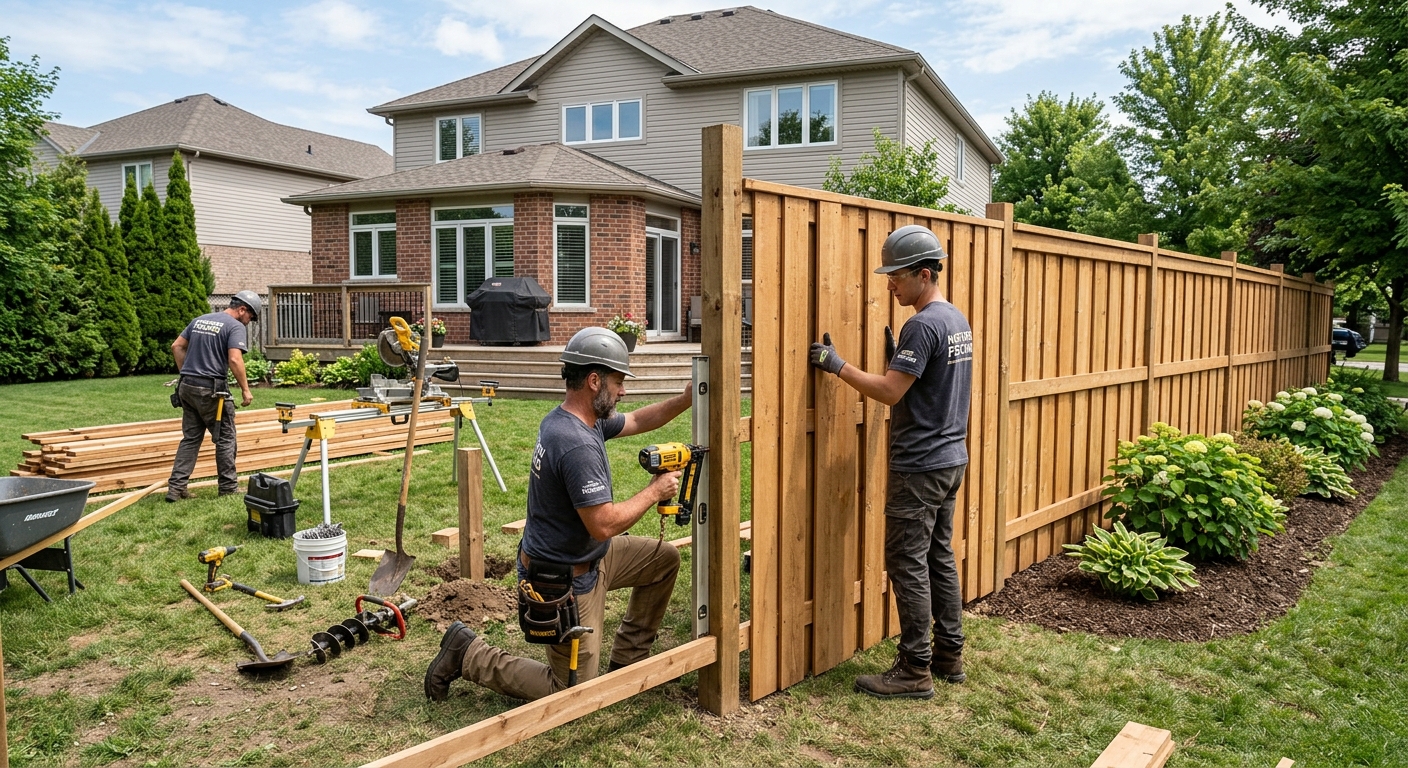
Fencing options and costs in Centennial Scarborough
Centennial Scarborough is a densely lived-in part of Toronto, and when homeowners plan yard privacy, it’s common to start with fencing—especially around front corners and backyard gathering areas. With a population of 13,362 (Statistics Canada, 2021 Census), steady residential demand is supported by ongoing infill and upgrades to older properties. In this area, fencing contractors often see the strongest activity in neighbourhoods like Highland Creek, where homeowners commonly add privacy fencing along rear lots and side yards.
Toronto’s fencing costs are shaped by cold-weather construction reality. Even though open-field wind exposure isn’t as severe as the Prairies, frost heave still matters: local best practice typically treats the design frost line at roughly 42"–48", so many 6–8 ft privacy fences use concrete-set posts set about 3.5–4 ft deep for long-term stability. That means you’ll see higher labour time (and ready-mix) compared with “driven post” installs.
Material choice also drives quote differences. Vinyl/PVC and aluminum options often cost more upfront than standard wood, but they tend to reduce maintenance schedules over the life of the fence. For a fast starting point, use the bands below: wood installation in Toronto generally lands around $65–$120 per section footprint (labour-and-install pricing varies by site), while vinyl/PVC tends to sit higher, commonly $75–$130.
Below is a practical comparison of common fencing materials for Centennial Scarborough, including typical lifespan, maintenance expectations, and privacy performance.
| Material |
Lifespan |
Maintenance |
Privacy Rating |
Price per Linear Foot |
| Pressure-treated pine (standard wood) |
12–18 years |
Stain/coat every 2–3 years; inspect posts annually |
High (solid pickets/rails) |
$15–$26 |
| Cedar (natural rot resistance) |
15–25 years |
Light staining/oiling every 2–4 years; less warping than pine |
High (solid style options) |
$18–$32 |
| Vinyl / PVC (no-maintenance) |
20–30 years |
Rinse annually; check fittings after freeze-thaw extremes |
High (solid privacy panels) |
$20–$36 |
| Chain-link (galvanized steel) |
20–35 years |
Occasional washing; tighten hardware as needed |
Low to Medium (privacy slats add some privacy) |
$13–$22 |
| Aluminum ornamental |
25–40 years |
Wash as needed; no rust with proper powder coat |
Low to Medium (ornamental infill) |
$22–$40 |
| Composite / recycled material |
20–30 years |
Rinse annually; inspect for fastening issues |
High (solid privacy designs) |
$24–$44 |
Prices are estimates only and vary by project scope, site access and material selection.
What affects the price of fencing in Centennial Scarborough
In Centennial Scarborough, the same fence height and “about the same length” can still produce quotes that vary by 30–50% across Toronto and Ontario. The biggest reason isn’t just material cost—it’s how deep the posts must be set, how many gates you add, and how difficult the install is around driveways, narrow side yards, or sloped lots. Two crews can quote differently because one team plans for frost-safe concrete-set posts, while another tries to reduce labour time, which can shorten service life.
Frost line depth sets how deep posts must be set. In cold Ontario conditions, best practice typically calls for posts being set roughly 4–6 inches below the design frost depth to prevent heaving, which often works out to 1.5–2.0 m of embedment depending on soil and fence height. For a typical 6–8 ft privacy fence, that pushes contractors toward longer posts and concrete setting, raising material and ready-mix costs. Wind also influences panel style and spacing: while Toronto doesn’t have Prairie-level open exposure, solid tall fences can still rack under gusts, so heavier posts and tighter spacing are common.
Concrete examples from Centennial Scarborough: (1) If your backyard is on clay-mixed soil, contractors often recommend concrete-set posts instead of gravel packs to reduce movement—this can add a noticeable labour-and-mix premium. (2) If you’re installing near a driveway apron with tight access, the crew may need additional equipment handling, and that can move you toward the higher end of wood ($65–$120) or vinyl/PVC ($75–$130) installations. (3) If you’re replacing an old fence, disposal and post removal can shift the quote upward even when the new materials are similar—sometimes more than homeowners expect when the old posts are concrete-set.
Finally, the housing mix matters. Many properties in the Toronto area were landscaped decades ago, so you’ll run into mature roots, irregular property grades, and older property-pin locations that require careful locating—each adds time and therefore cost.
| Price Factor |
Why It Matters |
Cost Impact |
| Fence length in linear feet |
Most materials and labour scale directly with footage |
Primary driver (often the biggest swing) |
| Post depth required |
Frost line determines embedment length and excavation depth |
Can add significant labour + longer posts |
| Post setting method |
Concrete vs. gravel pack vs. driven posts affects stability |
Concrete-set usually costs more but lasts longer |
| Material choice |
Vinyl/cedar/chain-link have very different material and hardware costs |
Shifts you between budget and premium bands |
| Gate count and type |
Gates require heavier frames, hinges, and precise alignment |
Double drive-through gates can add more than expected |
| Grade and terrain |
Sloped yards require stepped or raked panel installation |
More layout time and sometimes more material |
| Old fence removal and disposal |
Concrete remnants and demolition cleanup add crew time |
Can move the total notably upward |
| Permit fees and survey / property line locate |
Locates reduce disputes and rework; permits can apply above thresholds |
Small line items that still affect total |
Permits & regulations in Ontario
In Ontario, fence rules are largely municipal and property-line based, and permits can apply depending on height and location. As a practical benchmark used by many Toronto-area homeowners, fences above a height threshold—often around 2.0 m (6.5 ft) at the rear and roughly 1.0–1.2 m (3–4 ft) near the front or corner—may require a building permit. The key point is that even if your neighbours have a fence, the permit requirement depends on your fence’s position relative to streets, lot lines, and setbacks.
Before any post holes are dug, call for utility locates through Ontario One Call to prevent damage to buried services. Next, verify property lines: a survey or property-pin locate helps avoid encroachment disputes—particularly common on older lots where landscaping may obscure pins. Shared fence ownership and responsibilities are governed by provincial line-fences legislation, so if a fence sits on or near the boundary, you’ll want clarity on who maintains and how replacement costs are handled.
To verify a contractor in Centennial Scarborough, check three things step-by-step. First, confirm their Ontario licence/registration status and business details through the appropriate online resources. Second, ask for a certificate of insurance showing liability coverage (and request it be valid for the project dates). Third, confirm they carry WSIB coverage (or provide the applicable clearance letter if they are exempt). A legitimate fencing contractor won’t hesitate to provide these documents before you sign or pay deposits.
Choosing the right fence material for Centennial Scarborough
Choosing a fence material in Centennial Scarborough is really about matching your priorities—privacy, low maintenance, and budget—to Toronto’s freeze-thaw climate. Pressure-treated pine is the most budget-friendly start, but it typically needs staining or protective coating every 2–3 years to limit grey weathering and maintain a neat appearance. Cedar is a popular “step up” because it has better natural rot resistance and often looks warmer longer, but it still benefits from periodic staining to keep it looking consistent.
Vinyl/PVC is the low-maintenance choice for many homeowners: it doesn’t require painting or staining, and many people like the clean, uniform look. The trade-off is upfront cost and performance in extreme cold—hardware and fastening details matter, especially when panels expand and contract. Chain-link is usually the lowest upfront cost and lasts a long time, but it provides minimal privacy unless you add privacy slats or plantings. Aluminum ornamental is a good mid-range option if you want durability and a tidy front-yard look with no rust; it’s not a privacy fence by design.
For post stability, Toronto’s frost line means concrete-set posts are usually the smart default for 6–8 ft privacy fences. That deeper embedment improves long-term performance in clay and mixed soils. In practical pricing terms, it’s common to see vinyl land around the higher Toronto band ($75–$130), while wood installs often fall nearer $65–$120—so if you plan to stay in your home 10+ years, the reduced maintenance time can justify the difference. If you only need a short run or you’re budgeting for phased upgrades, pressure-treated pine can still make sense.
| Material |
Cold Tolerance |
Lifespan |
Annual Maintenance |
Best For |
Price Band |
| Pressure-treated pine |
Good when properly set on concrete and stained |
12–18 years |
Inspect annually; stain/coat every 2–3 years |
Budget-friendly privacy fencing |
$65–$120 |
| Cedar |
Good; benefits from periodic staining to resist freeze-thaw |
15–25 years |
Inspect annually; stain/oil every 2–4 years |
Higher-end look with natural rot resistance |
$80–$135 |
| Vinyl / PVC |
Very good in cold with proper fastening and layout |
20–30 years |
Rinse as needed; check fittings after winters |
Low-maintenance privacy |
$75–$130 |
| Chain-link |
Excellent; galvanized steel holds up well in Ontario winters |
20–35 years |
Occasional wash; tighten hardware |
Security fencing with minimal privacy |
$45–$85 |
| Aluminum ornamental |
Very good; powder coat resists salt-free winter conditions |
25–40 years |
Wash as needed; inspect fasteners |
Durable front-yard style fencing |
$90–$160 |
| Composite / recycled |
Good; keeps shape with proper installation spacing |
20–30 years |
Rinse annually; check fasteners |
Privacy with reduced maintenance |
$95–$165 |
How to choose a fencing contractor in Centennial Scarborough
Start with credentials. In Ontario, a reputable fencing contractor should be able to provide their business registration details, liability insurance certificate, and WSIB coverage (or a clearance letter if applicable). To check insurance, look for a current COI that lists your project address or general service coverage and confirms adequate liability limits. For WSIB, request the clearance letter number and confirm it matches the company name on the quote. If they can’t provide documentation promptly, treat it as a red flag.
Next, get 2–3 itemised written quotes. You want a breakdown that separates material costs (posts, rails, panels, gates) from labour, and ideally shows the assumptions used (post depth, spacing, and whether concrete is included). Avoid “lump sum only” quotes that don’t show what’s in scope. Confirm whether the permit pull (if required) is included or excluded, and whether old fence removal and disposal are included in the price—especially if your existing posts are concrete-set.
Warranty matters. Ask for the workmanship warranty length (commonly expressed as years for installation issues), the product/manufacturer warranty terms, and whether warranties are transferable if you sell your home. Payment schedules should also be conservative: never pay more than about 10–15% upfront, and use progress payments with a holdback until the final walk-through is complete. Finally, demand a written start date and completion estimate that includes weather contingencies for post-hole work during freezing conditions.
- Request proof of insurance (liability) before the first deposit.
- Request WSIB clearance letter or confirmation of coverage.
- Verify the company name matches the quote and insurance documents.
- Get quotes itemised by labour vs. materials (not lump sum only).
- Confirm post embedment depth and whether concrete is included.
- Ask how the contractor handles sloped yards (stepped vs. raked panels).
- Confirm gate hardware specs (hinges, latches, tension/locks).
- Make sure fence layout includes any existing eaves, fences, or utility lines.
- Clarify property-line assumptions and whether a locate/survey is included.
- Confirm waste removal and disposal of old fencing is included or extra.
- Ask whether permits apply and who pulls them (if required).
- Use a written warranty summary for workmanship and products.
Red flags I often see with weaker fencing contractors in Centennial Scarborough include: refusing to provide insurance/WSIB documents, quoting without specifying post depth or concrete-set requirements, leaving old fence removal/disposal vague, offering only a single all-in price without an itemised breakdown, and asking for large upfront payments with no holdback until completion.
Frequently asked questions — fencing in Centennial Scarborough
Wood vs vinyl vs aluminum fence — which is best?
For most Centennial Scarborough homeowners, “best” depends on whether you want privacy, upkeep, or a front-yard look. Wood (pressure-treated pine) is usually the lowest upfront path, often starting near the Toronto band of $65–$120, but it requires staining/coating every 2–3 years to keep it looking sharp through freeze-thaw cycles. Vinyl/PVC tends to cost more upfront—commonly $75–$130—yet it’s popular because it’s essentially no-paint, with a simple rinse and occasional hardware checks. Aluminum is typically more mid-range and great for durability and curb appeal, but it generally won’t give you true privacy like a solid wood or vinyl privacy fence. For tall privacy runs, ensure posts are concrete-set to resist frost heave and panel racking in Ontario winters.
Do I need a permit to build a fence in Ontario?
In Ontario, a permit can be required depending on fence height and placement. As a common Toronto-area rule of thumb, fences above about 2.0 m (6.5 ft) at the rear and around 1.0–1.2 m (3–4 ft) near the front or corner may trigger a building permit requirement, though your municipal bylaw and exact location govern the final answer. Regardless of permit needs, you must respect property lines and municipal setbacks. Before digging post holes, you should call Ontario One Call for utility locates. For contractor selection in Centennial Scarborough, ask whether your quote includes the permit pull (if applicable) and what happens if the locate requires adjustments. A clear, written scope is the best protection against unexpected stop-work situations.
How long does a wood fence last in Centennial Scarborough?
With proper installation, wood fencing in Centennial Scarborough commonly lasts around 12–18 years for pressure-treated pine, and longer for cedar. The biggest determinant is post stability in freeze-thaw conditions: if posts are set shallow or without concrete where soils move, you’ll often see leaning and gaps sooner. Toronto-area best practice typically embeds posts deep enough to sit below the frost line (commonly about 3.5–4 ft deep for many tall privacy fences) using concrete-set posts for long-term stability. Maintenance also matters—staining or coating every 2–3 years helps slow weathering and keeps the surface protected. If your goal is a “set it and forget it” timeline, vinyl or composite usually reduces ongoing work compared with wood.
Who owns and maintains a shared fence?
Shared fence ownership and maintenance in Ontario generally follow provincial line-fences legislation, but the exact responsibilities depend on whether the fence sits on the boundary line and the agreement between adjacent owners. In practical terms for Centennial Scarborough homeowners, confirm: (1) whether the fence is on the property line or wholly on one lot, (2) who paid for the original fence (and whether there’s documentation), and (3) how replacement costs are typically handled if the fence needs repairs. If a fence is shared, it’s normal to coordinate inspections and agree on replacement scope before work starts. A good contractor can help you document existing conditions and provide measurements/photos for both neighbours—reducing conflict if disputes arise about location.
How do I find my property line before fencing?
Start with your property pins and any existing survey documentation. If pins are hard to locate due to landscaping, you’ll likely want a surveyor or a professional property-line locate to confirm the boundary before you install posts. This matters in Centennial Scarborough because older lots sometimes have landscaping that obscures pins, and fences installed even a small distance over the line can trigger disputes. Also call Ontario One Call before digging to protect buried services. When you request quotes, ask the contractor whether they rely on your survey, whether they include a locate step, and how they handle unknown boundaries. Avoid starting excavation until you have a clear, written fence line plan tied to the lot layout.
What's the most low-maintenance fence?
In Ontario’s climate, the lowest-maintenance option for most homeowners is usually vinyl/PVC (or aluminum for non-privacy runs). Vinyl’s advantage is that it doesn’t require staining or regular repainting, and you can often keep it looking good with an occasional rinse and basic checks after winter. You’ll still want proper installation details—especially for tall panels and gates—to handle freeze-thaw expansion and Ontario wind loading. If you’re choosing based on price-to-low-maintenance value, vinyl commonly falls within $75–$130 depending on fence height, post/rail configuration, and gate count. Aluminum can also be very low maintenance, but it typically doesn’t offer the privacy level of a solid vinyl privacy design.