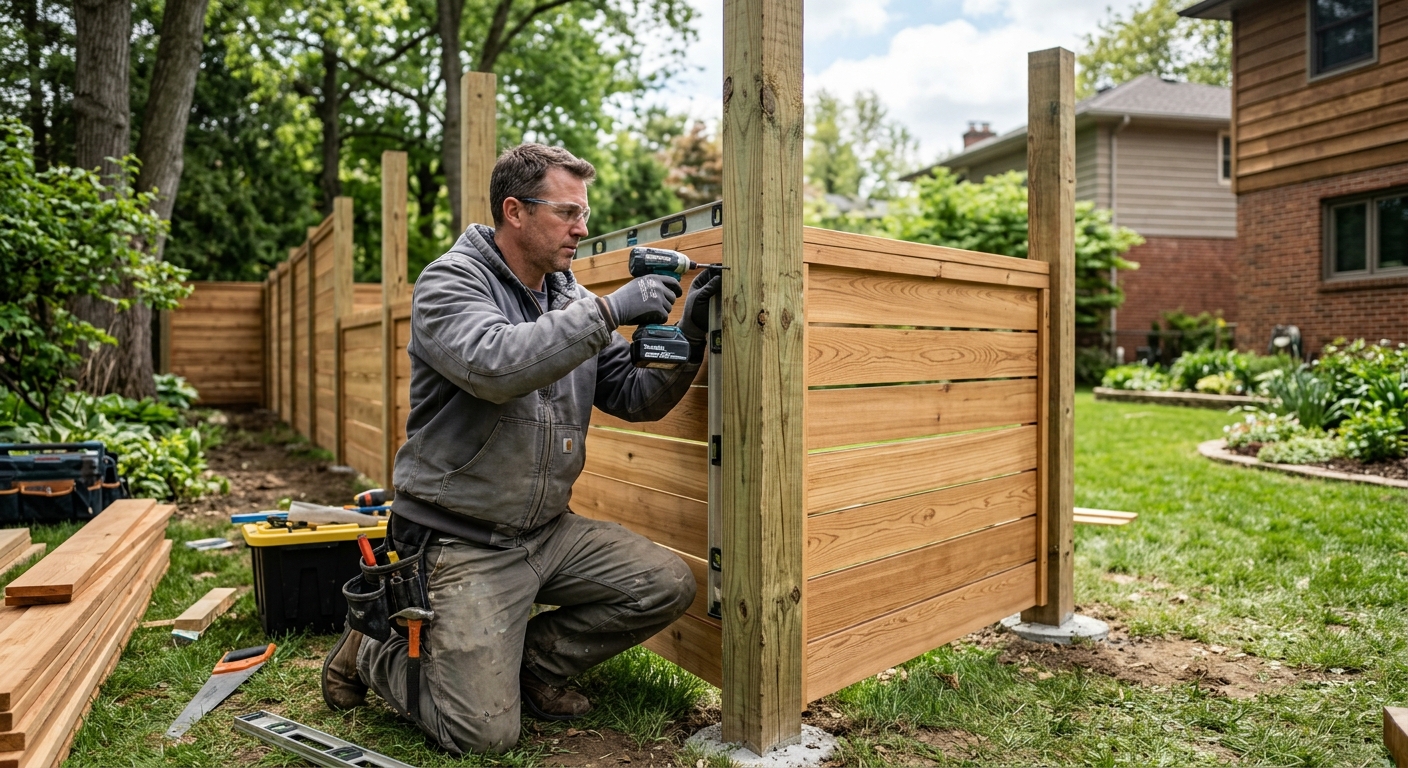
Fencing options and costs in Yonge-Eglinton
In Yonge-Eglinton, the right fence usually comes down to how much privacy you want, how often you’re willing to maintain it, and how the ground freezes in Southern Ontario. With a local population of 11,817 (Statistics Canada, 2021 Census), the Yonge-Eglinton area still sees steady demand because detached and townhome properties along major corridors tend to replace aging boundaries and add gates for pets and kids. In practice, that means contractors are familiar with common backyard layouts, side-yard access challenges, and the mix of older lots that need careful property-line checks before any trenching starts. Toronto’s frost behaviour also shapes pricing: posts for taller privacy fencing need to be set well below ground level to reduce frost heave risk, which increases concrete-setting labour and the amount of post/aggregate you use.
Solid 6–8 ft privacy fences (wood or vinyl) are common where neighbours are close and snow drifting can make visibility important. In spots like the Yonge Street–Eglinton Avenue area, where lots can be more constrained by driveways and landscaping, access and demolition scope can noticeably swing the quote. For comparison, solid materials often cost more per linear foot than chain-link, but they’re usually the best match for backyard privacy and wind shielding in Toronto’s winter freeze-thaw cycle. Below is a homeowner-friendly comparison by material so you can benchmark any quote you receive.
| Material |
Lifespan |
Maintenance |
Privacy Rating |
Price per Linear Foot |
| Pressure-treated pine (standard wood) |
10–15 years |
Stain/seal every 2–3 years to slow greying and splitting |
High (solid pickets/panels) |
$12 – $20 |
| Cedar (natural rot resistance) |
15–25 years |
Light staining every 2–4 years; inspect for loose boards |
High (solid pickets/panels) |
$16 – $26 |
| Vinyl / PVC (no-maintenance) |
20–30 years |
Minimal cleaning; replace damaged sections if impacted |
High (solid styles) |
$18 – $28 |
| Chain-link (galvanized steel) |
20–30 years |
Occasional wash; tension checks if gates sag |
Low–Medium (privacy slats add privacy) |
$10 – $16 |
| Aluminum ornamental |
25–40 years |
Wash annually; spot paint touch-ups if needed |
Low (open style) |
$16 – $26 |
| Composite / recycled material |
20–30 years |
Low; protect from impact and check hardware periodically |
Medium–High (depends on panel design) |
$17 – $30 |
Prices are estimates only and vary by project scope, site access and material selection.
What affects the price of fencing in Yonge-Eglinton
In Toronto (and right across Ontario), two quotes for the “same” fence can differ by 30–50% because the biggest cost drivers—post excavation depth, how posts are set, access for equipment, and removal/disposal of the old fence—often change from lot to lot. Even when the material is identical, Yonge-Eglinton projects commonly vary in gate count, slope, and how much concrete setting is required to handle freeze-thaw movement. In Southern Ontario, the frost line is commonly estimated around 42"–48", so contractors typically set posts about 4–6 inches below the design frost depth to prevent heaving. That usually means posts end up about 1.5–2.0 m deep, and for 6–8 ft privacy fences the added hole depth and concrete labour are a real part of the total cost.
Concrete-setting also raises material costs because longer posts are needed and you’ll use more ready-mix or on-site mix. In addition, while Toronto doesn’t have Prairies-level wind exposure, racking still matters: solid panel fences tend to need heavier posts and tighter spacing (often 6–8 ft centres) to stay straight against seasonal loads and snow impacts. Coastal BC’s wet climate accelerates wood rot without proper treatment, but in Yonge-Eglinton the bigger issue is freeze-thaw cycles—so the “how” matters as much as the “what”.
Here are practical examples we see locally: (1) A straight 50 ft run with 2 gates can land near the lower end of the chain-link band, while adding 1–2 extra posts for alignment can push wood or vinyl closer to the mid-range. (2) A 6 ft fence on a modest slope often requires stepped panels, which increases labour time and hardware versus a flat grade. (3) If demolition and hauling are included, removing an old fence stuck in compacted soil can add more labour than homeowners expect—sometimes enough to swing a $3,000-style budget job into the $4,000-plus range. For benchmarking, many homeowners notice wood installation falls roughly in the $65–$120 band, while vinyl/PVC often starts higher in the $75–$130 band for comparable heights and post spacing.
| Price Factor |
Why It Matters |
Cost Impact |
| Fence length in linear feet |
More run = more posts, rails, fasteners, and labour time. |
Primary driver (often 40–60% of the total) |
| Post depth required |
Frost line determines hole depth and post length to prevent heaving. |
Can add 10–25% depending on soil and depth |
| Post setting method |
Concrete-set posts resist movement better than gravel pack or driven posts. |
Concrete setting typically increases costs 5–20% |
| Material choice |
Vinyl/cedar cost more upfront; chain-link is usually the cheapest. |
Often shifts the quote by 20–40% end-to-end |
| Gate count and type |
Gates add framing, hinges, latches, and extra posts for support. |
Each gate commonly adds a meaningful line item (10–25% total) |
| Grade and terrain |
Sloped yards need stepped or raked panels and extra measurements. |
Can add 5–15% for layout and materials |
| Old fence removal and disposal |
Demolition, hauling, and dump fees can be labour- and access-dependent. |
Often adds 5–20% (sometimes more on tight sites) |
| Permit fees and survey / property line locate |
Administrative steps and locating pin positions protect you from encroachment. |
Varies, but budget a few hundred dollars to low-thousands |
Permits & regulations in Ontario
In Ontario, permits are often required when a fence exceeds typical height thresholds—commonly around 2.0 m (6.5 ft) for rear yards and about 1.0–1.2 m (3–4 ft) for front yards or corners, though local municipal rules can fine-tune this. Even when a permit isn’t triggered, you still must respect property lines and any municipal setback requirements that apply to your lot. Before any post holes are dug, call for utility locates through Ontario One Call to mark buried services. This is essential in older Yonge-Eglinton lots where landscaping and previous work can hide conduits or service lines.
Step-by-step for homeowners: (1) Confirm your property line using a survey or by locating your property pins so you don’t build on or past the boundary. (2) Ask your contractor whether they pull permits when required and include it in the quote scope. (3) Verify contractor credentials: you should ask for the Ontario licence details where applicable, a current certificate of liability insurance, and WSIB/WCB clearance for worker coverage. In practice, you can check liability coverage validity from the certificate and confirm WSIB/WCB status through the appropriate employer clearance process.
Work that typically does NOT require a permit: most fences below the common height thresholds, standard repairs, and fence panel replacements on the same footprint (when not altering height or location). Work that DOES often require a permit: new tall fences that exceed the usual height limits, significant changes in fence location/footprint, and certain installations that impact sightlines or setbacks.
Choosing the right fence material for Yonge-Eglinton
Choosing a fence material in Yonge-Eglinton is really about matching Toronto’s freeze-thaw winter reality to your priorities: privacy, low maintenance, budget, and expected lifespan. Pressure-treated pine is the most budget-friendly starting point, but it needs staining/sealing every 2–3 years to reduce grey weathering and splitting. Cedar looks better longer because it resists rot naturally, yet it still benefits from periodic maintenance—especially along wet, splash-prone edges. Vinyl/PVC is popular for low-maintenance living, but in extreme cold it can become more brittle if panels are underbuilt or if impacts occur; quality installation with solid post spacing matters. Chain-link is typically the longest-life budget option, but it gives little privacy unless you add privacy slats or a secondary screen. Aluminum ornamental fences offer an attractive, rust-resistant barrier with minimal upkeep, though they’re not designed for high privacy.
For Toronto’s frost conditions, most contractors recommend concrete-set posts for solid fences. With commonly used frost depth planning (around 42"–48"), that typically puts the practical post depth in the 1.5–2.0 m range for taller fences. That’s one reason vinyl or wood privacy fences may cost more than homeowners expect: the stronger installation (and sometimes heavier posts and closer spacing) helps the fence resist racking during winter and thaw cycles.
As a dollar example, if a chain-link option comes in near the lower band (roughly $45–$85 installed per linear foot), a comparable-length 6 ft solid wood privacy fence may land closer to the $65–$120 band, and a vinyl/PVC privacy fence often comes in higher (around $75–$130). That added cost is justified when you need real privacy and wind buffering—not just a boundary line.
| Material |
Cold Tolerance |
Lifespan |
Annual Maintenance |
Best For |
Price Band |
| Pressure-treated pine |
Good when properly set and sealed; check for board splitting after freeze-thaw |
10–15 years |
2–3 years staining/sealing (plus quick inspections) |
Budget privacy with willingness to maintain |
$65 – $120 |
| Cedar |
Good; handles winter moisture better than many softwoods |
15–25 years |
Light staining/finishing every 2–4 years |
Better appearance and longer-lasting wood privacy |
$75 – $130 |
| Vinyl / PVC |
Very good; can crack if panels are stressed or impacted |
20–30 years |
Minimal cleaning; inspect posts/hardware |
Low maintenance privacy |
$75 – $130 |
| Chain-link |
Good; galvanized steel tolerates freeze-thaw well |
20–30 years |
Occasional wash; check tension at gates |
Secure boundary at lowest cost |
$45 – $85 |
| Aluminum ornamental |
Excellent; won’t rust under Ontario conditions |
25–40 years |
Annual wash and spot touch-ups if needed |
Attractive, durable front/side fencing |
$90 – $160 |
| Composite / recycled |
Good; performs well if installed with correct spacing and solid posts |
20–30 years |
Low; clean and inspect fasteners |
Low-maintenance privacy with less timber upkeep |
$75 – $130 |
How to choose a fencing contractor in Yonge-Eglinton
To choose a fencing contractor in Yonge-Eglinton, verify three things up front: Ontario licensing where applicable, liability insurance, and WSIB/WCB coverage. Start by asking for a current certificate of insurance—then confirm the coverage limits and that the certificate is active for the project period. For WSIB/WCB, ask for clearance details or proof of current coverage so you’re not financially exposed if something happens on site. If a contractor won’t provide documentation, that’s usually a sign to move on.
Next, request 2–3 itemised written quotes. You want a breakdown that separates labour (layout, digging, setting, assembly) from materials (posts, rails, pickets/panels, hardware) and includes line items for gates, post-depth/concrete setting, and any required disposal. Avoid lump-sum quotes that don’t state whether demolition and hauling are included or excluded. Confirm whether permits are included and who is responsible for locating utilities. Make sure the scope also lists how they handle survey/property line verification.
Look at warranty terms: ask for the workmanship warranty length (how long they stand behind installation), the product/manufacturer warranty (what it covers), and whether warranties are transferable if you sell the home. For payment schedule, don’t pay more than about 10–15% upfront; hold back the remainder until the job is complete, aligned, and cleaned up. Finally, get a written start date and completion estimate so you have a clear timeline and accountability.
- Ask for proof of liability insurance and verify dates match your project.
- Request WSIB/WCB clearance/coverage proof for workers on site.
- Get an Ontario licence detail where applicable and confirm it’s current.
- Require 2–3 itemised quotes (labour vs materials, not just one total).
- Confirm post depth and whether posts are concrete-set for frost protection.
- Ensure quotes specify post spacing (e.g., 6–8 ft centres for privacy panels).
- Clarify what’s included in gate hardware (hinges, latches, frames).
- Verify disposal/dump fees and whether demolition is included.
- Ask who pulls permits (if required) and whether costs are included.
- Confirm utility locate responsibility before digging and trenching.
- Review warranty: workmanship duration plus manufacturer warranty terms.
- Set payment milestones: no more than 10–15% upfront; holdback until completion.
Red flags in Yonge-Eglinton include contractors who won’t state post-depth or concrete-setting methods, quotes that omit gate hardware details, vague “includes everything” language with no exclusions, insisting on large upfront payments, and refusing to provide insurance/WSIB/WCB documentation in writing.
Frequently asked questions — fencing in Yonge-Eglinton
How much does a fence cost in Yonge-Eglinton?
In Yonge-Eglinton, pricing depends mainly on fence length, height, gate count, access, and whether posts are concrete-set to handle Southern Ontario frost. As a practical benchmark for homeowners: chain-link is usually the lowest cost option at roughly $45 – $85 installed per linear foot, while wood fences commonly land around $65 – $120 installed per linear foot and vinyl/PVC often ranges $75 – $130. Taller solid privacy fences cost more because they need heavier posts, closer spacing, and deeper excavation (often roughly 1.5–2.0 m post depth in frost-planning). If you have an older fence for removal, demolition/haul-away can add another meaningful line item. Always compare like-for-like: panel height, post spacing, and post setting method.
How deep should fence posts be for Yonge-Eglinton's frost?
For Yonge-Eglinton and the wider Toronto area, the frost line is commonly planned at about 42"–48", so contractors typically set fence posts about 4–6 inches below the design frost depth to reduce frost heaving. In real terms, that usually means about 1.5–2.0 m into the ground for many privacy fence builds, especially for 6–8 ft fences. This depth matters more than most people expect because freeze-thaw movement can rack panels, loosen hardware, and cause leaning over time. Most stable installs therefore use concrete-set posts rather than simple driven posts in frost-prone, mixed/clay soils. Your local soil condition and fence type (solid panels vs open) can shift the exact depth and post size, so the best quote will clearly state excavation depth and setting method.
Wood vs vinyl vs aluminum fence — which is best?
There isn’t one “best” option for all Yonge-Eglinton homes; the best choice matches your maintenance tolerance and privacy needs. Wood (pressure-treated pine or cedar) is a strong value for privacy, but it typically needs staining/sealing every 2–3 years to slow grey weathering and keep boards from splitting. Vinyl/PVC is the lowest-maintenance for privacy in Toronto conditions—typically no regular staining—but it costs more upfront and should be installed with correct post spacing to avoid stress in cold snaps. Aluminum ornamental is excellent if you want a durable, rust-free look with minimal upkeep; however, it’s generally an open style, so privacy is limited. If you’re comparing budgets, homeowners often see wood near $65 – $120 and vinyl/PVC near $75 – $130 per linear foot, and they choose the higher cost when they truly want low-maintenance privacy.
Do I need a permit to build a fence in Ontario?
Ontario rules commonly trigger permits when fences exceed typical height thresholds—often around 2.0 m (6.5 ft) for rear yards and about 1.0–1.2 m (3–4 ft) for front yards or corners—though municipal details can vary. Even without a permit, you still must respect property lines and any municipal setback bylaws. In Yonge-Eglinton, it’s wise to confirm with your contractor whether permits are needed before installation, and whether survey/property-line locate work is part of their process. Also, before any digging, you must have utility locates done through Ontario One Call to mark buried services. For shared fence boundaries, follow line-fence rules and clarify ownership/maintenance responsibilities. A good contractor will ask for your pin locations or survey info and will spell out permit responsibility in writing.
How long does a wood fence last in Yonge-Eglinton?
Wood lifespan in Yonge-Eglinton depends heavily on species and how it’s installed. Pressure-treated pine often lasts about 10–15 years in typical conditions when it’s properly set and maintained, while cedar more commonly achieves 15–25 years because of its natural rot resistance. The biggest longevity factor is what happens at the base: if posts aren’t set deep enough for frost-planning and the installation doesn’t resist freeze-thaw movement, panels can loosen and moisture can accelerate deterioration. Maintenance also matters—staining/sealing every 2–3 years helps reduce grey weathering and protects against cracking. If your yard has lots of snow loading against the fence, or sprinklers wet the bottom rails, plan for more frequent inspections and minor repairs. A well-built wood fence with concrete-set posts can outperform a cheaper install that uses driven posts and minimal excavation.
Who owns and maintains a shared fence?
For shared fence situations in Ontario, ownership and maintenance typically depend on where the boundary lies and any agreement or established understanding between neighbours. Ontario’s line-fences legislation governs shared boundary responsibilities, so the first step is to confirm the property line using your survey or locate your property pins. If the fence is truly on or shared across the boundary, both sides may share responsibility, but in practice the details matter: who installed it, whether both neighbours use it for security, and whether there’s a past arrangement about repairs. In Yonge-Eglinton neighbourhoods, disputes are often avoided by documenting decisions in writing and confirming the location before work begins. When getting quotes, ask whether the contractor can build on the correct line (and how they handle layout) and whether both neighbours sign off on agreed changes such as replacing deteriorated panels or adding gates.