Fencing options and costs in Cookstown
In Cookstown, fencing demand is closely tied to how many homeowners are willing to invest in outdoor privacy, and the community’s small population of 1,214 (Statistics Canada, 2021 Census) means word-of-mouth recommendations travel fast. The Toronto economic region also tends to have a steady stream of projects because fences get treated as “home improvements” rather than just boundary markers—especially when properties are upgrading landscaping, driveways, or backyard living spaces. If you’re looking for privacy, you’ll typically see the most contractor activity around family-oriented residential pockets near the village core, where lots are used heavily in summer and neighbours prefer well-defined boundaries.
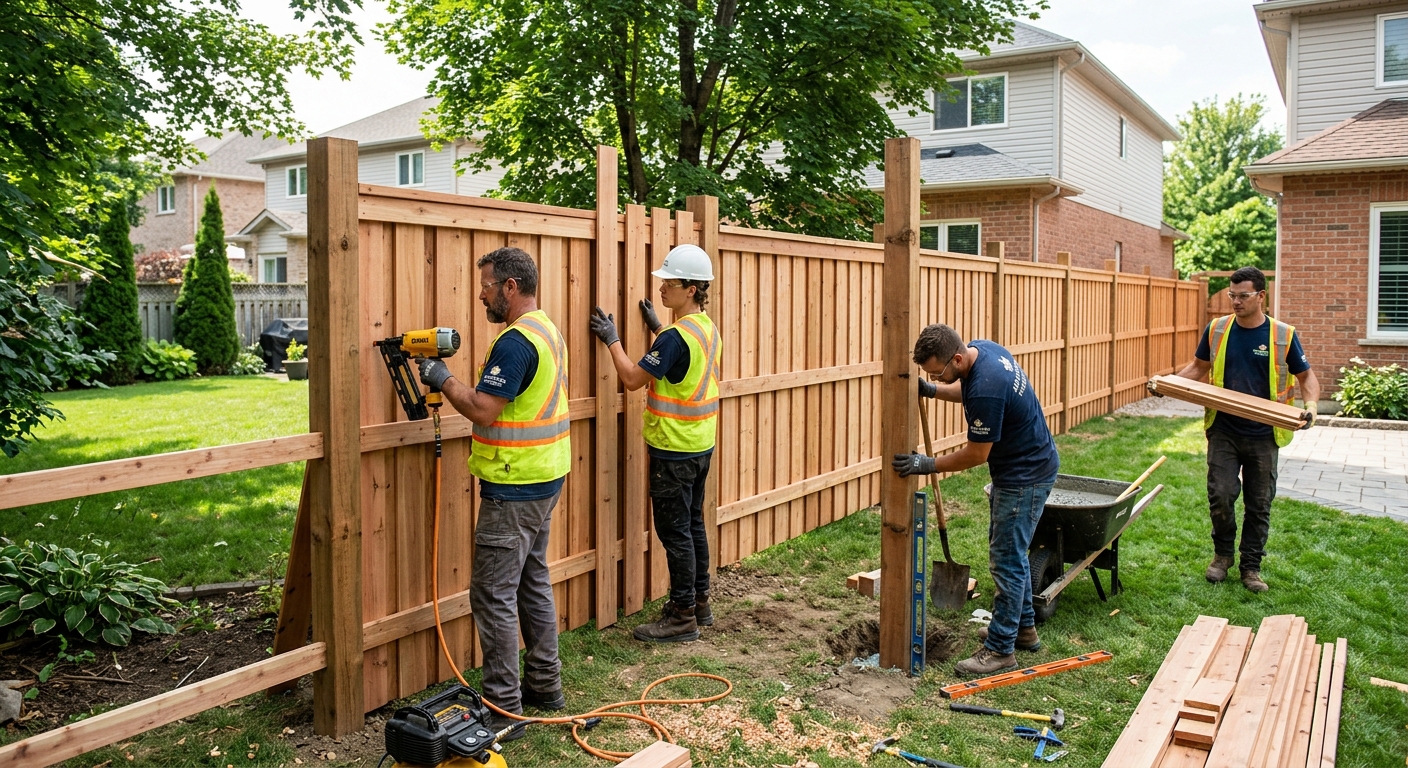
Pricing in the Toronto region is shaped by Southern Ontario’s freeze-thaw cycle and the practical reality of setting posts below frost to prevent heaving. Local installers commonly plan for a frost line around 42"–48" and set posts about 3.5–4 feet deep for privacy fences, often using concrete-set methods. That adds labour and ready-mix costs, but it reduces the “leaning fence” problems homeowners see after a couple of winters. Access also matters in Cookstown: narrower sides of lots, mature trees, and snow season ground conditions can change how quickly crews can dig, set, and brace panels.
Below are realistic cost ranges you can use to compare materials in Cookstown, then we’ll break down what pushes a quote up or down in the next section.
| Material |
Lifespan |
Maintenance |
Privacy Rating |
Price per Linear Foot |
Price Range |
| Pressure-treated pine (standard wood) |
8–15 years |
Stain/seal every 2–3 years |
Good (solid/close-board) |
$65–$120 |
$65 – $120 |
| Cedar (natural rot resistance) |
12–20 years |
Reseal/stain every 2–4 years |
Good (solid/close-board) |
$75–$130 |
$75 – $130 |
| Vinyl / PVC (no-maintenance) |
20–30 years |
Wash as needed; no staining |
Very high (solid privacy panels) |
$75–$130 |
$75 – $130 |
| Chain-link (galvanized steel) |
20–35 years |
Occasional cleaning; inspect fittings |
Low (security only) |
$45–$85 |
$45 – $85 |
| Aluminum ornamental |
25–40 years |
Rare: wash and inspect hardware |
Low to medium (open pickets) |
$90–$160 |
$90 – $160 |
| Composite / recycled material |
20–30 years |
Wash; minimal repairs |
High (solid boards) |
$85–$150 |
$85 – $150 |
Prices are estimates only and vary by project scope, site access and material selection.
What affects the price of fencing in Cookstown
In Cookstown and across the wider Toronto area, it’s common to see quotes for the “same fence” swing by 30–50%. The reason is that Toronto-region projects are rarely identical: post depth, panel style, gate hardware, and how difficult it is to access the work zone all drive real labour differences. In a market where the typical privacy fence uses concrete-set posts to manage freeze-thaw movement, your excavation and materials costs can change even if the fence length stays the same.
The biggest technical driver is frost line depth. Best practice is typically to set posts about 4–6 inches below the design frost depth; in Southern Ontario, that often means 1.5–2.0 m into the ground. That requirement typically increases both labour time and material cost because crews need longer posts, wider/cleaner holes, and more ready-mix when building a stable footing—especially for 6–8 ft privacy fences. While Toronto isn’t as wind-exposed as the Prairies, we still need to account for uplift and racking, so taller solid panels often use heavier posts and tighter spacing (commonly 6–8 ft centres).
Three local examples that commonly raise cost in Cookstown: (1) clay/mixed soils that hold water can slow drilling and make hole excavation messier; (2) longer fence runs with corner returns often add bracing and stronger posts; and (3) multiple gates (including double drive gates) add hardware, reinforcement, and precision alignment. Conversely, costs can be lower when you’re replacing an existing fence footprint with straightforward access and minimal grading.
Material choice also matters. If you’re comparing wood at roughly $65 – $120 versus vinyl/PVC at roughly $75 – $130 per linear foot, the “extra” can be justified when you expect low maintenance needs over Ontario winters and summers. Older housing stock can also affect foundations and buried service lines, which means more time for careful utility locating before any holes are dug—another cost lever that shows up on itemised quotes.
| Price Factor |
Why It Matters |
Cost Impact |
| Fence length in linear feet |
Most costs scale directly with run length: posts, rails, panels, fasteners |
Highest impact; often the #1 driver |
| Post depth required |
Frost protection dictates hole depth and post length |
Can add significant labour and concrete |
| Post setting method |
Concrete-set posts vs gravel pack vs driven posts changes materials and stability |
Concrete-set usually costs more but reduces failures |
| Material choice |
Vinyl/cedar typically cost more up front; chain-link costs less but offers less privacy |
Shifts price band (e.g., wood vs chain-link) |
| Gate count and type |
Walk-through gates are simpler; drive-through double gates need heavier frames |
Adds hardware, reinforcement and install time |
| Grade and terrain |
Slopes require stepped or raked panels and additional materials |
Often increases labour and cutting waste |
| Old fence removal and disposal |
Demolition time, stump/anchor removal, and hauling fees |
Can materially increase the total |
| Permit fees and survey / property line locate |
Longer fences near setbacks may require administrative steps |
Small to moderate add-on; prevents costly disputes |
Permits & regulations in Ontario
In Ontario, fence permits are often triggered by height. As a practical rule in many municipalities, fences above about 2.0 m (6.5 ft) at the rear and around 1.0–1.2 m (3–4 ft) at the front or corner may require a building permit, and setback requirements still apply. Even if your goal is privacy, you can’t assume “any height is fine”—municipal setback bylaws and property line location govern what you can install. In Cookstown, that means confirming where your boundary really sits (especially if previous fences were put in decades ago).
Before digging any post hole, you should always arrange utility locates through Ontario One Call. This is for your safety and for avoiding service interruptions. Next, obtain a survey or at minimum verify property pins/locate the line with a professional if there’s any uncertainty; this protects you from encroachment disputes with neighbours.
For shared fence ownership, Ontario’s line-fences rules generally guide responsibilities when a fence is on or between properties—details depend on how the boundary fence is defined and who benefits. To verify a contractor, ask for their Ontario licensing information (if applicable to their work), proof of liability insurance, and proof of WSIB/WCB coverage.
Step-by-step: (1) request a current certificate of insurance and check the expiry date and insured name; (2) confirm WSIB/WCB clearance or account status; (3) verify licence details through the relevant Ontario online sources where available; (4) keep all paperwork with your contract and quote references.
Choosing the right fence material for Cookstown
Choosing the right fence material in Cookstown is mostly about matching your priorities—privacy, low maintenance, and lifespan—to the realities of Southern Ontario winters and fast spring thaw. For pressure-treated pine, you get the budget-friendly entry point, but wood will weather: expect to stain or seal about every 2–3 years to keep it looking clean and to slow grey weathering and surface cracking. Cedar is a step up in appearance and rot resistance; it often holds up better in damp cycles, but it still needs periodic staining/maintenance for longevity.
Vinyl/PVC offers “set it and forget it” convenience with minimal upkeep, but in very cold snaps it can be more brittle than wood, so quality systems and proper installation matter. Chain-link is the longest-life low-cost option, but it doesn’t provide privacy—only security. Aluminum ornamental gives great curb appeal and won’t rust, yet it’s typically open picket style, so privacy is limited. For true privacy in the Toronto market, many homeowners choose vinyl, wood, cedar, or composite with solid panel configurations.
Post depth also ties back to material choice. Because frost line requirements are common across the region, you’ll usually still need concrete-set posts for tall privacy fences—often set about 3.5–4 feet deep—to avoid heaving. In areas with more exposure (corner lots or open backyards), heavier posts and tighter spacing help resist racking from wind and snow loads. A simple rule: if you’re paying for tall solid privacy, don’t cut corners on footings.
For example, if wood privacy comes in around $65 – $120 per linear foot and vinyl privacy is around $75 – $130, the additional cost can be justified for homeowners who want fewer weekend maintenance projects during Ontario’s wet springs and busy summers. When access is tight and post-setting is the same either way, the “real” value becomes reduced upkeep over time.
| Material |
Cold Tolerance |
Lifespan |
Annual Maintenance |
Best For |
Price Band |
| Pressure-treated pine |
Good with proper spacing and sealing |
8–15 years |
Inspect 1–2 times; stain/seal every 2–3 years |
Budget-first privacy |
$65–$120 |
| Cedar |
Good; handles damp cycles better |
12–20 years |
Light cleaning/inspection; stain every 2–4 years |
Natural look with better rot resistance |
$75–$130 |
| Vinyl / PVC |
Very good in typical GTA cold when installed correctly |
20–30 years |
Wash as needed; check brackets/hardware |
Low maintenance privacy |
$75–$130 |
| Chain-link |
Excellent (galvanized steel) |
20–35 years |
Occasional cleaning and tension check |
Security and long service life |
$45–$85 |
| Aluminum ornamental |
Excellent (no rust system) |
25–40 years |
Minimal; periodic wash |
Appearance with low upkeep |
$90–$160 |
| Composite / recycled |
Good; stable boards with quality installation |
20–30 years |
Wash; quick spot repairs if needed |
Solid privacy with durable boards |
$85–$150 |
How to choose a fencing contractor in Cookstown
Choosing the right fencing contractor in Cookstown starts with verifying credentials and protecting yourself from delays or workmanship issues. In Ontario, ask for proof of liability insurance (certificate of insurance), and confirm WSIB/WCB coverage depending on the worker/employer relationship. When you request documentation, look for: current dates, the correct business name, and coverage limits that make sense for property work. For example, a proper COI should clearly list the insured contractor and show it’s active before the start date. If a company can’t provide clearance information or a current certificate, pause and ask why.
Next, get 2–3 itemised written quotes—not one lump-sum number. A good quote separates labour and materials, lists footing/post depth assumptions, shows whether concrete-set posts are included, identifies gate hardware (hinges, latches, reinforcement), and clarifies demolition and disposal. Scope clarity is essential in Cookstown because frozen ground, clay pockets, and access constraints can add labour if they weren’t accounted for during measuring. Confirm whether your quote includes permit pulls (where required), property line locate/survey costs (if used), and hauling away old fencing.
Warranty matters too: ask for a workmanship warranty length, the manufacturer’s product warranty, and whether warranty coverage is transferable if you sell your home. Payment schedule should be conservative: never pay more than 10–15% upfront, and use a holdback until the fence is complete, cleaned, and inspected. Get a start date and an estimated completion timeline in writing so you can plan around Ontario weather and landscaping disruption.
- Request certificate of insurance and verify it’s current.
- Confirm WSIB/WCB coverage or clearance letter for the installing crew.
- Ask for the specific footing plan: concrete-set vs gravel pack vs driven.
- Ensure the quote lists post depth assumptions for frost protection.
- Get an itemised breakdown of labour hours, materials, and hardware.
- Confirm gate reinforcement and hardware grade (especially drive gates).
- Clarify disposal: who hauls away old fencing and debris.
- Check how the contractor handles sloped yards (stepped vs raked panels).
- Ask about how they protect lawns/driveways during excavation.
- Confirm utility locates are arranged before digging.
- Review warranty terms in writing: workmanship + product coverage.
- Ask for a written timeline including weather-related contingencies.
Red flags in Cookstown include: refusing to provide itemised quotes, quoting a tall privacy fence without discussing concrete-set posts or frost depth, vague warranty language (“we’ll fix it if it breaks” with no term), asking for a large upfront payment (over 10–15%), and skipping proof of insurance/coverage. If you see any of these, get another quote before signing.
Frequently asked questions — fencing in Cookstown
What is the cost per linear foot for fencing in Cookstown?
In Cookstown, fencing is commonly priced by material and installed complexity, and the typical installed bands for the Toronto region are a good reference point. Wood fencing generally lands around $65 – $120 per linear foot, while vinyl/PVC privacy is often around $75 – $130 per linear foot. Chain-link tends to be lower at roughly $45 – $85, and aluminum ornamental is typically in the $90 – $160 range. Your final number depends heavily on post-setting (often concrete-set for stability), fence height, gate count, demolition of old fencing, and how accessible the yard is for excavation. If your project requires stepped panels due to grading, expect labour to rise even if the linear footage is the same.
Should I repair or replace my old fence in Cookstown?
In Cookstown, repairing often makes sense when posts are solid, the fence line is still straight, and the issue is limited to boards/panels or a few loose rails. If you’re dealing with widespread leaning, soft posts, or rot at the base—common after multiple Ontario freeze-thaw cycles—replacement is usually more cost-effective over the long run. The biggest indicator is footing integrity: if the old posts weren’t set below frost or concrete settling wasn’t used where it should have been, repairs can hold temporarily and fail again sooner. Also consider privacy needs: if you’re moving from open pickets to true privacy, replacement is the practical upgrade path. A reputable contractor will inspect the post condition before recommending a full replacement or a targeted fix.
How do I handle a fence dispute with a neighbour in Ontario?
Fence disputes are stressful, so it helps to slow down and document everything. Start by reviewing your property line information—ideally using a survey or confirming property pins. Next, check the fence height and placement against municipal setback expectations and any local interpretation of Ontario line-fences responsibilities. If the fence is on or between properties, responsibilities can be shared depending on how the boundary is defined. Communicate in writing: share photos, your contractor’s measurements, and a clear proposal (repair vs replace, and who would bear costs). If you can’t agree, a professional fence locate/survey can clarify the boundary and reduce “guesswork.” In the meantime, don’t remove sections without understanding access and responsibility—Ontario neighbours often respond faster when you stay factual and organized.
What fence style offers the best wind resistance in Cookstown?
Wind resistance in Cookstown is less extreme than the Prairies, but tall fences can still rack and uplift during storms—especially where yards are more exposed. The most reliable approach is a solid privacy fence built with heavier posts and appropriate spacing, typically concrete-set posts set deep enough to resist movement. Closed-top solid designs (wood, vinyl/PVC, or composite) often outperform overly lightweight construction because they control panel flex, but they must be engineered for stability: thicker posts, correct rail spacing, and solid bracing at corners. Chain-link is durable but won’t provide privacy; its wind “give” is different—usually not the style you’d choose if your primary goal is both privacy and wind performance. The best result comes from proper footing depth and panel attachment, not just the material name.
How much does a fence cost in Cookstown?
The total cost depends on linear footage, height, material, gate count, and whether you’re removing an old fence. As a planning reference, wood and cedar installed pricing is commonly in the $65 – $120 range, vinyl/PVC is often $75 – $130, and chain-link tends to be $45 – $85 in this region. For a typical privacy run with concrete-set posts (common in Southern Ontario frost conditions), taller heights usually push you toward the higher end of the band because more labour and stronger framing are required. If you have a double drive gate, expect add-on costs for reinforcement and hardware. The most accurate way to estimate your total is to get itemised quotes that include post depth assumptions and demolition/disposal scope.
How deep should fence posts be for Cookstown's frost?
For Cookstown and surrounding Southern Ontario properties, frost protection is the reason fence posts are usually set deeper than homeowners expect. A common best-practice approach is to account for the design frost depth (often estimated around 42"–48" in Southern Ontario) and set posts approximately 3.5–4 feet deep for privacy fences, which also places the footing below the frost line. Practically, that means posts often go about 1.5–2.0 m into the ground depending on the system used and the local soil/grade conditions. In many Toronto-region installations, that depth is achieved with concrete-set posts because clay/mixed soils and freeze-thaw movement can destabilize driven posts. If your contractor proposes shallow posts “because it’s just one fence,” ask how they’re meeting frost heave prevention and whether concrete-set footings are included.