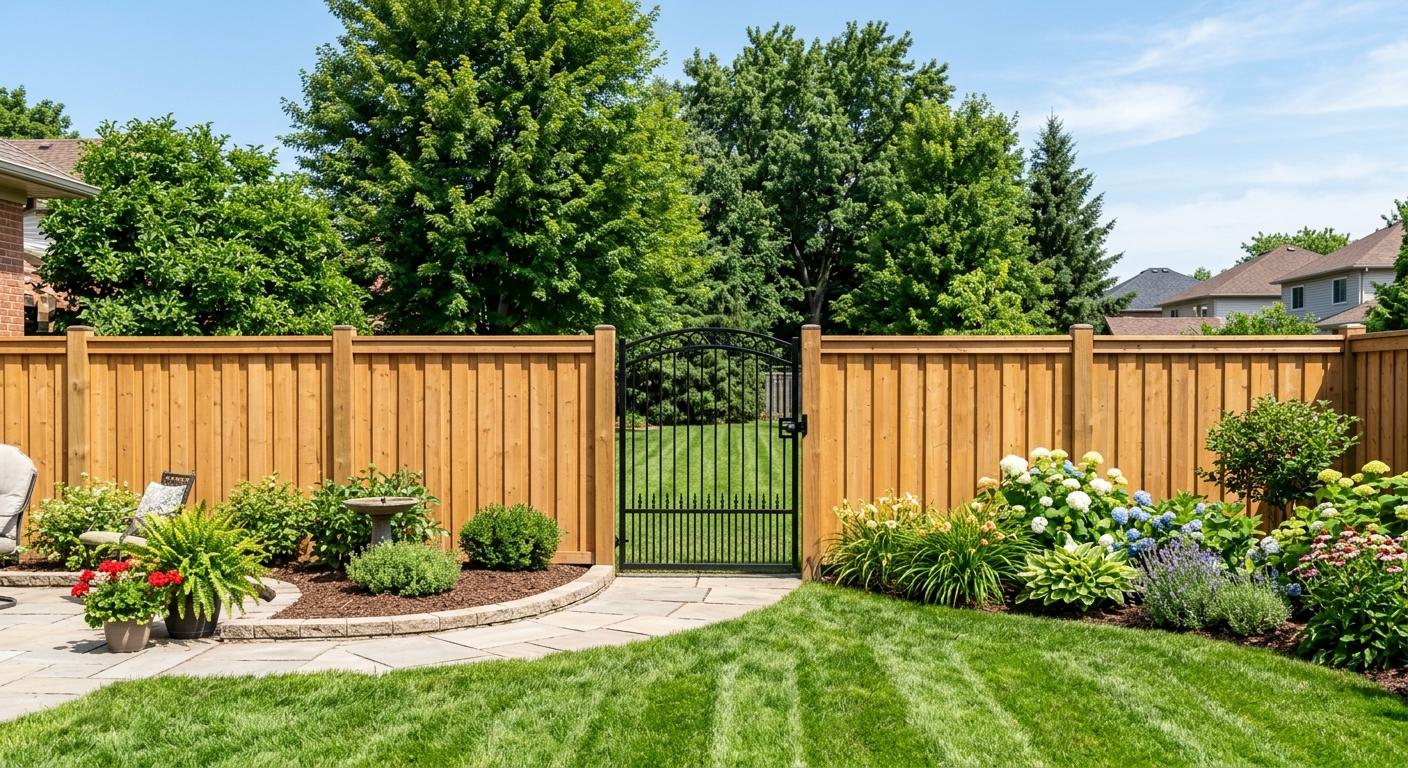
Fencing options and costs in Gloucester
Fencing in Gloucester can look similar from the street, but the actual cost is shaped by local demand and Ontario winter realities. With a population of 150,012 in 2021 (Statistics Canada, 2021 Census), Gloucester is a mature Ottawa-area market where fencing work is steady—especially in neighbourhoods with lots of detached and suburban lots that typically need boundary and privacy coverage. The strongest driver of repeat installs and new builds is the mix of housing types around the Ottawa economic region, where families often upgrade backyard privacy and front-edge landscaping as properties age (Statistics Canada, 2021 Census).
In winter, Ottawa-area frost depth is about 3.5–4 ft, and quality contractors plan for posts close to 4 ft to reduce winter heave and leaning. That deeper digging means more labour hours, more machine time, and more disposal for excavated soil—so you’ll usually see higher “installed” pricing than in milder parts of Canada. Wind and drifting snow loads also matter for privacy fences; panels act like sails, so post spacing and footing sizing are chosen for gusty conditions, not just summer static loads.
Contractor availability can also shift pricing. During peak spring–early summer installs, crews that can reliably set posts to the frost line (and pour concrete footings in clay soils) may charge toward the top end of Ontario residential ranges—often when demand is strongest in areas like Orleans and other fast-moving residential pockets where new landscaping and backyard projects are common.
Use the table below to compare typical lifespan, maintenance, privacy, and pricing so you can line up options before you request itemised quotes.
| Material |
Lifespan |
Maintenance |
Privacy Rating |
Price per Linear Foot |
| Pressure-treated pine (standard wood) |
12–18 years |
Stain/seal every 2–3 years |
High (solid pickets) |
$40 – $75 |
| Cedar (natural rot resistance) |
15–25 years |
Re-stain yearly to every 2 years (as needed) |
High (solid pickets) |
$55 – $95 |
| Vinyl / PVC (no-maintenance) |
20–30 years |
Wash only (annual rinse) |
High (solid panel systems) |
$45 – $80 |
| Chain-link (galvanized steel) |
25–40 years |
Occasional rinse and tension checks |
Low–Medium (not private by itself) |
$25 – $50 |
| Aluminum ornamental |
25–40 years |
Rinse; repaint only if custom powdercoat requires touch-ups |
Low–Medium (open pickets) |
$70 – $120 |
| Composite / recycled material |
25–35 years |
Wash; no staining |
Medium–High (depends on board spacing) |
$65 – $105 |
Prices are estimates only and vary by project scope, site access and material selection.
What affects the price of fencing in Gloucester
In Gloucester and the wider Ottawa region, two quotes for what looks like the “same” fence can differ by 30–50% because the buried and exposed parts of the job change—especially in winter. The biggest differences come from how deeply posts must be set for Ottawa’s frost depth (about 3.5–4 ft), the soil type around your property, and how windy your lot is when the fence is acting like a sail. Labour costs and machine time are also higher when digging is deeper and concrete is required, which is why a wood fence might land in the $40–$75 range while cedar or higher-end installs can push toward the upper bands.
Here’s the key: posts should be installed roughly 4–6 inches below the design frost depth to prevent freeze–thaw heaving. In cold Ontario, that often translates to setting posts at about 1.5–2.0 m into the ground. Deeper holes mean longer auger runs, more material haul-off, and typically longer posts—raising both labour and lumber costs. By contrast, milder regions may be able to use shallower depths (2–3 ft), which is why you’ll see less cost pressure elsewhere in Canada.
Wind can also change design. While we don’t get open-Prairie gusts, Ottawa-area privacy fences still need spacing and bracing sized for gusts and drifting snow loads. In very exposed lots, tighter post spacing and stronger panel systems can add cost.
Concrete examples from Gloucester-area jobs: (1) clay-heavy yards often require concrete footings for stability during freeze–thaw, which increases both pour time and disposal; (2) sloped lots in established neighbourhoods can require stepped panels, adding layout time and extra rails; (3) removing an older, frost-damaged fence can add hours to break-out and haul away posts—pushing the installed total beyond a basic linear-foot assumption. If you compare materials, vinyl often sits near the $45–$80 residential band, but the installation method (post depth, concrete vs gravel pack) can still be the difference-maker.
| Price Factor |
Why It Matters |
Cost Impact |
| Fence length in linear feet |
Most costs scale directly with total linear footage. |
Highest driver of the overall quote; increases materials and labour. |
| Post depth required |
Ottawa’s frost depth forces deeper footings to prevent heaving. |
Typically adds excavation time, longer posts, and concrete. |
| Post setting method |
Concrete is more stable in clay and freeze–thaw zones. |
Concrete-set posts cost more than gravel packs or driven options. |
| Material choice |
Vinyl, cedar, and chain-link have different material and system costs. |
Changes unit pricing; premium materials raise the installed range. |
| Gate count and type |
Gates require heavier framing, hinges, and sometimes custom sizing. |
One double drive-through gate can add significant cost over panels. |
| Grade and terrain |
Slope requires raking/stepped layout and extra rails/panels. |
Adds layout labour and may require more fasteners and materials. |
| Old fence removal and disposal |
Demolition, post extraction, and hauling vary by depth and condition. |
Can add hours and dump fees; buried posts can be difficult to remove. |
| Permit fees and survey / property line locate |
Regulatory and locate work affects scheduling and compliance. |
Adds direct administrative and contractor time costs. |
Permits & regulations in Ontario
In Ontario, fence height rules and permit requirements usually depend on location (front/corner versus rear yard) and the height of the fence. As a practical homeowner guideline, fences above about 2.0 m (6.5 ft) in the rear and around 1.0–1.2 m (3–4 ft) at the front or corner may trigger a building permit in many Ontario municipalities. Regardless of permit needs, your fence must respect property lines and local setback bylaws. Shared fence ownership is also regulated under provincial line-fence legislation, which affects who maintains what when fences sit along boundaries.
Before you dig any post holes, arrange utility locates (Ontario One Call) so you don’t damage buried services. Next, get a survey or locate your property pins before construction. This is one of the most common causes of disputes when a fence is installed “by guess” instead of verified measurements.
What typically DOES require a permit: a fence that crosses height thresholds (commonly rear yard around 2.0 m and higher front/corner fences) and any project requiring formal review due to placement near easements or unusual boundary conditions. What typically does NOT: straightforward replacements in-kind that stay below local height thresholds and don’t alter the fence location, drainage, or encroach onto easements—though you should confirm with the municipality or your contractor.
To verify your Gloucester contractor, check three things in order: (1) Ontario licence (and whether they’re properly registered for the work they advertise), (2) certificate of insurance showing general liability and that they have active coverage for the project dates, and (3) WSIB/WCB coverage. Ask for a certificate or clearance letter and confirm the information matches the company legal name; don’t accept photos that can’t be validated.
Choosing the right fence material for Gloucester
Choosing a fence material in Gloucester is really about balancing privacy, maintenance, and how the material handles Ottawa-area freeze–thaw cycles. With post holes commonly set near the frost line (about 3.5–4 ft regional depth planning), your long-term performance depends as much on installation as on the product. If you want the lowest upfront cost, pressure-treated pine is often the entry point in the $40–$75 installed band—but you’ll typically need staining or sealing every 2–3 years to slow grey weathering and surface checks. Cedar looks better out of the gate and has natural rot resistance, so it often lasts longer; however, it still benefits from periodic re-staining in our winters.
Vinyl/PVC is attractive for homeowners who want low maintenance: no staining, just an occasional wash. The trade-off is that extreme cold can make some products more brittle than wood—so reputable systems include proper reinforcement and correct post depth/spacing. Chain-link is the lowest cost and most durable for decades, but it provides little privacy unless you add slats or privacy screening, which changes airflow and wind load. Aluminum ornamental is rust-resistant and long-lasting, but it’s not a privacy material by design. Composite/recycled products sit in the premium tier, typically offering good longevity with less routine upkeep.
Concrete set posts are often worth it here because the ground can shift during freeze–thaw, particularly in clay soils—so the cost of proper concrete setting can be justified even when swapping from one material to another. As a simple budget example: if a pressure-treated pine fence costs around $40–$75 per linear foot and cedar comes in closer to the upper end, paying the extra for cedar can make sense when you want fewer appearance-related touch-ups, not just a longer lifespan. If privacy is the priority, solid-panel layouts and correct anchoring usually matter more than the fence species.
| Material |
Cold Tolerance |
Lifespan |
Annual Maintenance |
Best For |
Price Band |
| Pressure-treated pine |
Good when properly stained and installed on correct footings |
12–18 years |
Inspect; stain/seal every 2–3 years |
Budget privacy on a stable footing plan |
$40 – $75 |
| Cedar |
Good; resists rot in wet shoulder seasons |
15–25 years |
Re-stain as needed (often yearly to every 2 years) |
Appearance + privacy with better natural durability |
$55 – $95 |
| Vinyl / PVC |
Good with correct reinforcement and temperature-rated systems |
20–30 years |
Wash/rinse only |
Low-maintenance privacy and family-friendly upkeep |
$45 – $80 |
| Chain-link |
Excellent; galvanized steel handles cold well |
25–40 years |
Rinse; occasional tension checks |
Security with minimal visual obstruction |
$25 – $50 |
| Aluminum ornamental |
Excellent (powdercoated and corrosion-resistant) |
25–40 years |
Rinse; touch-ups only if needed |
Front/side aesthetics and rust-free longevity |
$70 – $120 |
| Composite / recycled |
Good; performance depends on system quality |
25–35 years |
Wash; no staining |
Long-life privacy where you want less upkeep |
$65 – $105 |
How to choose a fencing contractor in Gloucester
Choosing the right fencing contractor in Gloucester starts with proof, not promises. Verify Ontario licensing (ask for their business registration/licence details and confirm they’re operating under the company name you’re signing with). Then check liability insurance: request a certificate of insurance that lists the correct legal entity and shows coverage appropriate for property improvement work. Finally, confirm WSIB/WCB coverage—a reputable contractor will provide a clearance letter or equivalent proof on request.
Get 2–3 itemised written quotes. Avoid lump sums that only show one number. A proper fence quote breaks out labour versus materials, includes post depth assumptions for Ottawa frost conditions, and specifies how posts are set (concrete versus gravel pack) where needed. Read the scope carefully: does disposal of old fencing and excavation spoils come included? Is permit pulling included if the job crosses height thresholds? Are gates priced as complete units with hardware and adjustments, not “allowances”? Clarify what’s excluded (site re-grading, landscaping restoration, electrical locate costs beyond Ontario One Call, etc.) before you sign.
Look closely at warranty terms. Ask for the workmanship warranty length, the manufacturer/product warranty, and whether warranties are transferable to future owners. For payment scheduling, keep it practical: never pay more than 10–15% upfront, and use a holdback until the final walk-through is complete. Also require a written timeline with a start date and estimated completion so winter scheduling surprises don’t create cost pressure.
- Confirm they design to post depths suitable for Ottawa frost conditions (typically near 4 ft planning in practice).
- Ask how they handle clay soils and freeze–thaw risk (concrete footings vs gravel pack).
- Verify Ontario licence/business details match the quote and contract.
- Request a certificate of insurance with active dates and adequate liability limits.
- Confirm WSIB/WCB coverage via clearance letter or equivalent documentation.
- Get itemised labour + materials pricing, not just a single lump-sum line.
- Ensure quotes specify panel spacing, rail count, and gate hardware (hinges/latches/posts).
- Confirm removal scope: old fence take-down, post extraction, and dump fees.
- Ask whether utility locates and marking responsibilities are included or billed separately.
- Check if permits are included when fence height thresholds are met.
- Review warranty: workmanship duration, product warranty, and transferability.
- Set payment schedule: small deposit only, then progress payments with final holdback.
Red flags I see in Gloucester include: vague scope that doesn’t mention post depth or footing method, quotes that skip disposal of old posts, no proof of WSIB/WCB or insurance, and “lowball” pricing that later adds change orders for concrete setting, gates, or permit support.
Frequently asked questions — fencing in Gloucester
How long does a wood fence last in Gloucester?
In Gloucester and the Ottawa area, a wood fence life is closely tied to how it’s installed, not just the species. Pressure-treated pine often averages around 12–18 years when posts are set to frost-safe depth planning and the wood is protected with staining. Cedar typically lasts longer, often around 15–25 years, because it resists rot better through wet shoulder seasons. The bigger factor in our climate is freeze–thaw: if posts aren’t set deeply enough (commonly near ~4 ft planning based on Ottawa’s frost depth), you can get leaning much earlier, even if the boards look fine. Plan for re-staining every 2–3 years for pine and periodic re-finishing for cedar, and don’t ignore damaged base rails after winter.
Who owns and maintains a shared fence?
For fencing along a boundary, Gloucester homeowners should treat “shared fence” as a legal and maintenance question, not just a neighbourhood custom. In Ontario, shared fence ownership and maintenance obligations are governed by provincial line-fences legislation, which affects who can require repairs and how costs may be shared when the fence is on or near the boundary. Practically, you should confirm the fence alignment against property pins or a survey before assuming ownership, and document condition with photos for any disputes. If you’re replacing an older shared fence, a good approach is to notify neighbours early, propose an agreed plan (height/material), and clarify cost-sharing before work starts. A contractor can’t resolve ownership issues, but you can reduce risk by verifying the property line first.
How do I find my property line before fencing?
The safest way in Gloucester is to use a survey or locate your property pins before any digging. If you have an older survey from purchase or a previous permit, review it and compare it to current fencing and monuments—then confirm pin locations on site. If you don’t have pins located, ask a surveyor or property-plot service to mark the boundary. This matters because Ontario fence setbacks and boundary placement disputes are common when fences are installed “based on visuals.” Also, remember to arrange utility locates through Ontario One Call before post holes. Finally, require your contractor to reference the boundary marks during layout. This prevents costly relocation work and reduces the risk of conflict with the neighbour.
What's the most low-maintenance fence?
For many homeowners in Gloucester, vinyl/PVC is the lowest-maintenance option because there’s no staining and minimal routine upkeep—usually an annual wash/rinse. Depending on the system quality and how it’s installed, vinyl commonly falls into the Ontario residential range of about $45–$80 per linear foot. Composite/recycled materials can also be low-maintenance, often with wash-only care and solid longevity, though pricing is typically higher than standard wood and may vary by board system. By comparison, wood (even cedar) still needs periodic re-finishing to maintain appearance and reduce cracking or weathering. Chain-link is low maintenance too, but it doesn’t provide privacy by itself unless you add screening, which changes both airflow and cost.
How tall can my fence be in Gloucester?
Fence height limits in Ontario are commonly influenced by whether the fence is in the rear yard versus the front/corner areas, and whether it crosses local thresholds. As a general homeowner guideline, fences around the rear yard may need a building permit when they’re above about 2.0 m (6.5 ft), while front or corner fencing may have lower thresholds (often around 1.0–1.2 m (3–4 ft)). However, the exact rule can vary by municipal bylaw and fence placement details. The practical step is to confirm the proposed height and location with the municipality (or via your contractor’s permit support) before you schedule digging. Your contractor should also ensure the fence stays within property lines and respects setbacks and easements.
Should fence posts be set in concrete here?
In Gloucester, concrete setting is often the better choice for stability because Ottawa-area frost depth requires posts to be installed deep—commonly near ~4 ft planning—so they don’t heave and lean during freeze–thaw cycles. Concrete footings also help in soils that shift (especially clay), where a gravel pack alone may not hold as well over time. That said, whether concrete is required can depend on your exact soil conditions, post spacing, fence height, and the contractor’s engineered approach. A reputable fence installer should explain their post-depth and footing method in the quote, not just say “we’ll do it.” If you’re comparing quotes, look for explicit details about footing depth and whether concrete setting is included—because that’s a major driver of the installed cost and long-term performance.