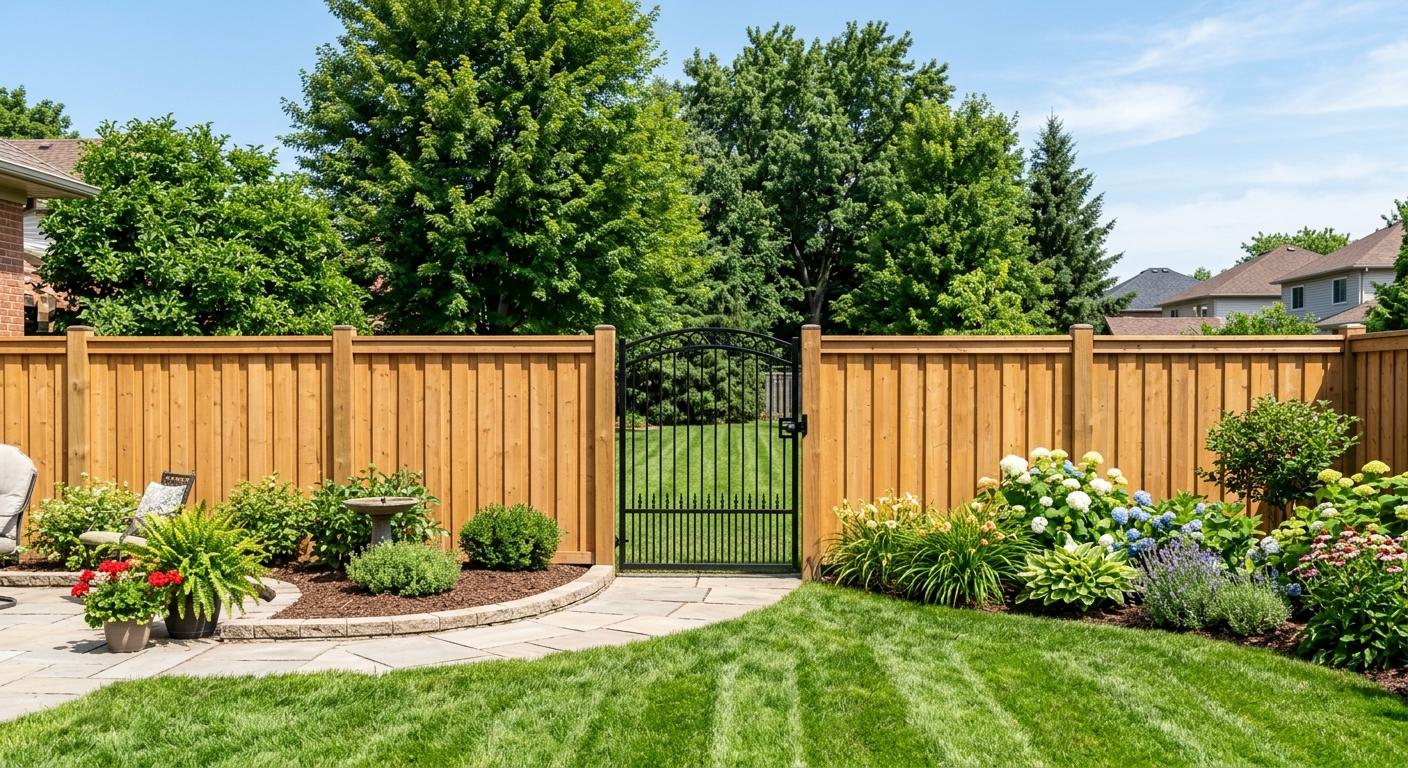
Fencing options and costs in Waterford
Waterford, Ontario is a small community of about 3,132 people (Statistics Canada, 2021 Census), and that matters because fencing demand tracks closely with steady owner-occupied housing. When properties are mostly single-family lots, a fence is often treated as part of day-to-day living—privacy, pets, and boundary clarity—so homeowners tend to replace or upgrade sooner rather than later. In practice, contractors in the Toronto economic region plan around the same seasonal rhythm: spring installs are common, and crews also need to schedule around frost-ready ground conditions and wet-site access.
Toronto-area pricing is shaped by two things: post-footing requirements and panel stability. In southern Ontario, the design frost line is commonly estimated around 42"–48", so for taller privacy fences the digging usually goes deeper than people expect. Most installers recommend concrete-set posts to resist heaving on clay and mixed soils, which increases labour time and ready-mix costs. At the same time, wind still plays a role—even if it’s not Prairie-extreme—so heavier posts and tighter spacing are typical for 6–8 ft fences to reduce racking and uplift.
In Waterford, trade demand is especially strong along the residential areas near the lake and along busier corridors where lots are more exposed and boundaries are longer (often with fewer interior barriers). If you’re comparing options, the table below gives realistic ballparks to help you narrow down what fits your goals before you request itemised quotes.
| Material |
Lifespan |
Maintenance |
Privacy Rating |
Price per Linear Foot |
| Pressure-treated pine (standard wood) |
10–15 years |
Stain/paint every 2–3 years; check fasteners |
High (solid/picket-close) |
$65–$120 |
| Cedar (natural rot resistance) |
15–25 years |
Stain or weather-seal every 2–4 years |
High (solid/picket-close) |
$75–$135 |
| Vinyl / PVC (no-maintenance) |
20–30 years |
Rinse as needed; inspect posts after freeze-thaw |
Very High (solid panels) |
$75–$130 |
| Chain-link (galvanized steel) |
25–40 years |
Occasional tightening and coating touch-ups |
Low (see-through) |
$45–$85 |
| Aluminum ornamental |
25–35 years |
Wash and inspect; no rust |
Medium (open design) |
$90–$160 |
| Composite / recycled material |
20–30 years |
Minimal cleaning; avoid impact damage and verify warranty |
High (solid/composite boards) |
$95–$170 |
Prices are estimates only and vary by project scope, site access and material selection.
What affects the price of fencing in Waterford
Even when two neighbours request “the same fence,” quotes in the Toronto region can swing by 30–50% because contractors price real site conditions, not just the fence style. A lot of that variation comes from foundation depth, post spacing, and how much labour is needed to set posts properly in Waterford’s mixed soils. Weather also affects crew scheduling: if the ground is saturated from spring thaw, excavation and concrete-set work takes longer, and that labour time is reflected in the quote.
Frost depth is the big one. For southern Ontario, posts are commonly set about 4–6 inches below the design frost depth to reduce the risk of frost heave. In cold Ontario conditions, that often means posts go roughly 1.5–2.0 m into the ground for taller privacy fences—especially when you’re installing 6–8 ft boards. To execute that depth safely and straight, most contractors in this area use longer posts and concrete-set methods rather than simple driven posts. That’s why you’ll often see wood fall into the $65–$120 per-foot band while vinyl can land into the $75–$130 per-foot range—materials aren’t the only difference; it’s also the footing and labour plan.
Concrete examples from Waterford-area projects:
- A straight backyard run on firm ground may stay near the lower end of the wood band; a similar-length run on clay that requires deeper holes and extra bracing moves the cost toward the higher end.
- A corner property with wind exposure often needs heavier posts and tighter centres; that can add both materials and labour, even if the fence length is the same.
- Sites with narrow access for wheelbarrows or mini-excavation often increase excavation time and concrete handling time.
Local housing age can also change the labour load. Older fences frequently have mixed posts embedded at odd depths or old concrete pads that require extra removal and disposal, adding dollars before the new line even begins.
| Price Factor |
Why It Matters |
Cost Impact |
| Fence length in linear feet |
Everything scales by footage: posts, rails, panels and hardware |
Largest driver; moving from 60 ft to 80 ft changes total labour and materials significantly |
| Post depth required |
Frost line determines hole depth and required post length |
Deeper holes increase excavation time, concrete, and post cost |
| Post setting method |
Concrete-set posts resist frost heave better than gravel pack or driven posts |
Concrete setting generally increases labour and ready-mix costs |
| Material choice |
Vinyl, cedar and chain-link use different fittings, weights and installation approaches |
Vinyl and cedar usually cost more than chain-link; aluminum typically sits higher than wood |
| Gate count and type |
Gates need stronger framing, hinges, latches and often wider posts |
Each gate adds framing labour and hardware; drive-through double gates usually cost the most |
| Grade and terrain |
Slopes require stepped or raked panels; rails may need custom fit |
More fitting time and extra hardware for clean alignment |
| Old fence removal and disposal |
Demolition time, haul-away, and recycling costs vary by site and material |
Can add a meaningful one-time charge per run |
| Permit fees and survey / property line locate |
Some fences require a permit; line confirmation prevents costly corrections |
Potential add-ons that vary by municipality and property complexity |
Permits & regulations in Ontario
In Ontario, fences above a height threshold often require a building permit—commonly around 2.0 m (6.5 ft) at the rear and about 1.0–1.2 m (3–4 ft) at the front or corner. Exact rules can vary based on location and municipal bylaws, but the key point for Waterford homeowners is that you can’t assume a “privacy height” fence is always permit-free. All fencing must also respect property lines and any setback requirements set out by the municipality where your lot sits.
Before you dig any post holes, call for utility locates through Ontario One Call. This is a practical safety step and helps avoid delays and hazards. Next, obtain a survey or locate your property pins if you don’t already have clear line confirmation—this reduces neighbour disputes and the risk of having to relocate sections after construction.
Shared fence ownership is governed by provincial line-fences legislation, which can affect how costs are shared when a fence benefits both properties.
Contractor verification in Ontario (step-by-step): ask for their Ontario business/licence details (check online via the relevant provincial/municipal business registration channels), request a current certificate of insurance naming you as an additional insured, and confirm they carry WSIB coverage (or the applicable coverage for the contractor’s classification). Then keep copies: certificate of insurance and any clearance letter that shows they’re in good standing.
Choosing the right fence material for Waterford
Choosing a fence in Waterford is mostly about matching the material to how you live—privacy and weather resistance, how much maintenance you’ll actually do, and your long-term budget. Pressure-treated pine is the budget-friendly starter option, but it requires staining or sealing every 2–3 years to reduce grey weathering and protect against moisture cycling. Cedar has better natural rot resistance and often looks great longer, though you’ll still want to maintain it with sealant or stain to keep colour even. Vinyl/PVC is attractive for low maintenance, but it can be more sensitive to extreme cold movement, so solid installation practices (true post depth and proper framing) matter. Chain-link is the most affordable per foot and lasts a long time, but it offers low privacy unless you add slats or vegetation. Aluminum ornamental is rust-resistant and tidy, with a mid-range cost, but it’s not a true privacy fence.
For Toronto-area winter stability, post depth is critical. With the design frost line around 42"–48" in southern Ontario, fence posts for 6–8 ft styles typically need to be set in the 1.5–2.0 m range (and deeper if your lot needs additional stability). That’s why concrete-set posts are usually recommended: they reduce heaving risk on clay and mixed soils. Wind and snow load considerations are handled through post size and spacing—heavier solid privacy fences generally need closer centres (often 6–8 ft) so they don’t rack during storms and freeze-thaw cycles.
Dollar-wise, here’s a common decision point: if you’re deciding between wood and vinyl for a privacy run, vinyl often sits higher in the $75–$130 band while standard wood typically lands in the $65–$120 band. The difference is usually justified when you want fewer maintenance trips and a cleaner look over time; if you’re comfortable maintaining wood and you’re managing budget tightly, wood can be the better value.
| Material |
Cold Tolerance |
Lifespan |
Annual Maintenance |
Best For |
Price Band |
| Pressure-treated pine |
Good with proper sealing and correct post depth |
10–15 years |
Light wash; stain/paint every 2–3 years |
Budget-conscious privacy |
$65–$120 |
| Cedar |
Excellent in freeze-thaw with quality install |
15–25 years |
Seal/stain every 2–4 years |
Better appearance and rot resistance |
$75–$135 |
| Vinyl / PVC |
Very good; proper bracing helps in Ontario freeze cycles |
20–30 years |
Rinse as needed; inspect fasteners/posts |
Low-maintenance privacy |
$75–$130 |
| Chain-link |
Good; galvanized coating handles winters |
25–40 years |
Occasional tightening and coating touch-ups |
Security with long service life |
$45–$85 |
| Aluminum ornamental |
Excellent; won’t rust in wet Ontario seasons |
25–35 years |
Wash; inspect for impacts |
Curb appeal and durable boundary marking |
$90–$160 |
| Composite / recycled |
Good; avoid impacts and confirm install details |
20–30 years |
Minimal cleaning; verify warranty |
Privacy with low upkeep |
$95–$170 |
How to choose a fencing contractor in Waterford
Start by verifying the basics for Ontario work. Ask for proof of business registration/licence details for the contractor’s entity, then request their certificate of insurance (general liability) and make sure it’s current. For workers, confirm WSIB coverage (or the applicable coverage for the contractor’s structure) and keep a clearance letter or confirmation document if they provide one. You can also verify coverage status through the WSIB public channels when available, and request written confirmation to store with your contract.
Next, get 2–3 itemised written quotes. You want a breakdown showing labour, concrete/post setting method, rail and post sizes, panel or board type, gates, hardware, and disposal. Avoid “lump sum” quotes that don’t specify how posts are set to the right depth for Ontario frost conditions.
Read the scope line-by-line: what is excluded (site grading, rock removal, permit pull, utility locate scheduling, extra gate additions), and what is included (permit assistance, property line locate, demolition and haul-away). Warranty matters too: ask for the workmanship warranty length, the manufacturer warranty on materials, and whether warranties are transferable if you sell the home.
Payment schedule should be conservative—never more than about 10–15% upfront. Hold back the balance until the fence is complete, aligned, and cleaned up. Finally, insist on a written start date and completion estimate that reflects weather-related scheduling in Waterford.
- Confirm their WSIB clearance and provide documentation.
- Request a current certificate of insurance (and expiry date).
- Ask for proof of Ontario business registration for the quoting entity.
- Get 2–3 itemised quotes with labour + materials breakdown (no vague totals).
- Check that post depth and setting method are specified in writing.
- Confirm gate framing size, hinges, latch type, and post reinforcement.
- Ask who handles permit pull if your fence exceeds height thresholds.
- Verify whether utility locates are scheduled and included or your responsibility.
- Confirm old fence removal and disposal scope (dump fees included?).
- Ensure grade issues are addressed (stepped vs raked sections).
- Require a clear warranty: workmanship duration and product warranty details.
- Set a payment plan with a holdback until final walkthrough and cleanup.
Concrete red flags I see in Waterford include: contractors who won’t put post depth and concrete-set details in the contract; quotes that omit gate hardware specifications; asking for most of the money up front; no proof of insurance/WSIB coverage; and refusing to clarify what’s included for demolition, disposal, and permit-related steps.
Frequently asked questions — fencing in Waterford
Should I repair or replace my old fence in Waterford?
In Waterford, the decision to repair versus replace usually comes down to how stable the posts are and whether moisture has compromised the structure. If the fence is sagging mainly because of loose rails or minor hardware failures, repairs can be cost-effective and may avoid the heavier labour of full post replacement. But if you’re seeing leaning posts, widespread rot in wood, or consistent gaps caused by frost movement, replacement is often the smarter long-term choice. That’s because Southern Ontario freeze-thaw and clay/mixed soils can worsen hidden issues. As a budget guide, a full wood installation often sits in the $65–$120 per linear foot band, while chain-link might be $45–$85 per foot if you’re prioritizing durability. Ask for an on-site assessment so the contractor can identify which sections are structurally failing versus purely cosmetic.
How do I handle a fence dispute with a neighbour in Ontario?
Fence disputes in Ontario usually revolve around the property line, ownership responsibility, and how the fence was built or repaired. First, confirm where the boundary actually is: if you don’t have a recent survey, obtain a survey or locate your property pins before major construction. Next, keep communication factual and written—photos, measurements, and copies of any previous agreements help. Ontario’s line-fences legislation governs shared fence ownership concepts, so if your fence is treated as a boundary fence, responsibilities may be shared. If you suspect the fence is on the wrong side of the line, pause work and get professional confirmation rather than trying to “average” distances. For the construction side, ensure your contractor is insured and can demonstrate the scope (including post depth and placement method) so you’re not left with an incomplete or non-compliant build.
What fence style offers the best wind resistance in Waterford?
For wind resistance in Waterford, the key is to reduce “sail area” and control racking. Solid privacy panels tend to perform well only when they’re engineered for wind: correct post size, solid concrete-set footings at proper depth, and tighter post spacing help resist uplift and twisting during storms. In open corners or longer exposed runs, I often recommend heavier posts and 6–8 ft centres to keep the fence from moving under gusts. If you want the best compromise, a properly built solid wood or vinyl privacy fence with reinforced posts usually beats lightweight picket designs in high-wind conditions. That said, chain-link is very wind-permeable and can hold up structurally if tension and end-post anchoring are done correctly, but it won’t provide privacy. If you’re comparing costs, privacy fences commonly fall closer to the wood or vinyl bands—wood typically $65–$120 per foot and vinyl $75–$130—because wind-stable installations require robust framing and footing work.
How much does a fence cost in Waterford?
In Waterford, fencing cost depends most on footage, gate count, and whether posts are concrete-set to the frost depth requirements. As a starting point for homeowners, pressure-treated wood installations generally land around $65–$120 per linear foot, while vinyl/PVC is often in the $75–$130 range. Chain-link is typically the lowest cost option at $45–$85 per foot, and aluminum ornamental often runs higher at about $90–$160 per foot depending on picket design and installation complexity. If your yard needs deeper footing, slope adjustments, extra bracing, or old fence removal/disposal, expect the price to move toward the upper part of the band. The fastest way to get an accurate number is to request 2–3 itemised quotes that clearly break out labour, concrete setting, materials, gates, and disposal—not just a single lump sum.
How deep should fence posts be for Waterford's frost?
For Waterford and the broader southern Ontario conditions, the common best practice is to set fence posts about 4–6 inches below the design frost depth to reduce frost heave risk. With the design frost line often estimated around 42"–48", that typically translates to approximately 1.5–2.0 m into the ground for many fence builds—especially privacy heights like 6–8 ft where wind loads and panel weight are higher. The exact depth can vary based on soil type and local conditions, so a contractor should measure your site conditions and explain how they’re determining hole depth. In this region, concrete-set posts are usually recommended for long-term stability because clay and mixed soils can shift during freeze-thaw cycles. If someone proposes only shallow driven posts for a tall fence without discussing frost depth, that’s a quality concern.
Wood vs vinyl vs aluminum fence — which is best?
The “best” choice depends on whether you prioritize privacy, low maintenance, or curb appeal. Wood (often pressure-treated pine) offers good value and can be built for strong privacy, typically in the $65–$120 per linear foot band, but it usually needs staining or sealing every 2–3 years in Ontario’s wet/dry cycles. Cedar is more rot-resistant and can look better longer, though it still benefits from periodic maintenance. Vinyl/PVC is usually the lowest-maintenance privacy route; it typically sits in the $75–$130 band and doesn’t require painting, but it still needs correct post depth and proper installation so boards and posts handle freeze-thaw movement. Aluminum ornamental is rust-resistant and mid-range to higher cost (about $90–$160 per foot), but it’s rarely a true privacy solution. For most Waterford homeowners wanting privacy with minimal upkeep, vinyl or cedar privacy designs are common winners—provided the contractor uses frost-depth concrete-set posts.