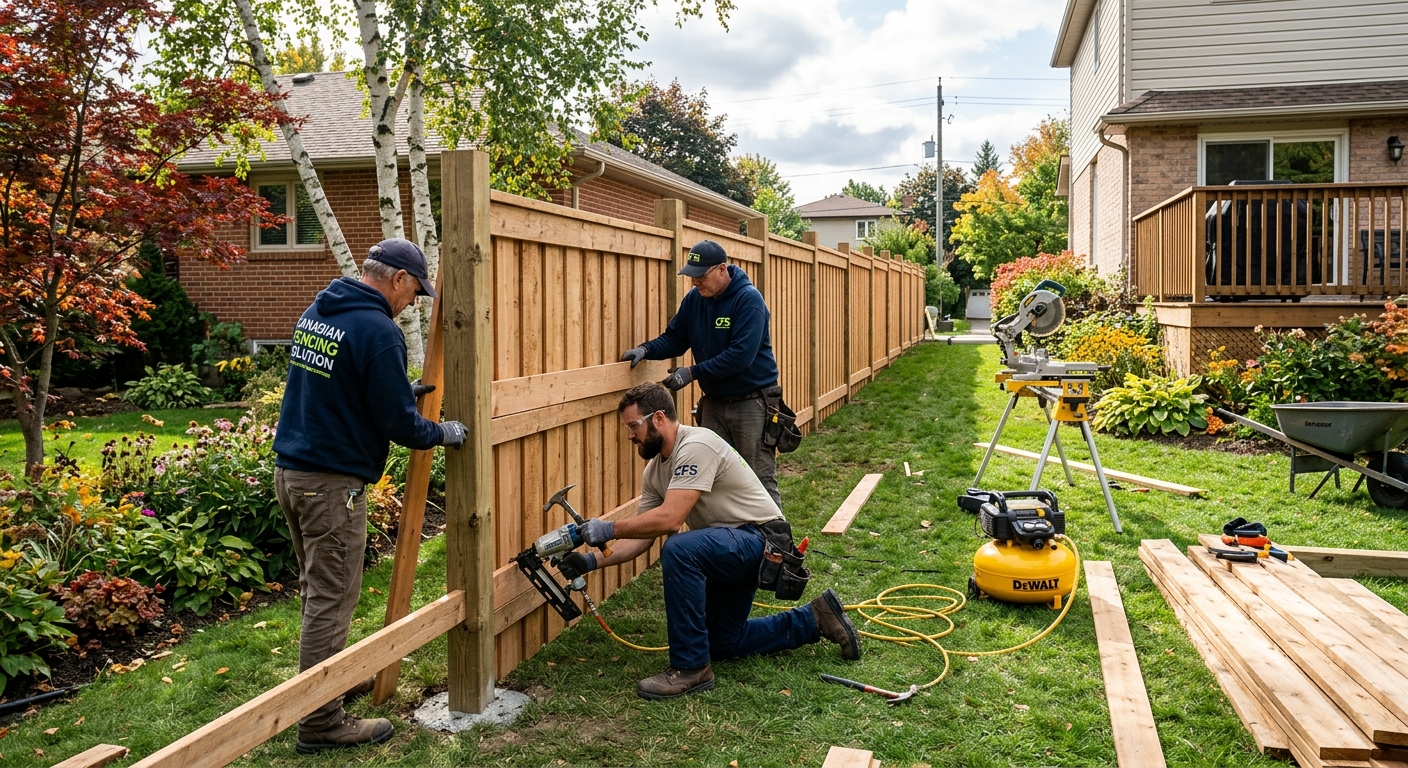
Fencing options and costs in Islington-City Centre West
In Islington-City Centre West, fence buying is practical and fast-moving—homeowners often want a clean boundary and privacy that holds up through Toronto winters. With a population of 43,965 (Statistics Canada, 2021 Census), the neighbourhood keeps steady demand for residential fence installs, especially around the established pockets of detached and semi-detached homes where backyards face each other closely. In that setting, every design choice that affects stability and appearance—post depth, panel style, and gate hardware—shows up directly in your quote.
Toronto’s climate drives cost because frost isn’t just “cold,” it’s freeze–thaw. Contractors typically set posts deeper to resist frost heave (commonly 3.5–4 feet, depending on soil and design), and that means concrete-set posts are the norm for 6–8 ft privacy fences. Combined with clay and mixed soils in the area, labour time and ready-mix costs rise, but long-term wobble and leaning are far less common. Demand is especially strong in higher-density residential stretches near Islington Avenue and portions of the neighbourhood closer to the City Centre and transit corridors, where replacement cycles are more frequent and access can be tighter.
Below is a straightforward comparison of common fence materials used in Islington-City Centre West, including typical lifespan, upkeep, and budget ranges, so you can map your priorities to realistic installed pricing before you request an itemised quote.
| Material |
Lifespan |
Maintenance |
Privacy Rating |
Price per Linear Foot |
| Pressure-treated pine (standard wood) |
10–15 years |
Stain/paint every 2–3 years; check posts after freeze–thaw |
High (solid boards) |
$65–$120 |
| Cedar (natural rot resistance) |
15–20 years |
Light staining every 2–3 years; occasional board replacement |
High (solid or close spaced) |
$75–$130 |
| Vinyl / PVC (no-maintenance) |
20–30 years |
Rinse annually; replace damaged sections if impact occurs |
High (solid privacy panels) |
$75–$130 |
| Chain-link (galvanized steel) |
20–35 years |
Minimal; tension checks and occasional coating touch-ups |
Low (semi-transparent) |
$45–$85 |
| Aluminum ornamental |
25–40 years |
Occasional cleaning; no rust when properly finished |
Low–Medium (open pickets) |
$90–$160 |
| Composite / recycled material |
25–35 years |
Low; wash and spot-replace warped boards if present |
High (solid privacy styles) |
$90–$160 |
Prices are estimates only and vary by project scope, site access and material selection.
What affects the price of fencing in Islington-City Centre West
In Islington-City Centre West (Toronto economic region), two contractors can quote the “same fence height” and still be 30–50% apart. The gap usually comes from how they design for frost stability, how they price access and labour, and whether they include concrete-set posts, gate hardware, and removal/disposal. The Toronto market also has active competition between crews specializing in wood privacy fences and those focused on vinyl and metal systems—so your exact material choice and layout can move the labour rate and install speed.
Toronto’s frost line is commonly planned around 42"–48", which translates into posts often needing to be set roughly 4–6 inches below the design frost depth to reduce heaving risk. For 6–8 ft privacy fences, that commonly means holes deeper than most people expect, and 1.5–2.0 m of embedment may be required depending on soil and design. When concrete-set posts are specified, you’re paying for longer posts, more excavation, and ready-mix—typically pushing wood privacy projects toward the higher end of $65–$120 per linear foot, and pushing vinyl privacy into the $75–$130 band.
Local conditions create cost swings in practical ways. Example 1: a long run with multiple corners and gate swings increases bracing and hardware—labour rises even if materials are the same. Example 2: clay-heavy ground can require tighter excavation and additional base prep before concrete is set. Example 3: if your yard is sloped near the fence line, contractors may need stepped panels or raked layouts, which adds layout time.
Wind in the GTA is not prairie-level, but taller solid panels still rack in gusts; that often means closer post spacing and heavier hardware, particularly on solid wood and vinyl privacy fences. All of that is why “linear feet” alone doesn’t tell the whole story—depth, soil, and layout do.
| Price Factor |
Why It Matters |
Cost Impact |
| Fence length in linear feet |
Most materials and labour are proportional to footage |
Highest impact; sets the base price |
| Post depth required |
Frost planning controls embedment, hole size, and post length |
Higher depth increases both material and labour |
| Post setting method |
Concrete vs gravel pack vs driven posts affects stability |
Concrete-set typically costs more but reduces long-term leaning |
| Material choice |
Vinyl/cedar often weigh more in cost than basic chain-link |
Shifts you between wood, vinyl, chain-link, and metal bands |
| Gate count and type |
Gates need stronger posts, hinges, and latches |
Adding a second gate can noticeably increase total cost |
| Grade and terrain |
Slopes require stepped or raked panels and extra layout time |
Moderate–high impact for uneven yards |
| Old fence removal and disposal |
Hauling and labour depend on condition and access |
Can add a meaningful surcharge |
| Permit fees and survey / property line locate |
Requirements vary by height and layout; locating prevents boundary disputes |
Occasional added cost if not already surveyed |
Permits & regulations in Ontario
In Ontario, fences may require a building permit depending on height and location. A common rule of thumb contractors follow is that fencing above about 2.0 m (6.5 ft) at the rear, or above roughly 1.0–1.2 m (3–4 ft) at the front or corner, can trigger a permit requirement (confirm your exact situation with the applicable municipal requirements). Regardless of permit needs, every fence must be built within property lines and in line with municipal setback bylaws.
Before any post holes are dug, homeowners should arrange utility locates using Ontario One Call. If you skip this and hit a buried service, the fix is expensive and delayed. Also, use a survey or property locate to confirm pin positions—Islington-City Centre West has older lot lines and established boundaries, and that’s where disputes usually start after “we thought the line was here” misunderstandings.
Shared fence ownership is guided by Ontario line-fences concepts: if a fence separates properties, both neighbours may share responsibility, and maintenance or replacement can become a negotiation topic. For your installer, ask how they handle boundaries and who supplies the locate.
To verify an Ontario contractor, check three things in writing: (1) an Ontario licence/registration when applicable for the business type, (2) liability insurance certificate (look for current coverage and appropriate limits), and (3) WSIB/WCB clearance—typically provided as a clearance letter or confirmable coverage statement. Ask for these before work begins, and keep copies with your contract.
Choosing the right fence material for Islington-City Centre West
Your best fence material in Islington-City Centre West depends on what you’re protecting—privacy, curb appeal, or long-term maintenance comfort—because Toronto’s freeze–thaw cycle punishes weak posts and untreated surfaces. Pressure-treated pine is the budget-friendly route, but it needs staining or sealing every 2–3 years to limit grey weathering and surface breakdown. Cedar is more rot-resistant and looks better longer, but it still needs periodic maintenance to keep colour and reduce cracking. Vinyl/PVC delivers true low maintenance once installed correctly, though extreme cold can make panels feel stiffer and impact-resistant installation details matter. Chain-link is the lowest upfront and very durable, but it won’t provide privacy without add-ons (like privacy slats or lattice). Aluminum ornamental offers a neat, rust-resistant look with minimal upkeep; it’s ideal when you want boundary definition more than screening.
Post depth is a make-or-break detail here. With Toronto’s frost planning (often 42"–48" design targets), concrete-set posts are commonly used for 6–8 ft fences to prevent heaving and post rotation. That added embedment and concrete labour costs show up in the installed price band: wood privacy often lands around $65–$120 per linear foot, while vinyl privacy typically sits in the $75–$130 range, especially when gates and corner bracing are included.
Here’s a realistic decision example: if your goal is maximum privacy and you’re budgeting for 60 linear feet, choosing vinyl over pressure-treated wood can cost roughly a few thousand dollars more over the full installed run, but the trade-off is far less annual work—fewer staining weekends and fewer late-season touch-ups after winter. On the other hand, if you’re comfortable maintaining wood, pressure-treated pine can be the best value for a short-to-mid timeframe.
| Material |
Cold Tolerance |
Lifespan |
Annual Maintenance |
Best For |
Price Band |
| Pressure-treated pine |
Good (stays stable when posts are properly set) |
10–15 years |
2–3 year stain cycle; quick inspections after winter |
Budget privacy with planned maintenance |
$65–$120 |
| Cedar |
Good (naturally more rot-resistant in damp seasons) |
15–20 years |
Stain/finish every 2–3 years; check for board warping |
Longer-lasting privacy and better natural appearance |
$75–$130 |
| Vinyl / PVC |
Very good (cold affects flexibility less than wood) |
20–30 years |
Rinse; inspect hardware and impacts |
Low maintenance privacy |
$75–$130 |
| Chain-link |
Very good (steel is durable through freeze–thaw) |
20–35 years |
Minimal; occasional tension check |
Secure boundaries, pets, utility fencing |
$45–$85 |
| Aluminum ornamental |
Excellent (won’t rot or rust when coated correctly) |
25–40 years |
Wash; inspect for loose pickets |
Curb appeal and boundary definition |
$90–$160 |
| Composite / recycled |
Good (resists rot; can be sensitive to installation details) |
25–35 years |
Low; periodic wash and spot checks |
Privacy panels with minimal upkeep |
$90–$160 |
How to choose a fencing contractor in Islington-City Centre West
Choosing the right contractor is mostly about proof: can they build fences that resist Toronto’s freeze–thaw, and do they carry the coverage to protect you? Start by verifying Ontario compliance and insurance. Ask for (1) proof of business eligibility/registration where applicable, (2) a liability insurance certificate showing current coverage, and (3) WSIB/WCB coverage or a clearance letter. You can request these documents directly and confirm the insurance certificate details match the contracting company name on the agreement.
Next, get 2–3 itemised written quotes rather than a lump sum. A good quote breaks down labour and materials separately (posts, rails, panels/pickets, hardware, concrete, gate components). It should also state how posts will be set for frost stability—concrete-set versus gravel pack versus driven posts—because that difference is where projects diverge in both performance and cost.
Read exclusions carefully: is old fence demolition and disposal included? Is permit pull included if required? Will they restore landscaping damaged during excavation? Warranty terms should be spelled out: workmanship warranty length (often 1–3 years for install), product/manufacturer warranty for the fence system, and whether the warranty transfers if you sell your home. Finally, payments matter—never pay more than 10–15% upfront, and hold back a portion until the job is complete and inspected. Get a start date and completion estimate in writing so you can plan around weather windows.
- Ask how deep they set posts for your height and soil conditions.
- Confirm whether they use concrete-set posts for privacy fence heights.
- Require an itemised list: materials, labour, hardware, concrete, and gates.
- Check that removal/disposal is included (or excluded) in writing.
- Confirm fence line layout method and whether they follow survey pins/locates.
- Verify liability insurance coverage limits and certificate validity.
- Verify WSIB/WCB clearance letter or equivalent coverage evidence.
- Ask about warranty: workmanship duration and product warranty details.
- Request a clear payment schedule with a stated holdback amount.
- Ensure the contract states start date and completion timeframe.
- Confirm gate latching/hinge hardware grade and warranty coverage.
- Ask how they handle slopes: stepped vs raked panels and which is included.
Red flags I see in Islington-City Centre West include: quotes that don’t specify post depth or setting method, “lump sum only” pricing without an itemised breakdown, refusing to provide insurance/WSIB/WCB documents, vague warranty language, and requests for large upfront payments with no signed contract.
Frequently asked questions — fencing in Islington-City Centre West
Wood vs vinyl vs aluminum fence — which is best?
For Islington-City Centre West and Ontario winters, the “best” option depends on whether you prioritize privacy, maintenance, or appearance. Wood (pressure-treated pine) is usually the most budget-friendly path, commonly starting in the $65–$120 per linear foot range for installed wood fencing, but it generally needs staining every 2–3 years. Vinyl/PVC is often chosen for low maintenance and typically sits around $75–$130 per linear foot for privacy styles; it’s a strong fit if you want to rinse and move on. Aluminum ornamental looks great and resists rust, but it doesn’t provide the same privacy level as solid wood or vinyl. In every case, ask how posts are set for frost stability (concrete-set is standard for most taller privacy fences).
Do I need a permit to build a fence in Ontario?
In Ontario, a permit may be required if your fence exceeds typical height thresholds—commonly around 2.0 m (6.5 ft) for the rear and about 1.0–1.2 m (3–4 ft) in front or corner areas, depending on the exact municipal rules and fence placement. Many fences below those thresholds can often be built without a permit, but you should confirm based on your location and height. Regardless, you must respect property lines and municipal setback bylaws. For peace of mind in Islington-City Centre West, verify the rule before you order materials, and ensure your contractor plans for utility locates before digging post holes (Ontario One Call). A survey locate helps avoid encroachment disputes.
How long does a wood fence last in Islington-City Centre West?
Wood longevity in Islington-City Centre West is mostly about post setting and surface maintenance through Toronto’s freeze–thaw cycles. When posts are concrete-set to resist frost heave and hardware is installed correctly, pressure-treated pine fences commonly last about 10–15 years. If you regularly stain or seal—typically every 2–3 years—you can slow weathering and reduce splitting, especially on horizontal rails and board ends that trap moisture. If a fence is installed with shallow posts, you’ll usually see leaning or loosened rails sooner, often after several winters. Cedar can extend the timeframe (often 15–20 years) because of natural rot resistance, but it still benefits from periodic finishing.
Who owns and maintains a shared fence?
Shared fence situations in Ontario can involve either neighbour-to-neighbour agreements or principles around line fences, but the core issue is responsibility for maintenance and replacement. If the fence sits on the boundary or is considered a shared divider, both parties may have rights and obligations depending on how the fence is positioned and how it was historically accepted/maintained. In practice in Islington-City Centre West, the best approach is to confirm: (1) where the fence line is relative to property pins, (2) whether neighbours consent to replacement or upgrades, and (3) who will pay for materials and labour. Get anything shared in writing—especially gate access and responsibilities—so the project stays smooth after installation.
How do I find my property line before fencing?
Before installing a fence, don’t rely on “it looks like the line” estimates—Toronto-area boundary disputes are common when fences are built without a locate. Start with your survey (if you have one) and identify property pins; if you’re missing documentation or pins are unclear, arrange a property locate/survey. Then align your fence layout to those pins rather than using existing fence remnants. In Islington-City Centre West, lot lines and older alignments can be less intuitive in backyards. Also, call Ontario One Call for utility locates before digging any post holes. If your contractor won’t document how they’re verifying the boundary, that’s a sign to pause and ask questions before ordering fencing.
What's the most low-maintenance fence?
For most homeowners in Islington-City Centre West, vinyl/PVC privacy fences are the lowest-maintenance option. Vinyl typically needs only periodic rinsing and an inspection of hardware after major weather—no staining, no painting, and far less surface cracking than untreated wood. Installed vinyl privacy commonly falls around $75–$130 per linear foot depending on height, gates, and post configuration. Aluminum ornamental is also low maintenance (wash and visual checks), but it usually won’t provide the same privacy as solid vinyl or solid wood. The key to keeping any “low-maintenance” fence performing is still proper installation—especially concrete-set posts for frost stability so panels don’t loosen or lean after winter.