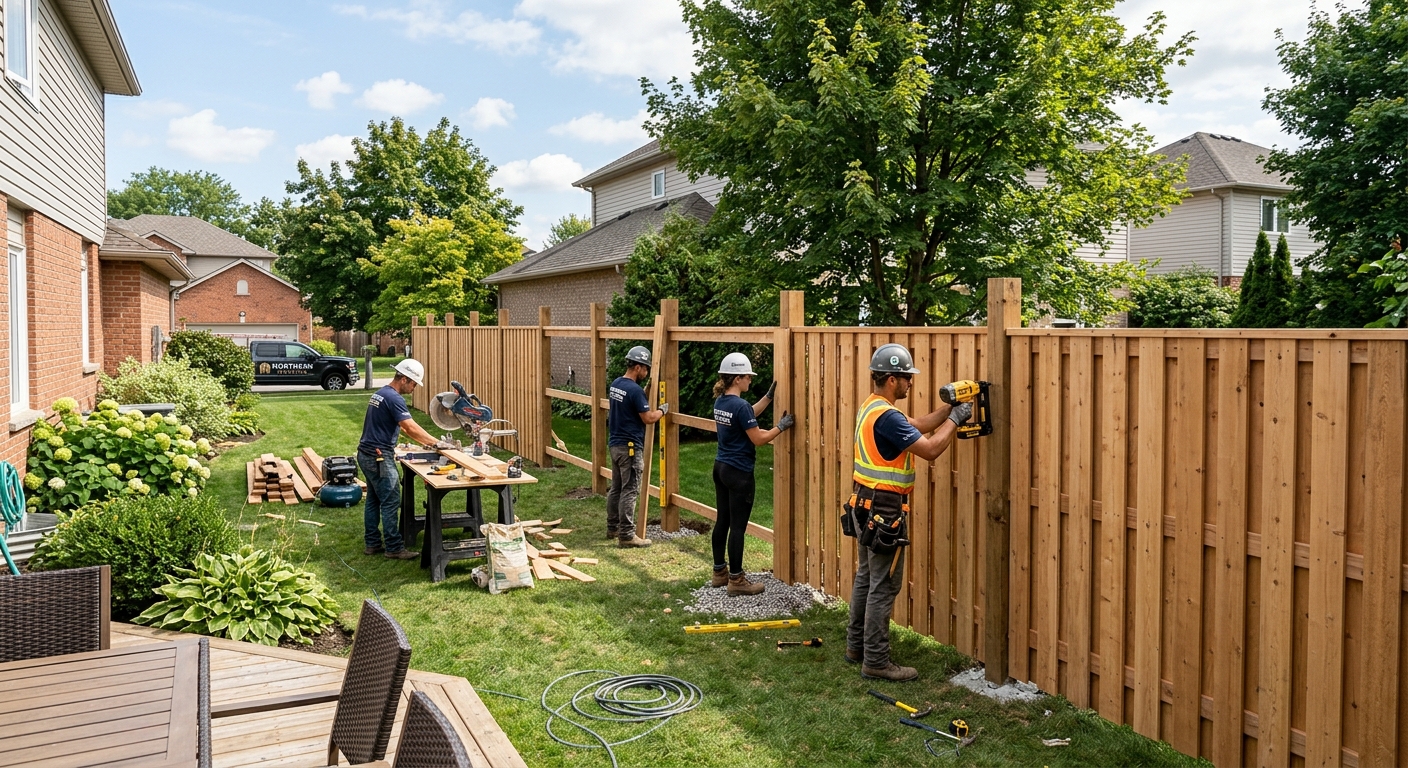
Fencing options and costs in Richmond Hill
Richmond Hill homeowners often ask for “the same fence” as a neighbour, but the installed cost can shift quickly once you account for privacy needs, post depth for Toronto-area frost, and how busy crews are in the GTA. With 56.7% of local dwellings being single-detached homes and 78.2% of households owning, most streets in Richmond Hill have a steady demand for new privacy fencing and gate work as properties change hands or backyard plans expand. (Statistics Canada, 2021 Census.)
In the Toronto economic region, the common frost-line guidance is roughly 42–48 inches. That typically means digging deeper post holes and planning concrete-set posts for most 6–8 ft privacy fences, especially where the soil is clay-like or mixed and can shift with freeze-thaw. The result is more labour time, more ready-mix use, and heavier fastening—so “budget fences” can look attractive until you compare like-for-like post and hardware specifications. Availability can also be seasonal: spring and early summer installs are busiest, and start times may extend in established neighbourhoods where access is tight.
Trade demand is especially strong around older, established pockets such as Oak Ridges, where yard fencing often needs upgrading due to age, sagging rails, and higher privacy expectations. Use the table below as a planning benchmark for typical material lifespans and per-foot pricing in Richmond Hill before we tailor a quote to your lot length, gates, and post depth requirements.
| Material |
Lifespan |
Maintenance |
Privacy Rating |
Price per Linear Foot |
| Pressure-treated pine (standard wood) |
10–15 years |
Stain/seal every 2–3 years |
High (solid boards) |
$65–$120 |
| Cedar (natural rot resistance) |
15–25 years |
Light staining every 2–4 years |
High (solid boards) |
$75–$130 |
| Vinyl / PVC (no-maintenance) |
20–30 years |
Occasional wash |
High (solid panels) |
$75–$130 |
| Chain-link (galvanized steel) |
20–35 years |
Occasional rust check at fittings |
Low–Medium (add privacy slats) |
$45–$85 |
| Aluminum ornamental |
25–40 years |
Wash annually; spot touch-up if needed |
Low–Medium |
$90–$160 |
| Composite / recycled material |
20–30 years |
Minimal cleaning |
High (privacy-style boards) |
$75–$130 |
Prices are estimates only and vary by project scope, site access and material selection.
What affects the price of fencing in Richmond Hill
In Richmond Hill, two quotes for the “same” fence can differ by 30–50% because the scope is rarely identical—especially around post depth, concrete setting, gate complexity, and whether old fencing removal and disposal are included. A backyard with 40–50 linear feet sounds straightforward, but once you add frost-depth excavation, corner posts, and a double gate for a driveway, material and labour both climb. Also, the Toronto market moves fast: when crews are booked, schedule risk can push costs higher for short-notice starts.
Post depth is the big driver. Toronto-area frost guidance is commonly treated as about 42–48 inches, and best practice typically sets post holes about 4–6 inches below the design frost depth to reduce frost heave risk. Practically, that often means posts set roughly 1.5–2.0 m into the ground, using concrete for stability on clay and mixed soils. Those extra hole depths mean longer posts and more labour, so concrete-set designs can sit at the upper end of the wood and vinyl ranges (for example, Toronto-area wood pricing often lands in the neighbourhood of $65–$120 per foot depending on spec).
Two other local examples that raise cost: (1) sloped backyards in areas like Westbrook often require raked or stepped rails, which increases layout time and hardware; (2) neighbourhood lots with narrow side access slow down equipment use, so excavating and panel setting takes longer. Wind isn’t the same extreme as the Prairies, but taller solid privacy fences can rack during winter storms and spring freeze-thaw, so we may increase post size or tighten spacing.
Material comparisons matter too. If you’re choosing chain-link for the lowest upfront spend, the Toronto band is commonly $45–$85 per foot, but adding privacy slats changes the maintenance and wind load details. Matching the fence type to your yard conditions is what keeps pricing predictable.
| Price Factor |
Why It Matters |
Cost Impact |
| Fence length in linear feet |
Most materials and labour scale directly with total runs |
High (primary driver) |
| Post depth required — frost line determines post length and hole depth |
Deeper holes and longer posts increase excavation and concrete |
Medium–High |
| Post setting method — concrete vs. gravel pack vs. driven posts |
Concrete-set posts improve stability on clay/mixed soils |
Medium–High |
| Material choice — vinyl vs. cedar vs. chain-link |
Upfront material costs and hardware differ widely |
Medium |
| Gate count and type — walk-through vs. drive-through (double) |
Gates need heavier frames, hinges, latches and more labour |
High for driveway doubles |
| Grade and terrain — sloped yards require stepped or raked panels |
More layout time and custom cut components |
Medium |
| Old fence removal and disposal |
Demolition, hauling and dump fees add cost |
Medium |
| Permit fees and survey / property line locate |
Some fences need permits and all projects should confirm boundaries |
Low–Medium |
Permits & regulations in Ontario
In Ontario, whether you need a permit depends largely on fence height, location, and local rules. As a practical starting point in Richmond Hill, fences above a height threshold—commonly around 2.0 m (6.5 ft) for the rear and 1.0–1.2 m (3–4 ft) at the front or corner—often trigger permit requirements. However, municipalities can have additional conditions, especially around sightlines and property line placement. Always confirm with the City’s bylaw office or your permit pathway before you start.
Regardless of permit needs, you must respect property lines and any applicable setback requirements. Before you dig post holes, you should arrange utility locates through Ontario One Call. In practice, that means calling before excavation so utility crews can mark gas, hydro, telecom and any buried lines. If there’s any chance of boundary disagreement, get a survey or at least a property- pin locate before installing, since fencing on the wrong line is a common source of disputes and costly rework.
Shared-fence ownership is addressed by Ontario line-fences rules. If you’re building or upgrading a fence that functions as a boundary fence, you may need to coordinate with the neighbour about costs and responsibilities.
To verify a contractor in Richmond Hill: request (1) your contractor’s Ontario licence/registration details, (2) a current certificate of insurance with liability coverage showing you as additionally insured (where applicable), and (3) proof of workplace coverage. Many roofing and fencing trades in Ontario operate with either WSIB coverage or the applicable WCB structure—ask for the clearance letter or account proof, not just a promise.
Choosing the right fence material for Richmond Hill
Choosing fencing material in Richmond Hill is about matching what you want—privacy, low maintenance, budget, and long-term appearance—to how Toronto-area winters treat wood and how the local market builds with frost-depth posts. Pressure-treated pine is usually the budget-friendly path, but it typically needs staining or sealing every 2–3 years to prevent greying and surface checks from winter cycles. Cedar looks better and naturally resists rot, yet it still benefits from regular staining to maintain its look and protect surface grain. Vinyl/PVC is popular for “set it and forget it” maintenance, but in extreme cold snaps it can become brittle if installed incorrectly—so proper fastening and post hardware matters. Chain-link is the lowest-cost material and lasts a long time, but it provides little privacy unless you add slats or mesh. Aluminum ornamental is rust-resistant and durable in wet seasons, though it’s not a privacy-first option due to its open design. Composite/recycled boards can offer a strong privacy look with minimal cleaning, but pricing often sits closer to vinyl than basic wood.
Post depth is where Ontario climate drives decisions. With frost guidance around 42–48 inches, many Richmond Hill installs require concrete-set posts and longer post lengths so the bottom of the post sits beyond the freeze zone. That means even a “cheap” wood fence can end up costing more if it’s a privacy height (6–8 ft) with deeper set posts and heavier rails for racking resistance. Wind-driven uplift isn’t coastal or prairie-level, but solid panels in winter wind still need proper spacing and solid corner hardware.
A concrete example: if you’re comparing pressure-treated pine privacy at roughly $65–$120 per linear foot versus vinyl privacy at roughly $75–$130, the extra $10–$30 per foot can be justified when you want to avoid annual upkeep and plan for 20+ years. If you don’t mind maintenance, cedar can also be a good “looks vs upkeep” compromise in Richmond Hill’s mature neighbourhoods.
| Material |
Cold Tolerance |
Lifespan |
Annual Maintenance |
Best For |
Price Band |
| Pressure-treated pine |
Good with concrete-set posts and proper bracing |
10–15 years |
Stain/seal every 2–3 years |
Budget privacy where you can maintain |
$65–$120 |
| Cedar |
Very good; handles freeze-thaw well when sealed |
15–25 years |
Light stain every 2–4 years |
Appearance-focused privacy |
$75–$130 |
| Vinyl / PVC |
Good; must be installed with correct fastening |
20–30 years |
Occasional wash |
Low-maintenance privacy |
$75–$130 |
| Chain-link |
Excellent; resilient galvanized steel |
20–35 years |
Minimal (check fittings) |
Security boundary on a budget |
$45–$85 |
| Aluminum ornamental |
Excellent (powder-coated) |
25–40 years |
Wash annually; spot touch-ups |
Attractive perimeter with airflow |
$90–$160 |
| Composite / recycled |
Good; performance depends on board quality and hardware |
20–30 years |
Low (wash as needed) |
Privacy with minimal upkeep |
$75–$130 |
How to choose a fencing contractor in Richmond Hill
Choosing a fencing contractor in Richmond Hill should start with proof, not promises. Ask for your contractor’s Ontario licence/registration details and confirm the company name matches the quote and invoices. Request a current certificate of liability insurance showing coverage limits appropriate for work on occupied residential properties. For workplace coverage, ask for proof of WSIB or the applicable WCB coverage (a clearance letter or account proof is best)—this is how you reduce your risk if a worker is injured on your property.
Then get 2–3 itemised written quotes, not lump sums. A proper fencing quote should separate materials (posts, rails, boards/panels, hardware, gate components) and labour (excavation, post setting, panel installation, grading/raking, gate build/adjustments). Also ask whether a permit pull is included (when required) and whether demolition and disposal of the old fence is part of the quoted scope. If the contractor will haul away debris, confirm dump fees are included or listed separately.
Warranty matters: ask for the workmanship warranty length and what it covers (post setting, alignment, rail fastening, gate sag). Then ask about the product/manufacturer warranty for the fence system and whether it transfers if you sell your home.
Payment schedule should be conservative. Never pay more than 10–15% upfront for materials—then tie remaining payments to milestones (e.g., post-setting inspection/approval, completion of panels, then final gate alignment). Hold back the final portion until the job is fully cleaned up and functional. For scheduling, insist on a written start date and completion estimate, including any weather contingency language.
- Quote includes fence length in linear feet and measured run locations, not just “approx.”
- Specifies post depth approach (e.g., concrete-set) and post spacing for the chosen height.
- Lists gate hardware brand/type, hinge count, latch type, and swing/clearance.
- Includes disposal: whether old fence removal and hauling are included or extra.
- Confirms if property line locating/survey check is your responsibility or their scope.
- States what’s excluded (e.g., tree stump removal, landscaping touch-ups, sidewalks/drainage impacts).
- Provides a workmanship warranty in writing (not just “we stand behind it”).
- Includes a product warranty and clarifies what voids it (improper maintenance, modifications).
- Shows proof of insurance before work starts, with appropriate limits.
- Provides WSIB/WCB clearance proof (request a clearance letter, not just a statement).
- Includes schedule and whether concrete setting requires a cure window.
- Uses a milestone-based payment plan with a final holdback.
Concrete red flags I see in Richmond Hill: (1) quotes that skip post depth and simply say “standard installation,” (2) refusing to provide insurance/coverage proof, (3) offering to drive posts instead of concrete-set for a tall privacy fence without explaining frost considerations, (4) no written scope for disposal and clean-up, and (5) asking for large upfront payments (more than 15%) before any work begins.
Frequently asked questions — fencing in Richmond Hill
Should I repair or replace my old fence in Richmond Hill?
In Richmond Hill (and across the GTA), the decision usually comes down to how the posts are anchored and how far the structure has shifted. If the fence is still straight, rails are intact, and only a few boards are failing, repairs can be cost-effective—especially if rot hasn’t spread into the post bases. However, if you’re seeing leaning panels, loose hardware, or posts that wobble at ground level, repairing often becomes “temporary.” Frost cycles and freeze-thaw movement can loosen marginal foundations, and older wood can grey and split even when it appears only mildly worn.
As a rule of thumb, if more than about 25–30% of the runs or multiple corner posts are failing, replacement is usually the better long-term value. For planning, note that wood fencing installs commonly land around $65–$120 per linear foot depending on whether concrete-set posts and gates are included.
How do I handle a fence dispute with a neighbour in Ontario?
Fence disputes in Ontario are commonly about boundaries, shared responsibility, or damage claims. Start by confirming where your property line actually is—use survey pins/locate services rather than estimates from drawings or memory. In Richmond Hill, I strongly recommend you document the condition with photos and measure the fence alignment relative to pins. If you’re unsure, ask a surveyor to locate boundary markers before you spend money on repairs or upgrades.
Next, communicate in writing and keep it calm and factual. Ontario line-fences principles can apply to boundary fencing and cost sharing, but your specific situation depends on who built what and what the neighbour agrees to. If there’s encroachment, do not “fix” by moving the fence without confirming the boundary. For safety, avoid digging near marked utilities until you complete Ontario One Call locates.
What fence style offers the best wind resistance in Richmond Hill?
Richmond Hill doesn’t face prairie-level open-field wind, but tall solid fences can still rack during winter gusts and spring storms. The most wind-resistant setups are typically solid privacy styles with heavier post sizing, proper post spacing, and strong bracing at corners and gate openings. A properly installed wood privacy fence with concrete-set posts and tight rail/hardware spacing tends to resist wind better than lightweight panel systems.
Vinyl can perform well when installed correctly—especially when the contractor uses the right post hardware and doesn’t underbuild the framing. Aluminum ornamental fencing is generally more wind-permeable (which can reduce pressure), but it won’t provide the same “solid panel” resistance because it’s designed with openings. For lots with more exposure (open corners, near ravines/greenbelt edges, or long straight runs), it’s worth asking for a wind-focused layout with closer post centres and hardware sized for 6–8 ft heights. This is also where concrete-setting reduces post movement.
How much does a fence cost in Richmond Hill?
Fence cost in Richmond Hill typically depends on linear feet, fence height, gate count, and especially post depth for frost stability. For budget planning, Toronto-area bands often put chain-link around $45–$85 per linear foot, while wood and vinyl privacy fences commonly fall in the broader $65–$120 to $75–$130 range depending on spec (post size, concrete-set vs alternatives, and whether removal is included). Aluminum ornamental frequently sits higher, often around $90–$160 per linear foot.
On a typical suburban lot, a driveway double gate and deeper concrete-set posts can change the total more than material choice alone. If you tell me your approximate run length and whether you need 6 or 8 ft privacy fencing, I can help you interpret how your numbers should compare to these local bands.
How deep should fence posts be for Richmond Hill's frost?
In the Richmond Hill area, frost depth guidance is commonly treated as about 42–48 inches in Southern Ontario. Best practice is to set posts below the frost-affected zone—typically an additional 4–6 inches beyond the design frost depth to reduce frost heave risk. In practical terms, that often translates to setting many privacy-fence posts about 1.5–2.0 m into the ground, especially for 6–8 ft fences and in soils that can be clay-rich or mixed.
Because of that, many contractors recommend concrete-set posts (not just driven posts) for stable long-term performance. Concrete-set posts also help maintain alignment when the ground freezes and thaws over multiple winters. If you’re getting quotes, confirm post setting method, post sizes, and hole depth—not just the fence height.
Wood vs vinyl vs aluminum fence — which is best?
There isn’t one “best” fence material for every Richmond Hill yard—it depends on your priorities. Wood (pressure-treated pine or cedar) is usually best when you want solid privacy and are comfortable with periodic maintenance. Cedar generally looks nicer and resists rot better, but both wood types require staining/sealing over time. Vinyl/PVC is best for low maintenance and a consistent look; however, it’s often higher upfront and must be installed with correct hardware and framing to handle cold snaps and wind loads.
Aluminum ornamental is best for appearance and durability with airflow, and it won’t rust the way some metals can, but it generally won’t provide privacy unless you add screening. Cost-wise, wood/vinyl bands often land around $65–$120 to $75–$130 per linear foot depending on build quality, while aluminum commonly sits around $90–$160. For most homeowners seeking privacy, vinyl or cedar with concrete-set posts is the common winner; for perimeter aesthetics and airflow, aluminum fits better.