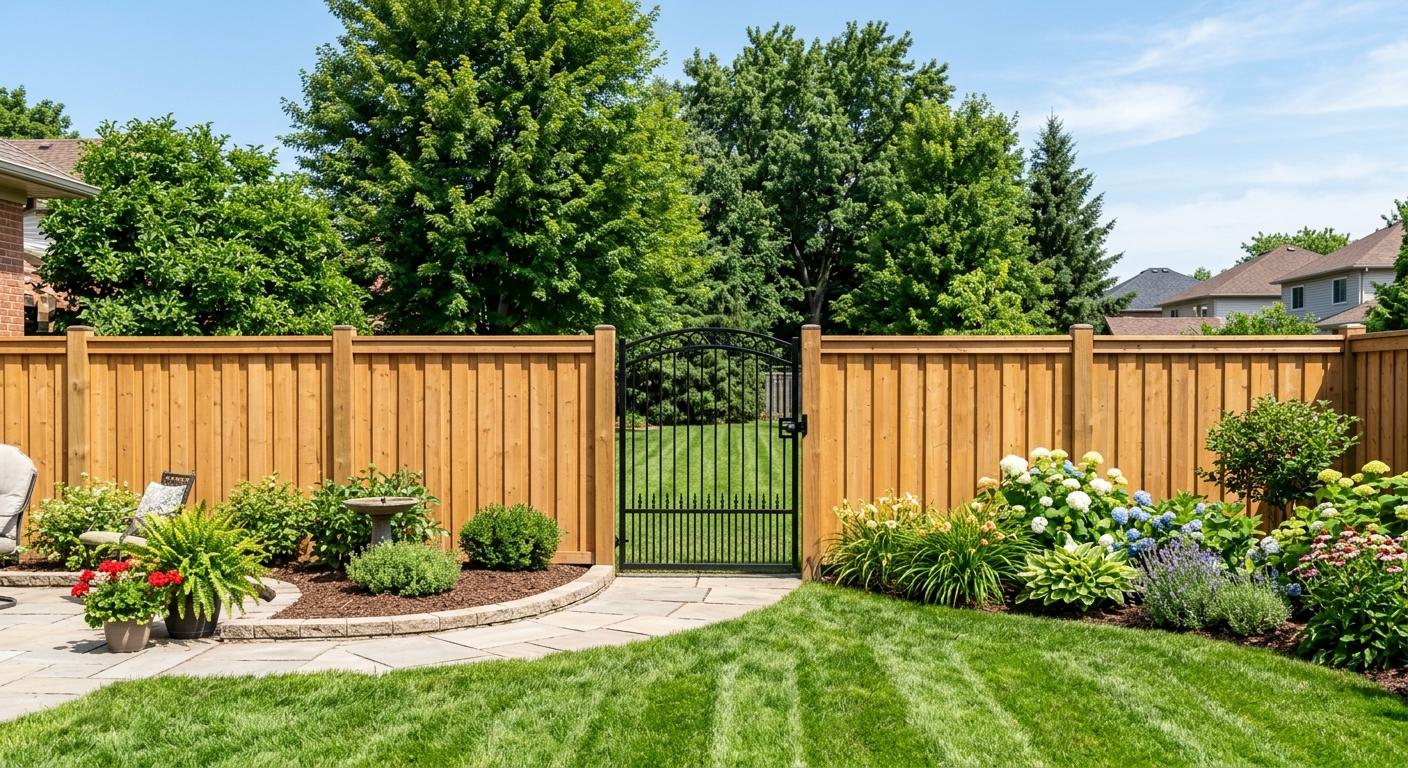
Fencing options and costs in Centre District
Centre District homeowners typically have a lot riding on their fencing choice—privacy for backyard living, safe kids/pets, and a clean boundary that looks good through Toronto’s winters. Even with a relatively small local population (1,656 residents per the Statistics Canada, 2021 Census), the demand for fencing in this area stays steady because households with detached homes tend to invest in perimeter upgrades more often—every upgrade creates both short-term contractor work and ongoing maintenance activity. In the Toronto economic region, pricing is shaped by a practical reality: frost. The frost line in Southern Ontario is commonly treated at about 42"–48", so most reputable crews plan for concrete-set posts rather than relying on driven posts alone, particularly for 6–8 ft privacy fences.
Contractor availability also matters. Toronto and nearby neighbourhoods like Leaside and portions of the wider Centre District area see a consistent mix of infill and older housing stock, which can mean variable fence layouts, different gate widths, and more uneven grades around established properties. On top of that, clay-and-mixed soils plus freeze–thaw cycles increase the need for proper hole depth, post bracing, and galvanized hardware—details that show up in itemised quotes.
Below is a realistic comparison of common fence materials you’ll see quoted in Centre District, including typical lifespan, maintenance expectations, privacy level, and price per linear foot for installed work. Use the table to sanity-check any proposal you receive before we talk next about what drives your quote up or down.
| Material |
Lifespan |
Maintenance |
Privacy Rating |
Price per Linear Foot |
| Pressure-treated pine (standard wood) |
10–15 years |
Stain/seal every 2–3 years; occasional board replacement |
7/10 (solid panel layouts) |
$12–$18 |
| Cedar (natural rot resistance) |
15–25 years |
Light staining every 3–4 years; check posts annually |
8/10 (solid panel layouts) |
$16–$24 |
| Vinyl / PVC (no-maintenance) |
20–30 years |
Wash as needed; inspect rails in extreme cold |
9/10 (solid privacy styles) |
$18–$26 |
| Chain-link (galvanized steel) |
25–35 years |
Minimal; tighten hardware and check tension |
3/10 (security only) |
$9–$14 |
| Aluminum ornamental |
25–40 years |
Occasional wash; no rust with proper powder coat |
4/10 (semi-privacy) |
$14–$24 |
| Composite / recycled material |
20–30 years |
Low; periodic cleaning; verify colour-fastness in sun |
8/10 (solid styles) |
$16–$26 |
Prices are estimates only and vary by project scope, site access and material selection.
What affects the price of fencing in Centre District
In Centre District and across the broader Toronto area, two quotes for the “same” fence can differ by 30–50% because the real scope usually changes: post depth strategy, soil conditions, hardware upgrades for wind, and how much time it takes to move materials and remove an old fence. Even within Southern Ontario, crews price differently based on the expected frost heave risk and the labour required to set posts correctly.
Start with the frost depth. When design frost is about 42"–48", best practice is setting holes roughly 4–6 inches below the design frost depth to reduce movement. In practical terms, that commonly means posts going 1.5–2.0 m into the ground on many Toronto jobs, and for 6–8 ft privacy fences you’re usually using concrete-set posts and longer hardware. That increases material cost and labour time, so it can push you toward the top of the wood fence band (about $65–$120 installed) if you’re doing a full replacement.
Wind still matters even when you don’t have Prairie-level exposure. Taller solid privacy panels can rack, so Toronto crews often tighten post spacing (commonly 6–8 ft centres) and upgrade post size and bracing, which impacts the total installed price. On the other side, projects can come in lower when yard access is easy and you’re building on straight runs with minimal grade changes.
Two concrete Centre District examples I see often: (1) replacing a leaning wood privacy fence with concrete-set posts typically lands in the mid-to-upper wood range because of concrete and excavation time; (2) upgrading to vinyl privacy can cost more upfront (often within the $75–$130 installed band) but can be justified when you want to avoid staining cycles in Toronto’s wet spring/freeze-thaw seasons—especially if you’d otherwise be rehabbing boards every few years. If you’re doing a short chain-link run for pet containment, you may stay closer to the $45–$85 band since post setting is still required, but panel complexity and privacy components are lower.
| Price Factor |
Why It Matters |
Cost Impact |
| Fence length in linear feet |
Most labour and materials scale directly with total run |
Major—often the largest driver |
| Post depth required |
Frost line determines hole depth and required post length |
Medium to major—adds excavation and concrete |
| Post setting method |
Concrete-set posts improve stability versus gravel pack or driven posts |
Medium—concrete and labour add cost |
| Material choice |
Vinyl, cedar, and chain-link differ in cost, hardware, and installation time |
Medium—can shift you between $65–$120, $75–$130 bands |
| Gate count and type |
Gates require heavier framing, hinges, latches and alignment |
Medium—more gates increase time and hardware |
| Grade and terrain |
Sloped yards need stepped or raked panels and extra layout time |
Medium—layout and cutting add labour |
| Old fence removal and disposal |
Demolition, hauling, and recycling/disposal fees |
Low to medium—can become major with tight access |
| Permit fees and survey / property line locate |
Verification avoids setbacks/encroachments and dispute-driven rework |
Low to medium—depends on documentation needs |
Permits & regulations in Ontario
In Ontario, permit needs typically start when you’re putting up a fence above a height threshold—often around 2.0 m (6.5 ft) at the rear, and 1.0–1.2 m (3–4 ft) near the front or corner. Exact thresholds and rules can vary by municipality and fence location, but the principle is consistent: taller boundary fences are more likely to trigger a building permit and/or special review. Regardless of height, all fences must respect property lines and municipal setback bylaws, and they must be installed with safe clearances around services.
Before anyone digs a post hole, you should call for utility locates through Ontario One Call. It’s the right step because frost-depth holes go deeper than most homeowners expect, and you don’t want to hit buried lines. Also, get a survey or a proper property line locate if there’s any chance the existing fence is off line; that protects you from encroachment disputes and the cost of moving work after the fact.
To handle shared boundaries, line-fences rules are governed under provincial legislation. If the neighbour is involved, document what’s being replaced, who pays, and whether both parties agree on height and material.
Licence and coverage checks you should do in Centre District: (1) verify the contractor’s Ontario business registration/licence details where applicable and confirm they provide a clear certificate of insurance; (2) request proof of liability insurance and ensure it covers fencing work at your address; (3) confirm they carry WSIB (Worker Safety and Insurance Board) coverage—your contractor should provide a clearance letter; if they cannot, treat it as a red flag. Finally, ask who pulls the permit (if one is required) and whether permit-related inspections are included.
Choosing the right fence material for Centre District
Choosing a fence material in Centre District is mostly about matching your priorities—privacy, low maintenance, and lifespan—to Toronto’s freeze–thaw cycles and how crews typically set posts here. Because posts often need to be set deep for frost stability, the long-term performance comes down to both the fence material and the foundation. In most Toronto residential backyards, concrete-set posts are strongly recommended for privacy heights to reduce movement that can rack panels in wind.
Pressure-treated pine can be the best budget entry point, but you should expect staining or sealing every 2–3 years to slow grey weathering and protect the wood from Toronto’s wet seasons. Cedar looks better and resists rot longer, so it’s a common “step up” when you want a warmer finish with fewer repairs—though it still benefits from periodic maintenance. Vinyl/PVC is the low-maintenance favourite for many homeowners; just keep in mind that extreme cold can make some components feel stiffer, so you still want correct post spacing and rail support. Chain-link is the most economical option for security and can last decades, but it won’t deliver real privacy without privacy slats or planted screening. Aluminum ornamental offers a clean, rust-resistant look and mid-range cost, but it’s typically not a full privacy system. Composite/recycled boards can be a middle ground—often priced above basic wood while aiming to reduce staining work.
For Toronto frost conditions, ask about post depth and setting method. If the contractor plans simple driven posts at privacy height, that’s not aligned with common Southern Ontario best practice. A concrete-set approach helps your fence resist movement during spring thaw.
Where the dollars make sense: if you’re deciding between pressure-treated pine and cedar for a similar solid privacy layout, the cedar option often costs more (commonly within the $65–$120 wood band but trending toward the upper end) because you’re buying longer-life material with better appearance. If you’re comparing vinyl privacy to wood, vinyl’s higher installed price (often within the $75–$130 band) can be justified when you’d otherwise be paying for repeated staining, board replacements, and labour-driven maintenance cycles.
| Material |
Cold Tolerance |
Lifespan |
Annual Maintenance |
Best For |
Price Band |
| Pressure-treated pine |
Good with correct post setting; needs sealing |
10–15 years |
0.5–1.5 hours (inspection + minor touch-ups); stain every 2–3 years |
Budget privacy where you’re willing to maintain |
$65–$120 |
| Cedar |
Good; stable when posts are set deep and hardware is galvanized |
15–25 years |
0.5–1 hour (clean/inspect); light stain every 3–4 years |
Natural look with less frequent maintenance |
$65–$120 |
| Vinyl / PVC |
Very good; avoid flimsy rail spacing in cold snaps |
20–30 years |
0.25–0.5 hours (wash/inspect) |
Low-maintenance privacy and clean curb appeal |
$75–$130 |
| Chain-link |
Excellent |
25–35 years |
0.25–0.5 hours (tension/hardware check) |
Security on a tighter budget; add slats if needed |
$45–$85 |
| Aluminum ornamental |
Excellent in cold winters; powder coat resists corrosion |
25–40 years |
0.25–0.5 hours (wash/inspect) |
Attractive boundary with low rust risk |
$90–$160 |
| Composite / recycled |
Good; stable with proper framing |
20–30 years |
0.25–0.5 hours (wash/inspect) |
Privacy with reduced staining work |
$75–$130 |
How to choose a fencing contractor in Centre District
Choosing a fencing contractor in Centre District starts with verification, not just price. First, confirm the company’s Ontario coverage for fencing work: ask for (1) liability insurance (request the certificate and confirm the address/job type is covered); (2) WSIB coverage—your contractor should be able to provide a current clearance letter; and (3) ensure any subcontractors (if used) are covered as well. If the contractor can’t provide these documents on request, pause the process.
Next, get 2–3 itemised written quotes. A proper fence quote should break out labour and materials separately (posts, rails, panels, hardware, gates, concrete, and demolition/disposal). Avoid lump-sum only pricing unless it’s accompanied by a detailed scope document. Watch for exclusions like “no permit fees,” “no property line locate,” or “disposal not included”—those omissions can add surprise costs after you’ve booked the work.
Warranty matters too. Ask for the workmanship warranty length (how long they stand behind installation) and the manufacturer’s product warranty (wood/vinyl/aluminum system components). Also ask whether the warranty is transferable if you sell your home.
On payment schedule, never pay more than 10–15% upfront. Hold back a portion until the job is complete, posts are set properly, gates align, and cleanup is done. In Toronto, timing can be impacted by soil conditions—agree on a written start date and completion estimate based on your fence type and required excavation depth.
- Request WSIB clearance letter (current) and keep a copy of it with your contract.
- Verify liability insurance certificate before the crew starts any excavation.
- Get a start date and completion timeline in writing.
- Demand itemised pricing: labour, materials, concrete, hardware, gates, and disposal.
- Ask whether permit pulling is included if your fence triggers a permit threshold.
- Confirm how they determine the property line (survey locate vs. existing fence line).
- Ensure the quote states post depth and setting method (concrete-set for privacy heights).
- Check panel spacing and bracing plan for wind resistance and racking control.
- Verify gate hardware spec (hinges/latches) and whether gates are included in linear footage or as separate line items.
- Confirm cleanup and disposal: do they remove old boards/posts, and where do they haul?
- Confirm warranty details in writing, including what qualifies as workmanship defects.
- Use a staged payment plan with a holdback until final measurements and walkthrough approval.
In Centre District, 4–5 red flags I see repeatedly: quotes that don’t state post depth or setting method; missing or outdated WSIB/liability documents; “cheap” pricing that leaves out old fence removal/disposal; no written scope for gates and grade adjustments; and large upfront payments (well above 10–15%) without a clear contract schedule.
Frequently asked questions — fencing in Centre District
Should I repair or replace my old fence in Centre District?
If your old fence is mainly cosmetic (warped pickets, a few loose boards) a repair can make sense in Centre District, especially if the posts are still solid and properly set. But once you see post movement, leaning runs, or widespread rot at the base, replacement usually costs less over time because Toronto’s freeze–thaw can keep stressing weak foundations. For privacy fences, repaired sections often reintroduce imbalance, and wind can make the problem spread along the run. As a rule of thumb, if more than a third of the panels/rails need replacement or posts are failing at the ground line, plan for a full install. For budgeting, a new wood fence often falls in the $65–$120 range installed, while vinyl privacy commonly runs in the $75–$130 band—sometimes worth it if you want fewer maintenance cycles.
How do I handle a fence dispute with a neighbour in Ontario?
In Ontario, fence disputes usually come down to property lines, height/setback rules, and shared boundary expectations under line-fences principles. Start by confirming where your property pins are (a survey or locate helps), rather than relying on the existing fence line—old fences are often shifted. Collect your documents: photos, your contractor’s measurements, and the proposal showing planned height and placement. Communicate in writing with your neighbour and propose a solution like a jointly agreed material and height, or a survey-led correction if placement is off. If you’re replacing a tall fence, remember that a permit may be required (commonly above 2.0 m at the rear and lower thresholds near the front/corner), which strengthens the argument that you’re installing to current rules. Keep your contractor’s scope clear and aligned to the final agreed boundary location.
What fence style offers the best wind resistance in Centre District?
For wind resistance in Centre District, the key is not just style—it’s solid panel control and correct engineering for racking. Solid privacy fences (wood or vinyl) can perform well when posts are properly anchored (often concrete-set for frost stability) and when rail spacing and bracing are sized for the fence height. Semi-open designs like aluminum ornamental can resist wind loads better because air passes through, but they won’t provide full privacy. Chain-link typically handles wind forces well, but again offers minimal privacy unless you add slats. If your run faces a corner, a busy street exposure, or a more open backyard feel, choose heavier posts and closer spacing (commonly 6–8 ft centres) rather than trying to “save” on structure. A properly installed 6–8 ft privacy fence with correct post depth is usually the practical balance for Toronto residential wind conditions.
How much does a fence cost in Centre District?
Typical installed fencing in Centre District lands in the same regional bands most homeowners see across the Toronto economic region. Wood fence installation commonly ranges from about $65–$120 installed, while vinyl/PVC is often $75–$130 installed. Chain-link fencing is usually the lowest cost at $45–$85 installed, and aluminum/metal ornamental is typically $90–$160 installed. Your final number depends heavily on linear feet, gate count, grade changes, and especially post setting—Toronto frost conditions often require deeper, concrete-set posts for privacy heights. Access matters too: narrow side yards or lots of removal/disposal work pushes labour. If you want a quick budget check, tell your contractor your approximate fence length, desired height, whether you need demolition, and whether you want privacy (solid) or security (open) panels.
How deep should fence posts be for Centre District's frost?
For Centre District, posts generally need to be set deep enough to avoid frost heave during winter thaw cycles. Local best practice commonly treats Southern Ontario frost at about 42"–48", and crews typically plan to set holes roughly 4–6 inches below the design frost depth. In practical terms, that’s often about 1.5–2.0 m into the ground for many residential privacy fences in the Toronto area, especially for 6–8 ft heights. Because your soil is often a mix of clay and variable material, simple driven posts can shift over time. Most contractors therefore recommend concrete-set posts for long-term stability, with correct backfill and bracing while the concrete cures. Your contractor should state post depth and setting method clearly in the quote—if they don’t, ask.
Wood vs vinyl vs aluminum fence — which is best?
In Centre District (Toronto), “best” depends on whether your priority is privacy, appearance, or low maintenance. Wood (pressure-treated) is usually the most budget-friendly path, often within the $65–$120 installed range, but it needs staining/sealing every 2–3 years to prevent weathering and to slow rot at stress points. Cedar is a step up in look and rot resistance, but it still benefits from periodic maintenance. Vinyl/PVC is often the easiest long-term ownership choice—commonly $75–$130 installed—because it’s low-maintenance and holds up well in freeze–thaw when installed with correct spacing and solid post anchoring. Aluminum ornamental costs more (commonly $90–$160 installed) but wins on rust resistance and curb appeal; it’s typically not full-privacy. If you want privacy, vinyl or wood/cedar privacy styles usually fit better; if you want a maintenance-light ornamental boundary, aluminum is a strong choice.