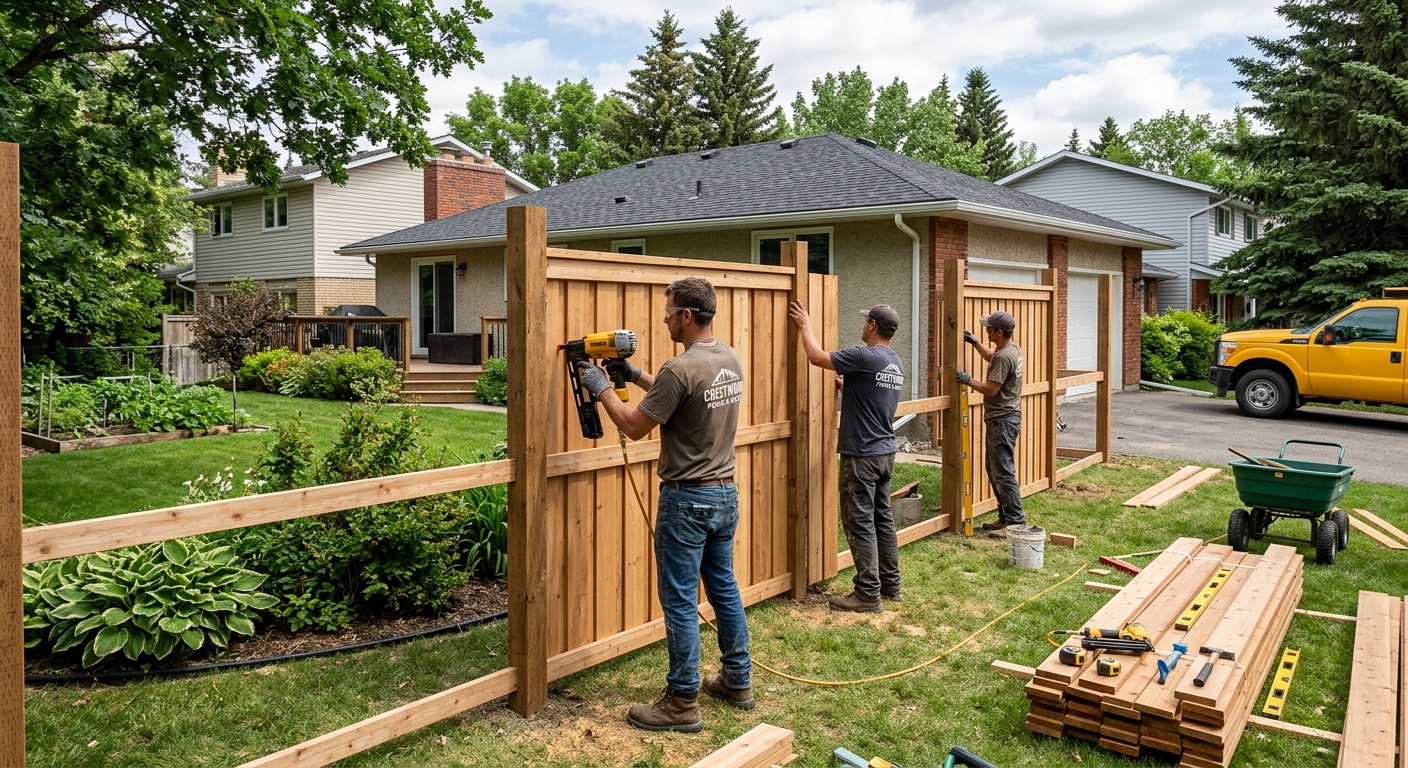
Fencing options and costs in Harriston
In Harriston, fencing tends to be a “need it now, build it right” purchase—homeowners want their backyard usable through mud season and into winter, and they also want the fence to stay straight for years. With a population of 1,797 (Statistics Canada, 2021 Census), demand is smaller than big-city GTA centres, but the surrounding rural lots around Harriston still generate steady work, especially when detached properties need boundary upgrades. In many households, that means fencing decisions are one of the first home improvements after landscaping and driveway updates. The strongest predictor of local demand is simply how many detached homes are being actively maintained in the area.
Pricing in the Toronto economic region is shaped by Southern Ontario’s frost conditions and common contractor methods. Although Harriston isn’t the open-wind exposure of the Prairies, the frost line still drives how deep posts must be set—typically around 3.5–4 feet minimum for stability on 6–8 ft privacy fences. Concrete-set posts are the norm in mixed clay soils, which adds labour time and ready-mix costs, but it reduces long-term heaving and leaning. You’ll also notice wood and vinyl privacy installs cost more in tight-access properties where hauling and excavation take longer.
If you’re around the neighbourhoods near downtown Harriston and the older, established lots where line fences get replaced more often, fencing installers tend to be busiest. With that in mind, here’s how popular materials compare before you get site-specific measurements and a quote.
| Material |
Lifespan |
Maintenance |
Privacy Rating |
Price per Linear Foot |
| Pressure-treated pine (standard wood) |
10–15 years |
Stain/seal every 2–3 years |
High (solid board/rails) |
$65–$120 |
| Cedar (natural rot resistance) |
15–25 years |
Light staining as needed (often 3–5 years) |
High (solid picket/board) |
$75–$130 |
| Vinyl / PVC (no-maintenance) |
20–30 years |
Rinse only; occasional hardware checks |
High (solid or board styles) |
$75–$130 |
| Chain-link (galvanized steel) |
20–40 years |
Occasional tension check |
Low to medium (add privacy slats if desired) |
$45–$85 |
| Aluminum ornamental |
25–40 years |
Rinse; repaint only if damaged (rare) |
Low (visual openness) |
$90–$160 |
| Composite / recycled material |
20–30 years |
Very light cleaning; inspect for warping |
High (board-style) |
$90–$160 |
Prices are estimates only and vary by project scope, site access and material selection.
What affects the price of fencing in Harriston
In Harriston and throughout the Toronto economic region, quotes for the “same fence” can swing by 30–50% because the work is rarely identical once we account for soil conditions, frost requirements, and how much labour it takes to install straight, level panels. Some contractors price a simpler build (lighter posts, gravel-only setting, wider centres), while others price the method that holds up in Ontario winters—concrete-set posts and tighter hardware for taller privacy sections.
Frost line depth is the big driver. In cold Ontario, many post holes need to be set roughly 4–6 inches below the design frost depth to prevent heaving, which commonly means setting posts around 1.5–2.0 m into the ground. That pushes labour time higher and increases material waste (longer posts, more concrete), especially for 6–8 ft privacy fences. Wind isn’t as punishing as on the Prairies, but snow loading and gusts still matter: taller solid panels rack more easily, so builders use heavier posts (or closer spacing) to keep the fence aligned.
Here are a few practical Harriston examples that change cost quickly: (1) clay that holds water can slow excavation and increase labour for clean footing; (2) a sloped yard often requires stepped or raked sections, which adds layout time and trim labour; and (3) easy access (wide driveway and short carry paths) can keep material handling straightforward, while narrow side yards increase time for hauling and wheelbarrowing. Budget-wise, wood privacy frequently falls in the lower end of the $65–$120 band, while vinyl privacy and cedar often land higher—commonly within the $75–$130 range depending on post size and gate hardware.
| Price Factor |
Why It Matters |
Cost Impact |
| Fence length in linear feet |
The number of panels, rails, and posts scales directly with length. |
Largest portion of total cost |
| Post depth required |
Frost line governs hole depth and post length for stability. |
Higher concrete and longer materials |
| Post setting method |
Concrete vs. gravel pack vs. driven posts changes labour and footing stability. |
Concrete-set typically costs more but lasts longer |
| Material choice |
Vinyl, cedar and chain-link differ in material price and installation method. |
Up to mid-to-high price band changes |
| Gate count and type |
Double drive gates require more framing, hinges, and alignment time. |
Can add a significant premium |
| Grade and terrain |
Slopes require stepping/racking and extra cutting. |
Layout and labour increase |
| Old fence removal and disposal |
Debris hauling and dealing with buried post remnants takes time. |
Often adds hours and dump fees |
| Permit fees and survey / property line locate |
Some fences need permits and proper line location to avoid disputes. |
Extra administrative and locating costs |
Permits & regulations in Ontario
In Ontario, fence permitting can depend on height and location, and the thresholds are commonly applied with rear yards starting around 2.0 m (6.5 ft) and front/corner areas around 1.0–1.2 m (3–4 ft). When you’re planning a tall privacy fence in Harriston—especially where it faces a street or sits near a corner—assume a permit may be required and confirm with your municipality before you dig. Even when a permit isn’t required, the fence still must respect property lines and any municipal setback bylaws.
Before digging any post holes, call for utility locates. In Ontario that means Ontario One Call (1-800-400-2255) so crews can mark buried services. Next, get a survey or at least a pin locate (locating property pins) so you don’t build into a neighbour’s yard or create an encroachment dispute. Shared fence ownership is typically handled under Ontario’s line-fences principles, so keep documentation of who has the fence responsibility on each boundary.
For contractor verification, a homeowner can (1) confirm the contractor’s Ontario business details via the appropriate online registry entry, (2) request a certificate of insurance showing liability coverage, and (3) ask for WSIB clearance/coverage confirmation if the contractor has workers. Ask to see current documents before work starts—then keep copies for your records.
Bottom line: permit is typically needed for taller fences, while utility locates and property line accuracy are non-negotiable for every installation.
Choosing the right fence material for Harriston
Choosing the right fence material in Harriston is mostly about balancing privacy, low maintenance, and how well the fence handles Ontario temperature swings. Pressure-treated pine is usually the budget-friendly option, but it needs staining or sealing every 2–3 years to prevent grey weathering and surface checks. Cedar looks great longer and has better natural rot resistance, though it still benefits from periodic maintenance to keep colour even. If you want the “set it and forget it” approach, vinyl/PVC is typically the lowest-maintenance in day-to-day care, but in extreme cold it can become brittle—so it needs correct installation with proper spacing and hardware.
For privacy, the most consistent performance comes from solid board styles (wood, cedar, composite) and solid vinyl panels. Chain-link is often the cheapest to install, but it offers little privacy unless you add slats or a privacy screen; it’s also great for pet containment with minimal upkeep. Aluminum ornamental is durable and won’t rust, but it’s visually open—ideal for defining property boundaries rather than blocking sightlines.
Because the Toronto-area frost line commonly drives posts to be set around 3.5–4 feet deep for tall fences, concrete-set posts are usually recommended for stable privacy builds in Harriston’s clay/mixed soils. That said, the post system matters as much as the material—proper setting helps prevent racking and leaning in winter freeze/thaw cycles. If you’re comparing price: moving from pressure-treated pine toward cedar can be justified when you expect 15–25 years of curb/yard appeal; a jump is often within the move from roughly $65–$120 to $75–$130 per linear foot, depending on fence height, post spacing, and gate hardware.
| Material |
Cold Tolerance |
Lifespan |
Annual Maintenance |
Best For |
Price Band |
| Pressure-treated pine |
Good with proper post depth and sealing |
10–15 years |
1–3 times per year spot checks; stain/seal every 2–3 years |
Budget privacy with a manageable maintenance plan |
$65–$120 |
| Cedar |
Good; handles freeze/thaw better than pine when installed correctly |
15–25 years |
Light staining or cleaning every 1–3 years as needed |
Premium look and rot resistance for privacy |
$75–$130 |
| Vinyl / PVC |
Very good if installed with correct spacing and hardware |
20–30 years |
Usually 0–1 rinse/wash pass per year |
Low-maintenance privacy and straight lines |
$75–$130 |
| Chain-link |
Excellent; galvanized steel resists Ontario weather |
20–40 years |
1 tension/connector check every few years |
Security with minimal maintenance |
$45–$85 |
| Aluminum ornamental |
Excellent; doesn’t rust in winter salt spray areas |
25–40 years |
0–1 rinse; touch-up only if damaged |
Attractive boundary definition with curb appeal |
$90–$160 |
| Composite / recycled |
Good; can handle cold when installed per manufacturer specs |
20–30 years |
0–1 wash/clean; inspect for alignment |
Long-life privacy with reduced upkeep |
$90–$160 |
How to choose a fencing contractor in Harriston
Choosing a contractor in Harriston is less about flashy ads and more about checking the paperwork and the details in the estimate. Start by verifying Ontario coverage and compliance: ask for their certificate of insurance (liability) and confirm WSIB/workers’ coverage status if they have employees. To check Ontario standing, use the appropriate online registry sources available for businesses and request the exact company name that matches the quotes and invoices. If a contractor won’t provide insurance or coverage proof, treat that as a serious risk.
Next, get 2–3 itemised written quotes—not one lump sum. A strong quote breaks out labour (excavation, setting, install), materials (posts, rails, panels/boards, hardware), and extras (gate framing, concrete, removal/disposal). Read the exclusions: is permit work included (when required), does the price include utility-locate coordination, and is old fence removal/dump disposal included or charged separately? Good contractors also specify whether they’ll use concrete-set posts for tall privacy fences, including recommended hole depth for frost stability.
Warranty matters too. Ask for the workmanship warranty length, plus the manufacturer warranty on the product. Confirm whether warranties are transferable if you sell your home. For payment, never pay more than 10–15% upfront; hold back a portion until the job is complete and materials are inspected. Finally, get a start date and estimated completion timeline in writing so you’re not stuck during peak site-work periods.
- Request insurance certificate and WSIB/workers’ coverage proof before work starts.
- Confirm the quote names the exact legal company and contact info that match invoices.
- Get an itemised breakdown of labour, materials, and equipment (not a single total).
- Ensure post depth and setting method are stated (concrete-set for tall privacy).
- Verify panel spacing and hardware type for wind/snow racking resistance.
- Confirm gate count, gate type, latch hardware, and swing direction in writing.
- Ask who handles utility locates and whether the contractor provides documentation.
- Check whether old fence removal and disposal are included in the price.
- Make sure slope/grade adjustments (stepped/raked panels) are addressed.
- Clarify cleanup standards and whether sawdust/debris is hauled away.
- Confirm warranty terms separately for labour and for product/manufacturer.
- Agree on payment schedule: 10–15% max upfront and holdback on completion.
Red flags I see in Harriston are: (1) quotes that don’t mention post depth or concrete setting for tall fences; (2) no written scope for gate hardware and alignment; (3) refusing to provide proof of liability insurance and WSIB coverage; (4) asking for a large upfront deposit without a signed contract; and (5) vague timelines with no start/completion dates.
Frequently asked questions — fencing in Harriston
How do I find my property line before fencing?
In Harriston, the safest way to confirm your property line is to get a survey or have your property pins located before any post holes are dug. If you don’t have recent survey documents, ask a surveyor to mark the boundary and note where the fence should sit relative to setbacks. You can also locate pins through a locate service, but pins should be validated against documentation to avoid guesswork. Before anyone excavates, require utility locates via Ontario One Call so buried services are marked. This combination—pins/survey plus utility locate—reduces the risk of building into a neighbour’s space, which can become expensive to correct. For homeowners, it’s also a good time to confirm whether your planned fence height triggers a permit requirement.
What's the most low-maintenance fence?
For most Ontario homeowners, vinyl/PVC is the most low-maintenance option: it typically needs only an occasional rinse and hardware checks, and it won’t rot like wood. In Harriston’s freeze/thaw cycles and winter moisture, vinyl generally holds up well when installed correctly with appropriate spacing and solid post footing. Chain-link is also very low maintenance and can last decades, but it won’t provide privacy by itself unless you add slats/screens. If you want privacy with minimal upkeep, solid vinyl often competes well against wood once you factor in staining and labour over time. In the Toronto region pricing bands, vinyl privacy commonly sits around $75–$130 per linear foot, compared with pressure-treated wood’s $65–$120 range.
How tall can my fence be in Harriston?
Fence height rules vary by location and whether the fence is in the front, rear, or a corner side yard. As a common Ontario guideline used by many municipalities, rear yards are often around 2.0 m (6.5 ft) before a building permit may be required, while front/corner areas are often closer to 1.0–1.2 m (3–4 ft). In Harriston, if you’re planning a tall privacy fence near a street or corner, don’t assume—confirm with the local permit process before you install. Even when a permit isn’t required, setbacks and property-line accuracy still matter. Tall solid fences also need sturdier posts and spacing to resist racking from wind and snow load, which can affect quote price.
Should fence posts be set in concrete here?
For tall privacy fences in Southern Ontario (including the Harriston area and the broader Toronto economic region), concrete-set posts are usually the best choice for long-term stability. The reason is frost: the frost line commonly sits around 42"–48", so contractors typically set posts about 4–6 inches below the design frost depth to reduce heaving. That often translates to holes roughly 1.5–2.0 m deep depending on soil and design. Gravel-only or driven posts can be cheaper up front, but they’re more likely to shift or lean over time in mixed soils. Concrete also improves stability for 6–8 ft fences that require heavier posts and closer spacing to avoid rack. The added labour and ready-mix usually explains why wood privacy can start around $65–$120 and higher-demand builds often reach the upper end.
What's the best fence for privacy?
The best privacy fence is usually a solid board style with tight spacing—pressure-treated pine, cedar, vinyl/PVC, or composite—because they block sightlines effectively. In Harriston’s winter conditions, the real performance comes down to how the fence is built: correct post depth for frost stability, appropriate post sizing, and solid hardware connections so the panels don’t rack during wind and snow. Vinyl and composite can offer the easiest long-term privacy with less staining, while cedar gives an upscale look with better rot resistance than pine, though both still need some maintenance. If you’re watching budget, pressure-treated pine is a common starting point in the $65–$120 band; if you want a longer-maintenance-free experience, vinyl or cedar often fits the $75–$130 band depending on height, gate hardware, and footing requirements.
How do I compare fencing quotes?
To compare fencing quotes in Ontario (and around Harriston), insist on the same scope in each proposal: total linear feet, fence height, gate count/type, post depth, post spacing, and the setting method (concrete-set vs. gravel pack). The biggest mistake homeowners make is comparing only the total price when one quote assumes lighter posts, different centres, or less concrete. Make sure each estimate lists labour and materials separately, including disposal/removal of the old fence if applicable. Check timelines, warranty terms for workmanship and product, and whether permits (when required for taller fences) are included. Before signing, verify contractor documents: liability insurance and workers’ coverage/WSIB confirmation. A good contractor should answer these items clearly and provide a written schedule.