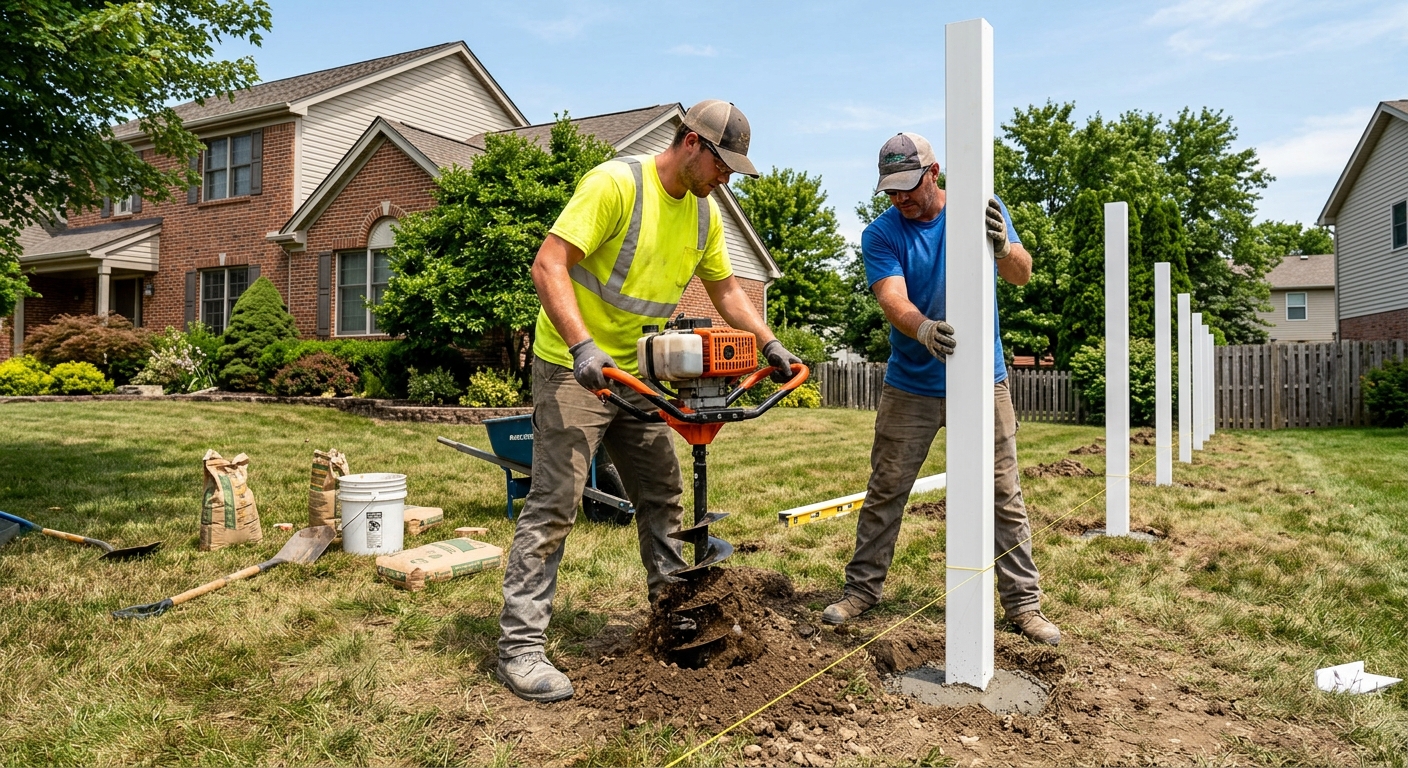
Fencing options and costs in Lillooet
Lillooet is a small community where most neighbourhood streets connect to large lots, so fencing decisions tend to affect everyday views, privacy, and dog/cycling safety. With 925 homeowner households in the area (83.3% of households own) and single-detached homes making up 69.4% of dwellings (Statistics Canada, 2021 Census), there’s steady demand for perimeter fencing, back-yard privacy, and gates as families maintain older properties—over half of homes were built before 1981, so fence lines often get refreshed or replaced alongside exterior upgrades (Statistics Canada, 2021 Census).
In the Lower Mainland–Southwest, pricing is shaped by mild but not trivial frost and wind conditions. Even when winters feel gentle, posts still must be set below the local frost depth to limit heaving, and wetter soils can mean deeper holes, more concrete, and more labour than a “dry-site” install. Wind exposure also influences material choice: lighter pickets can flex, while solid panels and taller privacy fences need stronger posts and better bracing.
In Lillooet, installs are especially common around town’s older residential pockets and along the quieter hillside neighbourhoods where yards are more exposed to wind gusts. Crew availability can also affect turnaround times when multiple jobs overlap during the milder spring and early-fall fence season.
Below is a realistic snapshot of what Lillooet homeowners typically budget for common fence types, leading into a more detailed look at what moves your quote up or down.
| Material |
Lifespan |
Maintenance |
Privacy Rating |
Price per Linear Foot |
Price Range |
| Pressure-treated pine (standard wood) |
10–15 years |
Stain/seal every 2–3 years; inspect posts and rails annually |
Medium–High |
$18–$32 |
$55–$95 |
| Cedar (natural rot resistance) |
15–25 years |
Light staining every 2–4 years (to slow greying); check hardware |
High |
$22–$40 |
$65–$110 |
| Vinyl / PVC (no-maintenance) |
20–30 years |
Rinse/wash as needed; no staining or sealing |
High (solid styles) |
$25–$48 |
$75–$130 |
| Chain-link (galvanized steel) |
20–30+ years |
Occasional tightening; hose rinse; replace damaged sections |
Low (security only) |
$12–$22 |
$30–$55 |
| Aluminum ornamental |
25–40 years |
Wash annually or as needed; touch up minor paint nicks |
Low–Medium |
$28–$55 |
$90–$170 |
| Composite / recycled material |
25–35 years |
Minimal cleaning; avoid abrasive scraping; inspect posts |
Medium–High (solid panel styles) |
$26–$50 |
$80–$140 |
Prices are estimates only and vary by project scope, site access and material selection.
What affects the price of fencing in Lillooet
Even for the “same” fence—same height and roughly the same look—quotes across the Lower Mainland–Southwest and British Columbia can vary by 30–50%. The gap usually comes from how crews handle ground conditions and wind exposure, not just the material. If a site needs deeper post holes, more concrete, extra bracing, or careful rail alignment on a slope, your labour hours increase quickly. In wetter soils, contractors often can’t assume a simple gravel-bed installation will hold long-term, so costs rise even when the fence is only a few feet higher.
Frost line depth sets how deep posts must be set to prevent heaving. Published Canadian guidance commonly uses about 3 feet minimum embedment in much of Canada, and in practice many BC installs still go deeper than the bare minimum—often with posts set 4–6 inches below the design frost depth—so material and post length increase, plus concrete usage goes up. On top of that, Lower Mainland–Southwest jobs can involve frequent ground-softening during wet spells, which makes excavation slower and can increase disposal costs. Meanwhile, wind exposure is a bigger story than most homeowners expect: where gusts are higher, stronger posts and tighter spacing are needed, especially for solid wood and vinyl privacy.
In Lillooet, two local cost examples are common. First, replacing an older fence where the bottom rails are rotten often means re-holing multiple posts and removing more damaged lumber than expected. Second, a backyard on a damp, darker soil patch typically requires extra care with hole depth and concrete setting. If you’re comparing options, a typical wood budget in the region can land around the $55–$95 band, while vinyl/PVC often pushes to $75–$130 once posts, bracing, and material complexity are factored in.
As a general rule, older housing stock means more frequent “unknowns” behind existing fence lines—anchors, buried remnants, or uneven grades—which is why two similar-length estimates can still diverge by hundreds or even a thousand dollars.
| Price Factor |
Why It Matters |
Cost Impact |
| Fence length in linear feet |
Labour, posts, rails, and material quantities scale directly with length |
Highest driver; longer runs can account for most of the final total |
| Post depth required |
Frost protection dictates hole depth and often post length |
Deeper holes can add concrete, post material, and excavation time |
| Post setting method |
Concrete vs. gravel pack affects stability and labour steps |
Concrete-setting usually increases cost; driven posts reduce concrete use but require proper conditions |
| Material choice |
Vinyl and composites require different structural spacing; cedar/wood need maintenance |
Shifts you between typical bands: chain-link lowest, wood mid, vinyl higher, metal highest |
| Gate count and type |
Gates require heavier frames, hinges, latches, and alignment work |
Each additional gate commonly adds a noticeable premium; double-drive gates cost more |
| Grade and terrain |
Slope requires stepped sections or raked panel fabrication |
More cutting, templating, and hardware adjustments add labour |
| Old fence removal and disposal |
Demolition is time-consuming and may include hauling and dump fees |
Can materially add to the total if footing and posts are sunk deeply |
| Permit fees and survey / property line locate |
Front/corner height limits and property-line accuracy can require paperwork |
Small but meaningful administrative and professional service costs |
Permits & regulations in British Columbia
In British Columbia, fences above a height threshold often require a building permit. While rules can vary by municipality, the common guideline homeowners run into is roughly 2.0 m (6.5 ft) for rear yards and about 1.0–1.2 m (3–4 ft) for front yards or corners, especially where fences affect sightlines and setbacks. In all cases, your fence must respect the property line and any municipal setback requirements that apply on your street.
Before you dig a single post hole, call for utility locates. In BC this is typically done through BC 1 Call, and the point is to prevent hitting buried services such as power, telecom, or irrigation. Also consider obtaining a survey or at minimum locating the property pins/markers so your contractor can set posts in the correct place; fencing disputes are difficult (and expensive) to unwind after the fact.
Shared fence ownership is handled under provincial line-fences legislation: neighbours may have rights and responsibilities depending on the situation, and maintenance expectations can vary with how the fence was originally built and used. If you’re planning a privacy fence that changes wind or snow drift patterns, talk to the neighbour early so placement and expectations are aligned.
To verify your contractor in Lillooet: check their provincial business information, request a certificate of liability insurance (with the fence work listed), and ask how their workers are covered (Workers’ compensation coverage). If they can’t provide documentation promptly, treat it as a major red flag before signing a contract.
Choosing the right fence material for Lillooet
Choosing a fence material in Lillooet is mostly about matching your priorities—privacy, low maintenance, budget, and lifespan—to the reality of Lower Mainland–Southwest weather. Pressure-treated pine is the budget-friendly path, but it generally needs staining or sealing every 2–3 years to reduce greying and keep water out of the wood surface. Cedar offers a better look and more natural rot resistance, yet it’s still smart to plan on maintenance every few years, especially where wind-driven rain hits hardest.
Vinyl/PVC is the true low-maintenance option: you typically wash it, not stain it. The trade-off is upfront cost, and in cold snaps vinyl can become more brittle than wood, so quality systems and correct installation matter. Chain-link remains the lowest installed price and is long-lived, but it won’t give privacy unless you add slats or landscaping. Aluminum ornamental fences resist rust and look crisp, but they’re usually decorative rather than private.
Post depth and setting approach also connect to material performance. In Lower Mainland–Southwest conditions, crews typically set posts below the design frost depth—often deeper than a bare minimum—then use concrete for corner posts, gate posts, and privacy panels where stability is critical. Concrete-set posts can cost more initially, but they reduce movement that leads to misaligned rails and premature failures.
For a simple comparison: if you’re deciding between wood and vinyl, wood often sits around the $55–$95 band, while vinyl/PVC commonly lands near $75–$130. That extra spend is often justified when you want long-term privacy with minimal upkeep, or when repeated summer staining is not realistic for your household schedule.
| Material |
Cold Tolerance |
Lifespan |
Annual Maintenance |
Best For |
Price Band |
| Pressure-treated pine |
Good (with proper treatment and seal) |
10–15 years |
Inspect 1×/year; stain/seal every 2–3 years |
Budget privacy and traditional look |
$55–$95 |
| Cedar |
Good (naturally rot-resistant) |
15–25 years |
Inspect 1×/year; stain lightly every 2–4 years |
Natural appearance with better weathering |
$65–$110 |
| Vinyl / PVC |
Moderate to good (avoid cheap brittle systems) |
20–30 years |
Wash/rinse as needed; check hardware after storms |
Low-maintenance privacy |
$75–$130 |
| Chain-link |
Good |
20–30+ years |
Tighten/replace damaged sections; rinse |
Security, pets, and boundary definition |
$30–$55 |
| Aluminum ornamental |
Excellent |
25–40 years |
Wash annually or as needed |
Decorative curb appeal with long service life |
$90–$170 |
| Composite / recycled |
Moderate (system quality matters) |
25–35 years |
Minimal cleaning; inspect posts and fasteners |
Consistent appearance with fewer maintenance tasks |
$80–$140 |
How to choose a fencing contractor in Lillooet
Start by verifying British Columbia credentials and coverage before you ever talk design. Ask the contractor for their business registration details and a certificate of liability insurance that clearly lists the fence work. For worker coverage, request proof of workers’ compensation coverage (often shown through the worker’s comp/clearance documentation). You don’t need to be an expert—your job is to confirm they can legally and financially stand behind the people doing the job.
Next, get 2–3 itemised written quotes. A good fence quote breaks labour and materials apart (posts, rails, panels, hardware, concrete, and excavation), and it should list what’s included for disposal and any site restoration. Watch for vague “all-in” language—especially if the job might involve old fence removal, slope adjustments, or gate hardware upgrades.
Warranty matters: confirm the workmanship warranty length, the product/manufacturer warranty, and whether the warranty is transferable to future owners. Ask about what happens if panels warp, posts loosen, or a gate sags prematurely.
For payment, never pay more than 10–15% upfront. Hold back the remaining balance until the fence is complete and snagged areas are fixed. Finally, require a start date and completion estimate in writing, and ask how they handle weather delays in BC’s wet/spring conditions.
- Confirm BC contractor documentation before work begins; request insurance proof in writing.
- Ask for liability coverage limits and ensure the fence project is covered.
- Confirm workers’ compensation coverage (clearance or equivalent documentation).
- Get 2–3 itemised quotes with line-by-line labour and materials.
- Ensure the quote states whether permit pull is included or your responsibility.
- Clarify if old fence removal, stump/grub removal, and hauling/disposal are included.
- Verify fence line staking and how they confirm property pins/markers.
- Ask how gates are framed and whether hardware is included (hinges, latch, closer if applicable).
- Confirm post depth approach (below frost depth) and whether concrete is used for corners/gates.
- Review warranty: workmanship duration, product warranty duration, and transferability.
- Agree on payment schedule with a conservative upfront deposit (10–15%).
- Get a written start date, milestones (posts first, then panels), and completion estimate.
In Lillooet, common red flags include contractors who: (1) won’t provide insurance/coverage documents, (2) quote a fixed price without mentioning post depth or soil conditions, (3) skip a property-line verification plan, (4) propose concrete-free post installs in corners/gates without explaining stability measures, and (5) ask for large upfront payments beyond 10–15%.
Frequently asked questions — fencing in Lillooet
How long does a wood fence last in Lillooet?
In Lillooet and the wider Lower Mainland–Southwest, wood life mainly depends on moisture exposure, post setting, and maintenance habits. Pressure-treated pine commonly lasts about 10–15 years when posts are set properly below frost depth and you plan for staining/sealing every 2–3 years. Cedar can stretch closer to 15–25 years because of its natural rot resistance, but it still benefits from periodic maintenance to slow greying and surface wear. If your yard has persistent wet spots or wind-driven rain hitting end posts and gate areas, those sections typically fail first—so the “real” lifespan is often a blend of materials and how the fence is installed at corners and gates. If your current fence is built before 1981 and has wobbly posts, a full re-post is often the most cost-effective long-term repair.
Who owns and maintains a shared fence?
Shared fence rules in British Columbia generally fall under provincial line-fences legislation, and the practical answer depends on how the fence was built and whether both neighbours benefit from it. Some shared fences are effectively “party fences,” where the ownership and maintenance responsibilities can be split—other situations are less clear if one side installed and paid for the original boundary. Before replacing a shared fence, confirm the property line and discuss scope with your neighbour (height, material, and where the posts sit). A good contractor can help you document what’s being built where, but the legal ownership/maintenance question should be reviewed in line with BC’s line-fences approach. If you’re doing a permit-required height fence, keep your neighbour informed early so expectations match the final design and location.
How do I find my property line before fencing?
For fencing in Lillooet, you want to confirm property pins/markers before digging post holes. The most reliable option is a survey, particularly if your lot is older or has had boundary discussions before. If pins are already established, locate them (often with a property marker search or by arranging a locate service through the appropriate channels) so your contractor can stake the fence line accurately. Avoid guessing based on visual boundaries like shrubs or worn edges—fence disputes are hard to resolve once concrete is poured. Also, arrange utility locates before any excavation, using BC 1 Call for buried services. A contractor who proposes to “eyeball it” without a plan for property-line verification is not the contractor you want for a fence replacement near setbacks or corners.
What's the most low-maintenance fence?
Most homeowners in British Columbia choose vinyl/PVC when they want the lowest day-to-day effort. A well-installed vinyl/PVC fence is typically in the $75–$130 band and is usually rinsed or washed rather than stained, which matters in damp seasons when wood coatings need reapplication. Chain-link is also low-maintenance, but it won’t provide privacy unless you add slats or a privacy screen. Wood (pressure-treated pine or cedar) can be lower-cost—often starting around the $55–$95 band for wood—but you’re trading convenience for periodic maintenance, including staining and regular hardware checks. In Lillooet, where you may see moisture swings, vinyl’s “no staining” routine is often the biggest practical benefit, especially for busy households.
How tall can my fence be in Lillooet?
Fence height limits in British Columbia are commonly tied to front/side versus rear yard placement, and fences above a threshold often need a permit—frequently around 2.0 m (6.5 ft) for rear yards and about 1.0–1.2 m (3–4 ft) for front yards or corners. Even when a fence is allowed, you must also follow property-line rules and any applicable setback requirements that affect sightlines. Because exact thresholds and setbacks can depend on local bylaws and your specific lot, the safest approach is to confirm with your municipality and have your contractor advise whether a permit is required for your exact height and location. If you’re planning a tall privacy fence, this is also when wind loading and post bracing should be engineered into the install—not treated as an afterthought.
Should fence posts be set in concrete here?
In Lillooet, setting posts in concrete is often recommended for long-term stability, especially for corner posts, gate posts, and privacy panels where movement causes sagging or misalignment. Even with BC’s milder winter feel, frost heave risk means posts still need to be set below frost depth; concrete provides a firm, stable base that helps resist shifting in wetter soil pockets. That said, the “right” method can vary by soil type and design: some sites may use gravel pack or driven-post approaches where conditions are suitable and engineered correctly. The key is that your contractor should explain their embedment depth and setting method in writing. If they won’t discuss post depth below frost and simply promise a cheaper install, expect higher risk of loosening and early failure in the most exposed sections.