Fencing options and costs in Chase
Chase is a small community in the Thompson–Okanagan region, and that shows up in fencing demand: with about 970 homeowner households, and 82.6% of households owning their homes, most fencing jobs start with residents protecting pets, gardens and privacy (Statistics Canada, 2021 Census). Many lots also back onto natural areas and seasonal creeks, so wind-driven rain and freeze–thaw cycles matter as much as aesthetics.
In Thompson–Okanagan, fence pricing is shaped by frost depth, soil conditions and wind exposure. Interior valleys and higher benches typically need posts set below the regional frost line so they don’t heave during freeze–thaw cycles; in Chase, that usually means deeper footings than “coastal-style” assumptions. Where yards have clay or poor drainage, concrete-set posts are more common to stabilize footing and keep fence lines straight. Wind exposure across open stretches can also push costs upward by requiring tighter post spacing and sturdier hardware, especially for privacy panels.
Local trade availability can also shift the final number. When several homes built before 1981 (49.4%) are going through refresh projects, you often see more demand for repairs and section replacements—plus more time spent removing older hardware and matching existing heights. In Chase, that makes work around the downtown/Station Road corridor and nearby residential lanes particularly busy, because properties are closer to access routes and trades can stage materials efficiently.
Below is a homeowner-friendly comparison of typical material choices and budget ranges, so you can translate your priorities into a realistic expectation before you request itemised quotes.
| Material |
Lifespan |
Maintenance |
Privacy Rating |
Price per Linear Foot |
| Pressure-treated pine (standard wood) |
10–15 years |
Stain/seal every 2–3 years; inspect boards and posts annually |
Medium to High (solid or close spacing) |
$55 – $85 |
| Cedar (natural rot resistance) |
15–25 years |
Light staining or oiling every 2–4 years |
High (solid panels) |
$70 – $105 |
| Vinyl / PVC (no-maintenance) |
20–30 years |
Occasional wash; inspect for impact damage |
Medium to High (depends on picket style) |
$75 – $115 |
| Chain-link (galvanized steel) |
25–40 years |
Very low; rinse off grime, check tension |
Low (security only) |
$35 – $60 |
| Aluminum ornamental |
25–35 years |
Wash annually or as needed |
Low to Medium (open design) |
$90 – $150 |
| Composite / recycled material |
20–30 years |
Low; clean with water and mild cleaner |
Medium to High (panel style) |
$95 – $145 |
Prices are estimates only and vary by project scope, site access and material selection.
What affects the price of fencing in Chase
If you’re seeing bids that differ by 30–50% for what looks like the “same fence,” that gap is usually explainable in Thompson–Okanagan conditions plus labour availability. Interior BC jobs often cost more than mild coastal microclimates because posts must be set deeper to manage freeze–thaw heave and because wind exposure can demand stronger framing. At the same time, Chase tends to be more affordable than the coldest Prairie markets where frost can be deeper and crews face more extreme winters—so the pricing often lands in the typical wood and vinyl bands rather than the highest-cost outliers.
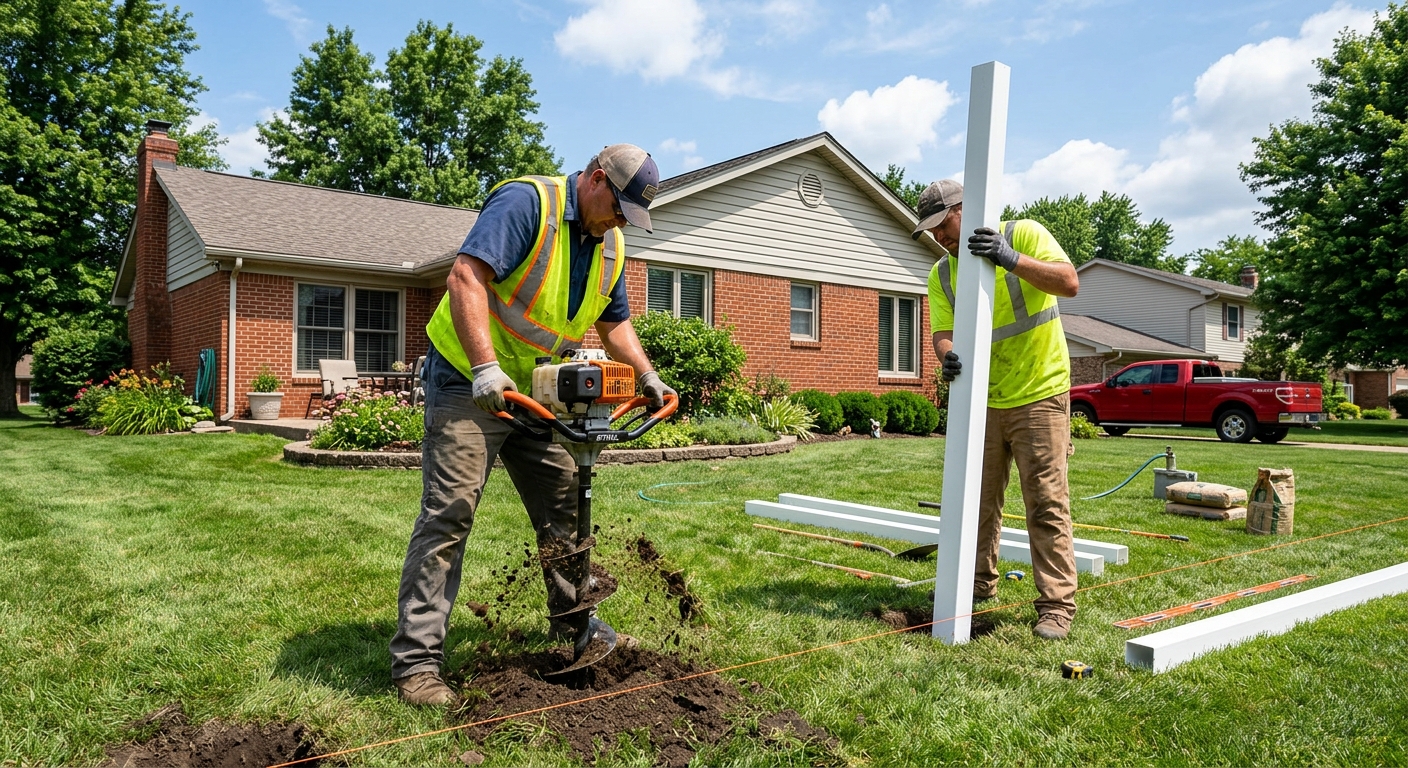
The biggest technical driver is frost line depth. A common installation rule of thumb is setting footings about 4–6 inches below the design frost depth so the post doesn’t move during freeze–thaw cycles. In colder, heavier-soil pockets, that can translate into deeper holes and a longer post length than “standard” estimates. When concrete-set posts are required (rather than a simple gravel pack), you add auger time, concrete volume and labour—pushing total cost upward.
Wind exposure matters too. On more open lots—especially where prevailing winds hit the fence face—contractors often tighten post spacing, add bracing and choose heavier rails. That can raise costs even if the material remains in the lower band.
Here are a few practical Chase examples that change price quickly: (1) A 60–80 ft run of privacy fence with deep concrete-set posts often comes out closer to wood pricing at $55 – $85 per linear foot, but the same length with lighter “gravel-set” assumptions can look cheaper until winter proves the risk. (2) Replacing fence sections on older properties can add $ for removal because you’re often cutting out posts that have shifted—then resetting alignment. (3) Choosing vinyl/PVC usually moves you into the $75 – $115 range, but the savings show up over time if you don’t want to re-stain wood in a damp snow-and-rain cycle.
| Price Factor |
Why It Matters |
Cost Impact |
| Fence length in linear feet |
Most costs scale directly with material and labour quantity. |
Highest impact (primary driver) |
| Post depth required |
Frost heave prevention depends on setting depth below frost. |
Can noticeably increase total cost when deeper holes/concrete are needed |
| Post setting method |
Concrete-set posts provide stability in challenging soils. |
Concrete adds time, auger work and material costs |
| Material choice |
Vinyl, cedar, chain-link and ornamental differ in framing and hardware. |
Ranges from budget chain-link to higher-cost aluminum/vinyl |
| Gate count and type |
Gates require thicker framing, hinges and latching hardware. |
Extra cost per gate; double gates typically add more labour and material |
| Grade and terrain |
Slope requires raked or stepped panels to keep top lines true. |
More cutting and layout time |
| Old fence removal and disposal |
Demolition, hauling and dump fees add labour. |
Often increases the quote by adding crew hours and disposal costs |
| Permit fees and survey / property line locate |
Required documentation protects you from encroachment and line disputes. |
Variable; can add a meaningful but predictable amount |
Permits & regulations in British Columbia
In British Columbia, fence permitting is height- and location-dependent. As a practical rule for homeowners in Chase, fences above a threshold—often around 2.0 m (6.5 ft) at the rear and about 1.0–1.2 m (3–4 ft) at the front or corner—may require a building permit. Setbacks and property-line requirements still apply, and municipal bylaws can tighten what’s allowed near streets, lanes or intersections.
Before you dig any post hole, call for utility locates. In BC, use BC 1 Call so marked lines are visible before the auger starts. Also, obtain a survey or at least a locate of your property pins before installing—fence disputes are expensive, and the cost to correct an encroachment is rarely offset by “saving” during initial layout.
Shared fence ownership (common on side boundaries) is governed by provincial line-fences legislation. Your agreement with your neighbour—plus who built first, who maintains, and how costs were historically shared—matters for ongoing repairs. If there’s a dispute, get it documented in writing before construction.
Concrete: what typically DOES require a permit—new fences above height thresholds (or fences in sensitive locations like corners/visibility areas) and any fence that may affect access or safety. What typically does NOT—routine replacement of like-for-like fencing within allowed heights, where no property-line or variance issues exist.
To verify a contractor in BC: check their licence (and/or business registration details) through the relevant online registry, request proof of liability insurance (with policy limits), and ask for coverage documentation for worker protection (WSIB/WCB clearance or equivalent). Always confirm the certificate’s expiry date and that the named insured matches the company quoting your job.
Choosing the right fence material for Chase
Choosing the right fence material in Chase is mostly about matching the board system to local climate realities: interior freeze–thaw cycles, snow load and seasonal moisture. In the Thompson–Okanagan region, posts must be set below frost risk so they don’t heave, which can mean concrete-set posts in clay or poorly drained yards. That deeper installation is the foundation cost you can’t “cheap out” on if you want a straight fence line after winter.
Pressure-treated pine is the budget-friendly choice, but it typically needs staining or sealing every 2–3 years to avoid grey weathering and surface cracking. Cedar looks better longer and resists rot, but it still benefits from regular oiling/staining. Vinyl/PVC has a clear advantage for homeowners who want low maintenance—no staining—but it can crack if struck hard and extreme cold can make panels more brittle if the fence is under-designed for wind load. Chain-link is the lowest upfront option and lasts a long time, but it won’t give privacy. Aluminum is clean and rust-resistant, with mid-range pricing, but it’s ornamental (lower privacy) and needs solid post anchors in exposed wind.
On wind-exposed lots, I recommend paying attention to rail strength, post spacing and hardware. For example, investing in a cedar privacy fence can be justified if you’re comparing against cheaper wood: if wood privacy runs closer to $55 – $85 per linear foot, cedar often lands higher, but you may recoup value through a longer lifespan (less rework) and better appearance. If your main priority is budget and security rather than privacy, chain-link at $35 – $60 per linear foot can make sense, especially if you keep tension and top rails maintained.
| Material |
Cold Tolerance |
Lifespan |
Annual Maintenance |
Best For |
Price Band |
| Pressure-treated pine |
Good with proper post depth and staining |
10–15 years |
Inspect yearly; stain/seal every 2–3 years |
Value privacy/security fence when you’re okay with maintenance |
$55 – $85 |
| Cedar |
Very good; handles moisture better than most softwoods |
15–25 years |
Inspect yearly; oil/stain every 2–4 years |
Premium-looking privacy with more natural rot resistance |
$70 – $105 |
| Vinyl / PVC |
Good when installed with correct spacing and bracing |
20–30 years |
Wash as needed; check impact damage |
Low maintenance and clean lines |
$75 – $115 |
| Chain-link |
Excellent; galvanized components tolerate winter well |
25–40 years |
Very low; rinse and check tension periodically |
Security and pet containment on a budget |
$35 – $60 |
| Aluminum ornamental |
Very good; powder-coated systems resist freeze effects |
25–35 years |
Wash annually or as needed |
Attractive curb presence with minimal rust risk |
$90 – $150 |
| Composite / recycled |
Good; performs best with proper framing and drainage |
20–30 years |
Low; clean with water/mild cleaner |
“Wood look” with reduced upkeep |
$95 – $145 |
How to choose a fencing contractor in Chase
When you hire a fencing contractor in Chase, verify three basics: licensing status (where applicable), liability insurance, and worker protection coverage (WSIB/WCB clearance or equivalent). Ask for proof before work begins. For liability insurance, request a current certificate of insurance and confirm the named insured matches the company on your contract. For worker coverage, ask for clearance/coverage documentation and check the dates—expired documentation is a common issue after storms and schedule changes.
Next, get 2–3 itemised written quotes that separate labour and materials. Ideally the quote lists post depth assumptions, post setting method (concrete vs. gravel pack vs. driven where allowed), panel type, gate hardware, and whether disposal and removal of old fencing are included. Avoid “lump sum only” pricing without line items, because it’s harder to compare scope across bidders.
Read the scope carefully: is permit pulling included if the project requires it? Are utility locates included or the homeowner’s responsibility? Will the contractor repair or replace damaged landscaping, and are there any exclusions for rock removal or poor soil? A clear workmanship warranty should be in writing (typical durations vary by contractor and material system). Also ask whether the product manufacturer warranty transfers to you if ownership changes.
For payment schedule, never pay more than 10–15% upfront. The balance should connect to milestones, with a holdback until the final walk-through is complete and fence line alignment, gate operation and cleanup are done. Finally, insist on a start date and completion estimate in writing so you’re not waiting through freeze–thaw season.
- Ask for proof of liability insurance and confirm the certificate is current.
- Request worker protection clearance/coverage documentation (WSIB/WCB equivalent) before digging.
- Ensure the quote specifies post depth and setting method based on frost risk.
- Confirm how corners and slopes are handled (stepped vs. raked panels).
- Check whether concrete, auger time and disposal are itemised or hidden in “labour.”
- Verify gates are included with hardware (hinges, latch, posts and reinforcement).
- Ask who provides and pays for utility locates in your specific case.
- Look for permit pull responsibility stated clearly (if required).
- Confirm warranty length for workmanship and product separately.
- Use a payment schedule with only small upfront deposit (10–15%).
- Get a written timeline for start and completion, not just a “best effort.”
- Make sure cleanup and final haul-away of old material are explicitly included.
Red flags I see in Chase: quotes that don’t state post depth or concrete setting assumptions; “lump sum” pricing with no material grades or hardware details; contractors who ask for most payment upfront; no written warranty terms; and crews who start digging without confirming utility locates or property line layout.
Frequently asked questions — fencing in Chase
How deep should fence posts be for Chase's frost?
For Chase and the Thompson–Okanagan interior climate, fence posts generally need to be set below the design frost risk so they won’t heave during freeze–thaw cycles. A practical method contractors use is setting footings about 4–6 inches below the design frost depth. In many Chase yards, that means posts longer than “coastal” assumptions and, on heavier or poorly drained soil, concrete-set posts are commonly used for stability. If your site has clay or stays damp in spring, I usually recommend budgeting for deeper concrete-set holes rather than relying on a shallow gravel pack. Confirm this in writing in your quote—any bidder who won’t discuss post depth is guessing, not designing. (Statistics Canada, 2021 Census)
Wood vs vinyl vs aluminum fence — which is best?
There’s no single “best” in British Columbia—your priorities decide. Wood (pressure-treated pine or cedar) gives traditional look and often lower upfront pricing, especially for privacy panels; a typical wood install can land around $55 – $85 per linear foot. Vinyl/PVC is usually higher upfront but suits homeowners who want minimal maintenance (wash and inspect only), often around $75 – $115. Aluminum is rust-resistant and crisp-looking, typically best when you want curb appeal more than privacy; it often falls in the higher range like $90 – $150. In Chase, cold snaps and interior moisture make correct post depth and bracing more important than material marketing—so choose the material you can maintain, and make sure the post system is engineered for frost and wind. (Statistics Canada, 2021 Census)
Do I need a permit to build a fence in British Columbia?
Often, yes—but it depends on the fence height, placement and local bylaws. In BC, fences above common thresholds (often about 2.0 m at the rear and roughly 1.0–1.2 m at the front/corner) may require a building permit. Even if you don’t need a permit, you still must respect property lines and municipal setback rules. For any fence project in Chase where height approaches those limits, I recommend checking requirements before you order materials so you don’t rework framing. Also remember the practical steps: call for utility locates before digging, and get a survey or locate your pins so you don’t build into a neighbour’s property. Shared fence arrangements are addressed under provincial line-fences principles, so clarify responsibilities early. (Statistics Canada, 2021 Census)
How long does a wood fence last in Chase?
With correct installation in Chase, a wood fence commonly lasts 10–15 years for pressure-treated pine and about 15–25 years for cedar, assuming the posts are set correctly for frost and the fence is maintained. The two biggest “life” factors are post depth (frost heave can break alignment and accelerate failure) and maintenance timing (staining/sealing to prevent rapid surface breakdown). In a Thompson–Okanagan freeze–thaw and snow cycle, neglecting maintenance tends to show up as grey weathering, cracking and faster board replacement. If you’re replacing on older homes built before 1981, it’s also common that you’ll find varied post conditions behind the current fence line, which can shorten lifespan unless the system is fully rebuilt. For best results, ask your contractor to specify post depth and the maintenance schedule for your chosen wood. (Statistics Canada, 2021 Census)
Who owns and maintains a shared fence?
In British Columbia, shared fence ownership and maintenance are handled under provincial line-fences legislation, but the real-world answer depends on your boundary agreement and the history of the fence. Typically, if the fence is on or along a shared boundary, responsibility is shared, but specifics—like who built it first, who paid, and what repairs are planned—can vary. In Chase, the safest approach is to get your agreement in writing: confirm which sections are shared, what maintenance standards apply, and how costs are split for repairs or replacement. If there’s uncertainty about the original boundary location, resolve it with a survey or property pin locate before major work—otherwise you risk building on the wrong side and creating a dispute. (Statistics Canada, 2021 Census)
How do I find my property line before fencing?
Before you install fence posts in Chase, don’t rely on guesswork. Start with your property documentation: your most reliable baseline is a survey or your property pin locations. If pins aren’t visible, hire a surveyor or request a property line locate so stakes/pins can be identified on site. This matters because fences are often planned along boundaries, and even a small offset can trigger neighbour disputes. Then confirm access constraints for utilities—call for locates (BC 1 Call) before you dig so you don’t hit buried services. When you meet a contractor, ask them how they’ll handle layout: do they reference pins/survey marks, and do they include adjustments for gates and setbacks? A good quote will mention property line verification responsibilities clearly. (Statistics Canada, 2021 Census)