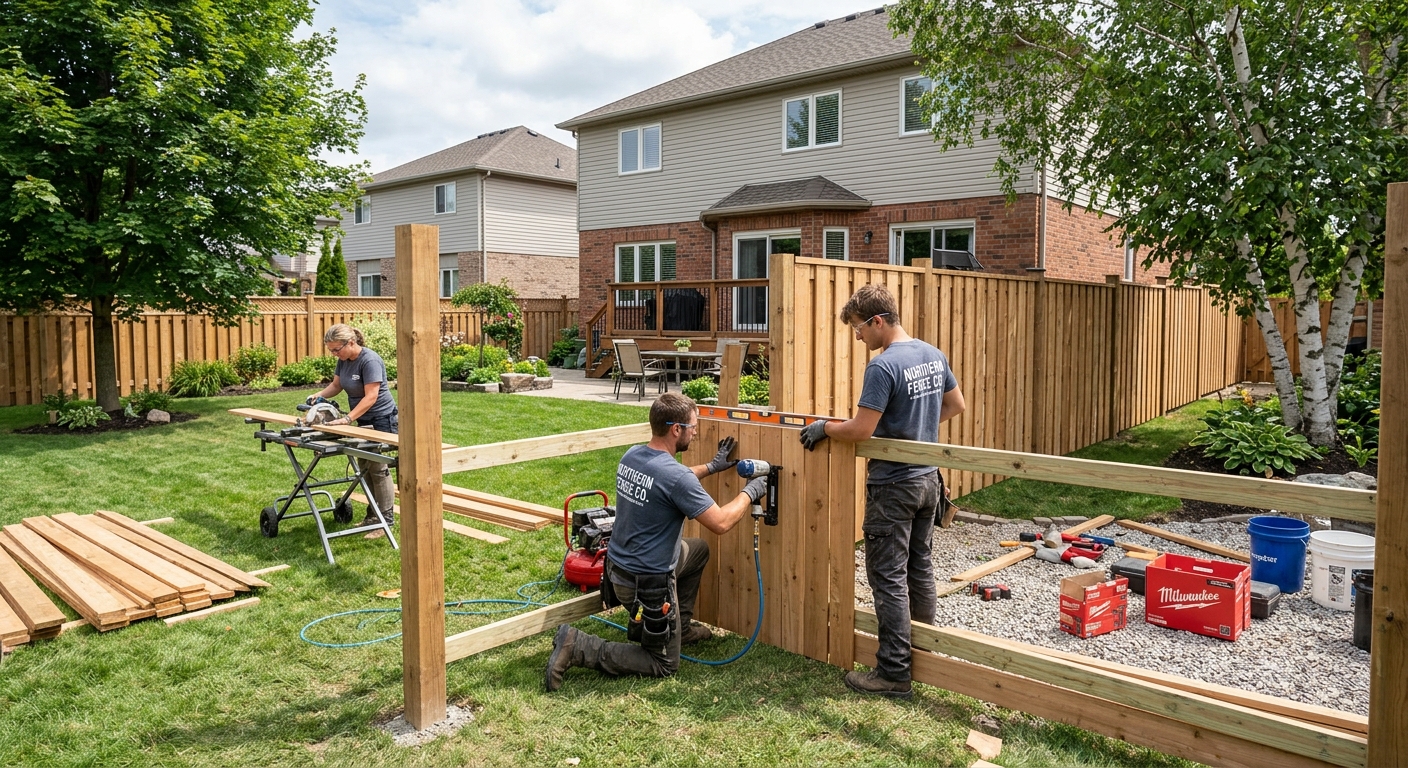
Fencing options and costs in Cranbrook
Cranbrook homeowners typically choose fencing based on privacy needs, winter durability, and the reality of Kootenay freeze–thaw. With 65.2% of local dwellings being single-detached homes (Statistics Canada, 2021 Census), there’s steady demand for backyard privacy fences, side-yard runs, and gate upgrades—especially around homes built before 1981, when older fence layouts and post types often need modernization. In the Kootenays, costs are shaped less by material alone and more by how contractors must build footings for the frost line and persistent winter heave. Posts often need to be set close to or below typical design frost depths, with deeper augering, more excavation time, and more concrete for corners and gate posts than homeowners may expect from milder regions.
In Cranbrook’s colder valley microclimates, contractors commonly lean toward concrete-set posts for long-term stability, particularly for taller privacy installations where wind-driven racking is more noticeable during snow-loaded winter storms. Trade demand is especially strong in family neighbourhoods such as neighbourhoods in the West Hill area, where many properties are landscaped and require clean, secure perimeter fencing that still holds alignment after freeze–thaw cycles. Availability can also vary by season: spring and early summer tend to be busier, and scheduling pressure can affect quote timing more than material pricing.
Below is a practical comparison of common options, using local Kootenay pricing as a baseline and keeping in mind that post depth, gate count, and site access usually determine the final number.
| Material |
Lifespan |
Maintenance |
Privacy Rating |
Price per Linear Foot |
| Pressure-treated pine (standard wood) |
10–15 years |
Stain/seal every 2–3 years; fastener checks |
Good (solid panels) |
$45–$75 |
| Cedar (natural rot resistance) |
15–20 years |
Light staining typically every 3–4 years |
Good (solid boards) |
$60–$95 |
| Vinyl / PVC (no-maintenance) |
20–30 years |
Wash as needed; inspect hardware |
Very good (solid privacy styles) |
$70–$110 |
| Chain-link (galvanized steel) |
20–30 years |
Occasional tension checks |
Low (visibility through mesh) |
$30–$55 |
| Aluminum ornamental |
25–40 years |
Wash; no rust with proper coatings |
Low to medium (open pickets) |
$80–$140 |
| Composite / recycled material |
20–30 years |
Minimal; occasional cleaning |
Good (solid profiles) |
$95–$150 |
Prices are estimates only and vary by project scope, site access and material selection.
What affects the price of fencing in Cranbrook
In Cranbrook and across the Kootenays, it’s common to see fencing quotes for what looks like the same job land 30–50% apart once you compare the details. The biggest reason is the regional build standard for frost and freeze–thaw: post depth, footing design, and the amount of concrete labour required can vary even when the fence length and height are similar. By contrast, milder parts of British Columbia can use shallower post settings, and Ontario/Alberta jobs sometimes lean heavier on driven posts and different framing methods—so unit pricing doesn’t translate perfectly between regions.
For Kootenay sites, post holes are often dug so posts sit about 4–6 inches below the design frost depth to reduce heaving. That typically means deeper augering, longer posts, and more excavation time, especially for structural corners and gate posts—cost components that can push total price toward the upper end of wood and vinyl bands (for example, wood often lands around $45–$75 per linear foot, while vinyl commonly sits in the $70–$110 range). Wind and snow load also influence design choices: while Prairies wind can be harsher, Cranbrook acreage and exposed slopes still benefit from tighter post spacing and stronger rails to prevent panel racking.
Two local examples where cost rises in Cranbrook: (1) a sloped backyard along a driveway that requires stepped or raked panels often adds additional framing and labour compared with a flat yard; (2) a double gate at the side yard usually adds extra post sizing and hardware—frequently increasing labour and material beyond a straight-run section. On the other hand, costs can lower when there’s easy access for a skid-steer or when homeowners choose chain-link (often $30–$55 per linear foot) and accept a lower privacy rating, because lighter tensioning frames reduce rebuild labour around frost-prone corners.
| Price Factor |
Why It Matters |
Cost Impact |
| Fence length in linear feet |
More length means more posts, rails, fasteners and labour hours. |
Primary driver (often the majority of total cost) |
| Post depth required |
Frost line determines hole depth, post length and footing size. |
Can swing costs significantly due to excavation + concrete |
| Post setting method |
Concrete vs. gravel pack vs. driven posts affects stability in freeze–thaw. |
Concrete-set commonly adds more materials and labour |
| Material choice |
Vinyl, cedar and chain-link have different rail systems, durability and pricing. |
Shifts total into different bands (wood ~ $45–$75; chain-link ~ $30–$55; vinyl ~ $70–$110) |
| Gate count and type |
Double gates need stronger posts, more hardware and tighter alignment. |
Higher cost than equivalent fence run; hardware and labour premium |
| Grade and terrain |
Sloped yards require stepping, racking, or custom panel sizes. |
Extra framing time and additional materials |
| Old fence removal and disposal |
Existing posts may be concrete-set or frozen in place. |
Disposal + demo time can add a noticeable line item |
| Permit fees and survey / property line locate |
Setbacks and property line confirmation protect against encroachment disputes. |
Administrative and survey costs can be material to the final total |
Permits & regulations in British Columbia
In British Columbia, fence rules generally come down to height thresholds, property line/setback bylaws, and ensuring utilities are protected before digging. While local bylaws can vary, many properties follow a common practical threshold: fences above about 2.0 m (6.5 ft) at the rear and about 1.0–1.2 m (3–4 ft) at the front or corner often need a building permit. Even when a permit isn’t required, fences must respect property lines and any municipal setback requirements.
Before installing any fence posts, you must call for utility locates—this is non-negotiable. In BC you can use BC 1 Call. If you don’t have a clear plan of where property pins are, obtain a survey or at minimum locate your property pins before digging. This helps avoid encroachment disputes, especially where older fences may have been built slightly off-line.
Shared fence ownership rules are governed by provincial line-fences legislation, so it’s smart to discuss responsibilities with a neighbour early and document agreements (who pays for which side, and what happens at the end of life).
For contractor qualification in Cranbrook, homeowners should verify three items: (1) British Columbia licence through the applicable online registry; (2) liability insurance by requesting a certificate of insurance naming your property/address as the project location; and (3) coverage for workers—confirm WSBC/WCB status by asking for clearance documentation or the current clearance letter. Do this before work starts, not after a quote is approved.
Choosing the right fence material for Cranbrook
Choosing a fence material in Cranbrook is about matching your priorities—privacy, low maintenance, budget, and lifespan—to the realities of Kootenay winters. The region’s freeze–thaw cycles mean post stability matters as much as the surface material, so correct post-depth installation and solid corner/gate bracing are usually the difference between a fence that stays straight for years and one that loosens over time. Also note the housing profile here: with many homes built before 1981 (Statistics Canada, 2021 Census), older yards often have legacy fence footprints, uneven ground, and settled posts that can influence what “good value” looks like.
Pressure-treated pine is the budget-friendly route, but it needs staining every 2–3 years to avoid grey weathering and to protect the boards and fasteners. Cedar costs more upfront but has natural rot resistance and typically looks better longer; it still benefits from periodic maintenance. Vinyl/PVC is popular for low maintenance and privacy styles, but in extreme cold it can become brittle if the system is poorly installed—quality hardware and proper thermal expansion practices matter. Chain-link offers the lowest cost and longest life in a practical sense, but it won’t deliver privacy without add-ons. Aluminum is rust-resistant and low-maintenance, but it’s generally ornamental rather than private. Composite/recycled materials often sit in the mid-to-high range while targeting longer appearance life with minimal upkeep.
On post depth: for Cranbrook’s frost regime, many installs require concrete-set posts or deep footings below frost influence for structural stability. You’ll typically see deeper excavation rather than shallow “tamp and go” methods. Where wind and snow loading are higher—exposed slopes or corners—closer post spacing and sturdier rails are usually worth the spend.
For a dollar example: if you’re comparing standard wood to vinyl for a privacy run, it’s common for wood to be in the $45–$75 per linear foot range and vinyl to be $70–$110 per linear foot. If you expect to skip staining for a decade and want a cleaner look with less labour, that extra $25–$35 per linear foot can be justified—especially when your biggest regional cost driver is already the post-depth work, so the incremental material upgrade isn’t the only factor.
| Material |
Cold Tolerance |
Lifespan |
Annual Maintenance |
Best For |
Price Band |
| Pressure-treated pine |
Good (with proper board thickness and fasteners) |
10–15 years |
Stain/seal every 2–3 years (plus fastener checks) |
Budget privacy with acceptable upkeep |
$45–$75 |
| Cedar |
Good (naturally resistant to rot) |
15–20 years |
Light staining often every 3–4 years |
Appearance-first privacy in winter conditions |
$60–$95 |
| Vinyl / PVC |
Very good (system quality matters in extreme cold) |
20–30 years |
Minimal—wash/inspect hardware as needed |
Low-maintenance privacy |
$70–$110 |
| Chain-link |
Excellent (galvanized steel performs well) |
20–30 years |
Minimal—tension and coating checks |
Secure perimeter where privacy isn’t required |
$30–$55 |
| Aluminum ornamental |
Excellent (coated metal holds up to moisture) |
25–40 years |
Minimal—periodic washing |
Attractive, rust-resistant front boundaries |
$80–$140 |
| Composite / recycled |
Good (designed for freeze–thaw) |
20–30 years |
Low—cleaning and occasional hardware checks |
Solid privacy with minimal upkeep |
$95–$150 |
How to choose a fencing contractor in Cranbrook
Choosing a fencing contractor in Cranbrook starts with verification: in British Columbia, confirm the contractor’s licence through the appropriate online registry, then ask for a current certificate of liability insurance that covers the work being performed. For worker coverage, request proof of WSBC/WCB status (for example, a clearance letter or current account status documentation) before work begins—this matters if a crew member gets injured on site.
Next, get 2–3 itemised written quotes that separate labour and materials (posts/rails/panels/hardware), rather than a single lump sum. Itemisation should show assumptions about post depth/setting, gate hardware, panel count, and disposal or haul-away. Review the scope for exclusions: ask whether permits are included, whether old fence removal is part of the price, and how they handle difficult access, rock, or unforeseen excavation. You should also see whether the quote allows for stepped/raked sections on sloped yards.
Warranty matters: look for a workmanship warranty length, a product/manufacturer warranty (especially for vinyl hardware and coatings), and whether the warranty is transferable if you sell your home. For payment, never approve large up-front deposits—stick to about 10–15% maximum upfront, and hold a remainder until the job is complete and cleaned up. Finally, request a start date and a completion estimate in writing, along with weather-related scheduling expectations for winter or freeze conditions.
- Confirm BC licence number and the exact scope (fencing/installation) on the registry.
- Ask for liability insurance certificate and confirm coverage dates match the project timeline.
- Request WSBC/WCB clearance documentation for the employer/crew.
- Get itemised quotes: labour + concrete + posts + rails + panels + hardware + disposal.
- Ensure the quote states post depth/setting approach for frost stability.
- Check gate hardware details (hinges, latches, latch height, and double-gate bracing).
- Clarify whether permits/pull costs are included or if you pay separately.
- Confirm disposal haul-away is included if removing an old fence.
- Ask about how they handle rock, roots, and uneven grade (stepped/raked solutions).
- Verify warranty: workmanship term, product/manufacturer term, and transferability.
- Request a written schedule: start date, install duration, and final walkthrough timing.
- Agree to a payment schedule with a holdback until completion and cleanup.
Red flags in Cranbrook: contractors who (1) won’t discuss post depth and footing approach for frost; (2) give only lump-sum pricing with no material breakdown; (3) refuse to provide insurance/licence/WSBC/WCB proof; (4) ask for more than 10–15% upfront without a clear contract; or (5) promise “quick installs” that skip concrete-set posts for corners and gates on deeper frost sites.
Frequently asked questions — fencing in Cranbrook
Can I install a fence on a slope in Cranbrook?
Yes, you can install a fence on a slope in Cranbrook, but it needs a design approach that respects grade changes. Typically, contractors will use stepped panels (keeping the fence level) or raked panels (following the slope). In Kootenay freeze–thaw conditions, slopes can also concentrate water flow and movement, so the post holes and setting method matter as much as the visual finish. For older yards and properties built decades ago, you may have settled ground or uneven footprints, which affects layout and may require more careful measurements. If you’re budgeting, expect additional labour for stepped framing and potentially more hardware; however, the bigger cost driver is still post depth requirements and correct setting below frost influence. Depending on your material, chain-link may start around $30–$55 per linear foot, while vinyl privacy styles often fall into the $70–$110 range.
What is the most weather-resistant fence for Cranbrook's climate?
“Most weather-resistant” often means the system that stays aligned through freeze–thaw, wind, and snow loading. In Cranbrook and the Kootenays, that usually points to materials with stable framing plus correct, deep post setting. Chain-link with galvanized components is very durable against moisture and winter conditions, and aluminum ornamental is also well-suited because it won’t rot or rust like untreated wood. Vinyl/PVC can perform extremely well for appearances and low maintenance, but it must be installed with appropriate hardware and proper post depth so it doesn’t rack as soils move. Wood can work too, especially pressure-treated or cedar, but it depends on staining/maintenance and fastener condition. For long-term value, many homeowners choose vinyl or chain-link, balancing the regional post-cost driver with the material lifespan; typical installed pricing bands often reflect this, with chain-link around $30–$55 per linear foot and vinyl around $70–$110.
How do I prevent wood fence rot in Cranbrook?
Wood rot prevention in British Columbia comes down to details: the right treatment, good airflow, and fastener quality—plus getting the posts and ground contact correct. For rot resistance, avoid leaving cut ends unprotected, and make sure boards are installed so water drains rather than pools. Use pressure-treated lumber properly, and inspect fasteners and rail connections during the first winter after installation, because freeze–thaw can loosen hardware if the system isn’t rigid. In Cranbrook, many crews recommend staining or sealing on a cycle (often every 2–3 years for pressure-treated pine) to prevent grey weathering and moisture absorption. Cedar resists rot naturally, but it still needs maintenance in persistent damp periods and around sprinkler overspray. Finally, confirm the quote includes a frost-aware post setting approach—concrete-set posts and correct depth reduce underground movement that can pull wood components loose over time.
What is the cost per linear foot for fencing in Cranbrook?
In Cranbrook, installed fencing costs vary mainly by material and by how deep and how robustly posts are installed for frost stability. As a practical baseline, wood fencing installation commonly lands in the $45–$75 per linear foot band, cedar typically costs more than standard wood, vinyl/PVC privacy styles often fall around $70–$110 per linear foot, and chain-link can be as low as $30–$55 per linear foot depending on height and tensioning requirements. Aluminum ornamental is often priced higher, frequently in the $80–$140 per linear foot range. Keep in mind that your quote can move up or down based on gates, corner bracing, grade (stepped/raked sections), old fence removal, and site access for excavation. In Kootenay conditions, post depth and concrete setting are usually the key reasons two “similar” quotes can differ by 30–50%.
Should I repair or replace my old fence in Cranbrook?
Often you should repair when the posts are still solid and the fence panels are just worn—hinges/latches are out of alignment, a few boards need replacement, or minor rail sections have pulled loose. Replacement usually makes more sense if posts have shifted due to freeze–thaw, the bottom rails are rotting, or there’s widespread leaning or sag that indicates movement at the footing level. In Cranbrook’s winter climate, small issues can escalate when water intrusion and soil heave continue year after year. If your fence was installed decades ago (common in homes built before 1981), it may not have been built to modern frost-aware post-depth standards. A smart approach is to request a contractor assessment and ask for the post condition review before you commit. Pricing depends on what you choose: repairing may cost less upfront, but if you need deep post rework anyway, replacement can be closer to the $45–$75 wood band or higher if you upgrade to vinyl ($70–$110).
How do I handle a fence dispute with a neighbour in British Columbia?
Fence disputes in British Columbia usually start with clarifying the facts: property line location, height, and responsibility for shared fencing. Start by checking your documentation (existing surveys, property pins if available) and ask for a clear discussion about where the fence should be. If there’s any uncertainty, get a survey or have pins located before you agree to changes—this reduces “it was here when we moved in” misunderstandings. Because fencing ties into local setbacks and permit thresholds, confirm whether the fence is within required height limits at the relevant side or rear location. Provincial line-fences legislation can govern shared fence responsibilities, so it’s important to understand who pays for which improvements. Keep communication respectful and in writing (emails/texts) to document agreements. If you can’t resolve it directly, use mediation channels where available rather than arguing on-site—especially in Cranbrook winter conditions where snow and limited visibility can make work and meetings harder.