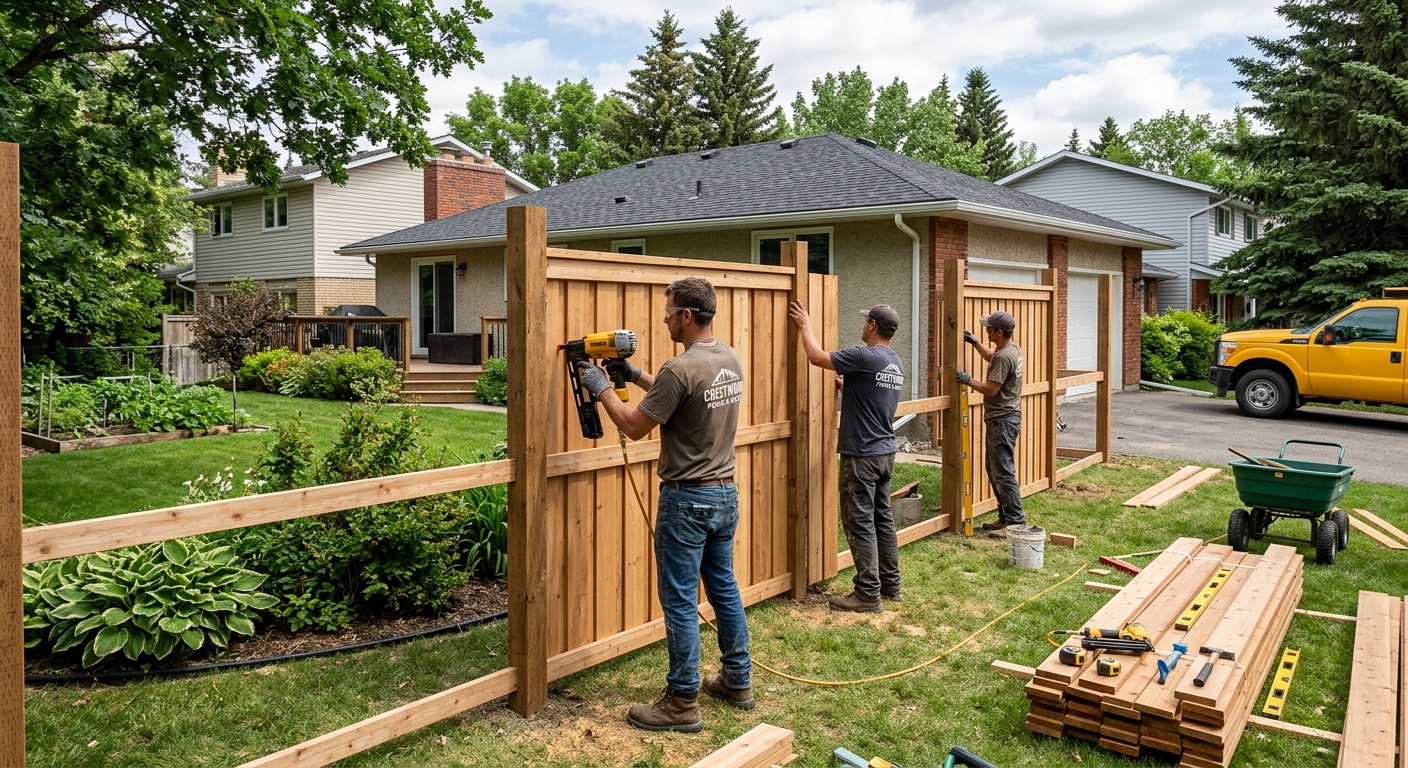
Fencing options and costs in Sicamous
Sicamous homeowners often start with the practical question: what will last through our freeze–thaw swings and seasonal wind, without turning the yard into a maintenance project? With 2,613 people living in town (Statistics Canada, 2021 Census) and about 1,005 homeowner households (80.7% of households own), there’s a steady baseline of fence work whenever families modernize lots, replace aging runs, or add pets and garden boundaries. Single-detached houses make up 63.5% of dwellings, which is why you’ll see demand cluster around neighbourhoods with more yards and side-yard access—especially along the Coldstream/river-bench style properties near the waterfront and older residential strips where upgrades are frequent.
In the Thompson–Okanagan region, fence pricing is shaped by frost depth, soil drainage, and wind exposure. Interior valleys typically need deeper post setting than coastal areas to prevent heaving during winter thaws, and that pushes both material quantities (longer posts) and installation labour (auger time, concrete, and clean backfill). If your lot has heavier clay or poor drainage, costs can rise again because contractors may need deeper, concrete-set footings for stability. On the other hand, sheltered sites with reasonably level grade can keep labour efficient, and materials like chain-link can remain one of the lowest initial-cost options.
Below are realistic Sicamous cost bands so you can compare options apples-to-apples before you request quotes—then we’ll break down what drives differences in your final number.
| Material |
Lifespan |
Maintenance |
Privacy Rating |
Price per Linear Foot |
| Pressure-treated pine (standard wood) |
10–15 years |
Stain or seal every 2–3 years |
High (solid boards); Medium (lattice styles) |
$18 – $26 |
| Cedar (natural rot resistance) |
15–25 years |
Seal/stain every 2–4 years |
High (solid boards); Medium (lattice styles) |
$23 – $34 |
| Vinyl / PVC (no-maintenance) |
20–30 years |
Rinse annually; occasional panel replacement |
High (solid privacy panels); Medium (semi-private) |
$25 – $40 |
| Chain-link (galvanized steel) |
20–30 years |
Minimal (wash as needed) |
Low to Medium (privacy slats optional) |
$14 – $20 |
| Aluminum ornamental |
25–40 years |
Wash as needed; repaint only if custom powder-coat fades |
Low (decorative pickets) |
$30 – $45 |
| Composite / recycled material |
20–30 years |
Rinse annually; occasional hardware tightening |
High (privacy styles); Medium (semi-private) |
$26 – $42 |
Prices are estimates only and vary by project scope, site access and material selection.
What affects the price of fencing in Sicamous
It’s common to see quotes for the “same” fence vary by 30–50% across Thompson–Okanagan and other parts of British Columbia. The big swing usually isn’t the fence design—it’s the installation requirements created by interior frost conditions and local site conditions. In Sicamous, contractors typically plan post holes to go roughly 4–6 inches below the design frost depth so posts don’t heave during freeze–thaw cycles. While coastal BC can often get by with shallower setbacks, interior valleys and colder pockets may effectively push you toward deeper, more stable foundations—meaning longer posts, more drilling, and more time on-site. In colder regions (and in some Ontario/Alberta markets), that depth can become 1.5–2.0 m equivalent work, and that’s where concrete-set posts are a frequent cost driver. Even if your exact frost requirement sits on the lower end, the labour pattern—auger time plus concrete and proper backfill—still matters.
Wind exposure adds another lever. On open benches and exposed lots, heavier posts and tighter spacing help reduce racking; sometimes a less “open” panel style is used to manage load. A sheltered yard can stay on standard spacing and keep the labour efficient. Concrete examples from Sicamous: (1) a sloped backyard may require stepped sections, which adds layout time; (2) clay that holds moisture can increase the need for concrete-set posts for longevity; (3) lots with limited vehicle access or tight side gates slow material staging, raising labour per hour. When you compare materials, those installation factors affect everyone: wood typically lands around the local wood band (about $55–$85 per linear foot range for installation), while vinyl/pvc often comes in higher (about $75–$115 depending on style and height). Chain-link can be the lowest installed option (often $35–$60), but it can still cost more if you need heavier gates or if the site demands deeper bracing posts.
| Price Factor |
Why It Matters |
Cost Impact |
| Fence length in linear feet |
Every material lineal cost and every post location scales directly with length |
Highest driver; a long run can dominate the entire budget |
| Post depth required |
Frost line determines post length and hole depth to prevent heaving |
Deeper holes increase drilling time, spoil removal and often concrete use |
| Post setting method |
Concrete versus gravel pack versus driven posts changes labour and materials |
Concrete-set posts typically cost more but reduce movement in difficult soils |
| Material choice |
Vinyl, cedar, and chain-link have different material costs and performance |
Upfront material differences add on top of similar labour for posts and bracing |
| Gate count and type |
Gates require heavier hinges, latch hardware, and stronger posts |
Each gate can add substantial labour plus higher hardware and bracing |
| Grade and terrain |
Sloped yards require racked/stepped panels and more layout time |
Often adds labour even if linear footage stays the same |
| Old fence removal and disposal |
Demolition, hauling, and disposal add time and equipment needs |
Can add a meaningful “site work” line item, especially for concrete footings |
| Permit fees and survey / property line locate |
Some fences require permitting; accurate property lines reduce rework |
Administrative and locate costs can add to the total but prevent costly corrections |
Permits & regulations in British Columbia
In British Columbia, fences above a height threshold often require a building permit and you still must respect property lines and any local setback rules. As a practical rule of thumb, fences around the rear can be subject to permitting at about 2.0 m (6.5 ft), while front or corner locations often trigger permitting around 1.0–1.2 m (3–4 ft). Because Sicamous is in the Thompson–Okanagan region, contractors usually treat permitting as part of early planning rather than a last-minute step—especially if your fence includes multiple gates or runs close to lane/driveway sight lines.
What does require a permit: installing (or substantially replacing) a fence that exceeds the height thresholds, creating a fence that changes site circulation where required by the municipality, or adding larger structures (for example, certain combination fences/screens) that fall under building requirements. What typically does not require a permit: small, compliant replacement fence sections that stay under the applicable height limits, as long as they remain within property lines and setbacks.
Step-by-step for a homeowner in Sicamous: (1) confirm your intended line and height before ordering materials; (2) obtain a survey or locate your property pins so you don’t encroach; (3) call for utility locates before digging—use BC 1 Call or the equivalent utility locate service available in your area; (4) verify the contractor’s British Columbia licence status using the appropriate online registry; (5) request liability insurance certificates showing adequate coverage, and ask for confirmation they maintain the required worker coverage (WSIB/WCB) for their crews; (6) keep a copy of all documentation with your quote and contract so inspections (if required) can be supported quickly. Shared fence ownership and line responsibility are governed by provincial line-fences legislation, so review that in advance if the boundary is shared.
Choosing the right fence material for Sicamous
Choosing the right fence material in Sicamous is about matching what you want—privacy, low maintenance, budget, and lifespan—to what the Thompson–Okanagan climate demands. Pressure-treated pine is the lowest upfront wood option, but it typically needs staining or sealing every 2–3 years to reduce grey weathering and early surface cracking. Cedar costs more initially, yet it generally resists rot better and ages more gracefully, still requiring periodic seal/stain. Vinyl/PVC is popular for low maintenance: it’s essentially rinse-and-go, but the material can become more brittle if panels are not installed correctly and if impacts occur (for example, snow pushing or careless lawn equipment). Chain-link is usually the most budget-friendly and longest-lasting with minimal upkeep, but it offers limited privacy unless you add privacy slats or plant screens. Aluminum ornamental looks sharp and won’t rust, but it’s typically a privacy-light option due to open pickets.
Post depth matters regardless of material. Because interior freeze–thaw can heave poorly set posts, contractors generally design for posts to sit below the effective frost depth—often calling for concrete-set posts where soil is clay-heavy or drainage is poor. That foundation cost is one reason why wood and vinyl comparisons aren’t purely a “material price” decision; the installation method can narrow the gap or widen it depending on your site.
For example, a privacy-style wood fence might land in the wood installation band (often $55–$85), while vinyl/PVC commonly sits in the higher $75–$115 installed range depending on height and rail layout. The extra can be justified if you want to stop routine staining—particularly in households built before 1981, when yards are frequently upgraded all at once and owners prefer fewer repeat maintenance cycles over time.
| Material |
Cold Tolerance |
Lifespan |
Annual Maintenance |
Best For |
Price Band |
| Pressure-treated pine |
Good (with proper staining and post setting) |
10–15 years |
Light inspection; stain/seal every 2–3 years (plan 1–2 seasons) |
Budget privacy with traditional look |
$55 – $85 |
| Cedar |
Good to very good (rot resistance helps in wet spells) |
15–25 years |
Light rinse; seal/stain every 2–4 years |
Attractive privacy with better weathering |
$60 – $95 |
| Vinyl / PVC |
Very good in cold (if installed with correct clearances) |
20–30 years |
Rinse annually; check posts/hardware after storms |
Low-maintenance privacy and curb appeal |
$75 – $115 |
| Chain-link |
Excellent (galvanized coating resists corrosion) |
20–30 years |
Minimal (wash/spray as needed) |
Security boundary on a tighter budget |
$35 – $60 |
| Aluminum ornamental |
Excellent (non-rusting metal) |
25–40 years |
Rinse annually; touch-up rarely |
Style and safety with visibility |
$90 – $150 |
| Composite / recycled |
Good (durable against rot) |
20–30 years |
Rinse annually; occasional fastener checks |
Privacy with a wood-like appearance and less rot risk |
$85 – $135 |
How to choose a fencing contractor in Sicamous
When you hire a fence contractor in Sicamous, start with proof, not promises. In British Columbia, you should verify the contractor’s licence status using the relevant online registry, and ask for a current certificate of liability insurance showing they’re covered for jobsite incidents (make sure your name/address is listed correctly on the COI if required). For worker coverage, request their clearance letter or documentation that they carry WSIB/WCB coverage for their crews; a legitimate fencing contractor should provide it without hesitation. If they can’t produce current documents, that’s a serious red flag.
Next, get 2–3 itemised written quotes. Look for a breakdown of labour and materials (posts, rails, panels, concrete, hardware, gate components), not just a lump sum. Check what’s excluded: permit pulling (if needed), utility locates, property line locating/survey, old fence removal and disposal, and any extra grading for sloped yards. Confirm warranty details in writing: workmanship warranty length, product/manufacturer warranty terms, and whether warranties transfer if you sell your home. Finally, payment schedules matter—never pay more than about 10–15% upfront, and insist on a holdback until the job is complete and cleaned up.
To keep timelines realistic in the Thompson–Okanagan, get a start date and completion estimate in writing, including how weather delays are handled.
- Ask for their BC licence number and verify it online before signing.
- Request a certificate of liability insurance (current coverage; correct jobsite address).
- Get proof of WSIB/WCB clearance for worker coverage.
- Obtain quotes that list labour, materials, and hardware separately (not one total).
- Confirm post setting method (concrete-set vs gravel pack vs driven) and how depth is determined for frost.
- Make sure gate hardware is specified (hinge type, latch type, number of posts for bracing).
- Clarify disposal: is old fence removal and hauling included?
- Confirm whether utility locates are included and who books BC 1 Call.
- Ask how they verify the property line (survey/locate pins) before building.
- Check if they include permit pulling where height thresholds require it.
- Review warranty: workmanship duration, product warranty terms, and transferability.
- Set payment terms: keep upfront to 10–15% and hold back until completion and final walk-through.
Red flags I commonly see with fencing contractors in Sicamous: vague scopes that don’t name materials or post-setting methods; refusing to provide insurance or WSIB/WCB documentation; quoting “per section” without linear footage math (so your real fence length surprises you later); asking for a large upfront payment beyond 10–15%; and starting without confirming property lines or utility locates, which can lead to rework and disputes.
Frequently asked questions — fencing in Sicamous
Who owns and maintains a shared fence?
In Sicamous (British Columbia), shared fence responsibility is typically handled under provincial line-fences principles, but the practical answer depends on how your boundary is set and what the original agreement says. If you and your neighbour share the boundary line, both parties may be expected to contribute to maintenance or replacement, especially where the fence serves a common boundary purpose. Before replacing a shared fence, confirm the line (survey or locate pins), discuss whether the existing fence is on the boundary, and agree in writing on who supplies materials, who performs labour, and how costs are split. If there’s disagreement, documentation of condition and photos—plus a clear scope and quote—helps move the conversation forward.
How do I find my property line before fencing?
The safest approach in Sicamous is to confirm property pins or get a survey before any post holes are dug. Even small placement errors can turn into expensive rework or boundary disputes, especially where older homes and mature landscaping have altered how people “think” the line runs. Ask for a locate of your property pins (or commission a survey if pins can’t be found), then mark the fence line with a contractor so the layout is based on verified boundaries. If your project needs a permit due to height thresholds, getting accurate line information early also helps prevent delays. Finally, before digging, ensure utility locates are booked through the proper utility locate process so you don’t hit buried services when setting deeper frost-safe post holes.
What's the most low-maintenance fence?
For low-maintenance in British Columbia’s Thompson–Okanagan climate, vinyl/PVC and aluminum are usually the easiest to live with. Vinyl typically requires only periodic rinsing and occasional hardware checks after storms, while aluminum ornamental won’t rust and is simple to clean. Compared with pressure-treated pine, which commonly needs staining/sealing every 2–3 years, these options reduce recurring seasonal upkeep. On price, vinyl/PVC installation in the region commonly falls in the higher band of about $75–$115 per linear foot depending on height and style, while wood is often in the $55–$85 range. If you want privacy without annual staining, vinyl privacy panels are often the best match—just make sure posts are set correctly for frost movement and wind load so the system stays straight.
How tall can my fence be in Sicamous?
Fence height rules in BC are usually tied to a permitting threshold and whether the fence is in a front/corner versus rear area. As a typical guide, rear fences may require a permit around 2.0 m (6.5 ft), while front or corner fences may trigger permit requirements around 1.0–1.2 m (3–4 ft). Even if a fence is permitted, you must still meet property line requirements and local setback bylaws. The exact “allowed height” can differ by municipality, so the best move for Sicamous homeowners is to confirm the planned height with your contractor early and ask whether a permit is needed before materials are ordered. A proper permit check prevents rework and inspection issues after the posts are already set below grade.
Should fence posts be set in concrete here?
Often, yes—at least when your soil conditions or frost-depth requirements make it necessary. In the Thompson–Okanagan interior, contractors commonly set posts below the effective frost line to prevent heaving during freeze–thaw cycles; that can mean deeper holes and, in many cases, concrete-set posts for stability. Whether concrete is required depends on soil drainage and the fence system design, but if you have heavier clay or standing moisture, concrete helps lock the post base and reduce movement. The additional concrete and labour can be reflected in your quote (and can push totals upward versus a lighter gravel-pack approach), but it’s frequently worth it for long-term alignment. The right contractor will explain their post-setting method and depth planning and tie it to site conditions rather than using a one-size-fits-all method.
What's the best fence for privacy?
For privacy in Sicamous, a solid privacy-style panel is the key, and then material choice depends on how much maintenance you want. Cedar and pressure-treated pine are both capable of high privacy with solid board layouts, while vinyl/PVC privacy panels offer strong privacy with low ongoing maintenance. If you’re comparing budgets, wood installation commonly sits around $55–$85 per linear foot, while vinyl/PVC often lands in the $75–$115 range depending on height, style, and hardware. The extra for vinyl can be justified if you want to avoid staining cycles in our interior climate swings. Also remember that privacy fences still face wind and snow loads; the best results come from correct post depth/frost-safe setting and proper bracing, not just more material height.