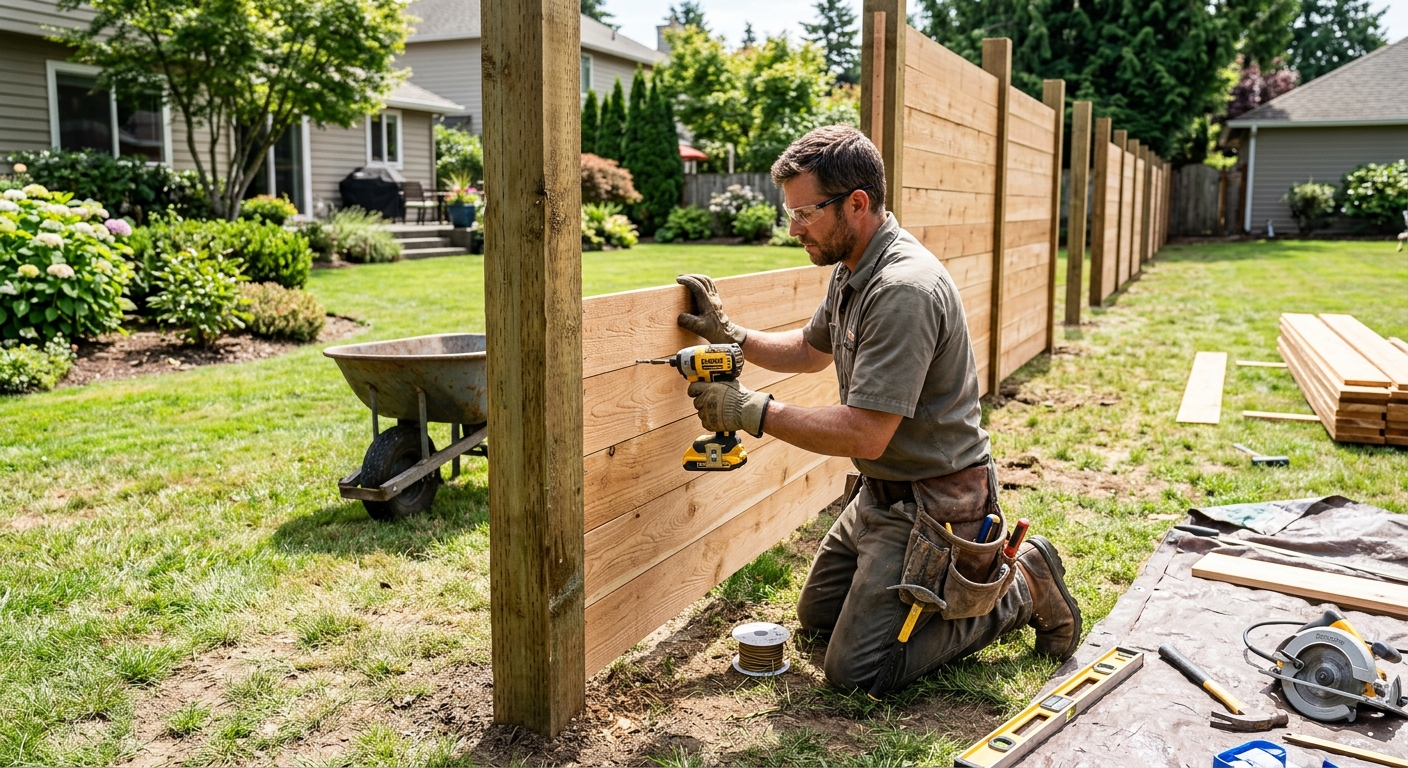
Fencing options and costs in Taylor
Fencing in Taylor is shaped by the fact that the community is dominated by single-detached homes—41.7% of dwellings—so there’s steady demand for yard privacy, pet containment, and property definition. With 77.1% of households owning their homes (Statistics Canada, 2021 Census), homeowners are also more likely to invest in longer-life materials and proper post foundations, which directly affects installed pricing.
In Northeast BC’s Peace region, costs can run above generic provincial averages because the frost environment and wind exposure are tough on fences. Frost penetration commonly exceeds 4 ft around the Peace River districts, so posts often need to be set 4–5 ft deep using belled footings and concrete to reduce seasonal movement and frost heave. On open lots, strong winter winds can “sail” a solid privacy fence, so contractors may tighten post spacing, upsize posts, or recommend more wind-friendly layouts. That engineering work takes time—especially when colder temperatures lengthen the auger/excavation process and reduce crew productivity—so availability of experienced crews matters.
In Taylor, trades like fencing are especially busy around growth pockets such as the broader residential areas near the town core and along local road frontage where properties typically need front-yard definition and back-yard privacy. If you’re comparing options, the best starting point is understanding typical installed price bands—see the table below.
| Material |
Lifespan |
Maintenance |
Privacy Rating |
Price per Linear Foot |
| Pressure-treated pine (standard wood) |
10–15 years (often longer with good staining) |
Stain/seal every 2–3 years; inspect posts annually |
High (solid boards) |
$80–$130 |
| Cedar (natural rot resistance) |
15–25 years (site conditions permitting) |
Seal or stain every 2–4 years; replace worst boards as needed |
High (solid or close-spacing) |
$95–$135 |
| Vinyl / PVC (no-maintenance) |
20–30 years |
Rinse/wash seasonally; check brackets after storms |
High (solid panels) |
$85–$140 |
| Chain-link (galvanized steel) |
25+ years |
Occasional rinse; tighten hardware after wind events |
Low–Medium (not for privacy unless topped/closed) |
$55–$90 |
| Aluminum ornamental |
25–35 years |
Minimal; occasional wash; touch-up only if needed |
Medium (open pickets) |
$95–$150 |
| Composite / recycled material |
20–30 years |
Low; wash and inspect for warping/impact damage |
High (solid/composite boards) |
$110–$160 |
Prices are estimates only and vary by project scope, site access and material selection.
What affects the price of fencing in Taylor
In Taylor, two quotes that look similar on paper can differ by 30–50% because the “same fence” often isn’t the same foundation design, wind engineering, or installation method. In Northeast BC’s Peace region, crews frequently work through deeper frost conditions and higher wind exposure than many milder BC areas, and that drives both labour time and post material requirements. You’ll also see pricing differences tied to crew availability—skilled fence installers who can properly set posts for deep frost are booked sooner during the colder installation windows.
Frost line depth is a major reason costs rise. A common rule of thumb is setting posts roughly 4–6 inches below the design frost depth, which in deep-frost areas often means digging 4–5 ft holes. That typically requires longer posts, concrete setting, and sometimes belled footings to prevent frost heave. In milder climates you may see gravel-pack or shorter embedment, but in Northeast BC that shortcut can lead to seasonal leaning and expensive repairs.
Wind exposure also pushes costs up. Open Prairie-style lots can require tighter post spacing and sometimes upsized posts to handle gust loads. A solid privacy style can act like a sail, so contractors may recommend ranch rail or chain-link on exposed sides even if you prefer “lattice-and-wood” for the back. As a baseline, wood and vinyl often land in the $80–$130 and $85–$140 ranges per linear foot respectively, while chain-link may start closer to $55–$90 per linear foot depending on height and finishing.
Local cost examples in Taylor: (1) older properties (28.4% of homes built before 1981) often have buried remnants, extra demo time, or mature landscaping that slows excavation; (2) sloped backyards in town require stepped installation, which increases layout labour; and (3) a gate with a latch designed for winter operation adds hardware and fitting time—especially when posts must be set deep and square.
| Price Factor |
Why It Matters |
Cost Impact |
| Fence length in linear feet |
Most materials (posts, rails, panels) scale directly with length |
Often the single biggest driver of the total |
| Post depth required |
Frost depth dictates embedment and hole depth to reduce movement |
Deeper holes increase labour + concrete; longer posts raise material cost |
| Post setting method |
Concrete vs. gravel pack changes stability in freeze/thaw cycles |
Concrete setting typically adds cost but improves long-term alignment |
| Material choice |
Vinyl/PVC and premium metals cost more; wood/chain-link can be cheaper |
Can swing installed cost by roughly one price band |
| Gate count and type |
Gates require stronger posts, hinges, latches, and tighter alignment |
Each gate usually adds a noticeable surcharge over straight sections |
| Grade and terrain |
Sloped yards require stepping/racking or custom panel alignment |
More layout time and possible material waste |
| Old fence removal and disposal |
Demo, haul-out, and potential digging for disconnected footings add time |
Can add substantial labour and disposal fees |
| Permit fees and survey / property line locate |
Required documentation prevents encroachment disputes and protects both parties |
Minor to moderate added cost depending on the scope |
Permits & regulations in British Columbia
In British Columbia, fence height rules commonly trigger permits when fences exceed certain thresholds—typically around 2.0 m (6.5 ft) at the rear and about 1.0–1.2 m (3–4 ft) at the front or corner, depending on location and municipal rules. Even when a permit isn’t required, you must respect property lines and any municipal setback requirements that apply to your lot. Because fences are often used to define boundaries, it’s smart to verify your exact property line before posts are dug.
Before digging any post hole in Taylor, call for utility locates through the appropriate provincial one-call system (BC 1 Call). You should also obtain a survey or locate your property pins before installation. That helps avoid encroachment disputes when older fences were built “close enough” decades ago.
Shared fence ownership rules are governed by provincial line-fences legislation, which can affect who is responsible for repairs or replacement—especially when only part of a boundary fence is failing.
To verify a contractor properly in BC, confirm the company has the correct business licensing (where applicable), carries liability insurance with clear coverage limits, and provides proof of coverage for workers (commonly WCB coverage). Ask for the certificate of insurance (COI) and check the expiry date. Many reputable contractors can also provide a clearance letter upon request.
Is the permit requirement always the same in Taylor?
Not always. While BC commonly uses height-based thresholds (often around 2.0 m at the rear and 1.0–1.2 m at the front/corner), the exact requirement can depend on local bylaws and the fence’s location on the property. The safest approach is to ask your contractor to confirm the height and placement with the right local rules before quoting, and then follow up by checking with your municipality for the final determination. If you plan a tall privacy fence, budget time for permit review; it can affect your schedule more than material lead times in colder seasons.
Choosing the right fence material for Taylor
The right fence in Taylor depends on what you want most: privacy, low maintenance, budget control, or maximum lifespan. Pressure-treated pine is usually the lowest upfront option, but in Northeast BC’s freeze/thaw and wet-dry swings it needs staining or sealing roughly every 2–3 years to reduce grey weathering and protect rails and posts. Cedar looks better and resists rot naturally, yet it still benefits from periodic sealing to keep the colour even and extend the life of pickets. Vinyl/PVC is popular for “set it and forget it” because it typically needs minimal annual care, but in extreme cold it can be less forgiving of impact and installers must use the correct expansion and hardware spacing. Chain-link is the long-life budget workhorse—excellent for perimeter security and wind—but it won’t deliver privacy unless you add privacy slats or screen growth.
Because Northeast BC requires deep post embedment for frost control (often 4–5 ft holes), all materials can cost more than you’d expect if the foundation isn’t included in the plan. For privacy fences—especially solid panels—concrete-set posts are commonly recommended because they help keep the fence aligned through deep frost. Wind is also key: tight post spacing and sturdier frames reduce wobble and panel movement during winter gusts.
To see where prices make sense: if you’re deciding between wood and vinyl, moving from a pressure-treated pine fence in the $80–$130 per linear foot range to a vinyl/PVC fence in the $85–$140 range can be justified when you want lower ongoing maintenance and you’re tired of yearly staining schedules. If privacy is your priority and you have a more exposed side, a stronger cedar or well-built wood privacy layout may outperform cheaper materials over the long run.
| Material |
Cold Tolerance |
Lifespan |
Annual Maintenance |
Best For |
Price Band |
| Pressure-treated pine |
Good when properly sealed and installed with deep frost-ready posts |
10–15 years |
Low-medium: seasonal inspection; stain/seal every 2–3 years |
Budget privacy with acceptable maintenance |
$80–$130 |
| Cedar |
Good; handles cold well if airflow and drainage are respected |
15–25 years |
Low-medium: inspect annually; seal/stain every 2–4 years |
Premium look with rot resistance |
$95–$135 |
| Vinyl / PVC |
Very good for cold; needs correct expansion/hardware fitting |
20–30 years |
Very low: rinse/wash and hardware checks after storms |
Low maintenance and clean appearance |
$85–$140 |
| Chain-link |
Excellent in cold; strong for wind when tensioned properly |
25+ years |
Low: tighten occasional hardware; rinse |
Security/perimeter on exposed lots |
$55–$90 |
| Aluminum ornamental |
Excellent; corrosion-resistant in wet-freeze cycles |
25–35 years |
Very low: wash as needed |
Front yard curb appeal and durable fencing |
$95–$150 |
| Composite / recycled |
Good, but impact can be a factor—use robust posts for wind |
20–30 years |
Low: wash and inspect for impact damage |
Long life with minimal upkeep |
$110–$160 |
How to choose a fencing contractor in Taylor
Choosing the right fencing contractor in Taylor starts with checking credentials and coverage before you compare prices. In British Columbia, ask for proof of liability insurance and workers’ coverage. To check liability insurance, request a certificate of insurance (COI) and verify the coverage limits, the effective and expiry dates, and that it lists the correct legal business name. For workers’ coverage, ask for proof of WCB clearance/coverage for the company or its workers (they should provide documentation when requested). If you don’t receive certificates or they can’t explain what they cover, that’s a major warning sign.
Next, get 2–3 itemised written quotes. You want a breakdown that separates labour (excavation, post setting, carpentry/assembly, gates) from materials (posts, rails, panels, concrete, hardware). Avoid quotes that only provide a single lump sum without clarifying whether concrete setting and disposal are included.
Read the scope line-by-line: is permit pulling included (if required), is demolition/removal included, and where is old material hauled? Confirm workmanship warranty length and whether it covers post re-alignment or only material defects. Also ask if the product/manufacturer warranty is transferable if you sell the home.
For payment scheduling, use a controlled approach: never pay more than 10–15% upfront for materials, then hold back a portion until the job is complete and final alignment is confirmed. For timeline, require a start date and an estimated completion date in writing—cold snaps and deep-frost auger work can shift schedules.
- Verify liability insurance COI (coverage limits, expiry date, correct legal name).
- Confirm workers’ coverage documentation (WCB clearance/coverage).
- Ask for a written permit plan if your fence height may exceed typical thresholds.
- Require itemised labour + materials, not just a lump sum.
- Confirm post depth and embedment method for deep frost (4–5 ft holes where required).
- Check whether concrete setting and belled footings are included where needed.
- Confirm gate hardware quality and whether hinges/latches are rated for winter use.
- Ask if disposal/haul-out of old fencing is included.
- Ensure they specify fence style orientation and how wind exposure is handled.
- Confirm stepped/raked installation for slopes and how they’ll measure grade changes.
- Get warranty terms in writing (workmanship duration and product warranty details).
- Set a payment schedule with holdback until final inspection and walk-through.
Red flags in Taylor include: quotes that don’t specify post embedment depth or setting method for frost; promises to avoid concrete in deep-frost areas; vague scope language that excludes disposal or permit work; missing insurance documents; and unwillingness to provide itemised pricing or a written timeline.
Frequently asked questions — fencing in Taylor
How tall can my fence be in Taylor?
In Taylor and across British Columbia, fence height limits often depend on where the fence sits on your property (front/corner versus rear) and the applicable local bylaws. A common planning reference is about 2.0 m (6.5 ft) at the rear and roughly 1.0–1.2 m (3–4 ft) at the front or corner, but the “permit needed” threshold can vary by municipality and the fence’s exact placement. Because you’re digging posts and installing a permanent structure, it’s wise to confirm the final height and location before ordering materials. If your design is tall for privacy, expect a bit more paperwork and schedule time, especially during colder periods when contractors are busiest.
Should fence posts be set in concrete here?
For Taylor and Northeast BC’s Peace region conditions, concrete setting is commonly recommended—especially for privacy fences and anywhere you expect heavy wind loads. Deep frost is the driver: frost penetration commonly exceeds 4 ft in the broader Peace area, so posts often need 4–5 ft embedment and concrete in belled footings to reduce frost heave and seasonal movement. Some fences may be able to use alternate methods in milder settings, but in Taylor the risk of post shifting is higher if embedment and setting aren’t designed for freeze/thaw. A well-written quote should state post depth and the exact setting method, and it should match the fence height and exposure.
What's the best fence for privacy?
For privacy in Taylor, solid wood (pressure-treated pine or cedar) and vinyl/PVC privacy styles are usually the top choices because they block sightlines and can look clean year-round. The trade-off is wind: open, exposed yards may need tighter post spacing and heavier framing to prevent wobble, which can raise labour. If you want low maintenance, vinyl/PVC (often in the $85–$140 per linear foot range) can make sense because you typically avoid the frequent staining schedule that wood requires. If you prefer natural materials and better rot resistance, cedar can perform well, though it still benefits from periodic sealing. Regardless of material, ensure your contractor designs for deep frost embedment so panels stay aligned.
How do I compare fencing quotes?
Start by comparing quotes item-by-item, not by the total. Ask each contractor for an itemised breakdown that separates labour and materials, and confirms whether concrete setting, post depth, and excavation are included. In Northeast BC, post embedment depth and setting method can change the price significantly—sometimes enough to swing the project by 30–50%. For example, if one quote prices wood in the $80–$130 band but doesn’t include deep post setting or disposal, the “savings” often disappears. Also confirm gate hardware quality, warranty terms, whether permits are included (if required), and the proposed timeline. Finally, check that the contractor provides insurance documentation and coverage details before signing.
How long does fence installation take in Taylor?
Timelines in Taylor can vary with weather, ground conditions, and how complex the layout is. Deep frost planning affects the work pace: if it’s colder, augers and excavation can take longer, especially when crews must set posts properly for frost control. Straight fence runs with standard gates can often be completed within a short install window, but sloped yards (stepped or raked sections), frequent access interruptions, and old fence removal typically add time. Site prep and utility locates can also influence scheduling—especially if locating reveals unexpected services that require rerouting or adjusted post placement. When you request a quote, ask for a written start date and a completion estimate tied to your exact scope.
Can I install a fence on a slope in Taylor?
Yes, you can install a fence on a slope in Taylor, but the design choice matters. Contractors typically use stepped panels or racked frames so the fence follows the grade while keeping consistent post stability. On slopes, you also need careful layout because uneven grade can change effective height and stress wind loads—particularly for solid privacy fences. Ensure the contractor specifies how they’ll measure the slope and how many posts will be adjusted, not just “we’ll make it work.” With Northeast BC’s deep frost conditions, each post still needs proper embedment and setting method so seasonal movement doesn’t amplify along the slope. Ask to see photos of similar stepped installations and confirm this scope is included before ordering materials.