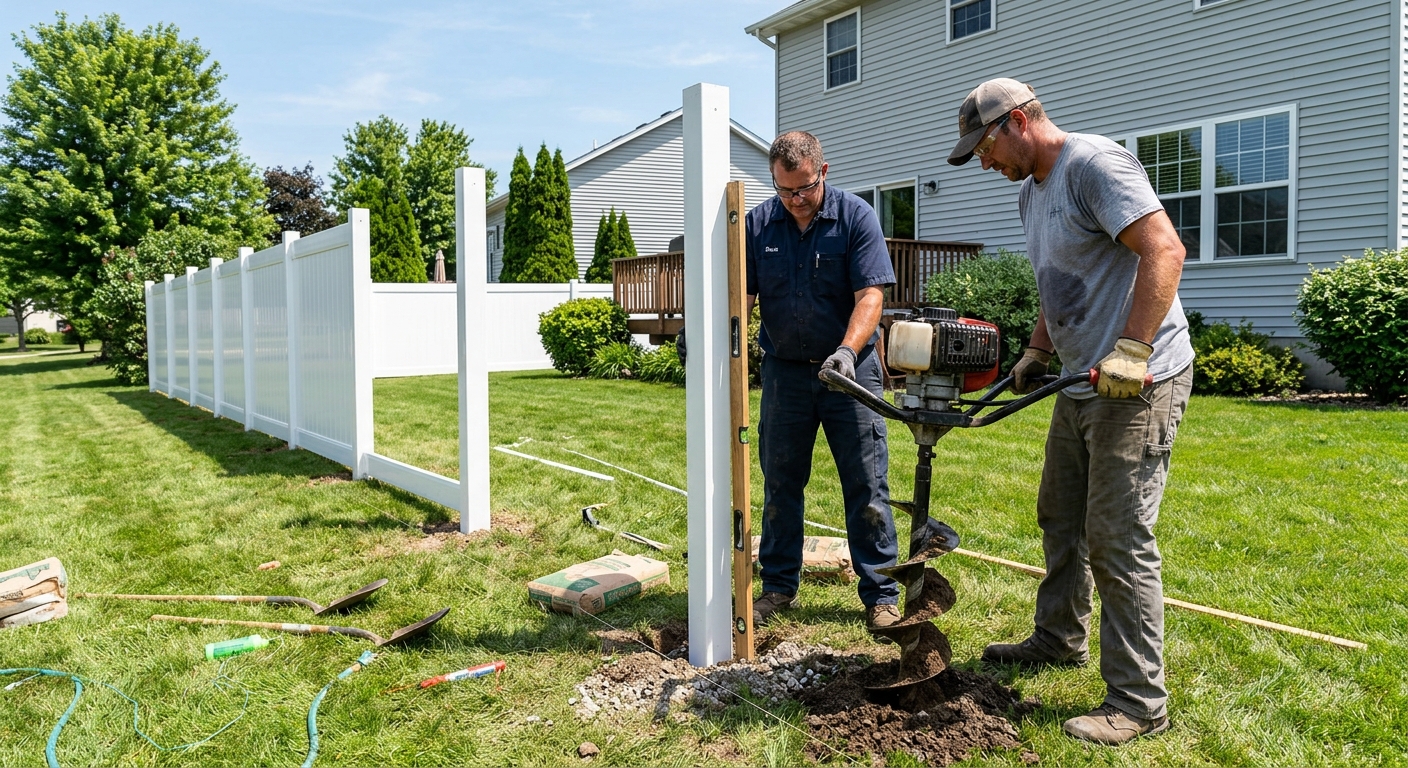
Fencing options and costs in West Point Grey
In West Point Grey, British Columbia, your fence choice usually starts with what you want most—privacy, appearance, or low maintenance—because the city’s character lots attract homeowners who care about curb appeal. With 13,065 residents in the 2021 Census (Statistics Canada, 2021 Census) and a strong mix of family homes and detached properties, there’s steady demand for backyard and side-yard fencing, particularly around the University Endowment Lands edge and the older residential pockets near Broadway. Each fenced parcel is a potential project, and in this neighbourhood the “busy season” often lines up with spring landscape upgrades.
Lower Mainland–Southwest pricing is shaped by a mild but not trivial coastal frost and wind pattern: posts still need to be set below the local frost depth to limit heaving, and wetter Fraser Valley-style soils commonly mean deeper holes, more concrete, and more labour than a drier-site install. The result is that even “ordinary” fence projects can come in at the higher end of typical ranges—especially for privacy styles that require sturdier posts, tighter spacing, and reinforced gate frames. Contractor availability can also affect final cost; when crews are booked for simultaneous landscaping and fencing work, quotes can reflect scheduling and material pickup timing.
The sections below compare the most common material options by lifespan, maintenance expectations, and realistic installed price bands, then show how project specifics drive the final number.
| Material |
Lifespan |
Maintenance |
Privacy Rating |
Price per Linear Foot |
| Pressure-treated pine (standard wood) |
10–15 years |
Stain or seal every 2–3 years; inspect posts/rails annually |
High (solid or close board) |
$55–$95 |
| Cedar (natural rot resistance) |
15–25 years |
Light sealing every 2–4 years (or accept natural weathering) |
High (solid or close board) |
$70–$115 |
| Vinyl / PVC (no-maintenance) |
20–30 years |
Rinse wash as needed; no staining; occasional hardware checks |
Very High (solid pickets/boards) |
$75–$130 |
| Chain-link (galvanized steel) |
20–35 years |
Rinse; check tension and occasional coating touch-ups |
Low to Medium (view-through) |
$30–$55 |
| Aluminum ornamental |
25–40 years |
Wash and inspect annually; no rust (proper coating required) |
Low to Medium (open pickets) |
$90–$170 |
| Composite / recycled material |
20–30 years |
Rinse and clean; check fasteners; avoid harsh abrasives |
Medium to High (depends on slat design) |
$95–$155 |
Prices are estimates only and vary by project scope, site access and material selection.
What affects the price of fencing in West Point Grey
Fence quotes for the “same” job can vary by 30–50% across the Lower Mainland–Southwest simply because the cost drivers are usually in the ground and the logistics, not the fence fabric alone. A 6-foot privacy run on flat ground can be a straightforward install, while the same length on a slope, with hard access, wet soil, or required gate reinforcement, becomes a different build. In British Columbia, even when the finish looks similar, labour intensity changes—especially when crews must auger deeper, set more concrete, or build around existing landscaping and property-line constraints.
Frost line depth matters most because it controls how deep posts must be set to reduce heaving. In most Canadian practice, post embedment is often about 4–6 inches below the design frost depth; in coastal BC it can be shallower than the Prairies, but contractors in West Point Grey still commonly go deeper than the “bare minimum” for stability. In wetter soils, deeper holes mean more labour and more concrete, which pushes wood and vinyl privacy jobs toward the higher end of the $55–$95 and $75–$130 bands.
Climate also accelerates maintenance needs. Coastal BC’s mild temperatures and frequent moisture can speed up wood grey weathering and rot if pressure-treated pine isn’t properly stained and if drain paths around posts don’t work. For example, a privacy fence in low-lying areas near downspouts often needs more concrete setting and careful backfill; a higher, well-drained yard may allow easier installation with less post correction.
Wind exposure in the Lower Mainland can still be significant along open property lines and around corners, so crews may increase post stiffness and add reinforcement rails. That’s why a longer run with multiple corners can cost noticeably more than an equivalent straight run—sometimes by several hundred dollars just due to framing changes.
| Price Factor |
Why It Matters |
Cost Impact |
| Fence length in linear feet — the primary cost driver |
More panels and rails require more posts, hardware, and installation time |
Major swing; often changes the total by hundreds per 10 linear feet |
| Post depth required — frost line determines post length and hole depth |
Deeper embedment improves stability and reduces heaving |
Higher material and labour; wetter sites raise the impact further |
| Post setting method — concrete vs. gravel pack vs. driven posts |
Concrete improves holding power in soft/wet soils and for corner/gate posts |
Often adds the equivalent of several hundred dollars on typical privacy fences |
| Material choice — vinyl vs. cedar vs. chain-link |
Different structural requirements and hardware styles affect labour and cost |
Moves you between local bands like wood ($55–$95) and vinyl ($75–$130) |
| Gate count and type — walk-through vs. drive-through (double) |
Gates require heavier frames, bracing, and better alignment |
Commonly adds $500–$2,000+ depending on width and finish |
| Grade and terrain — sloped yards require stepped or raked panels |
Adjustments increase cutting time, waste, and framing complexity |
Can increase costs by 10–25% on noticeable slopes |
| Old fence removal and disposal |
Labour plus dump fees; may require extra bracing for safe disassembly |
Often adds a significant line item, especially with concrete footings |
| Permit fees and survey / property line locate |
Some fence heights and lot situations require formal steps before building |
May be minor for simple installs; can add $200–$800+ depending on complexity |
Permits & regulations in British Columbia
In British Columbia, fence height requirements can trigger a building permit when you exceed local thresholds—commonly around 2.0 m (6.5 ft) for rear yards and about 1.0–1.2 m (3–4 ft) for the front or corner areas. The exact rules depend on your municipal bylaws, but the practical takeaway for West Point Grey homeowners is consistent: check before you order materials if you’re aiming for a tall privacy fence. All fences must respect property lines and any applicable setback requirements.
Before digging any post holes, call for utility locates through the appropriate one-call service (in BC, BC 1 Call). Also, obtain a survey or at least a professional property-line locate before installing when pin placement is uncertain—encroachment disputes are expensive to fix after the fact, especially when your fence corners land close to a lot line.
Shared fence ownership and line-fences are handled under provincial line-fences legislation; your agreement with neighbours matters, but it doesn’t replace the need to stay on your side of the line and comply with height/setback rules.
What typically DOES require a permit: fences above the common height thresholds (rear around 2.0 m and front/corners around 1.0–1.2 m), or any fence configuration that your municipality classifies as requiring approval. What typically does NOT: routine replacement of an existing fence that stays within the same height and location, and standard lower fences that do not exceed thresholds—still confirm with your municipality.
To verify a contractor in West Point Grey, ask for (1) their BC business licence or registration details (often listed publicly via provincial/registry tools), (2) a certificate of insurance showing adequate general liability and coverage limits, and (3) a letter or documentation confirming WSBC coverage for the contractor and any workers. Where to look: request the COI directly (with the named insured and policy effective dates), confirm licence/registration online where the details are published, and keep copies in your job folder.
Choosing the right fence material for West Point Grey
Choosing the right material in West Point Grey comes down to matching your priorities—privacy, low maintenance, and budget—to a coastal climate that stays wet and repeatedly cycles moisture. Pressure-treated pine is the budget-friendly route, but it usually needs staining or sealing about every 2–3 years to prevent grey weathering and protect the wood at the post connections. Cedar looks great and naturally resists rot better than many softwoods, yet it still benefits from maintenance to keep colour and reduce surface breakdown. If you want “set it and forget it,” vinyl/PVC is popular for privacy runs: it won’t need staining, but very cold snaps can make components feel brittle if the system isn’t installed correctly (proper expansion allowances and good hardware matter).
Chain-link is the lowest cost and longest-lasting option, but it provides limited privacy unless you add privacy slats or a planted screen. Aluminum ornamental fences offer an attractive look with no rust, yet they’re not ideal when full privacy is the goal. In Lower Mainland–Southwest installs, concrete-setting is often used for corner posts, gate posts, and privacy-heavy framing, because deeper, stable embedment helps compensate for wetter soils and coastal frost action. While coastal frost depth is often shallower than Ontario or Alberta, contractors still frequently set posts deeper than the minimum guide because it reduces future wobble and alignment issues.
For wind and snow load considerations, the key is stiffness: solid wood and vinyl privacy fences generally require stronger posts and better rail bracing, especially on yards that are more exposed. A realistic example: moving from chain-link at roughly $30–$55 per linear foot to vinyl privacy around $75–$130 per linear foot can be justified if you’re blocking street view, improving usable backyard comfort, and want minimal annual upkeep. If your goal is security with no privacy, that premium may not be worth it.
| Material |
Cold Tolerance |
Lifespan |
Annual Maintenance |
Best For |
Price Band |
| Pressure-treated pine |
Good (but needs coating/paint schedule) |
10–15 years |
Stain/seal every 2–3 years; annual fastener and post checks |
Budget-friendly privacy or boundary fencing |
$55–$95 |
| Cedar |
Good (naturally rot resistant) |
15–25 years |
Light sealing every 2–4 years; inspect after wet winters |
Appearance-focused privacy with better natural durability |
$70–$115 |
| Vinyl / PVC |
Good (proper installation helps in cold snaps) |
20–30 years |
Rinse/clean as needed; check rails/hardware annually |
Low maintenance privacy and long-term appearance |
$75–$130 |
| Chain-link |
Very good (galvanized steel) |
20–35 years |
Minimal; periodic wash and tension checks |
Security, pets, and open airflow without privacy |
$30–$55 |
| Aluminum ornamental |
Excellent (coated metal) |
25–40 years |
Wash and inspect annually; no rust treatment |
Attractive front yard definition |
$90–$170 |
| Composite / recycled |
Good (varies by brand; avoid mis-fit expansion) |
20–30 years |
Rinse and check fasteners; occasional component replacement |
Modern look with reduced wood maintenance |
$95–$155 |
How to choose a fencing contractor in West Point Grey
When hiring a fencing contractor in West Point Grey, verify three essentials: licensing/registration details in British Columbia (as applicable to the contractor’s business activity), proof of liability insurance, and WSBC/WCB coverage for workers. How to check: (1) request their certificate of insurance and confirm it includes general liability with sufficient coverage, and that the policy is active for your project dates; (2) ask for WSBC clearance or equivalent proof of coverage status before work begins; and (3) look up their business details using the public-facing registry resources and confirm the address and business name match the quote paperwork.
Next, get 2–3 itemised written quotes, not a lump-sum estimate. The best quotes break labour and materials out separately—posts, rails, panels/pickets, hardware, concrete/setting mix, gates, and any required site prep. Read exclusions carefully: confirm whether permit pulls are included, whether old fence removal and disposal are included, and whether you’re paying extra for concrete removal, hauling, or restoring disturbed landscaping.
Warranty is where many homeowners get surprised. Ask for (a) a workmanship warranty (how long they stand behind installation), (b) the manufacturer warranty for the product finish and materials, and (c) whether the warranty is transferable if you sell your home. Also ask about what “foundation issues” or “post movement” means under their workmanship terms.
Payment schedule matters too: never pay more than 10–15% upfront. Use a holdback until the job is fully complete and gates/straightness meet expectations. Finally, require a written start date and an estimated completion timeline—coastal scheduling can shift when crews are also doing landscaping installs.
- Ask for a detailed, itemised quote (labour + materials), not just a total.
- Confirm post setting specs: depth and whether corner/gate posts are concrete-set.
- Verify insurance certificate is current and matches the company name on the contract.
- Request WSBC coverage proof/clearance before work starts.
- Check whether permit handling is included if you’re exceeding common height thresholds.
- Clarify fence line locating: will they rely on stakes or do they require a survey?
- Confirm old fence removal and disposal are included (and how it’s hauled away).
- Ask about gate hardware and alignment plan (double gates need bracing).
- Get a materials list with brand/product names and colours/finishes.
- Confirm warranty terms in writing: workmanship length and manufacturer warranty coverage.
- Use a payment schedule with a holdback until completion and walkthrough sign-off.
- Require start and completion dates in the signed scope.
In West Point Grey, common red flags include: (1) quotes that don’t specify post depth and setting method, (2) missing or expired insurance/coverage documentation, (3) refusing to itemise labour vs materials, (4) vague scope about permits, removal, or cleanup, and (5) asking for large deposits (over 15%) before any work is done.
Frequently asked questions — fencing in West Point Grey
What's the best fence for privacy?
For privacy in West Point Grey, most homeowners choose a solid-panel fence: cedar or pressure-treated pine for a classic look, or vinyl/PVC when they want minimal upkeep. In the Lower Mainland–Southwest market, privacy panels typically land in the mid to higher local bands—wood is often quoted around $55–$95 per linear foot, while vinyl privacy commonly comes in around $75–$130. The coastal wet conditions mean material alone isn’t the full answer: ask your contractor how they’re setting posts (especially corner and gate posts) and whether they’re using concrete where needed for long-term alignment. If your yard is exposed to wind, request extra bracing for solid fences so the panels stay tight.
How do I compare fencing quotes?
Compare quotes line-by-line, not by the total alone. Look for itemised sections covering posts, rails, panels/pickets, gate hardware, concrete or gravel setting mix, and disposal/removal if you have an older fence. For West Point Grey, also confirm the post depth embedment plan, since wet soils and coastal frost action affect heaving resistance. A quote that’s cheaper may be using a different setting method, fewer concrete-filled posts, or lighter gate bracing—those choices show up in wobble within a couple of winters. Make sure the scope states whether permits are included (for taller fences) and whether they will locate property pins or rely on stakes. If needed, ask for clarification before signing.
How long does fence installation take in West Point Grey?
Timing depends on length, site access, and whether you need removal. For a typical residential run in West Point Grey, many installs complete in 1–3 working days, with extra time for multiple gates, steep grades, or hard-to-handle materials like long privacy rails. Wet ground can slow down drilling and setting, and if the design includes deeper holes for post stability, crews may take longer per post. If there’s an old fence with concrete footings to remove, that’s often a major schedule driver. Ask your contractor for a start date and completion estimate in writing, plus a plan for what happens if materials don’t arrive on time.
Can I install a fence on a slope in West Point Grey?
Yes, you can install a fence on a slope in West Point Grey, but the installation method matters for both appearance and strength. Most contractors use stepped or raked panel designs. Stepped fencing follows the terrain in discrete height changes, while racked installations create a smoother continuous slope (depending on material and panel type). Expect more labour and waste on slopes, because rails and panels require more careful cutting and alignment. If your yard funnels water to one side, make sure drainage paths around posts are addressed so you don’t get uneven movement. Your contractor should show you how they’ll handle the transition at corners and near gates so the fence stays straight.
What is the most weather-resistant fence for West Point Grey's climate?
For Lower Mainland–Southwest conditions—mild but wet coastal weather and occasional freeze-thaw—vinyl/PVC and properly installed galvanized chain-link are among the most weather-resistant options, especially when you want fewer annual tasks. Vinyl privacy fences are widely chosen for low maintenance, landing in the $75–$130 band, while chain-link often comes in around $30–$55 and can last decades with minimal upkeep. That said, “weather-resistant” also depends on how posts are set: ask how corner and gate posts are anchored and whether concrete is used where soil conditions warrant it. For wood, cedar tends to resist rot better than typical pressure-treated pine, but both need correct sealing and routine inspections after wet winters.
How do I prevent wood fence rot in West Point Grey?
Preventing rot is mostly about keeping wood dry where it matters most: at the posts and fastener points. In West Point Grey’s wet coastal environment, use quality pressure-treated lumber or cedar, and insist on proper installation—especially post embedment depth below the frost-affected zone and correct setting method. Concrete-set corner and gate posts are commonly used because they stabilize the fence and reduce side-to-side movement, which can tear wood over time. Also ask for correct spacing and drainage so water doesn’t pool around post bases. Maintenance matters: stain/seal pressure-treated pine about every 2–3 years, and inspect annually for loose rails, gaps at hardware, and any signs of soft wood near grade. If you catch issues early, repairs are far cheaper than full panel replacement.